
Business Coaching and Consulting for High-Ticket Growth
The leap from quarter-million to multi-million dollar revenue isn't just about working harder. For women-owned service businesses in the high-ticket space, this transition demands a fundamental shift in how founders think, operate, and lead. Business coaching and consulting becomes essential at this inflection point, not as a luxury but as the strategic lever that transforms operational chaos into predictable profit. When your revenue reaches $250K to $5M, you're no longer running a practice-you're building an enterprise, and that requires a completely different operating system.
Why Traditional Business Advice Fails High-Ticket Service Founders
Most generic business coaching and consulting advice originates from product-based businesses or low-ticket service models. That guidance collapses under the weight of high-ticket realities.
When you're delivering $15K, $50K, or $150K engagements, the math changes everything. You can't scale through volume alone. Your client relationships are complex, multi-layered, and demand sustained founder involvement. The typical "hire a VA and automate everything" playbook becomes laughably inadequate.
The Operational Drag Nobody Talks About
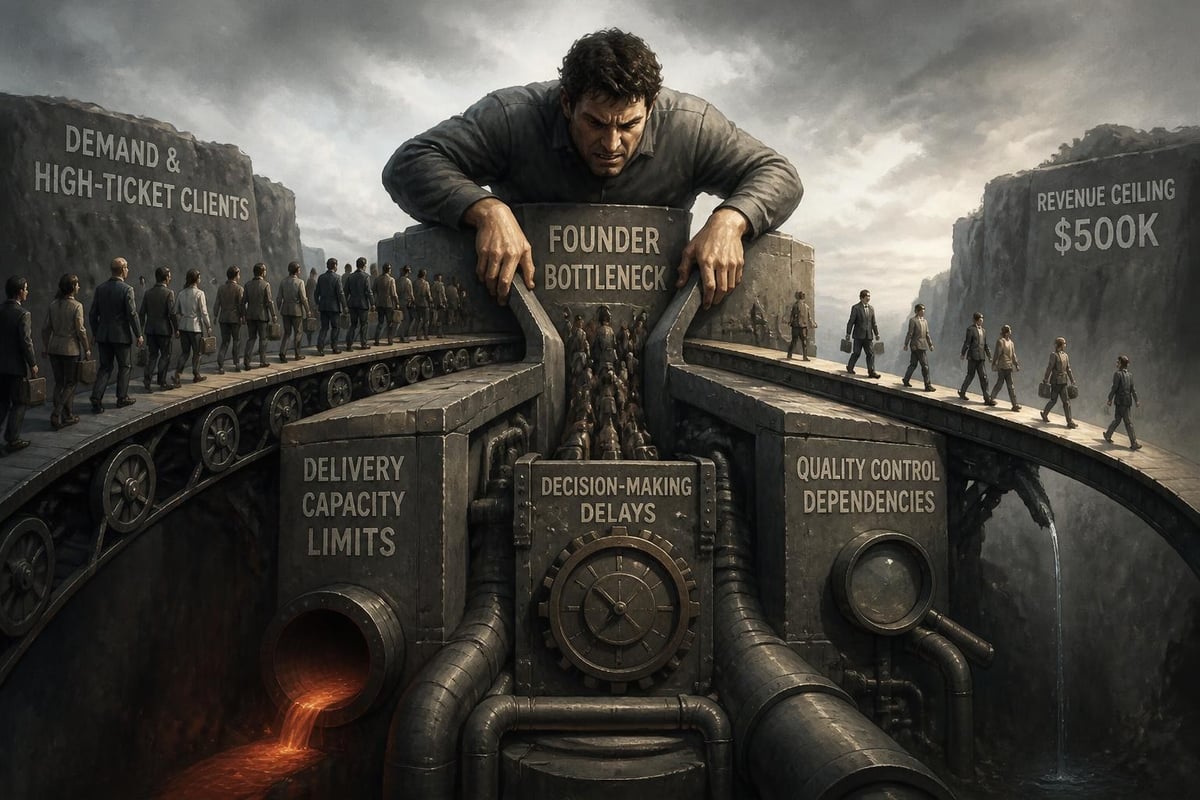
Here's what actually happens as you scale: every new client adds exponential complexity. Your systems weren't built for eight simultaneous high-touch engagements. Your team lacks the frameworks to deliver without you. Your positioning starts to blur as you say yes to anyone who can pay your fee.
This operational drag manifests in three painful ways:
- Revenue plateau despite demand (you have leads but lack delivery capacity)
- Founder burnout despite delegation (you've hired but remain the bottleneck)
- Profit erosion despite growth (revenue climbs while margins compress)
The Future of Jobs Report underscores this challenge, showing how rapidly changing market conditions require continuous capability building, particularly for service businesses navigating AI-driven transformation.
The Four Pillars That Transform Chaos Into Profit Architecture
Effective business coaching and consulting for high-ticket services isn't about tactics. It's about installing a complete operating system-what we call Profit Architecture-across four critical pillars.
Positioning: Building Unassailable Market Authority
Your positioning either compounds your growth or sabotages it. At $250K, you can survive as a generalist. At $2M, vague positioning becomes an existential threat.
Market authority isn't about being known-it's about being the only logical choice for a specific transformation. This requires ruthless focus on who you serve, what outcome you guarantee, and why competitors can't replicate your methodology.
Strong positioning creates three multiplier effects:
- Higher conversion rates (50-70% instead of 15-20%)
- Shorter sales cycles (weeks instead of months)
- Premium pricing power (clients seek you, not the reverse)
| Weak Positioning | Authority Positioning |
|---|---|
| "Business coach for entrepreneurs" | "Revenue scale architect for women-owned consulting firms $500K-$3M" |
| Generic promises of growth | Specific outcome (e.g., "predictable $100K months") |
| Competing on credentials | Competing on proprietary methodology |
| Founder sells everything | Positioning pre-sells, founder closes |
Acquisition: Installing Sales Systems That Don't Require You
The founder-dependent sales model is a trap. Business coaching and consulting at this level means building acquisition systems where your methodology sells itself.
High-ticket sales aren't transactional. They're transformational conversations where prospects self-diagnose their gap and see your framework as the bridge. This requires:
- Diagnostic tools that reveal the hidden cost of their current state
- Framework visibility that demonstrates your unique approach before the sale
- Value anchoring that positions your fee against the cost of staying stuck
- Decision architecture that guides ideal clients toward enrollment
When done correctly, your close rate should exceed 60% of qualified conversations. Lower than that signals a positioning or sales system problem, not a leads problem. The change management insights from Bain show how capability transfer during the sales process builds confidence and accelerates buying decisions.
Delivery: Systematizing Client Outcomes Without Founder Labor
Here's the paradox: clients buy your expertise, but sustainable profit requires delivering outcomes through systems and team, not heroic founder effort.
This shift terrifies most high-ticket service owners. You've built credibility through personal delivery. The idea of stepping back feels like quality compromise. But it's actually the opposite.
Systematized delivery produces better outcomes because it:
- Captures and codifies your best thinking (instead of reinventing with each client)
- Creates consistency (clients get your methodology, not your Monday mood)
- Enables specialization (team members excel at specific delivery components)
- Compounds learning (each engagement improves the system)
The transition requires documenting your invisible expertise-the questions you ask, the frameworks you apply, the quality checks you perform-and building those into repeatable processes.

Leadership: Establishing Boundaries That Protect Profit
The final pillar separates sustainable businesses from burnout factories: leadership through boundaries.
Women founders, particularly in service businesses, often confuse excellent client service with unlimited availability. You respond to Slack at 9 PM. You add scope because the client seems stressed. You skip team development to jump into delivery.
These boundary violations compound into profit erosion:
- Unbilled scope expansion (typically 15-30% of delivery hours)
- Team confusion about standards (if you override your own systems, why should they follow them?)
- Decision fatigue (every exception requires a founder decision)
- Unsustainable growth (revenue requires proportional founder time)
Research on effective one-on-one management conversations reveals that clear boundaries and structured coaching conversations actually improve team performance and client outcomes.
When to Engage Business Coaching and Consulting
Timing matters enormously. Engage too early, and you're implementing systems before you understand your business model. Engage too late, and you're unwinding expensive mistakes.
The optimal engagement window opens when you experience these three conditions simultaneously:
- Proven offer-market fit (you can sell consistently at your target price point)
- Delivery capacity ceiling (you have demand but can't fulfill without founder overwhelm)
- Profitable unit economics (your engagements are profitable before considering founder opportunity cost)
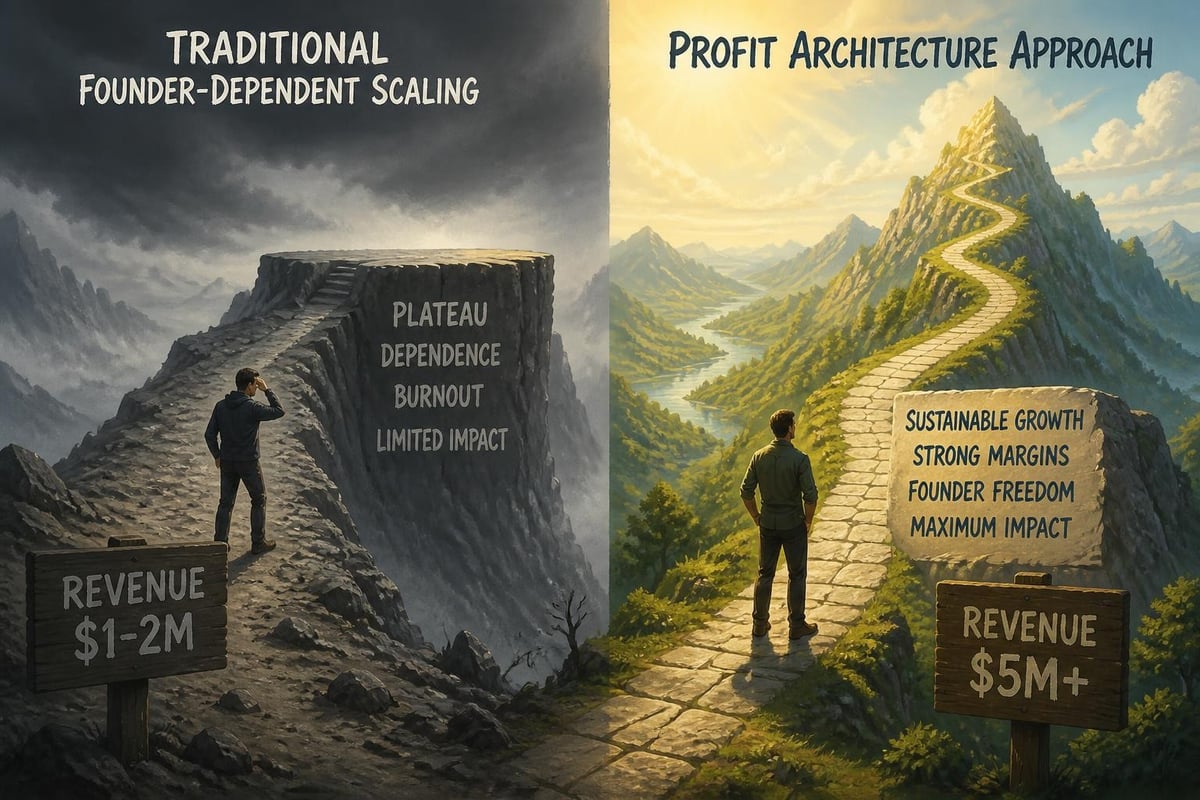
If you're below $250K annual revenue, focus on refining your positioning and acquisition before building elaborate systems. If you're above $1M and still experiencing these symptoms, you're leaving significant profit on the table.
The Real ROI: What Changes When You Install Profit Architecture
Let's talk about actual outcomes from business coaching and consulting focused on Profit Architecture, not vague promises of "growth."
Financial Impact
Properly implemented, you should see:
- 30-50% margin improvement within six months (through scope control and delivery efficiency)
- 2x revenue capacity without team expansion (through founder time liberation)
- 40-60% reduction in sales cycle length (through positioning clarity)
| Metric | Before Profit Architecture | After Implementation |
|---|---|---|
| Gross margin | 45-55% | 70-80% |
| Founder delivery hours | 60-80% of capacity | 15-25% of capacity |
| Client onboarding time | 6-12 weeks | 2-4 weeks |
| Team decision escalations | 15-25 per week | 3-5 per week |
| Revenue per client | $25K-$50K | $75K-$150K |
Operational Freedom
The numbers matter, but the lifestyle shift matters more. Founders report:
- Taking actual vacations without client emergencies
- Ending client delivery entirely (team owns outcomes)
- Making strategic decisions instead of firefighting
- Building the business they actually want to lead
Strategic Optionality
Perhaps most valuable: Profit Architecture creates exit options. Whether you want to sell, scale to eight figures, or transition to equity partnerships, systematized operations make your business valuable beyond your personal brand.
How Business Coaching and Consulting Actually Works
The mechanics matter. Bad consulting adds dependency. Excellent consulting builds capability.
The Diagnostic Phase
Every engagement should begin with ruthless honesty about current state. Where is profit actually leaking? Which founder beliefs are creating bottlenecks? What systems exist in name only?
This diagnostic typically reveals that the presenting problem isn't the real problem. Founders say "I need better marketing" when the real issue is conversion. They say "I need to hire" when the real issue is delegation frameworks. They say "I need more revenue" when the real issue is margin.
The Framework Installation
Theory without implementation is consulting theater. The work happens when you install frameworks into actual operations:
- Document your methodology so it's teachable
- Build decision matrices so your team stops asking permission
- Create quality checkpoints so excellence scales
- Design client experiences so delivery is consistent
According to SHRM's guidance on coaching in performance management, embedding coaching frameworks into daily operations drives sustained performance improvement far more effectively than periodic interventions.
The Capability Transfer
The goal isn't perpetual consulting. It's capability transfer. You should become increasingly competent at operating your Profit Architecture, not increasingly dependent on external support.
This means working sessions, not just strategy sessions. Co-creating frameworks, not just receiving them. Building your strategic thinking muscle, not outsourcing it.
Selecting the Right Business Coaching and Consulting Partner
Not all consulting is created equal. The wrong partner costs you time and money. The right partner accelerates your trajectory by years.
Red Flags to Avoid
Watch for these warning signs:
- Generic frameworks applied identically to product and service businesses
- Consultant dependency (they become a permanent fixture, not a strategic intervention)
- Tactic obsession (focusing on Instagram strategy before fixing positioning)
- Scalability promises without addressing founder bottlenecks
- Male-centric playbooks that ignore how women-owned businesses actually operate
What to Look For Instead
Exceptional business coaching and consulting for high-ticket services includes:
- Industry-specific expertise in your revenue range and business model
- Proprietary methodology (frameworks you can own and scale)
- Implementation partnership (they work alongside you, not above you)
- Bounded engagement (clear milestones and graduation criteria)
- Profit focus (measuring success in margin and founder freedom, not just revenue)
The PwC Workforce Hopes and Fears research demonstrates how skills-first approaches and coaching interventions drive both retention and performance, reinforcing the importance of capability-building partnerships.
The Profit Architecture Implementation Roadmap
While every business is unique, the implementation sequence follows a predictable pattern across four quarters.
Quarter 1: Positioning Clarity & Sales System Foundation
- Sharpen market positioning to authority level
- Document proprietary methodology
- Build diagnostic sales tools
- Install qualification criteria
Quarter 2: Delivery Systematization
- Map current delivery process
- Identify founder-dependent steps
- Build team playbooks
- Create quality assurance checkpoints
Quarter 3: Team Capability Development
- Transfer delivery ownership
- Establish decision frameworks
- Implement feedback systems
- Measure outcome consistency
Quarter 4: Leadership & Boundary Installation
- Define scope boundaries
- Create escalation protocols
- Build strategic planning rhythm
- Optimize profit margins
Resources from the CIPD on learning needs diagnosis show how asking the right questions during each phase ensures interventions address root causes rather than symptoms.
Common Myths That Keep Founders Stuck
Let's dismantle the beliefs that prevent founders from getting the business coaching and consulting they actually need.
Myth 1: "I need to figure it out myself"
Reality: The problems you're facing at $500K-$2M aren't solvable through more hustle. You need frameworks you've never built before. Expertise accelerates-it doesn't replace-your leadership.
Myth 2: "Consulting is for struggling businesses"
Reality: The best time to engage is from strength, not desperation. When you're profitable but capacity-constrained, you have leverage to implement properly. Crisis consulting is expensive and limited.
Myth 3: "I can't afford it until I hit [revenue target]"
Reality: The cost of not fixing founder bottlenecks is your opportunity cost. Every quarter you delay is $50K-$200K in unrealized profit. The question isn't affordability-it's whether you can afford to wait.
Myth 4: "My business is too unique"
Reality: Your market may be unique, but your operational challenges aren't. Founder bottlenecks, delivery inconsistency, and positioning blur follow predictable patterns. Proven frameworks adapt to your context.
The Decision Framework
You're reading this because something isn't working. You've built a successful business, but growth feels harder than it should. You're working more while enjoying it less.
Here's how to decide if business coaching and consulting focused on Profit Architecture is your next right move:
Say yes if:
- Your revenue is $250K-$5M and growth is creating more complexity than freedom
- You're the bottleneck in delivery, sales, or decisions (or all three)
- Your margins are compressing despite revenue growth
- You have demand but lack capacity to fulfill profitably
- You want to build something valuable beyond your personal brand
Wait if:
- You're still validating product-market fit (revenue below $250K)
- You're not yet profitable at the unit level
- You're not willing to implement frameworks (knowledge without action is waste)
- You want magic bullet tactics instead of systematic transformation
You can explore whether this approach aligns with your business through a strategic conversation with the Rise Reign Rule team.
What Success Actually Looks Like
After implementing Profit Architecture through focused business coaching and consulting, founders describe a specific shift.
You stop being a highly-paid practitioner and become an actual CEO. Your calendar reflects strategic priorities, not client emergencies. Your team makes excellent decisions without you. Your bank account reflects the value you create. Your life includes space for things beyond work.
The business runs on systems, frameworks, and team capability. You focus on positioning, partnerships, and profit optimization. Client outcomes improve because delivery is systematized, not dependent on your personal heroics.
Most importantly: growth stops feeling like a threat. Instead of fearing what adding the next $500K in revenue will cost you, you see it as leverage. Your business scales cleanly because the foundation supports it.
This isn't theoretical. It's the predictable result of installing the right operating system at the right stage of growth. The companies featured in Rise Reign Rule case studies demonstrate this transformation across diverse service models and markets.
Business coaching and consulting becomes essential when you recognize that the strategies that got you to $250K-$1M won't carry you to $5M. The transition requires installing Profit Architecture-systems for positioning, acquisition, delivery, and leadership that create predictable profit and clean scaling. If you're a woman founder in the high-ticket service space experiencing operational drag and founder bottlenecks, Rise Reign Rule specializes in this exact transformation. We install the frameworks that turn your expertise into a scalable, profitable business you actually want to lead.


