
Business Coaching Business: Scale to 7 Figures in 2026
The business coaching business landscape has fundamentally transformed, creating unprecedented opportunities for strategic consultants who understand how to architect scalable service delivery. Women-owned consultancies generating $250k to $5M are particularly positioned to capitalize on market shifts that favor specialized expertise over generalized advice. The industry has evolved from personality-driven coaching into systems-driven transformation, where frameworks trump feelings and measurable outcomes define success. This evolution creates a clear dividing line between coaches who remain solopreneurs and those who build genuine consulting enterprises.
The Business Coaching Business Market Opportunity
The professional coaching industry reached $16 billion in the U.S. market, with business coaching statistics showing explosive growth across all sectors. This expansion isn't accidental. Business owners finally recognize that operational expertise delivers better ROI than motivational support alone.
Market dynamics favoring strategic consultancies include:
- High-ticket service businesses willing to invest $25k-$100k+ for transformational frameworks
- Decreased tolerance for low-value group programs masquerading as personalized support
- Demand for proprietary systems that solve specific bottlenecks rather than generic advice
- Growing recognition that founder energy alone cannot scale past seven figures
The distinction between traditional coaching and strategic consulting has never been more critical. Women entrepreneurs building a business coaching business must position themselves as architects of profit systems, not cheerleaders with certifications.
Understanding Modern Client Expectations
Today's sophisticated service business owners demand measurable transformation. They've already consumed countless courses and participated in multiple masterminds. What they lack isn't knowledge or motivation, it's implementation infrastructure.
Your business coaching business must solve the operational drag that prevents scaling. Founders trapped in delivery, scrambling through chaotic sales processes, or drowning in client management aren't seeking another framework to think about. They need systems installed, boundaries implemented, and profit architecture constructed.
Positioning Your Business Coaching Business for High-Ticket Sales
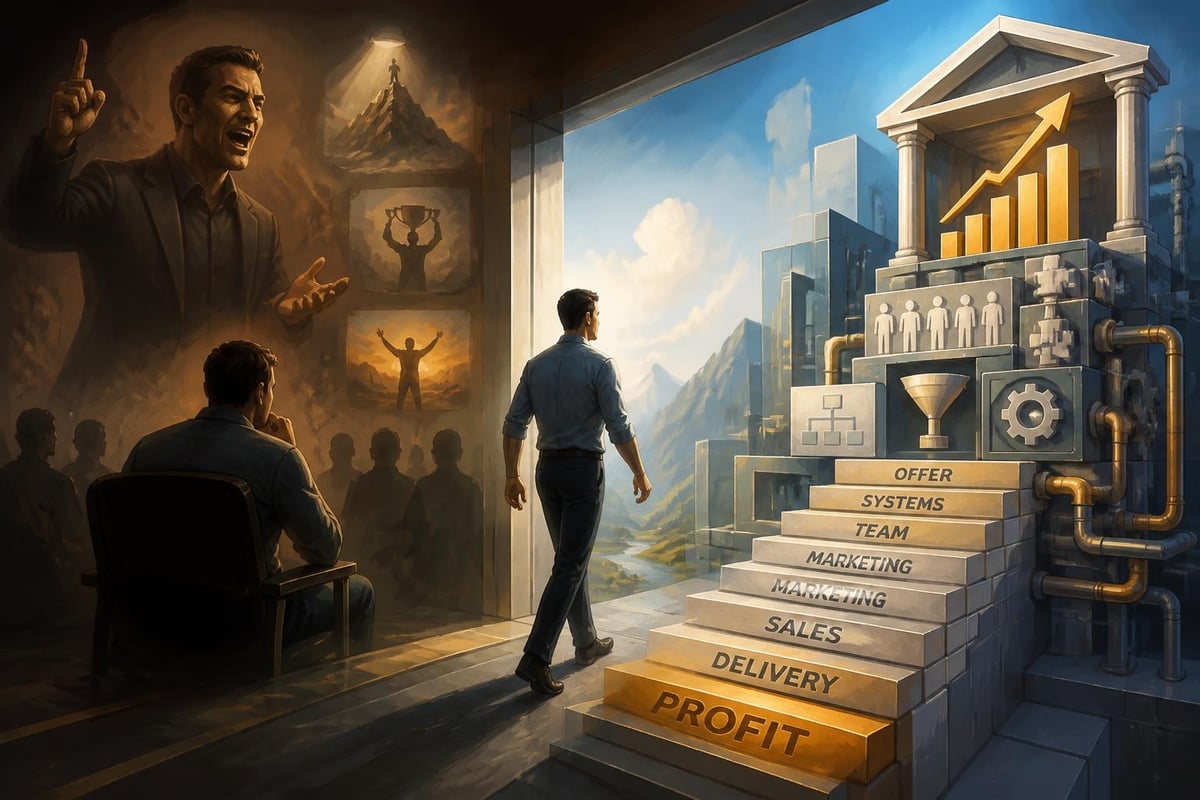
Market authority determines pricing power. Generic business coaches compete on price and personality. Strategic consultancies command premium fees because they own specific transformations within defined markets.
The Profit Architecture positioning model includes four critical elements:
- Specialization depth - Choosing a narrow vertical (women-owned service businesses, $250k-$5M revenue range)
- Proprietary methodology - Developing frameworks that competitors cannot replicate
- Outcome ownership - Guaranteeing specific results tied to business metrics
- Implementation systems - Installing solutions rather than recommending strategies
Consider this positioning comparison:
| Generic Coach | Strategic Consultancy |
|---|---|
| "I help entrepreneurs grow" | "I install Profit Architecture for women-owned service businesses scaling from $250k to $5M" |
| Motivational support | Operational transformation |
| Monthly retainers ($2k-$5k) | Project fees ($25k-$100k+) |
| Personality-dependent | Systems-dependent |
| Client success varies wildly | Predictable, replicable outcomes |
This level of positioning clarity allows your business coaching business to attract clients who understand value versus cost. When you solve founder bottlenecks with proprietary systems, price resistance evaporates.
Building Market Authority Through Content
Authority isn't built through viral posts or vanity metrics. It's constructed through demonstrating systems thinking publicly. Your content strategy should showcase how your frameworks solve specific problems.
Effective authority-building content includes:
- Case breakdowns showing exact systems that produced measurable results
- Framework reveals demonstrating proprietary methodologies without giving away implementation
- Diagnostic content helping prospects identify their specific bottlenecks
- Industry analysis positioning trends within your specialized expertise
The services you offer should reflect this positioning clarity. Each offering must connect to a specific pillar of transformation, creating a logical progression from diagnosis through implementation.
Acquisition Systems That Convert Premium Clients
Sales systems separate sustainable consultancies from struggling coaches. Your business coaching business cannot scale if revenue depends on referral luck or social media algorithms. Predictable client acquisition requires engineered systems, not hopeful posting.
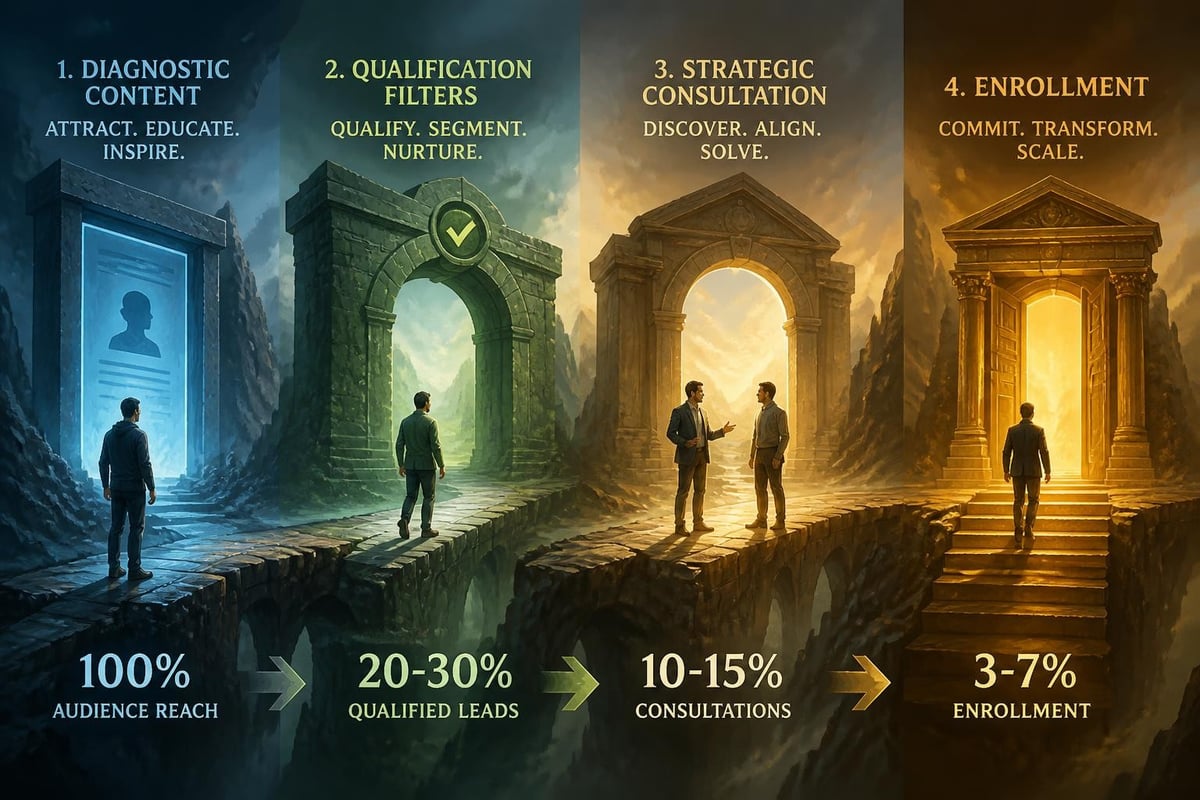
The modern high-ticket acquisition system operates through three conversion layers:
Discovery and Qualification
Premium prospects don't book calls from Instagram bio links. They require strategic warming through diagnostic content that identifies their specific bottlenecks. This means creating assessment frameworks that help them self-identify whether they're experiencing operational drag, founder bottleneck, or both.
Your qualification process should filter for:
- Revenue range ($250k-$5M for optimal transformation potential)
- Business model (high-ticket services, not low-margin volume plays)
- Ownership structure (women-owned businesses understand gender-specific scaling challenges)
- Implementation capacity (ability to execute systems, not just consume ideas)
Consultation Architecture
The sales conversation isn't about convincing. It's about diagnosing. Your business coaching business consultation should function as a strategic audit where you identify gaps across positioning, acquisition, delivery, and leadership.
Effective consultation structure:
- Current state diagnosis (revenue, delivery model, founder involvement, profit margins)
- Bottleneck identification (where operational drag creates the biggest constraint)
- Future state design (what becomes possible with proper systems)
- Investment presentation (clear pricing tied to transformation scope)
This approach converts 40-60% of qualified consultations because you're selling transformation architecture, not coaching hours. The industry trends in business coaching show clients increasingly value implementation over inspiration.
Proposal and Enrollment Systems
High-ticket decisions require processing time and internal alignment. Your proposal system should create urgency without pressure, demonstrating both the cost of delay and the value of immediate action.
Include specific deliverables tied to each pillar of your framework. Instead of "12 months of coaching," specify "Positioning audit and market authority implementation, sales system installation with conversion tracking, delivery optimization framework, and leadership boundary protocols."
Delivery Excellence and Client Outcomes
Your business coaching business scales through delivery systems that produce outcomes independent of founder heroics. This requires moving from custom coaching to structured implementation frameworks.
The delivery transformation happens across three dimensions:
Structured Onboarding
Every client enters the same diagnostic process, receives the same assessment tools, and begins with identical foundation-building. This consistency allows you to predict timelines, manage scope, and guarantee outcomes.
Your onboarding should install four critical systems within the first 30 days:
- Baseline metrics capture (current revenue, margins, delivery hours, sales conversion)
- Bottleneck mapping (identifying the primary constraint preventing next-level growth)
- Quick-win implementation (one tactical system that produces immediate result)
- Transformation roadmap (90-day implementation sequence across all four pillars)
This structure positions your business coaching business as a strategic partner executing a planned transformation, not a coach reacting to weekly crises.
Implementation Frameworks
Proprietary frameworks differentiate consultancies from commoditized coaching. Your frameworks must be specific enough to guarantee outcomes yet flexible enough to customize across client contexts.
Consider how Profit Architecture creates this balance through four distinct pillars:
| Pillar | Transformation Focus | Key Deliverables |
|---|---|---|
| Positioning | Market authority and premium pricing | Messaging frameworks, authority content systems, competitive differentiation |
| Acquisition | Predictable client flow | Sales systems, qualification processes, conversion optimization |
| Delivery | Client outcomes without founder burnout | Delivery protocols, team enablement, quality assurance |
| Leadership | Operational boundaries | Decision frameworks, delegation systems, capacity protection |
Each pillar includes diagnostic tools, implementation checklists, and measurement systems. This structure allows junior team members to support delivery while you focus on strategy and client relationships.
Outcome Measurement
Your business coaching business must measure what matters. Vanity metrics like engagement or awareness don't pay bills. Track revenue growth, profit margin expansion, founder time liberation, and team capability development.
Establish clear success metrics during onboarding and review monthly. When clients see measurable progress against defined goals, retention increases and referrals multiply. The growth statistics for business coaching show that outcome-focused consultancies command 3-5x higher fees than traditional coaches.
Leadership and Operational Boundaries
The irony of the business coaching business is that coaches often struggle with the same founder bottlenecks they help clients solve. Scaling your consultancy requires implementing the same systems you install for clients.
Capacity Protection
Your expertise is finite. Every hour spent in delivery is an hour unavailable for business development, team building, or framework refinement. Protect capacity through:
- Strict client caps (maximum simultaneous engagements based on delivery model)
- Time blocking (dedicated days for client work versus business building)
- Delegation protocols (clear handoff systems for junior consultants)
- Technology leverage (automation for administrative tasks and client communication)
These boundaries aren't selfish. They're strategic. Your business coaching business cannot serve clients at the highest level if you're operating from burnout and scattered attention.
Team Building for Scale
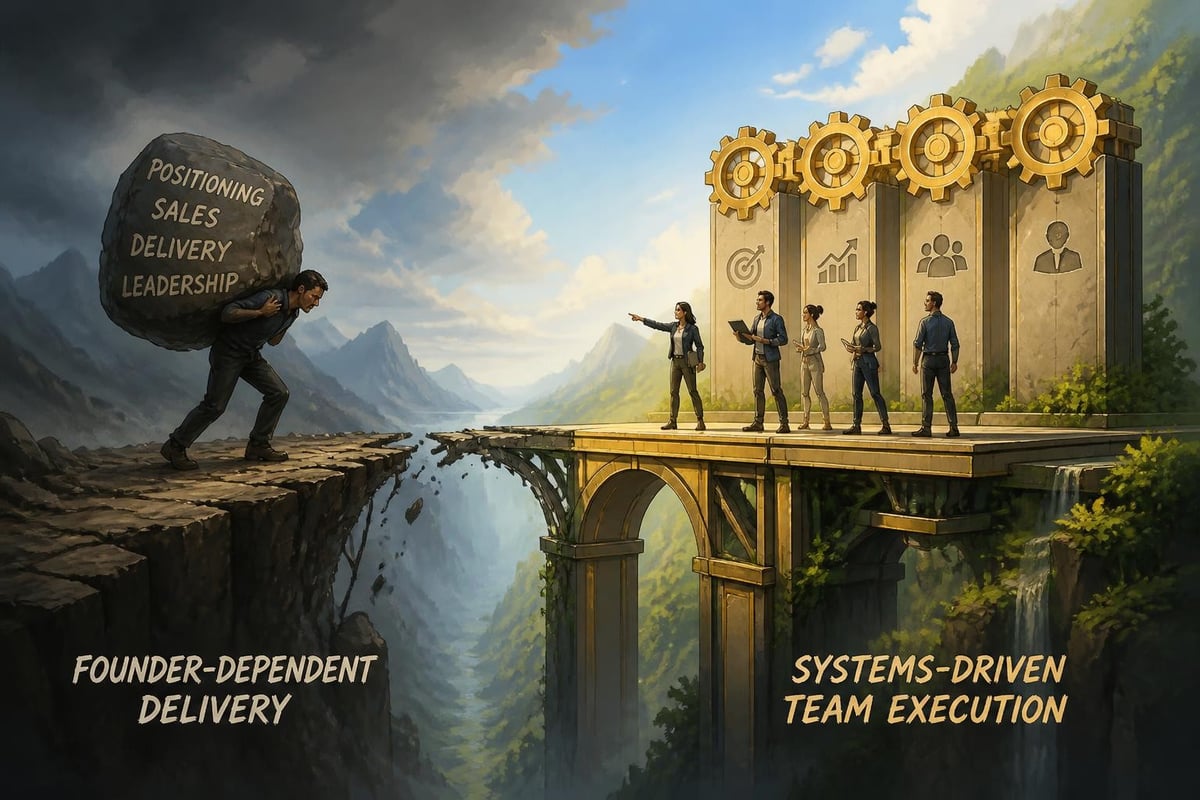
Sustainable consultancies build teams around frameworks, not founder personality. This requires documenting your methodologies, creating certification processes, and developing quality assurance systems.
Key roles for scaling your business coaching business:
- Implementation consultants who execute framework installation under your oversight
- Client success managers who handle ongoing support and accountability
- Business development specialists who manage lead qualification and consultation booking
- Operations coordinator who ensures delivery consistency and documentation
The transition from solopreneur to consultancy leader represents the most significant mindset shift in building a business coaching business. You're no longer the service, you're the architect of service delivery systems.
Pricing Strategy for Profitable Growth
Underpricing destroys consultancies faster than poor delivery. Your business coaching business must charge fees that support infrastructure investment, team development, and founder compensation worthy of the transformation you create.
Value-Based Pricing Model
Hourly billing and monthly retainers commoditize expertise. Project-based pricing tied to specific transformations allows you to capture value proportional to outcomes delivered.
Consider this pricing evolution:
- Entry-level engagement ($15k-$25k): Single pillar transformation (typically Acquisition system installation)
- Comprehensive transformation ($50k-$75k): Full Profit Architecture implementation across all four pillars
- Enterprise consulting ($100k+): Custom framework development with team training and ongoing optimization
These tiers allow clients to enter at different readiness levels while creating clear upgrade paths as they experience results.
Investment Justification
High-ticket pricing requires clear ROI demonstration. A $50k investment in your business coaching business should generate $250k-$500k in additional revenue or profit margin expansion. Build this math directly into your sales process.
When prospects balk at fees, the issue isn't price, it's value communication. Revisit your positioning, sharpen your diagnostic process, and ensure your frameworks demonstrate clear before-and-after transformation.
The comprehensive guide to starting a coaching business emphasizes that pricing confidence directly correlates with framework clarity and outcome certainty. If you cannot guarantee specific transformations, you cannot command premium fees.
Technology Infrastructure and Systems
Your business coaching business requires technology that enables scale without adding complexity. The wrong tools create operational drag. The right stack supports seamless delivery and clear measurement.
Essential technology categories include:
- CRM system for prospect tracking, client management, and pipeline visibility
- Project management platform for framework implementation and team coordination
- Communication tools for client interaction and internal collaboration
- Documentation system for framework storage and team training
- Analytics dashboard for tracking client outcomes and business metrics
Resist the urge to over-engineer. Start with core functionality and add sophistication as client volume demands it. Many consultancies waste months building perfect systems when manual processes would serve fine at current scale.
Framework Documentation
Your intellectual property lives in your frameworks. Document every diagnostic tool, implementation checklist, and measurement system. This documentation serves three critical functions:
- Team enablement - Junior consultants can deliver consistent quality
- Quality assurance - Client outcomes remain predictable across delivery team
- Business value - Documented systems create sellable assets if you choose to exit
The strategic approach to business coaching growth emphasizes that documented frameworks represent the primary asset differentiating consultancies from personality-dependent coaches.
Marketing and Client Attraction
Your business coaching business needs client flow that doesn't depend on social media algorithms or networking luck. Strategic marketing creates predictable visibility with your target market.
Authority Content Strategy
Content marketing for high-ticket services differs fundamentally from volume-based businesses. You're not chasing reach or engagement. You're demonstrating systems thinking to a small, qualified audience.
High-leverage content formats:
- Long-form articles deconstructing specific operational challenges
- Case studies showing exact frameworks that produced measurable results
- Email sequences diagnosing common bottlenecks in your target market
- Speaking opportunities at industry events where your ideal clients gather
Quality trumps quantity. One deeply strategic article reaching 100 qualified prospects produces better results than viral posts reaching 10,000 unqualified followers.
Strategic Partnerships
The fastest path to premium clients runs through referral relationships with adjacent service providers. Identify professionals who serve your target market but don't compete with your offerings.
Valuable partnership categories include:
- Accountants and CFOs who see financial challenges your frameworks solve
- Legal advisors who encounter operational issues during compliance work
- Marketing agencies who recognize when client success requires operational transformation
- HR consultants who identify leadership gaps your systems address
These partnerships work because they're mutually beneficial. You solve problems they identify but cannot fix, creating better outcomes for shared clients. Explore the featured case studies to see how strategic partnerships accelerate growth.
Thought Leadership Development
Establishing yourself as the authority on specific transformations creates inbound demand. This means contributing original thinking to industry conversations, not repeating conventional wisdom.
Develop signature concepts, coin terms for your frameworks, and articulate contrarian perspectives based on implementation experience. When you're quoted, interviewed, or referenced as the expert on founder bottlenecks or operational drag, your business coaching business attracts clients proactively seeking your specific solutions.
Common Pitfalls and How to Avoid Them
Even experienced consultants fall into predictable traps when building a business coaching business. Awareness prevents most mistakes.
Critical pitfalls include:
- Broad positioning - Trying to serve everyone serves no one particularly well
- Underpricing - Low fees attract wrong-fit clients and prevent infrastructure investment
- Custom delivery - Reinventing approaches for each client destroys profitability
- Founder dependency - Remaining the only person who can deliver creates artificial ceiling
- Metric avoidance - Failing to measure outcomes prevents improvement and premium pricing
The antidote lives in disciplined systems thinking. Every decision should strengthen your frameworks, clarify your positioning, or improve your delivery infrastructure. If an opportunity doesn't serve one of these goals, it's a distraction.
Additionally, understanding how to start a coaching business strategically from the foundation prevents costly pivots later. Build with scale in mind from day one, even if you're currently a solo practitioner.
Financial Management and Profit Optimization
Your business coaching business must model the profit architecture you install for clients. This means managing margins ruthlessly, forecasting cash flow accurately, and investing strategically in growth.
Margin Protection
High revenue means nothing without healthy profit margins. Track delivery costs precisely, including your time valued at appropriate rates. Many consultants discover they're earning less per hour than their junior team members once all costs are factored.
Target gross margins of 70-80% for advisory services and 50-60% for implementation-heavy projects. If margins fall below these thresholds, either pricing is too low or delivery is too inefficient.
| Business Model | Target Gross Margin | Common Margin Killers |
|---|---|---|
| Pure advisory | 75-85% | Scope creep, unlimited access, founder overdelivery |
| Framework implementation | 60-70% | Underestimated project hours, custom work, poor team delegation |
| Hybrid model | 65-75% | Unclear service boundaries, inconsistent pricing, delivery inefficiency |
Cash Flow Forecasting
Project-based pricing creates lumpy revenue. Your business coaching business needs cash reserves and accurate forecasting to manage this variability. Build financial models showing projected revenue, delivery costs, and operating expenses across rolling 12-month periods.
Implement payment structures that improve cash flow: 50% deposit at signing, 25% at project midpoint, 25% at completion. This structure funds delivery costs while protecting against scope expansion or client disengagement.
Future-Proofing Your Business Coaching Business
The consulting landscape continues evolving rapidly. Emerging trends in business coaching for 2026 emphasize technology integration, specialized expertise, and outcome guarantees. Position your business coaching business ahead of these shifts.
Technology Integration
AI and automation tools are transforming service delivery. Smart consultants leverage technology to enhance outcomes while protecting high-value strategic thinking. Use AI for data analysis, pattern recognition, and content creation while reserving human expertise for framework customization and strategic decision-making.
Specialization Deepening
Generalist coaches face increasing pressure from specialized consultants. Double down on your niche expertise. Become the definitive authority on specific transformations within defined markets. The narrower your focus, the higher your fees and the more predictable your outcomes.
Community Building
Your business coaching business benefits from cultivating community among current and former clients. Alumni networks create referral engines, provide social proof, and offer ongoing learning opportunities that justify premium positioning.
Consider launching private communities, hosting quarterly gatherings, or creating certification programs where successful clients become affiliates promoting your frameworks. These strategies create compounding value beyond individual client engagements.
For personalized guidance on implementing these strategies within your specific context, schedule a strategic consultation to explore how these systems apply to your business.
Building a business coaching business that scales past multiple six figures requires moving beyond personality-driven coaching into systems-driven consulting. The transformation from solopreneur to strategic consultancy happens through proprietary frameworks, predictable acquisition systems, scalable delivery models, and disciplined operational boundaries. If you're ready to install Profit Architecture in your women-owned service business and eliminate the operational drag preventing your next revenue level, Rise Reign Rule provides the strategic systems and implementation support that transform founder bottlenecks into predictable profit growth.


