
Coaching and Consulting: Scale Your High-Ticket Service
The revenue ceiling. You've hit it, felt it, and probably resented it. Your coaching and consulting business generates healthy revenue between $250k and $5M, yet you're trapped in a paradox: the more clients you serve, the less freedom you have. The business that was supposed to liberate you has become your most demanding client. You're not alone. According to the coaching industry's explosive growth trajectory, the market now includes 15% more practitioners than just three years ago, but operational efficiency remains the critical differentiator between those who scale and those who plateau.
The Hidden Cost of Being Indispensable
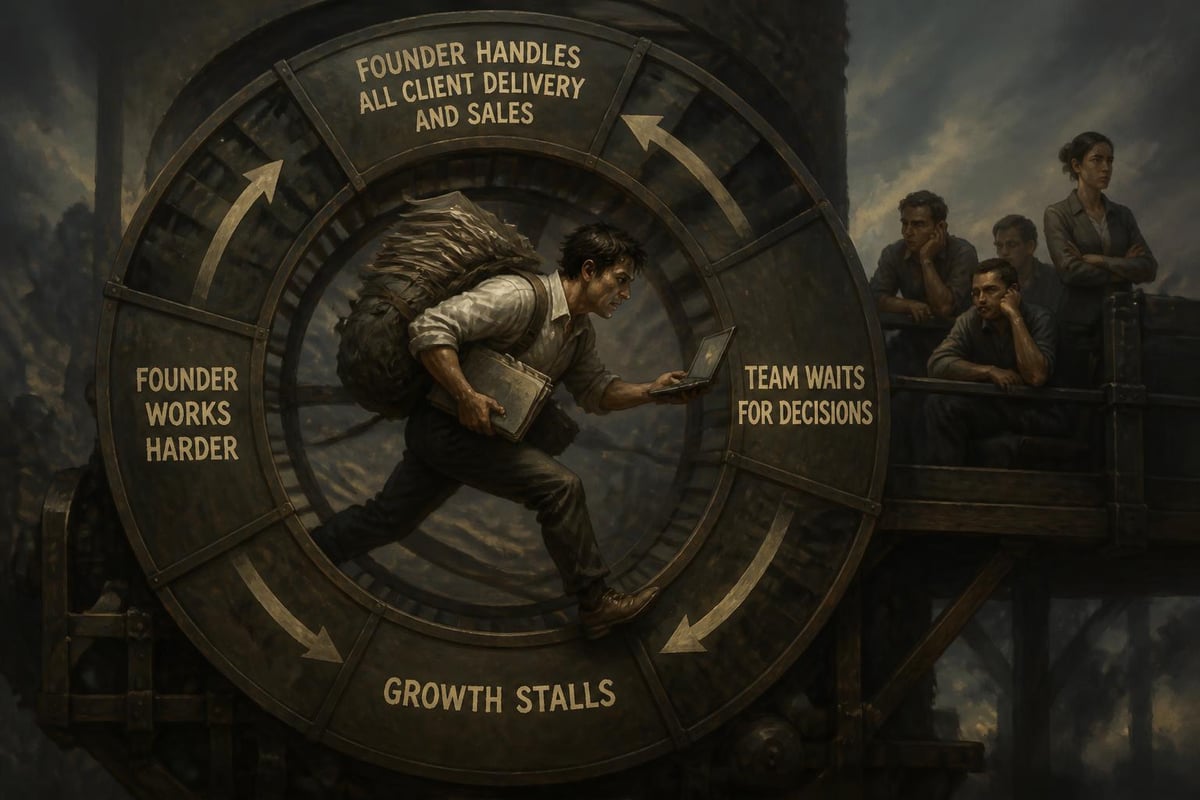
Most women-owned high-ticket service businesses don't fail because of poor marketing or inadequate expertise. They stall because the founder becomes the business's single point of failure.
Every client engagement requires your personal touch. Every sales conversation demands your presence. Every delivery milestone depends on your oversight. This isn't just exhausting; it's a mathematical impossibility for sustainable growth.
The operational drag manifests in three specific ways:
- Revenue plateaus despite increased effort and hours worked
- Client outcomes become inconsistent when you're stretched thin
- Team members wait for your decisions, creating bottlenecks throughout the organization
The irony cuts deep: your expertise created the business, but that same expertise now prevents it from evolving beyond you. This pattern repeats across coaching and consulting firms because most founders confuse activity with architecture.
The Difference Between Coaching and Consulting Models
Understanding the distinction between coaching and consulting becomes crucial when designing your profit architecture. Coaching traditionally focuses on asking questions that unlock client insights, while consulting delivers expert recommendations and implementations. Yet the most successful high-ticket service businesses in 2026 blend both approaches strategically.
Your clients don't hire you for pure coaching or pure consulting anymore. They hire you for outcomes. This shift demands a hybrid model where your methodology includes both facilitation and direction, both discovery and prescription. The diversification of coaching services reflects this evolution, with practitioners offering comprehensive solutions rather than single-modality engagements.
| Traditional Model | Profit Architecture Model |
|---|---|
| Founder-dependent delivery | Systematized frameworks |
| Time-based pricing | Value-based packages |
| Ad-hoc processes | Documented methodologies |
| Custom solutions | Scalable protocols |
| Individual expertise | Institutional knowledge |
The businesses that break through revenue ceilings don't just work harder. They architect differently.
Building Your Profit Architecture Framework
The coaching and consulting landscape demands a fundamental redesign of how you structure, sell, and deliver your services. This isn't about working more efficiently within your current model; it's about installing an entirely new operating system.
Positioning: Claim Your Market Authority
Your positioning problem isn't that prospects don't understand what you do. It's that they can't immediately distinguish why you're the only viable choice for their specific transformation. Generic positioning creates generic revenue.
The women-owned service businesses scaling past $5M in 2026 have abandoned broad market appeals. Instead, they've staked claim to razor-sharp territories where their authority becomes unquestionable. This narrow focus paradoxically expands opportunity because decision-makers seek specialists, not generalists.
Critical positioning elements include:
- A proprietary methodology with a memorable name
- Specific revenue or outcome metrics you guarantee
- Clear articulation of who you don't serve
- Thought leadership that challenges industry assumptions
When you position with precision, your strategic services become the obvious solution rather than one option among many. This clarity transforms your sales process from persuasion to qualification.
Acquisition: Install Sales Systems That Scale
Most coaching and consulting founders treat sales as an art when it needs to become a science. The high-performers create predictable revenue not through charisma but through architecture.
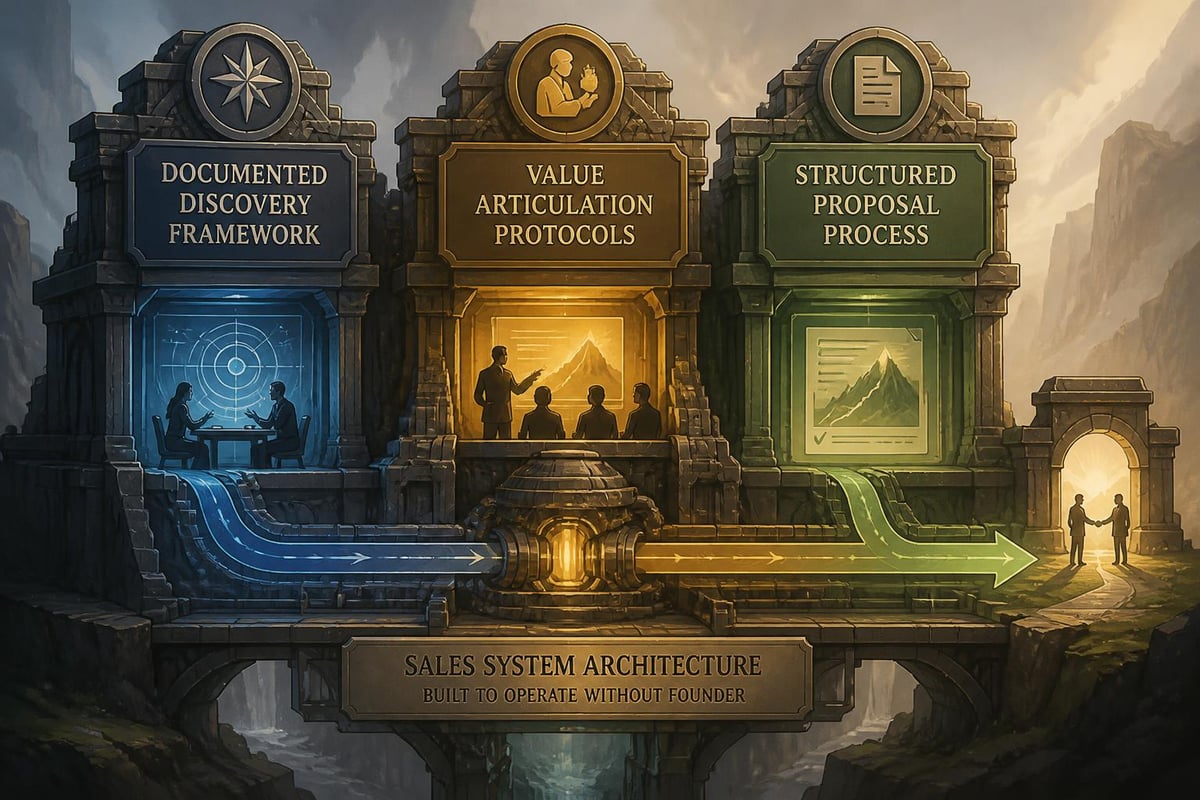
Your sales system requires three non-negotiable components: a documented discovery framework, a value articulation protocol, and a structured proposal process. Each component must function independently of your personal involvement, allowing team members to execute with confidence.
Consider the mathematics: if closing a $50k engagement requires ten hours of your time across discovery, proposal development, and negotiation, you've capped annual revenue at whatever your available hours permit. But when your acquisition system operates through documented frameworks, junior team members handle 70% of the process while you focus exclusively on high-leverage moments.
The rapid digital transformation across consulting markets has created sophisticated buyers who expect sophisticated systems. They're evaluating your sales process as a proxy for your delivery excellence.
Delivery: Engineer Predictable Client Outcomes
Here's the uncomfortable truth: your clients achieve results despite your delivery process, not because of it. The transformation happens through your expertise, but the inconsistency emerges from your lack of systematic delivery.
Engineering predictable outcomes requires disaggregating your expertise into transferable components. What insights do clients need in week one versus week eight? Which frameworks drive the fastest progress? What accountability structures prevent backsliding?
Your delivery architecture should include:
- Phase-based milestones with specific deliverables
- Template libraries for common scenarios
- Quality control checkpoints independent of founder review
- Client self-service resources for routine questions
- Automated progress tracking and reporting
The goal isn't to remove your expertise from delivery. It's to amplify your impact by systematizing everything that doesn't require your unique insight. When building trust and credibility becomes institutionalized rather than personalized, your business escapes the founder dependency trap.
Many high-ticket service providers resist systematization, fearing it will commoditize their offerings. The opposite proves true. Systems create the consistency that allows premium pricing because clients pay premiums for certainty, not customization.
Leadership: Setting Boundaries That Enable Scale
The hardest pillar for most women entrepreneurs isn't technical; it's personal. You've built your coaching and consulting practice on being responsive, available, and committed to client success. These virtues become vices when they prevent delegation and decision-making authority from flowing to your team.
Boundaries aren't about protecting your time from clients. They're about protecting your business from the limitations of your individual capacity. Every decision you make that someone else could make with proper training represents a bottleneck you're choosing to maintain.
The Decision-Making Matrix
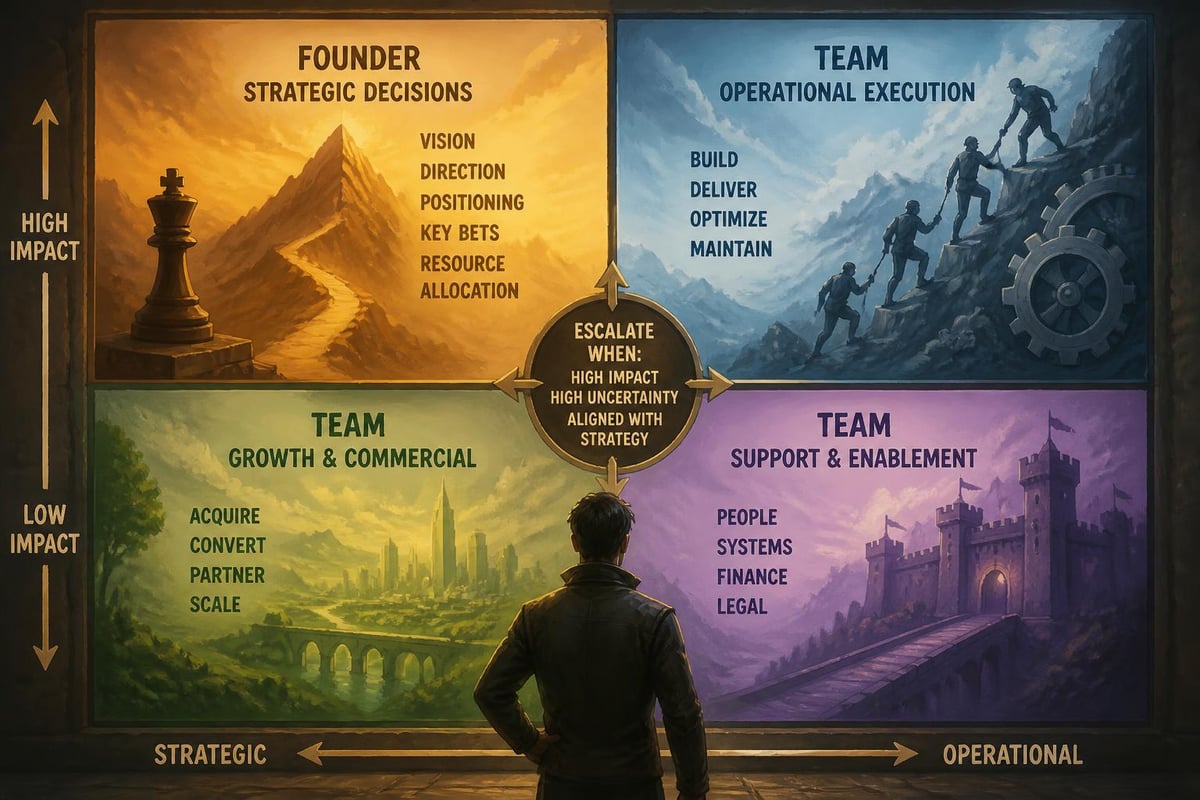
Which decisions require your involvement? Create explicit criteria that empower your team to act without seeking permission. When team members understand the boundaries of their authority, they stop being order-takers and start being operators.
| Decision Type | Owner | Escalation Trigger |
|---|---|---|
| Client onboarding protocols | Team lead | Contract variations >$10k |
| Delivery adjustments | Project manager | Timeline changes >2 weeks |
| Standard proposals | Sales team | Custom scope requests |
| Routine operations | Department heads | Budget variances >15% |
This matrix doesn't remove you from leadership. It removes you from operational drag that masquerades as leadership. Your role shifts from chief executor to chief architect, focusing on strategy, innovation, and the highest-leverage client relationships.
The growing coaching market rewards those who can deliver exceptional outcomes at scale. That requires you to lead rather than do, architect rather than implement, design rather than execute.
Technology as Your Scaling Multiplier
The coaching and consulting businesses breaking through revenue ceilings in 2026 aren't just installing better processes. They're leveraging technology to multiply founder impact without multiplying founder hours.
Consider your client acquisition funnel. Traditional approaches require personal involvement at every stage: content creation, social media engagement, discovery calls, follow-up, proposal development. But strategic technology deployment changes the equation entirely.
AI-powered tools now handle:
- Initial prospect qualification through intelligent chatbots
- Personalized email sequences based on engagement patterns
- Automated scheduling that respects your strategic calendar blocks
- Content repurposing that extends your thought leadership reach
- Data analysis that identifies your most profitable client patterns
Platforms like AdsRaw demonstrate how AI can create professional ad content without the traditional time and cost investment in creator management. This technological leverage allows service providers to test market messaging rapidly, identify what resonates, and scale what works without proportional increases in production resources.
The hesitation many founders express about technology often masks a deeper fear: if systems can replace my involvement, what makes me valuable? This question misunderstands value creation in high-ticket services. Your value lies not in performing routine tasks but in strategic insight, relationship cultivation, and continuous framework evolution.
The Human-Technology Balance
Technology should enhance your human expertise, not replace it. The most effective profit architecture combines automated systems for predictable processes with personal engagement at transformation moments.
When prospects complete your automated qualification sequence, they should encounter you at precisely the moment your expertise matters most. When clients progress through your delivery system, your involvement should appear at inflection points where guidance creates breakthrough value. This orchestration of automated efficiency and human excellence creates the scalability that pure coaching and consulting models cannot achieve.
The $16 billion U.S. coaching market includes 232,000 coaches, but only a fraction have installed the technological infrastructure that allows genuine scaling without sacrificing quality or burning out.
Financial Architecture: Pricing for Profit, Not Just Revenue
Revenue growth without profit expansion represents organizational failure masquerading as success. Many coaching and consulting businesses celebrate reaching $1M or $2M or $5M while their founders take home less than they did at $500k because costs scaled faster than systems.
Your pricing model should reflect the value you create, not the time you invest. Yet most service providers still anchor their fees to hourly calculations, competitive comparisons, or what feels comfortable rather than the transformation they engineer.
Value-based pricing requires three foundations:
- Documented ROI from previous client engagements
- Clear articulation of the cost of inaction for prospects
- Structured packages that eliminate scope creep
- Payment terms that improve your cash flow position
- Tiered offerings that create strategic client segmentation
When you price based on outcomes rather than inputs, your profit margins expand because efficiency improvements benefit you rather than subsidizing client fees. A client transformation that required 40 hours in year one might require only 25 hours in year three due to refined processes, but the value to the client remains constant or increases.
This pricing evolution separates sustainable high-ticket service businesses from those that hit revenue plateaus. The businesses struggling at $2M often have the same or lower profit margins than they did at $800k because they never transitioned from time-based to value-based economics.
The Integration Point: Where Everything Converges
Understanding coaching and consulting as a unified profit architecture rather than separate activities creates the leverage point for transformation. Your positioning informs your acquisition approach, which shapes your delivery methodology, which requires specific leadership boundaries, all supported by technological infrastructure and sound financial design.
This integration doesn't happen accidentally. It requires intentional design, typically guided by someone who's built these systems successfully. Most founders can't architect their own transformation any more than they can coach themselves to breakthrough results. The perspective, experience, and accountability come from outside the system.
The women entrepreneurs achieving predictable scaling recognize that their next growth phase requires different capabilities than their last. The skills that built a $500k business create the ceiling for a $5M business. Breaking through demands new architecture, not just new effort.
Consider scheduling a strategic conversation to identify your specific bottlenecks and the architecture required to eliminate them. This isn't about generic advice; it's about diagnosing your unique operational drag and prescribing the systematic remedies that create clean scaling.
Market Timing and Strategic Urgency
The coaching and consulting market in 2026 rewards specialization and operational excellence more than ever before. The emerging trends toward virtual delivery, niche positioning, and outcome-driven services mean that generalist approaches and founder-dependent models face increasing competitive pressure.
This creates both opportunity and urgency. Opportunity because the businesses that install profit architecture now will dominate their niches while competitors remain stuck in operational drag. Urgency because every quarter spent in founder-dependent operations represents not just current revenue limitations but widening competitive gaps.
The question isn't whether to evolve your business model. Market forces have already decided that question. The question is whether you'll architect that evolution strategically or allow it to happen reactively, through crisis rather than design.
Your competitors are making this choice right now. Some are doubling down on the old model, working harder within existing constraints. Others are installing the systems, frameworks, and leadership structures that will dominate the next five years of market evolution. Which side of that divide will your business occupy?
The comprehensive case studies demonstrate what becomes possible when operational drag transforms into profit architecture. These aren't aspirational stories; they're systematic implementations of the four-pillar framework that turns founder bottlenecks into scalable growth engines.
Beyond the Plateau: Your Next Strategic Move
Breaking through your current revenue ceiling requires acknowledging an uncomfortable truth: the business model that got you here cannot get you there. Your coaching and consulting practice needs fundamental redesign, not incremental improvement.
This transformation begins with honest assessment. Where does operational drag show up in your business? Which bottlenecks trace directly back to your personal involvement? What decisions must you make that prevent your team from operating independently? What systems exist in your head rather than in documented, transferable frameworks?
The answers to these questions reveal your profit architecture gaps. Most women entrepreneurs discover they're missing not one element but systematic integration across all four pillars. Positioning exists but lacks market authority differentiation. Sales happen but without documented systems. Delivery succeeds through heroic effort rather than engineered processes. Leadership focuses on doing rather than enabling.
Closing these gaps doesn't require more time. It requires different thinking, external perspective, and proven frameworks adapted to your specific context. That's exactly what strategic consultancies provide: the architecture your business needs installed by people who've built these systems successfully dozens of times before.
If you recognize your business in these patterns, you're not missing something fundamental about entrepreneurship. You're experiencing the predictable constraints of a business that's outgrown its original architecture. The solution isn't working harder within your current model. It's installing a new operating system designed for the scale you're pursuing.
The difference between coaching and consulting businesses that scale cleanly and those that plateau at founder capacity comes down to architecture, not effort. When you install systematic frameworks across positioning, acquisition, delivery, and leadership, operational drag transforms into predictable profit. Rise Reign Rule specializes in this exact transformation for women-owned high-ticket service businesses generating $250k to $5M in revenue, implementing the Profit Architecture framework that eliminates founder bottlenecks and creates the clean scaling you've been working toward.


