
How to Raise Coaching Prices Without Losing Clients
You are undercharging. You know it. But the thought of raising your prices makes your stomach drop because you can already see the clients walking away. Here is what nobody tells you: if your price increase makes clients leave, the price was not the problem. The value perception was. Price is not a filter you wave over your audience to see who is serious. Price is infrastructure. It funds the systems, the support, and the margin that let you actually deliver at a high level without burning yourself into the ground. When you raise your prices, you are not asking for more. You are telling the market what it costs to build something that can actually hold their transformation. The women who leave were never your clients anyway. They were renting your time at a discount. The ones who stay are the ones who understood the value from the beginning.
Why Underpricing Is the Silent Killer of Coaching Businesses
Most female coaches tie themselves in knots justifying why they cannot raise their rates. The market will not support it. My clients cannot afford it. I am not ready yet.
None of these statements are about the market. They are about you.
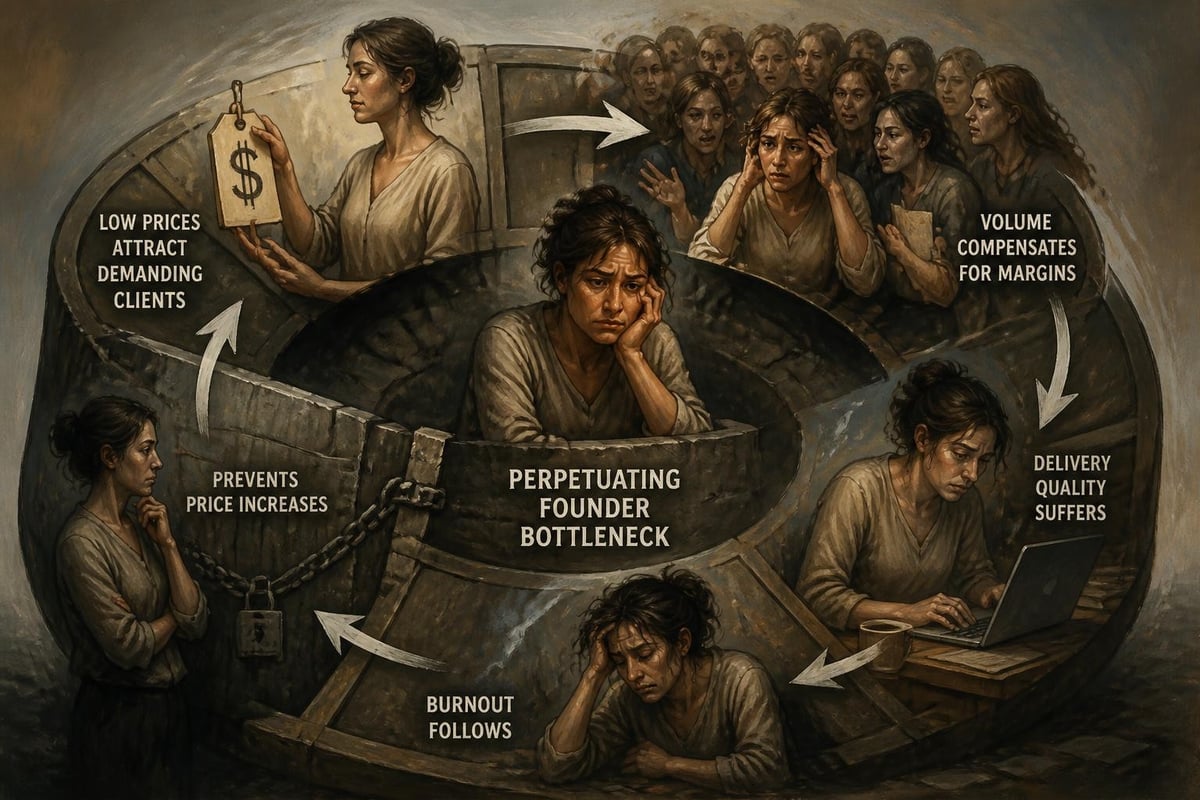
Underpricing creates a vicious cycle that looks like this:
- You charge too little because you fear objection
- Low prices attract price-sensitive clients who demand constant access
- You take on volume to compensate for thin margins
- Delivery quality drops because you are spread too thin
- You burn out and resent your business
- You believe you cannot raise prices because you are barely keeping up
The real cost of underpricing is not just revenue. It is operational drag, founder bottleneck, and the complete erosion of your leadership capacity. When you are drowning in low-margin work, you cannot build the systems that would free you to scale. This is exactly why effective leadership training emphasizes strategic decision-making over constant firefighting.
The Infrastructure Principle of Pricing
Price is not what you charge for your time. Price is what it costs to build and maintain the infrastructure that delivers consistent transformation.
That infrastructure includes your delivery systems, your support team, your client onboarding process, your marketing assets, your continuing education, and your energetic capacity to show up fully resourced.
When you price for infrastructure instead of hours, everything changes. You stop defending your rates and start investing in the operational excellence that makes those rates inevitable.
The Pre-Increase Audit: What Must Be True Before You Raise Prices
You do not raise prices in a vacuum. You raise them when the value infrastructure justifies the increase. That means conducting a ruthless audit of what currently exists versus what needs to exist.
Your Current Delivery Systems
Answer these questions honestly:
- Can a client articulate exactly what they get and when they get it?
- Do you have documented processes for onboarding, delivery, and offboarding?
- Is there a clear transformation pathway that does not depend solely on you?
- Do clients receive consistent communication, resources, and touchpoints?
- Can you deliver outcomes without personally being in every single interaction?
If you answered no to more than two of these questions, your pricing problem is actually a coaching and leadership development problem. You need to build the systems before you raise the investment.
Your Positioning and Market Authority
| Element | Underpriced Position | Premium Position |
|---|---|---|
| Language | "I help clients..." | "I specialize in [specific outcome] for [specific market]" |
| Proof | Testimonials focus on you being nice | Case studies focus on measurable business results |
| Access | Available anytime, immediate response | Structured touchpoints, strategic availability |
| Boundaries | Scope creep is normal | Scope is defined and protected |
Premium pricing requires premium positioning. Your market needs to understand not just what you do, but the specific problem you solve and the unique methodology you use to solve it. Vague generalist positioning will always create price resistance because prospects cannot distinguish you from cheaper alternatives.
The Four-Phase Price Increase Strategy
Raising your coaching prices without losing clients is not a single announcement. It is a strategic rollout across four distinct phases.
Phase One: Anchor Your New Value Architecture (Weeks 1-2)
Before you touch pricing, you need to rebuild how you communicate value. This means getting brutally specific about:
Your transformation statement. What exact outcome do clients achieve, in what timeframe, using what proprietary method? Generic promises like "grow your business" do not command premium prices. Specific promises like "install a repeatable sales system that generates five qualified calls per week without paid ads in 90 days" do.
Your delivery framework. Give your process a name. Map out the phases. Create visual assets that show the pathway from current state to desired state. When clients can see the architecture of transformation, price objections decrease dramatically. This is foundational coaching and leadership development work that separates you from commodity service providers.
Your proof library. Collect three case studies that demonstrate ROI. Not feelings, not satisfaction. Actual business metrics. Revenue increases, time reclaimed, team retention, client acquisition costs. Numbers anchor value in a way that emotion never will.
Phase Two: Segment Your Current Client Base (Weeks 3-4)
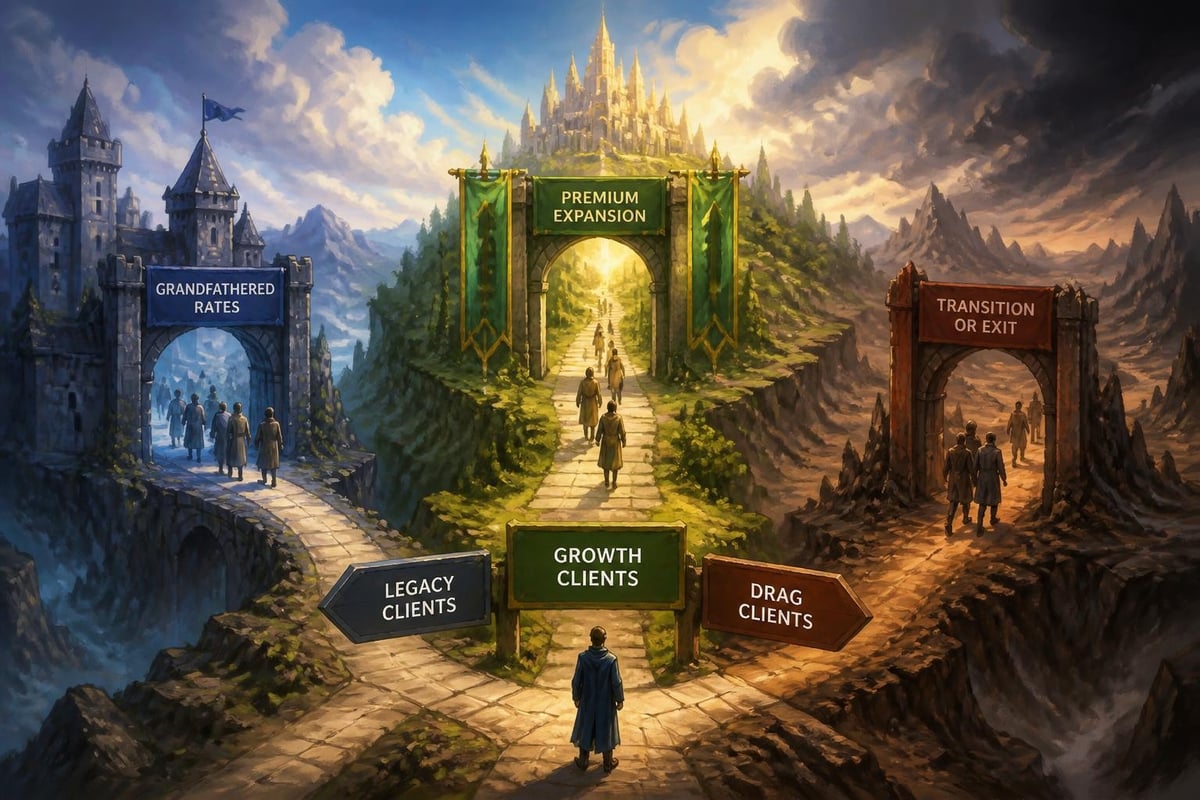
Not all clients are created equal. Before announcing any price change, segment your roster into three categories:
- Legacy clients who have been with you for over a year and represent stable, predictable revenue
- Growth clients who are actively getting results and could expand their engagement
- Drag clients who demand disproportionate time, resist implementation, or create energy debt
Your pricing strategy will be different for each segment. Legacy clients may get grandfathered at current rates with reduced scope. Growth clients may be offered expanded engagements at new pricing. Drag clients may be transitioned out entirely or moved to a lower-touch group format.
This segmentation exercise often reveals that the clients you are most afraid of losing are the ones creating the most operational drag. The fear of losing them is actually fear of admitting you should have established better boundaries and leadership from the start.
Phase Three: Announce to Existing Clients (Weeks 5-6)
When you communicate a price increase to current clients, you are not apologizing or asking permission. You are informing them of a business decision rooted in better serving them.
The communication framework:
Subject: Important Update About [Your Program Name]
Body:
- What is changing: New pricing effective [specific date] for new clients
- Why it is changing: Investment in enhanced delivery systems, expanded resources, additional team support
- What current clients need to know: Your current rate honored through [date], after which new pricing applies
- What enhanced value they receive: List specific new systems, resources, or support being added
Notice what is missing: apology, justification, or negotiation. You are not defending the increase. You are announcing the evolution of your business infrastructure.
Most women-owned businesses brace for backlash and discover something surprising instead. The clients who were going to object were already showing up as energy drains. The clients who understand value simply renew. Some even thank you for finally charging what you are worth.
Phase Four: Lock in New Client Pricing (Week 7 Onward)
Once existing clients are notified, new pricing goes live immediately for all new engagements. No exceptions, no grandfather clauses, no "I will match your old price if you sign today" desperation.
New client pricing includes:
- Updated proposal templates reflecting new investment levels
- Sales conversations that position price as infrastructure, not cost
- Payment plans structured to protect cash flow while maintaining commitment
- Clear scope boundaries that prevent discounting through scope creep
This is where many coaches falter. They announce the new pricing, then immediately undercut it when the first prospect hesitates. That hesitation is not about affordability. It is about perceived value. If you fold at the first objection, you are confirming the prospect's suspicion that your pricing was arbitrary.
The Psychology of Price Objections: What They Really Mean
When a prospect says "I cannot afford that," they are rarely making a factual statement about their bank balance. They are expressing uncertainty about value relative to investment.
Common objections and their translations:
| Objection | Translation | Your Response |
|---|---|---|
| "That's too expensive" | "I don't see how this is different from cheaper options" | Reinforce your unique methodology and specific outcomes |
| "I need to think about it" | "I'm not convinced this will work for me" | Share case study of similar client achieving results |
| "Can you do payment plans?" | "I want this but need to structure the investment" | Offer structured plan with commitment mechanisms |
| "Do you have anything cheaper?" | "I'm not your ideal client" | Refer to group program or different solution |
The clients who stay after a price increase are the ones who already understood the value. The ones who leave would have become your biggest energy drains anyway.
Research on leadership development consistently shows that leaders who establish clear boundaries and value frameworks attract higher-quality engagements. This principle applies directly to pricing strategy.
Building the Systems That Justify Premium Pricing
You cannot sustain premium pricing on charisma alone. You need operational systems that deliver consistent results without requiring your constant presence. This is the difference between a coaching practice and a scalable coaching business.
The Minimum Viable Systems Stack
Client onboarding system. From contract signature to first session, what happens? Who does it? When does it happen? If the answer is "it depends" or "I handle it," you do not have a system.
Delivery and accountability system. How do clients access materials? How is progress tracked? How are sessions scheduled and confirmed? How do clients get support between sessions? Every manual step you take is a future bottleneck.
Results documentation system. How are client wins captured, documented, and showcased? If you are not systematically collecting proof of transformation, you are making it harder to justify premium pricing for the next client.
Offboarding and referral system. How do engagements end? What happens after the final session? How are referrals requested and tracked? The client journey does not end when payment stops.
These systems are not overhead. They are the infrastructure that allows you to deliver premium outcomes at scale. When my sales coach helped me recognize this distinction, my entire pricing strategy shifted from defensive to strategic.

The Profit Architecture of Premium Pricing
Coaching and leadership development is not just about working with clients. It is about building a business that can sustain and scale those client relationships without draining your capacity. This requires what we call Profit Architecture: the deliberate design of systems across positioning, acquisition, delivery, and leadership.
Positioning pillar. Your market authority must justify your premium pricing. This means thought leadership content, speaking engagements, strategic partnerships, and visible expertise that makes your rates seem inevitable rather than aspirational.
Acquisition pillar. Your sales system must attract and convert clients who value transformation over transaction. This means qualifying hard, presenting value clearly, and closing without desperation or discounting.
Delivery pillar. Your client outcomes must be consistent, measurable, and attributable to your methodology. This means documented processes, accountability systems, and result tracking that proves ROI.
Leadership pillar. Your personal boundaries must protect your capacity to lead strategically rather than operate tactically. This means saying no to scope creep, firing energy-drain clients, and investing in team support that removes you from delivery bottlenecks.
When these four pillars are aligned, pricing becomes simple. You charge what it costs to maintain the infrastructure that delivers the outcomes. Clients who understand this infrastructure invest readily. Clients who do not understand it self-select out before wasting your time.
Implementation Timeline: Your 90-Day Price Increase Roadmap
Days 1-14: Value Architecture Rebuild
- Document your transformation framework
- Create visual delivery pathway
- Collect three case studies with metrics
- Build proof library of client wins
Days 15-30: Internal Systems Audit
- Map current delivery process
- Identify manual bottlenecks
- Design automation for onboarding and accountability
- Build result tracking system
Days 31-45: Client Segmentation and Planning
- Categorize current roster into legacy, growth, drag
- Design segment-specific communication
- Plan transition strategy for drag clients
- Create expansion offers for growth clients
Days 46-60: Price Announcement and Communication
- Send notification to existing clients
- Update all proposal templates and sales materials
- Train any team members on new positioning
- Prepare objection handling framework
Days 61-90: New Pricing Enforcement and Refinement
- Close new clients at premium rates only
- Track objection patterns and refine messaging
- Collect early feedback on enhanced delivery systems
- Document what is working and what needs adjustment
This timeline is not theoretical. It is the exact roadmap successful women-owned service businesses use to raise rates without client loss. The ones who skip steps struggle. The ones who execute methodically thrive.
What Happens When You Get This Right
When you raise your prices strategically and install the infrastructure to justify those prices, several things happen simultaneously:
Your client roster improves. Price-sensitive, high-maintenance clients self-select out. Committed, implementation-focused clients stay and invest more deeply. Your energy improves because you are working with people who respect your boundaries and value your expertise.
Your delivery quality increases. With higher margins, you can invest in better systems, support team, and resources. You are no longer cutting corners to maintain unsustainable volume. Your clients get better results because you have the capacity to show up fully resourced.
Your operational drag decreases. You are no longer compensating for low prices with high volume. You can focus on depth over breadth, quality over quantity, transformation over transaction. The founder bottleneck that was choking your growth starts to dissolve.
Your leadership capacity expands. When you are not buried in delivery, you can think strategically about positioning, market authority, and business architecture. You can build instead of just maintain. This shift from operator to leader is what ultimately enables clean scaling.
This is not theory. This is the documented pattern of every woman-owned business that successfully scales past the founder bottleneck. The research on leader development confirms that capacity expansion requires strategic withdrawal from tactical execution.
Common Mistakes That Sabotage Price Increases
Even with a solid strategy, certain mistakes will undermine your price increase before it takes effect.
Mistake one: Apologizing for the increase. When you apologize, you signal that the price is unreasonable. Clients pick up on that uncertainty and push back. State the change clearly and confidently, then move forward.
Mistake two: Offering discounts to the first objector. The moment you cave on your new pricing, you teach every future prospect that your rates are negotiable. Hold the line or do not raise prices at all.
Mistake three: Raising prices without improving delivery. If nothing changes except the invoice amount, clients will rightfully feel cheated. Price increases must be accompanied by infrastructure improvements that enhance value.
Mistake four: Grandfathering too many clients for too long. Legacy pricing should have an expiration date. If you grandfather indefinitely, you create a two-tier system that breeds resentment and operational complexity.
Mistake five: Failing to communicate the value infrastructure. Clients need to understand what their investment funds. Systems, support, resources, your continuing education, team capacity. Price is not about what you are worth. It is about what it costs to deliver transformation reliably.
Avoiding these mistakes requires coaching and leadership development focused on boundary-setting, value communication, and strategic decision-making. Most female founders struggle here not because they lack capability, but because they lack permission to prioritize profit alongside purpose.
Raising your coaching prices without losing clients comes down to one truth: price is infrastructure, not apology. When you build the systems, positioning, and delivery excellence that justify premium pricing, the right clients stay and invest more deeply while the wrong ones self-select out. If you are ready to install the Profit Architecture that eliminates founder bottleneck and creates predictable scaling in your women-owned high-ticket service business, Rise Reign Rule specializes in exactly this transformation for businesses generating $250k to $5M in revenue.


