
Coaching for Career Development: A Practical Guide
Coaching for career development is a structured partnership in which a trained coach helps you clarify your goals, close skill gaps, and turn insight into action, usually through regular one-on-one conversations. If you are a founder, an executive, or a high performer who has hit a ceiling, it is one of the fastest ways to get unstuck, because it replaces guesswork with a plan and accountability.
The U.S. Office of Personnel Management describes coaching as an experiential development process that supports change and growth, using structured dialogue to help people turn insights into action. That definition matters. A good coach does not hand you answers. A good coach builds your ability to find them, test them, and act on them.
This guide shows you what a career development coach does, how a engagement runs, what it costs, and how to pick a coach worth your money.
What Does a Career Development Coach Do?
A career development coach helps you define where you want to go professionally, identifies what stands between you and that destination, and holds you accountable for closing the distance.
In practice, the work usually includes:
- Clarifying direction. Sorting out what you want from your next five years, not just your next job title.
- Naming strengths and blind spots. Surfacing patterns you cannot see from inside your own calendar.
- Building a plan. Turning a vague ambition into milestones, deadlines, and measurable outcomes.
- Practicing hard conversations. Salary negotiations, promotion asks, firing decisions, boundary-setting with clients.
- Keeping you honest. Reviewing what you said you would do and what actually happened.
A coach is not a therapist, who works with emotional history and clinical concerns. A coach is also not a mentor, who shares lessons from their own path. And a coach is not a consultant, who diagnoses a problem and delivers a fix. Coaching sits between those roles. It is forward-looking, goal-driven, and built on questions more than advice.
Who Benefits Most From Coaching for Career Development?
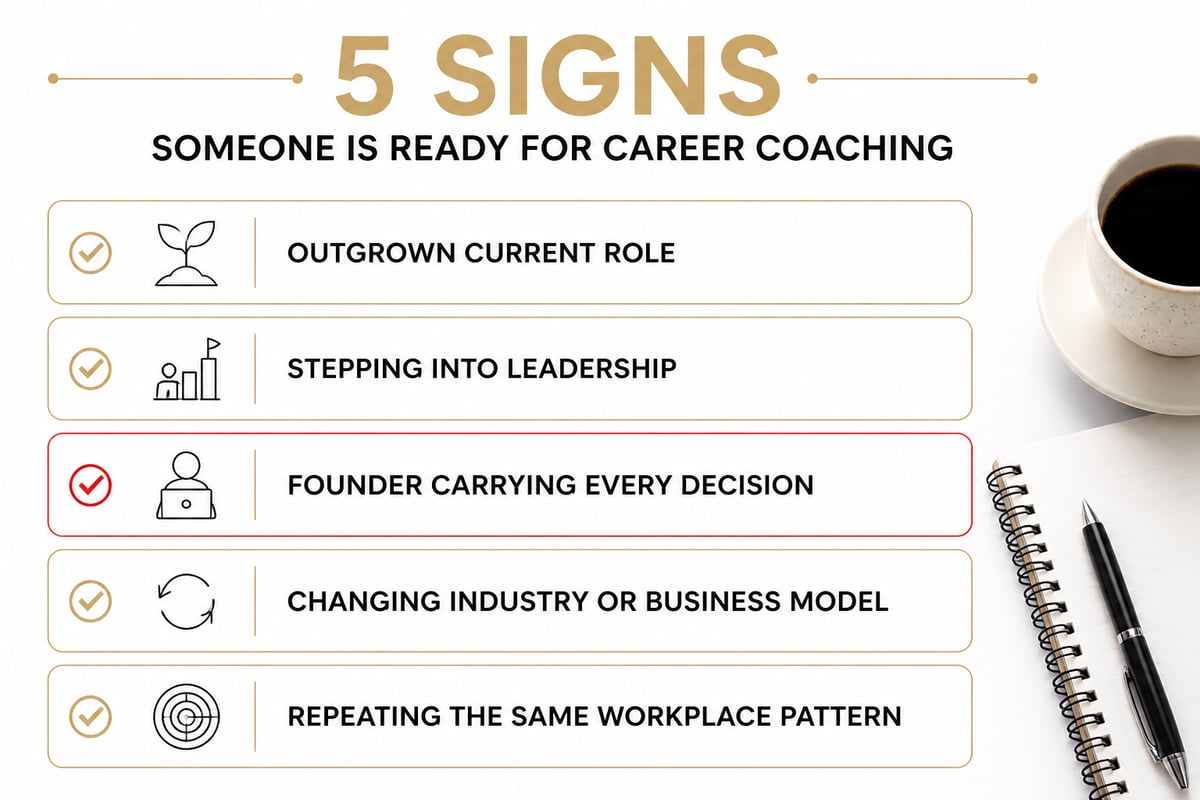
Coaching pays off most when you have the ability but lack clarity, leverage, or a second brain to think with.
Here are the situations where it tends to deliver:
- You have outgrown your role. The work no longer stretches you, but the next step is unclear.
- You are moving into leadership. Managing people and revenue requires different muscles than doing the work yourself.
- You are a founder carrying everything. Every decision routes through you, and growth has stalled because of it.
- You are changing industries or models. Moving from employee to owner, or from operator to strategist, is easier with a guide.
- You are stuck in a repeating pattern. Same conflict, same burnout, different job.
Skill gaps are a common thread. In a 2024 Pew survey, most U.S. workers said they had the education and training needed to get ahead, while a smaller share said they needed more. That group is a large pool of capable people who know something is missing but cannot name it. Coaching is built to name it.
How a Coaching Engagement Works Step by Step
Most career coaching engagements follow the same arc: assess, set goals, build a plan, act, and review.
Step 1: Discovery and assessment
The first session or two focus on where you are now. Expect questions about your results, your energy, your frustrations, and what you would change if nothing were off the table. Some coaches add formal assessments of strengths, communication style, or leadership habits.
Step 2: Goal setting
You and your coach translate what you want into specific targets. "Be a better leader" becomes "Delegate delivery oversight to a team lead within 90 days and cut my weekly client-facing hours by ten."
Step 3: Action planning
Goals become weekly commitments. This is where coaching separates itself from a good conversation with a friend. You leave each session with named actions and a date.
Step 4: Accountability and adjustment
At each session you report what happened. Wins get examined so you can repeat them. Misses get examined without judgment so you can fix the cause, which is usually a system problem rather than a willpower problem.
Step 5: Review and next phase
At the end of an agreed period, you measure progress against the original goals and decide whether to renew, shift focus, or stop.
Pay attention to what happens between sessions. Your results come from the work you do on your own time. The session is where you sharpen the plan.
What Are the 5 C's of Coaching?
The 5 C's of coaching are a popular memory aid for the qualities that make a coaching relationship work. Versions vary by trainer, but a common set is clarity, commitment, confidence, communication, and consistency.
- Clarity: knowing precisely what you are trying to achieve.
- Commitment: a real willingness to do the work between sessions.
- Confidence: the belief that you can act on what you decide.
- Communication: honest, open dialogue with your coach and with the people your goals affect.
- Consistency: showing up on schedule and following through over months, not days.
Use them as a self-check. If one of the five is weak, that is usually where your progress is leaking.
What Is the 70/30 Rule in Coaching?
The 70/30 rule says the coachee should do about 70% of the talking in a session, while the coach talks about 30%. The idea is that insight sticks when you say it out loud yourself, rather than hearing it from someone else.
It also works as a quality test. If your coach spends most of the hour lecturing, sharing war stories, or telling you what to do, you are getting mentoring or consulting, not coaching. That is not necessarily bad, but it is not what you signed up for. Strong coaches ask short, pointed questions and then leave room for you to think.
How Much Do Career Coaches Typically Cost?
Career coaching prices vary widely, from modest hourly rates for early-career guidance to premium retainers for executive and founder work, and the right number depends on the stakes of your decision.
Several factors move the price:
- Coach experience and specialization. A coach who has built and scaled service businesses charges differently than a generalist.
- Format. One-off sessions cost less per hour than multi-month engagements, though packages usually lower the per-session rate.
- Length and intensity. Weekly calls, voice-note support between sessions, and review of your actual numbers all add value and cost.
- Outcome focus. Coaching tied to revenue, promotion, or business results typically commands more than general exploration.
Rather than shopping on price alone, estimate what a six-figure decision made badly would cost you, then compare. A founder who delegates delivery a year sooner, or a leader who negotiates a title and pay bump with a rehearsed plan, can recoup a coaching investment quickly. For Rise Reign Rule's current offers and fees, visit the services page or reach out through the contact page.

Coaching for Career Development for Founders and Business Owners
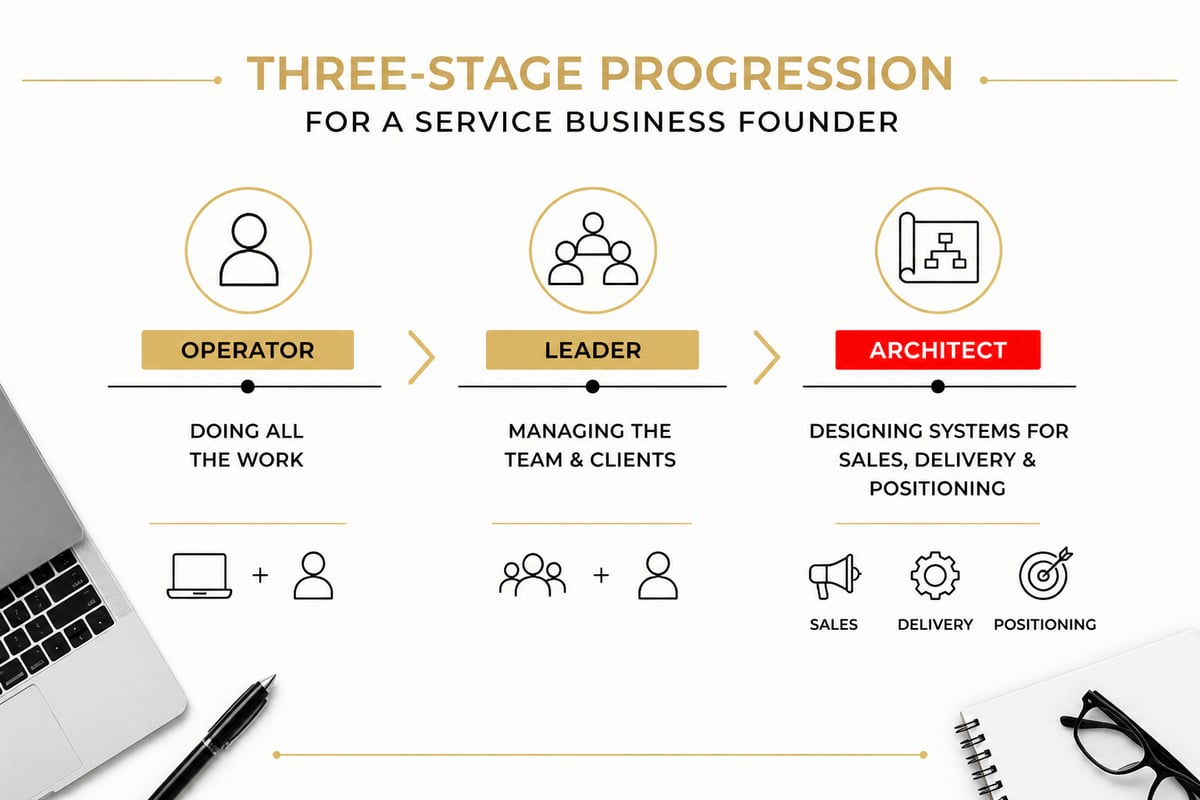
For founders, coaching for career development is less about climbing a ladder and more about changing your own role as the business grows. Your career path is the shift from operator to leader to architect.
This is where most service-business owners stall. In a business between $250k and $5M, the founder is often the top salesperson, the lead delivery expert, and the final decision-maker. Revenue grows, and so does the drag. Every client question, every pricing exception, every hiring call lands on one desk.
A coach who understands this stage helps you see which hat to drop first. Typical founder-level questions include:
- Which parts of delivery can someone else own without lowering quality?
- Where does your positioning attract the wrong clients, and what would sharper authority change?
- Which sales conversations still need you, and which can follow a system?
- Where are you missing boundaries that cost you time, margin, or energy?
Those four questions map neatly to positioning, acquisition, delivery, and leadership, the pillars behind Rise Reign Rule's Profit Architecture framework. If you want to explore the founder side in more depth, the Rise Reign Rule post on coaching for business owners covers what to expect, and the guide to finding a business coach walks through vetting your options.
Skills Worth Developing With a Coach
The skills that move careers are mostly human ones, and they are the skills coaching is best at building.
The same Pew survey found that workers most often rated interpersonal skills and written and spoken communication as very or extremely important, each rated highly by most workers, followed by critical thinking . Notice what is not at the top of that list: software certifications and technical credentials. They matter, but they are rarely what holds a capable person back.
Here is how those skills show up in a coaching plan:
| Skill | What it looks like in practice | A coaching exercise |
|---|---|---|
| Interpersonal skills | Managing a team, repairing a strained client relationship | Role-play a difficult feedback conversation |
| Communication | Presenting a proposal, writing a clear offer | Rewrite your pitch in three sentences |
| Critical thinking | Choosing between two growth paths with incomplete data | Map assumptions and test the riskiest one |
| Decision-making | Deciding what to stop doing | Rank commitments by revenue and energy cost |
| Boundary-setting | Saying no to scope creep and after-hours requests | Draft your policy and practice stating it aloud |
Pick one or two to work on at a time. Trying to improve everything at once is the fastest route to improving nothing.
How to Choose a Career Coach Worth Hiring
Choose a coach who has solved the problem you are facing, has a clear method, and will let you test the fit before you commit.
Use this checklist:
- Relevant experience. Ask what results they have produced for people in your situation, not just how many years they have coached.
- A defined process. You should be able to describe how they work after one conversation.
- Credentials where they matter. Certification from a recognized coaching body signals training, though lived experience in your field often matters more.
- Chemistry. You need to feel challenged and safe at the same time.
- Clear terms. Length, cadence, price, cancellation, and confidentiality should be in writing.
- Measurable goals. A coach who will not agree to define success is a coach who cannot be held to it.
Book an introductory session, and come ready with a real problem. Pay attention to the questions the coach asks. Sharp questions about your numbers, your calendar, and your avoidance patterns are a better sign than polished promises.
If you are comparing formats, Rise Reign Rule also covers executive coaching online and leadership coaching, which can help you decide what level of support fits.
How to Get the Most Out of Every Session
You get the most out of coaching by treating each session as a working meeting, not a pep talk.
- Arrive with an agenda. One decision you need to make, one obstacle, one win to examine.
- Share real numbers. Revenue, hours, pipeline, headcount. Coaching built on vague impressions produces vague advice.
- Do the work between sessions. If you complete fewer than half your actions, change the actions, not the coach.
- Say the uncomfortable thing. The topic you want to skip is usually the one that matters.
- Track progress in writing. A simple log of goals, actions, and results shows you what is working.
Remember that many workers are already investing in themselves this way. The Pew survey found that a majority of workers had taken a class or received extra training in the prior 12 months. Coaching adds something a class rarely does: someone who knows your situation and expects a report on what you did.
Signs Your Coaching Is Working
Coaching is working when your decisions get faster, your calendar gets lighter, and your results become more predictable.
Look for these markers within the first few months:
- You can state your priorities in a sentence and say no to what does not fit.
- You have handed off at least one responsibility that used to depend on you.
- Hard conversations happen sooner and with less dread.
- Your numbers, such as close rate, margin, or delivery time, are moving in the direction you set.
- You are initiating changes instead of reacting to fires.
If none of these have shifted after a fair trial, have an honest conversation with your coach. Either the goals need sharpening, the format needs adjusting, or the match is wrong.
FAQ
Is coaching for career development worth it for someone already successful?
Yes, and often more so. High performers usually have the most to gain because their remaining constraints are subtle: habits, blind spots, and decisions no one around them is positioned to challenge. A coach gives you an outside view without office politics.
How long does career coaching usually last?
Most engagements run several months, long enough to set goals, act on them, and review results. Shorter, single-topic work, like preparing for a promotion or a negotiation, can wrap up in a few sessions. Agree on a review point at the start so you can decide whether to continue.
What is the difference between career coaching and mentoring?
A mentor shares advice drawn from their own experience, usually informally. A coach uses structured questions and accountability to help you reach your own conclusions and follow through. Many people benefit from both.
Your next step is simple: write down the one career decision you have been postponing, and note what it is costing you each month in time, income, or energy. Bring that to a conversation with someone who can pressure-test it. If you run a women-owned high-ticket service business and the bottleneck is you, Rise Reign Rule installs Profit Architecture across positioning, acquisition, delivery, and leadership so your growth no longer depends on you doing everything. Start there, and build a business that scales cleanly.


