
Consulting and Coaching Services: Scale Beyond Bottlenecks
The decision to invest in consulting and coaching services represents a critical inflection point for women-owned high-ticket service businesses. When you've crossed the quarter-million-dollar threshold but find yourself trapped in operational chaos, when growth means more hours instead of more profit, you're experiencing what successful founders call "the ceiling." This ceiling isn't about market opportunity or your expertise. It's about the invisible architecture holding your business together. The businesses that scale cleanly from $250k to multi-million-dollar revenues understand one fundamental truth: you can't optimize what you haven't first structured. Strategic consulting and coaching services don't just offer advice; they install the systems that transform founder-dependent operations into predictable profit engines.
Why Traditional Business Advice Fails High-Ticket Service Businesses
Most generic business consulting treats a $400k service business the same as a product startup or retail operation. This fundamental misalignment wastes time and capital.
High-ticket service businesses operate with completely different economics. Your cost of goods sold lives primarily in expertise and time. Your sales cycles require trust-building, not impulse purchases. Your delivery depends on maintaining exceptional client outcomes while protecting founder capacity.
The challenges you face are specific:
- Client acquisition systems that work at $250k collapse at $750k
- Delivery models built for 10 clients break with 30
- Pricing structures designed for survival prevent scaling
- Founder involvement in every client conversation creates bottlenecks
- Team hiring happens reactively instead of strategically
Standard consulting frameworks imported from corporate environments or venture-backed startups simply don't address these realities. When consultants suggest "just hire a team" without addressing your delivery model, or coaches focus on mindset without fixing broken systems, you end up with expensive advice you can't implement.
The Operational Drag That Nobody Talks About
Operational drag represents the hidden tax every service business pays as it grows. It shows up as constant context-switching, duplicate client questions, proposal creation taking hours, onboarding processes that differ by client, and revenue that doesn't translate to profit.

This drag compounds invisibly. A founder spending 15 hours weekly on tasks that should be systematized loses 780 hours annually. That's nearly 20 full work weeks of high-value time converted into administrative burden. Consulting and coaching services that focus exclusively on revenue growth while ignoring operational infrastructure simply pour fuel on a structural fire.
| Drag Type | Annual Cost | Scaling Impact |
|---|---|---|
| Manual client onboarding | 120-180 hours | Limits client capacity to founder availability |
| Inconsistent delivery | 15-25% margin loss | Quality varies, referrals decrease |
| Reactive scheduling | 200+ hours | No time for strategic work |
| Proposal customization | 80-120 hours | Long sales cycles, low conversion |
The Four Pillars Framework for Service Business Transformation
Effective consulting and coaching services for high-ticket businesses must address four integrated areas simultaneously. Optimizing one pillar while neglecting others creates new bottlenecks.
Positioning: Building Market Authority That Commands Premium Pricing
Your market position determines every downstream conversation. When prospects view you as one option among many, you compete on price. When they view you as the singular solution to their specific problem, pricing strategy becomes a demonstration of value rather than a negotiation.
Authority positioning requires:
- Defining a specific transformation for a specific market segment
- Demonstrating proof through documented client outcomes
- Creating intellectual property that establishes methodology
- Building visibility where your ideal clients already gather
- Articulating value in business terms, not deliverables
Women-owned service businesses often underposition themselves, leading to scope creep, price objections, and clients who don't respect boundaries. Strategic repositioning isn't about fake authority. It's about claiming the expertise you've already earned and packaging it for maximum impact.
The businesses successfully implementing this approach see 30-60% price increases without losing conversion rates. They attract clients who pre-sell themselves and enter conversations ready to invest.
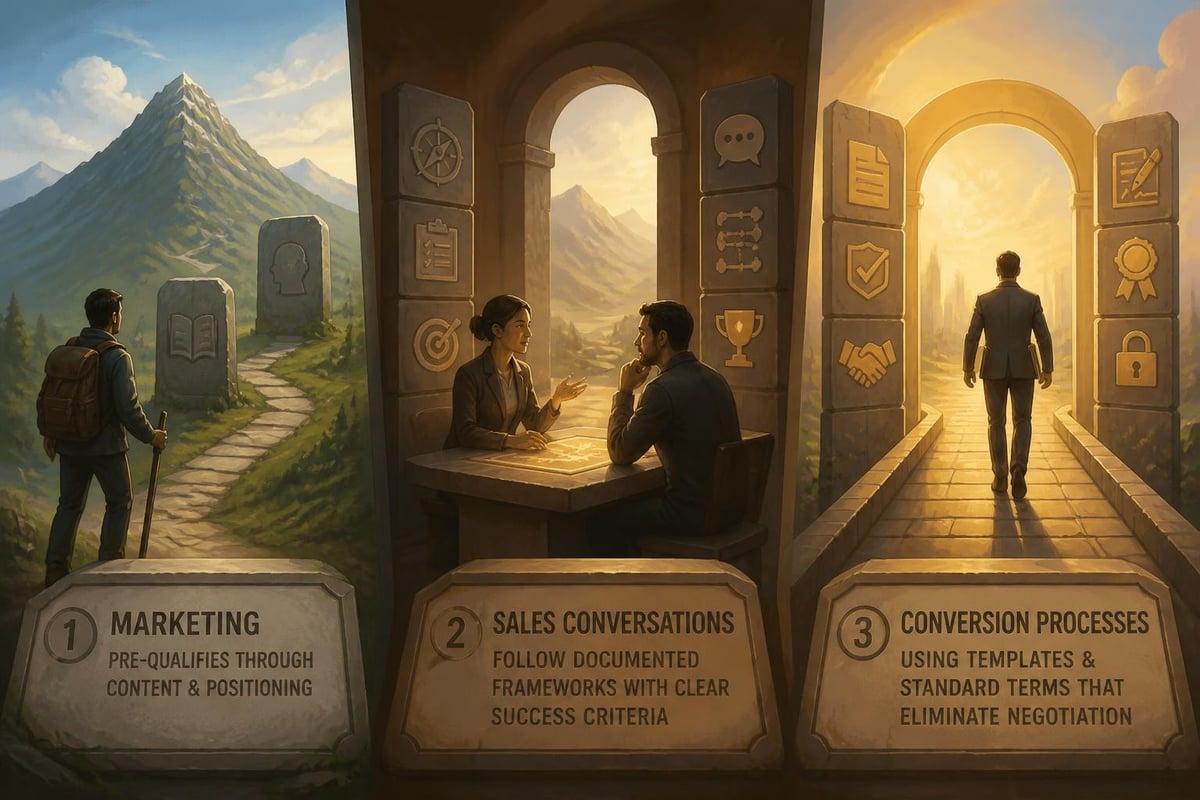
Acquisition: Sales Systems That Work Without You
Founder-led sales creates an immediate ceiling. When every discovery call, proposal, and contract negotiation requires your direct involvement, you've built a business that can't scale beyond your calendar capacity.
Systematized acquisition means:
- Qualification frameworks that filter ideal clients before sales conversations
- Sales scripts and processes that team members can execute consistently
- Proposal templates aligned to specific client segments and outcomes
- Pricing models that eliminate negotiation and scope confusion
- Conversion tracking that reveals exactly where prospects drop off
Many consultants recommend hiring salespeople without first building the system those salespeople need to succeed. The result? Expensive hires who can't close deals because they lack founder expertise, leading to the false conclusion that "nobody can sell like I can." Understanding consulting pricing models allows you to structure offers that sell themselves through clarity rather than charisma.
Delivery: Client Outcomes Through Repeatable Excellence
The fastest way to kill scaling momentum? Treating every client like a custom project. When delivery depends on founder genius applied uniquely to each situation, you've created an unscalable service model regardless of how much you charge.
Systematized delivery includes:
- Client onboarding sequences that establish expectations and gather information
- Delivery frameworks that ensure consistency while allowing customization
- Communication protocols that prevent endless Slack messages and emails
- Milestone structures that create clear progress indicators
- Offboarding processes that capture testimonials and generate referrals
This doesn't mean cookie-cutter service. It means building a proprietary methodology that produces consistent transformation while adapting to individual client contexts. The businesses that master this balance deliver better outcomes while reducing delivery time by 40-50%.
Quality consulting and coaching services help you identify which elements must remain bespoke and which should be standardized. This distinction represents the difference between expertise-based delivery and founder-dependent delivery.
Leadership: Boundaries That Protect Profit and Capacity
The least discussed pillar in most consulting and coaching services is leadership structure. Yet boundary failures destroy more scaling attempts than any other single factor.
Leaders of high-ticket service businesses must establish:
- Client boundaries around communication, scope, and expectations
- Team boundaries defining roles, decision rights, and escalation paths
- Time boundaries protecting strategic work from operational interruption
- Financial boundaries ensuring profit margins survive operational complexity
- Personal boundaries maintaining founder wellbeing during growth
Without clear boundaries, revenue growth paradoxically decreases quality of life. You make more money while working more hours, managing more complexity, and experiencing less freedom. Research on measuring ROI of leadership development demonstrates that boundary setting and decision frameworks generate measurable business outcomes, not just personal satisfaction.
Selecting Consulting and Coaching Services That Actually Drive Results
The professional services market floods business owners with options, making selection difficult. Most firms promise transformation but deliver generic frameworks that don't account for your specific business model.
Red Flags in Service Provider Selection
Avoid consultants and coaches who:
- Lead with tactics before understanding your business architecture
- Promise revenue growth without addressing operational capacity
- Offer identical programs regardless of your current revenue stage
- Focus exclusively on mindset without installing systems
- Can't demonstrate specific client outcomes in your business model
- Charge for ongoing support without clear milestone-based progress
The consulting industry includes practitioners operating under various professional standards and ethics, but credentials alone don't guarantee relevant expertise. Look for demonstrated experience scaling businesses similar to yours in structure, not just industry.
Investment Structures That Align Incentives
How consulting and coaching services price their offerings reveals their confidence in outcomes. Consider these models:
| Pricing Model | Best For | Risk Profile | Typical Investment |
|---|---|---|---|
| Hourly billing | Tactical implementation support | Low risk, low commitment | $200-$500/hour |
| Project-based | Specific deliverables (website, system build) | Medium risk, defined scope | $10k-$50k |
| Monthly retainer | Ongoing strategic guidance | Medium risk, relationship-based | $3k-$15k/month |
| Outcome-based | Transformation with clear metrics | Highest commitment both sides | $25k-$100k+ |
The most effective engagements for business transformation typically combine retainer-based strategic consulting with project-based implementation, creating both continuity and concrete deliverables. Pure hourly arrangements rarely produce transformative results because they incentivize time spent rather than outcomes achieved.
Implementation: What Actually Changes After Engagement
The gap between consulting recommendations and implemented systems destroys most professional services investments. You receive a beautiful strategy deck or detailed recommendations, then face the overwhelming question: "Now what?"
Effective consulting and coaching services include:
- Diagnostic phase documenting current state across all four pillars
- Architecture design creating the specific systems your business needs
- Implementation support building templates, SOPs, and tools
- Team enablement training your people to execute new systems
- Measurement frameworks tracking the metrics that matter for your business
This progression moves from analysis to installed infrastructure. The deliverable isn't a report. It's a functioning system your team operates independently.
The 90-Day Transformation Window
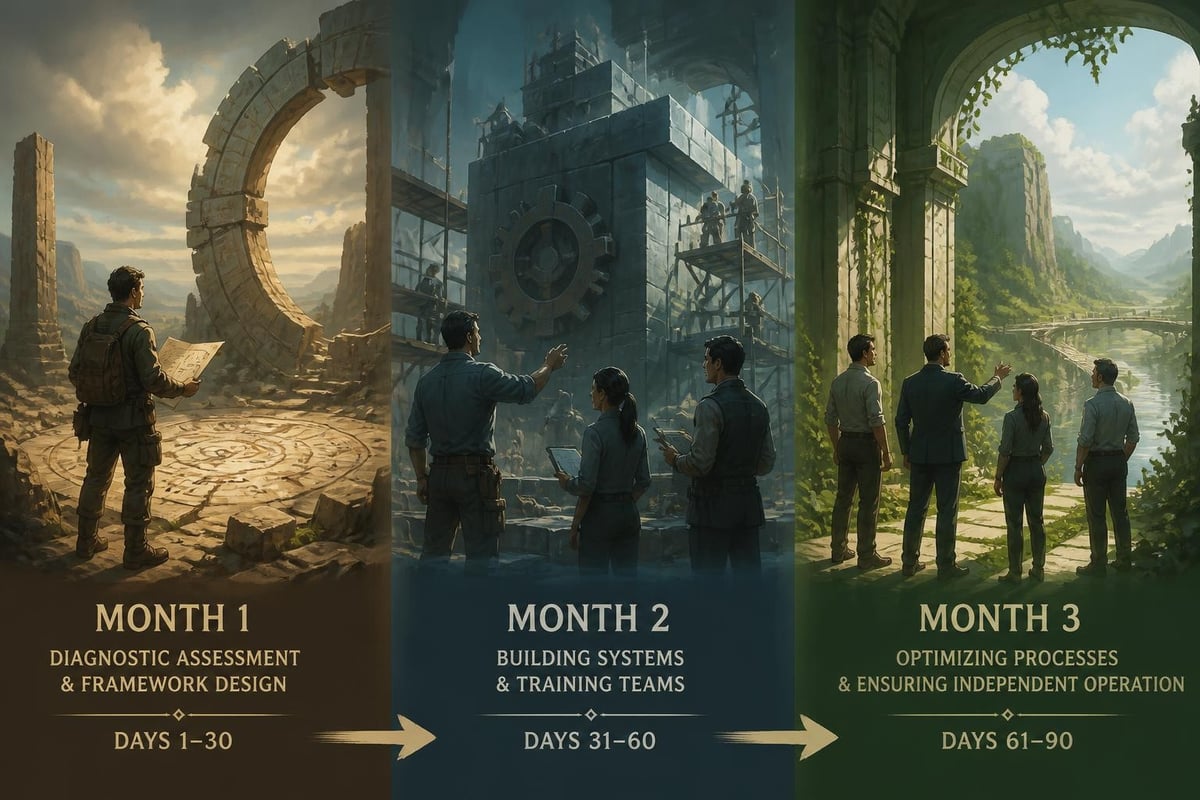
Sustainable business transformation happens in focused implementation windows, not extended engagements that drift into dependency. The most effective consulting and coaching services operate on 90-day intensive cycles:
- Days 1-30: Audit, analysis, and architecture design
- Days 31-60: System building and team training
- Days 61-90: Refinement, optimization, and handoff
This structure creates urgency, forces decision-making, and produces concrete results quickly. Extended engagements often indicate consultant dependency rather than business transformation.
Measuring ROI Beyond Revenue Metrics
Most businesses evaluate consulting and coaching services purely on revenue impact. This narrow lens misses critical transformation indicators that predict sustainable scaling.
Comprehensive success metrics include:
- Time recapture: Founder hours freed from operational tasks (target: 15-20 hours/week)
- Margin improvement: Profit percentage after accounting for delivery costs (target: 35-50%)
- Team leverage: Revenue per team member (target: $200k+ for service businesses)
- Sales efficiency: Conversion rate and average sales cycle length improvements
- Client satisfaction: NPS scores and referral generation rates
- Capacity utilization: Percentage of available capacity actually sold
A $500k business that increases profit margin from 15% to 40% while reducing founder hours by 50% has achieved more valuable transformation than a business that reaches $750k revenue at 10% margin while increasing founder hours.
Revenue growth without operational evolution creates a larger, more complex problem. Strategic consulting focuses on clean scaling where revenue, profit, and founder capacity all improve simultaneously.
Common Transformation Obstacles and Solutions
Even with excellent consulting and coaching services, implementation faces predictable obstacles. Anticipating these challenges accelerates progress.
Obstacle 1: Team Resistance to New Systems
Your existing team built workflows around current chaos. New systems feel like criticism of their previous work, creating defensive resistance.
Solution approach:
- Frame changes as business evolution, not personal failure
- Involve team members in system design where appropriate
- Demonstrate how new systems make their jobs easier
- Celebrate early wins publicly
Obstacle 2: Client Pushback on Boundary Changes
Long-term clients expect unlimited access and custom treatment. Implementing boundaries feels like service degradation to them.
Solution approach:
- Grandfather existing clients with transition timelines
- Frame boundaries as service improvements (faster response, better outcomes)
- Offer premium tier for clients wanting custom access
- Document that boundaries improve outcomes for everyone
Obstacle 3: Founder Guilt About Charging More
Women business owners disproportionately struggle with pricing increases, even when delivering extraordinary value. This psychological barrier prevents necessary repositioning.
Solution approach:
- Calculate the actual cost of delivery including all founder time
- Document specific client transformations in dollar terms
- Recognize that underpricing trains clients to undervalue expertise
- Connect higher pricing to better client selection and outcomes
Understanding that career and leadership coaching addresses both strategic systems and founder psychology demonstrates why purely tactical consulting often fails.
Integration: Making Consulting Recommendations Stick
The highest ROI consulting and coaching services don't just design systems; they ensure permanent integration into your business operations. This requires addressing both the technical and cultural dimensions of change.
Technical integration checklist:
- Document all new processes in accessible, searchable formats
- Build templates and tools that make execution easier than workarounds
- Integrate new systems with existing technology stack
- Create measurement dashboards providing real-time visibility
- Establish regular review cadences for continuous improvement
Cultural integration requirements:
- Align team compensation and recognition with new systems
- Make founders visibly commit to boundary adherence
- Celebrate teams and individuals who exemplify new approaches
- Address violations consistently, especially from high-performers
- Communicate the "why" behind changes, not just the "what"
Businesses that successfully integrate consulting recommendations typically designate an internal champion responsible for maintaining system integrity. This person guards against drift back to old patterns and escalates when key stakeholders circumvent new processes.
Beyond the Engagement: Building Self-Sufficiency
The ultimate success measure for consulting and coaching services is client independence. You should emerge from the engagement able to operate, optimize, and scale your business without ongoing consultant dependency.
Indicators of successful knowledge transfer:
- Your team can onboard new clients using established systems
- You can train new team members on delivery frameworks independently
- Sales conversations follow documented processes, not founder intuition
- Monthly business reviews happen using your own dashboard and metrics
- You identify and solve new bottlenecks using the frameworks you've learned
Many consulting relationships create subtle dependency where clients feel uncertain making decisions without consultant input. This dynamic serves consultant revenue but undermines client success. Businesses exploring personal development company partnerships should prioritize those building capability rather than dependency.
The most valuable consulting and coaching services teach you to think like a systems architect for your own business. The specific systems installed during engagement matter less than the capability to design new systems as your business evolves.
The Compound Effect of Integrated Transformation
When consulting and coaching services address all four pillars simultaneously rather than optimizing individual areas, transformation compounds across the business. Better positioning attracts higher-quality prospects. Systematic sales convert those prospects efficiently. Structured delivery produces exceptional outcomes while reducing delivery time. Strong boundaries protect the margin and capacity created by other improvements.
This integration produces results that feel disproportionate to the effort invested. A six-month transformation engagement can generate impact that persists for years because you've changed the underlying business architecture, not just implemented tactical fixes.
The businesses achieving this compound effect share common characteristics. They enter consulting relationships with genuine commitment to change, not just interest in new ideas. They allocate team time to implementation, not just founder attention to strategy sessions. They make difficult decisions about clients, team members, and offerings that no longer fit their evolution.
Strategic consulting becomes the catalyst for transformation you were already capable of achieving but needed structure, accountability, and expertise to execute. The investment in consulting and coaching services returns multiples not because consultants possess magic solutions, but because they install the systems that unlock the potential already present in your business and expertise.
The path from operational chaos to predictable profit doesn't require working more hours or accepting lower margins as the cost of growth. It requires installing the right architecture across positioning, acquisition, delivery, and leadership that allows your expertise to scale beyond founder capacity. Rise Reign Rule helps women-owned high-ticket service businesses implement exactly this transformation through the Profit Architecture framework, turning founder bottlenecks into systematized operations that drive clean scaling and sustainable profit.


