
Corporate Coaching: Scale Your High-Ticket Service Business
You've built a successful high-ticket service business, crossed the quarter-million revenue threshold, and now face a paradox: your expertise is simultaneously your greatest asset and your biggest constraint. Every client engagement requires your direct involvement. Your calendar is booked solid, yet profit margins remain stubbornly thin. The bottleneck isn't market demand or product-market fit. The bottleneck is you. This is precisely where corporate coaching becomes not just valuable but essential for scaling beyond founder-dependency into predictable, clean growth.
Why Traditional Business Advice Fails Women-Owned Service Businesses
Most business growth frameworks were designed for product companies or venture-backed startups, not for the unique dynamics of women-owned high-ticket service firms generating $250k to $5M annually. The conventional wisdom tells you to "hire more people" or "raise your prices," but these surface-level tactics ignore the structural issues beneath.
Corporate coaching addresses three systemic challenges traditional consulting misses:
- Operational drag created when systems are built around founder availability rather than client outcomes
- Authority dilution that happens when you try to scale delivery before solidifying market positioning
- Revenue ceiling imposed by trading hours for dollars without strategic leverage points
The difference between coaching and consulting matters here. While consultants diagnose problems and prescribe solutions, corporate coaching builds your internal capacity to identify patterns, make strategic decisions, and install repeatable systems. According to research on leadership coaching behaviors, organizations that shift to a leader-as-coach model see measurable improvements in team autonomy, decision quality, and operational efficiency.
The Hidden Cost of Founder Bottlenecks
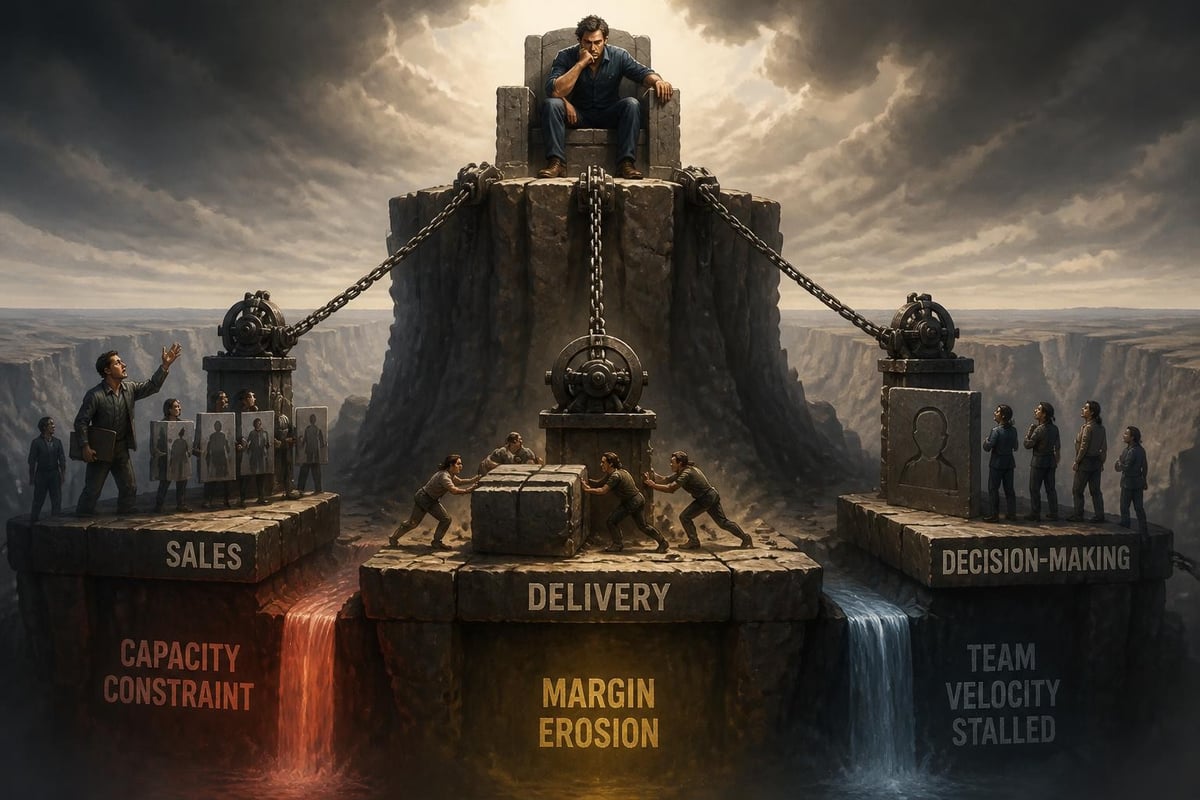
When every sales call, client delivery, and strategic decision flows through you, you're not running a business. You're operating an expensive freelance practice with overhead. The financial impact compounds quickly:
| Bottleneck Type | Revenue Impact | Time Cost | Scaling Limit |
|---|---|---|---|
| Sales-dependent | 40-60% capacity waste | 15-20 hrs/week | Your calendar |
| Delivery-dependent | 30-50% margin erosion | 25-35 hrs/week | Your expertise |
| Decision-dependent | 20-40% team slowdown | 10-15 hrs/week | Your availability |
Corporate coaching targets these bottlenecks systematically. Rather than adding more tactics to an already overloaded founder, it creates space for strategic thinking by installing frameworks that enable teams to operate independently.
The Profit Architecture Framework for Service Businesses
Most coaching engagements fail because they lack architectural thinking. They optimize individual components without addressing how those pieces interact. Rise Reign Rule's strategic approach treats your business as an integrated system where positioning, acquisition, delivery, and leadership must align for clean scaling.
Pillar One: Positioning Creates Market Authority
Before you can scale delivery or systematize sales, you need clarity on what you're known for and who you serve at the highest level. This isn't about narrowing your niche arbitrarily. It's about identifying where your methodology creates disproportionate value and building authority around that specific transformation.
Positioning work in corporate coaching includes:
- Extracting your proprietary methodology from tacit knowledge
- Documenting the transformation you create, not just services you deliver
- Identifying the exact market segment where your approach is 10x better than alternatives
- Building thought leadership assets that establish category authority
When positioning is unclear, every sales conversation becomes a negotiation. When positioning is sharp, qualified prospects arrive pre-sold on your methodology and ready to discuss implementation.
Pillar Two: Acquisition Systematizes Revenue
The goal isn't more leads. The goal is predictable revenue from qualified prospects who understand your value before the first call. Corporate coaching for acquisition focuses on installing repeatable systems that generate consistent pipeline without founder dependency.
This means moving from:
- Individual networking to strategic referral architecture
- Founder-led sales to methodology-based conversion systems
- Opportunity chasing to qualification frameworks that protect capacity
The SHRM framework for building coaching cultures emphasizes that sustainable change requires system-level thinking, not individual skill development. The same principle applies to sales systems in service businesses.
Pillar Three: Delivery Produces Client Outcomes
Scaling delivery without diluting outcomes is the make-or-break challenge for high-ticket service businesses. Corporate coaching here focuses on standardizing your client journey while maintaining the customization that justifies premium pricing.
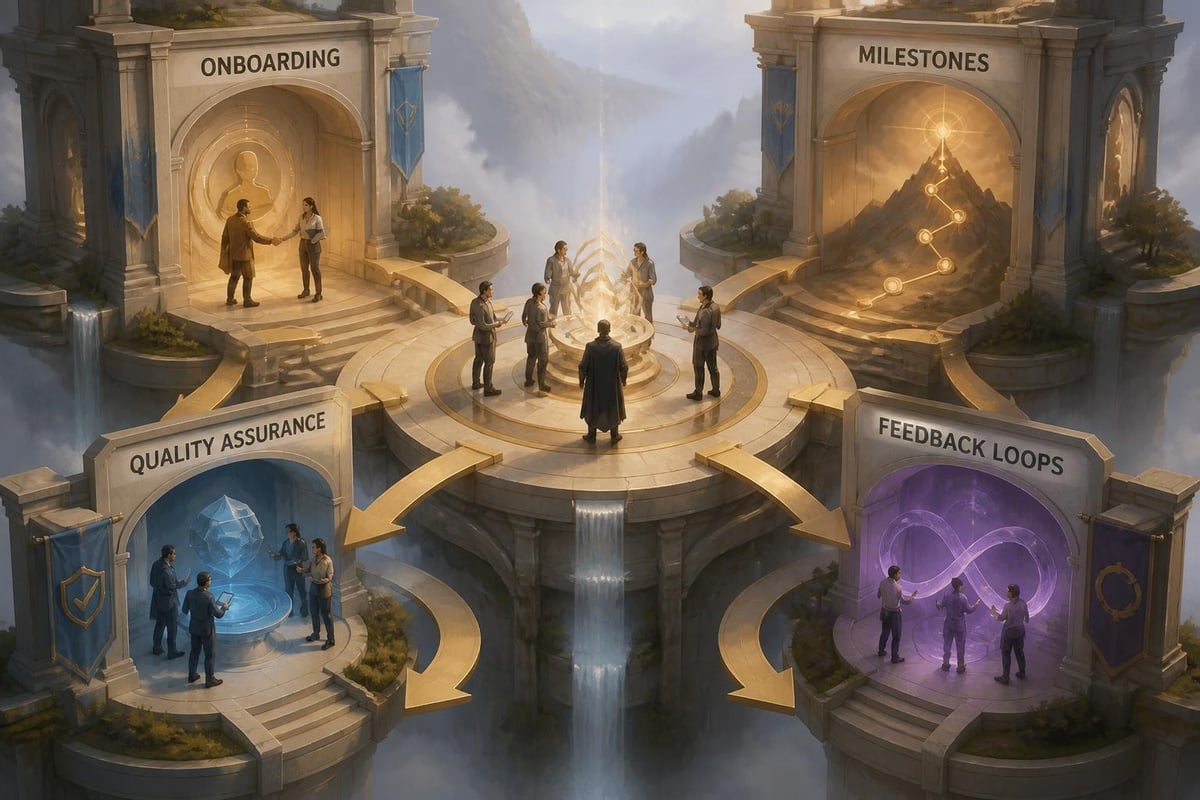
Key delivery components include:
- Onboarding frameworks that set clear expectations and gather necessary context efficiently
- Milestone architectures that create progress visibility for clients and accountability for teams
- Quality assurance processes that ensure consistency without founder review of every deliverable
- Feedback loops that capture client insights and feed continuous improvement
When delivery is founder-dependent, growth means working more hours. When delivery is systematized around outcomes, growth means installing proven frameworks with trained teams.
Leadership: The Pillar That Holds Everything Together
You cannot scale what you won't delegate. Yet delegation without boundaries creates chaos, quality issues, and eventual founder burnout. Corporate coaching for leadership focuses on installing decision frameworks, communication systems, and boundaries that enable autonomous teams.
Building Decision Architecture
Most founders become bottlenecks because their teams don't have clear decision rights. Every question flows upward because the framework for independent decision-making doesn't exist.
Effective decision architecture includes:
- Clear ownership matrices showing who owns which decision categories
- Risk thresholds defining when escalation is required vs. when teams proceed
- Documentation systems that capture decisions and rationale for institutional learning
- Regular review cycles that refine decision quality without micromanagement
According to the ICF Coaching Futures Report, organizations that invest in coaching see improved decision-making capabilities at all levels, reducing dependency on executive involvement in operational choices.
Installing Boundaries That Protect Capacity
High-achieving founders struggle with boundaries because their success came from saying yes, working harder, and being available. Scaling requires the opposite: strategic no's, leveraged systems, and protected thinking time.
| Boundary Type | Without Structure | With Structure |
|---|---|---|
| Client access | Unlimited, reactive | Defined channels, response SLAs |
| Team communication | Constant interruption | Scheduled sync points |
| Strategic time | Squeezed between meetings | Protected weekly blocks |
| Scope management | Creep and overdelivery | Clear deliverables, change process |
Corporate coaching helps you see boundaries not as restrictions but as the infrastructure that enables sustainable growth. Organizational psychology research confirms that clear role boundaries and expectations increase both performance and well-being.
Measuring ROI: What Good Corporate Coaching Delivers
If you can't measure it, you can't improve it. Corporate coaching should deliver quantifiable improvements in operational efficiency, revenue predictability, and founder capacity.
Leading Indicators of Coaching Success
Track these metrics to gauge whether your coaching engagement is creating real transformation:
- Founder capacity reclaimed: Hours per week freed from operational tasks
- Decision velocity: Average time from question to resolution without founder involvement
- Revenue predictability: Variance in monthly revenue compared to forecast
- Client delivery consistency: Time to first value, milestone completion rates, NPS scores
- Team autonomy: Percentage of decisions made without founder approval
The CIPD Good Work Index data shows that organizations with strong coaching cultures report 23% higher employee engagement and 18% better performance outcomes.
Financial Impact Timeline
Corporate coaching for scaling typically shows financial impact in three waves:
Months 1-3: Foundation and stabilization
- Reduced founder hours in delivery (10-15 hours/week)
- Documented processes and decision frameworks
- Initial team capability development
Months 4-8: System optimization
- Increased close rates from positioning clarity (15-25% improvement)
- Reduced delivery costs through systematization (20-30% margin improvement)
- Expanded team autonomy and velocity
Months 9-12: Scale activation
- Consistent pipeline from systematized acquisition
- Profitable growth without proportional founder time increase
- Foundation for next revenue tier ($5M+)

Choosing the Right Corporate Coaching Partnership
Not all coaching is created equal. The coaching industry is largely unregulated, and quality varies dramatically. For a women-owned high-ticket service business targeting clean scaling, you need more than motivational support or tactical advice.
What to Look for in Strategic Coaching
Framework-first approach: Does the coach bring a proprietary methodology designed for your specific business model, or do they offer generic advice customized on the fly?
System-level thinking: Will they help you install repeatable systems and frameworks, or just solve immediate problems without addressing root causes?
Industry-specific experience: Have they successfully guided businesses similar to yours through the exact transition you're attempting?
Measurement discipline: Do they establish clear metrics and hold you accountable to quantifiable progress?
The Deloitte leadership insights emphasize that effective coaching at scale requires integrated frameworks that address capability, culture, and systems simultaneously.
Red Flags That Signal Wrong-Fit Coaching
Be cautious of coaches who:
- Promise specific revenue outcomes without understanding your current systems
- Focus exclusively on mindset without addressing operational structure
- Lack experience with businesses at your revenue tier and growth stage
- Can't articulate a clear methodology or framework
- Emphasize volume (more content, more leads, more activity) over strategic leverage
Corporate coaching that drives real scaling results requires deep expertise in how high-ticket service businesses actually grow. You can see examples of this strategic approach in client transformation cases that demonstrate system-level change, not just tactical improvements.
The Future of Corporate Coaching in Service Businesses
The coaching landscape is evolving rapidly, with technology enabling new delivery models and increasing pressure for evidence-based approaches. Recent peer-reviewed research on AI coaching suggests that while AI tools can support certain coaching functions, the strategic thinking and customized framework installation required for service business scaling still demands human expertise.
Hybrid Coaching Models Emerging
Forward-thinking coaching practices are combining:
- Human strategic coaching for high-stakes decisions and framework design
- AI-assisted tools for tracking, accountability, and pattern recognition
- Peer cohorts for shared learning and cross-pollination
- Asynchronous resources for just-in-time learning and reference
This hybrid approach maximizes both the personalization of human coaching and the scalability of technology-enabled support.
Increased Emphasis on Operational Integration
The coaching industry is moving away from standalone engagements toward integrated partnerships that address strategy, operations, and leadership as interconnected systems. This shift aligns perfectly with what women-owned high-ticket service businesses need: not periodic advice sessions, but strategic partnership that installs architecture for sustainable scaling.
The businesses that will dominate their markets through 2030 won't be those with the best individual tactics. They'll be the ones with the strongest operational architecture, the clearest positioning authority, and the most leveraged delivery systems. Corporate coaching provides the framework and accountability to build that foundation while you're still running the current business.
Strategic scaling of a high-ticket service business requires more than hard work and good intentions; it demands architectural thinking that addresses positioning, acquisition, delivery, and leadership as an integrated system. If you're a woman founder generating $250k to $5M annually and facing founder bottlenecks that limit your growth, Rise Reign Rule specializes in installing the Profit Architecture framework that creates predictable profit and clean scaling. Your expertise built the business; strategic systems will scale it.


