
Effectiveness of Coaching: ROI for High-Ticket Services
The effectiveness of coaching has become a critical differentiator for high-ticket service businesses navigating the challenging terrain between startup chaos and sustainable scaling. For women-owned consultancies and agencies generating $250k to $5M annually, the right coaching intervention doesn't just provide motivation or accountability. It fundamentally restructures how founders approach operational systems, client delivery, and leadership boundaries. The question isn't whether coaching works, but rather which coaching methodologies deliver measurable returns on investment and create lasting organizational change.
Why Traditional Coaching Falls Short for Service Businesses
Most coaching programs fail to address the unique pressures facing women-owned high-ticket service businesses. Generic business coaching treats all revenue models the same, ignoring the specific operational drag that service delivery creates.
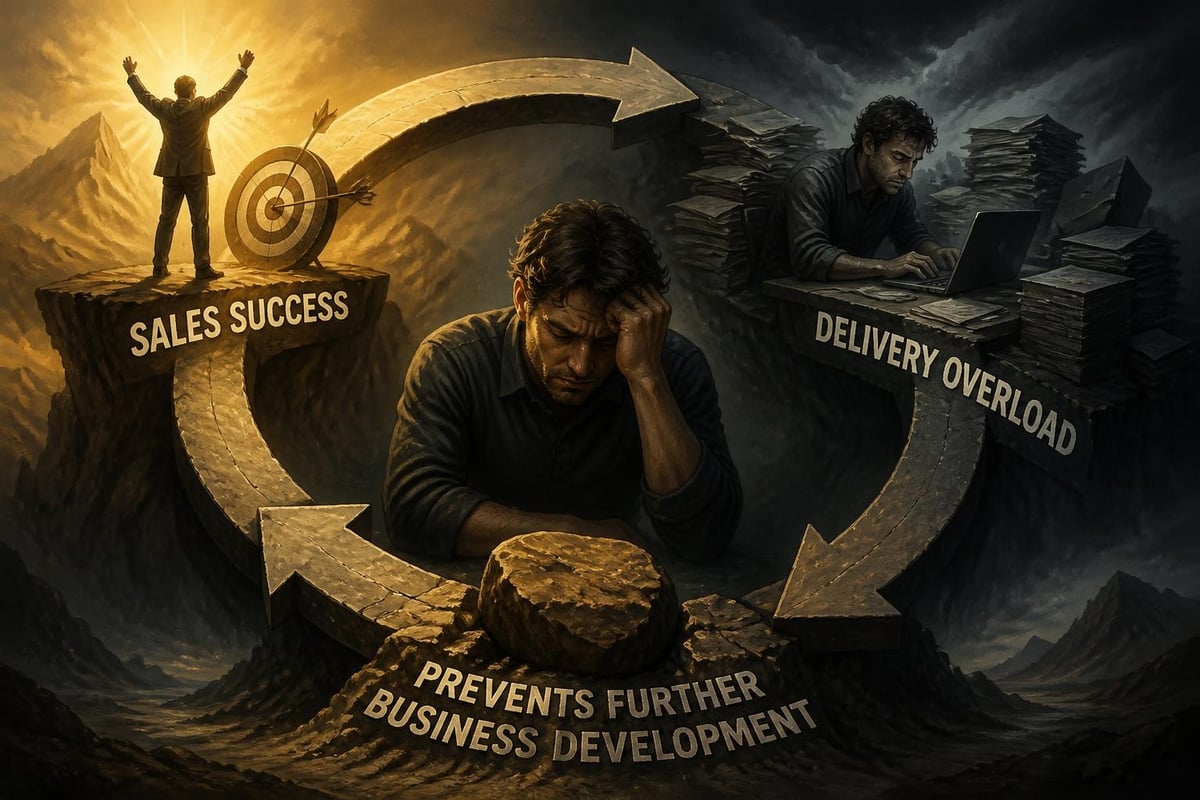
When you're selling $10k, $25k, or $50k+ engagements, every client relationship requires significant founder involvement. This creates an impossible equation: growth demands more sales, but more sales demand more founder time. Traditional coaching often exacerbates this problem by adding another time commitment without addressing the underlying structural issues.
The Data Behind Coaching Effectiveness
Research from Aston University demonstrates that workplace coaching generates positive effects on both organizational outcomes and individual performance metrics. However, the meta-analysis reveals something crucial: coaching effectiveness varies dramatically based on implementation quality and structural alignment.
For high-ticket service businesses, this means coaching must address systems, not just mindset. A founder with perfect clarity and unshakeable confidence still faces operational collapse if their business lacks proper:
- Client acquisition systems that don't require constant founder presence
- Delivery frameworks that maintain quality without founder micromanagement
- Leadership structures that establish boundaries around founder availability
- Positioning strategies that command premium pricing while attracting ideal clients
The effectiveness of coaching multiplies exponentially when it tackles these structural elements rather than treating symptoms like burnout, decision fatigue, or revenue plateaus.
Four Pillars That Determine Coaching Effectiveness
Strategic coaching for service businesses must address interconnected operational pillars. Each pillar supports the others, and weakness in any single area creates drag across the entire business.
Positioning: Building Market Authority That Commands Premium Pricing
Effective coaching starts with positioning because everything else flows from how the market perceives your expertise. Women-owned service businesses often undercharge because they haven't established differentiated market authority.
Coaching that improves positioning effectiveness addresses:
- Narrow niche definition that makes you the obvious choice for specific clients
- Thought leadership development that positions you as the category expert
- Pricing architecture that reflects true value rather than market averages
- Messaging frameworks that communicate transformation, not features
| Weak Positioning | Strong Positioning |
|---|---|
| "We help businesses grow" | "We install Profit Architecture for women-owned high-ticket agencies" |
| Competing on deliverables | Competing on unique methodology |
| Justifying price with features | Commanding premium through authority |
| Attracting tire-kickers | Attracting committed buyers |
When Rise Reign Rule works with clients on positioning, the effectiveness of coaching manifests in pricing conversations that close at 30-50% higher rates without increased objection handling.
Acquisition: Sales Systems Beyond Founder-Led Closing
The second pillar examines how your business generates and converts leads. For most high-ticket service businesses, the founder is the closer. This works until it doesn't.
Effective sales systems coaching builds repeatable processes that:
- Qualify leads before they reach your calendar through strategic application processes
- Nurture prospects with authority content that pre-sells your methodology
- Implement diagnostic frameworks that demonstrate expertise during sales conversations
- Create decision momentum through structured proposal and follow-up sequences
- Track conversion metrics that reveal exactly where deals stall or accelerate
The effectiveness of coaching in acquisition shows up in your calendar. If you're still spending 15+ hours weekly on discovery calls, consultations, and proposal presentations, your coaching hasn't addressed the system. You've simply become better at an inefficient process.

Delivery: Client Outcomes Without Founder Burnout
This pillar reveals where most service businesses hit their scaling ceiling. The effectiveness of coaching here determines whether you can grow beyond what you personally can deliver.
Strategic delivery systems include:
- Frameworks that team members can execute without constant founder oversight
- Quality control checkpoints that maintain standards while distributing work
- Client communication protocols that prevent scope creep and boundary violations
- Outcome measurement systems that prove value and support case study development
Many women founders resist delegating delivery because they believe clients pay for their personal involvement. Effective coaching reframes this belief: clients pay for outcomes, and your job is building the system that reliably produces those outcomes.
The services offered by strategic consultancies focus on installing these delivery frameworks rather than just advising on them. Implementation separates effective coaching from well-intentioned consultation.
Leadership: Boundaries That Protect Profitability
The fourth pillar addresses how founders show up in their businesses. Without clear leadership boundaries, even perfect systems collapse under founder interference.
Effective leadership coaching for service business founders addresses:
- Decision-making frameworks that prevent bottlenecks when the founder is unavailable
- Communication boundaries that stop Slack/email from consuming every evening and weekend
- Delegation protocols that actually transfer ownership rather than creating elaborate reporting requirements
- Energy management that protects the strategic thinking capacity that actually grows the business
Research on reducing impostor phenomenon through coaching shows that structured interventions can shift how leaders perceive their authority and capability. For women-owned businesses, this is particularly relevant as boundary-setting often triggers internal narratives about being difficult, demanding, or unavailable.
Measuring Coaching Effectiveness in High-Ticket Services
You can't improve what you don't measure. The effectiveness of coaching should show up in specific, trackable business metrics.
Revenue Metrics:
- Average deal size increasing without proportional increase in delivery time
- Revenue per founder hour improving quarter over quarter
- Percentage of revenue generated without direct founder involvement
Operational Metrics:
- Client acquisition cost trending downward as systems improve
- Time from lead to close decreasing as sales processes streamline
- Client delivery hours per project reducing as frameworks mature
Founder Metrics:
- Weekly hours spent in delivery versus strategy decreasing
- Calendar blocked for deep work increasing
- Decision-making bottlenecks identified and resolved
| Quarter | Founder Delivery Hours | Revenue | Revenue/Founder Hour |
|---|---|---|---|
| Q1 2026 | 480 hours | $187,500 | $391 |
| Q2 2026 | 360 hours | $243,750 | $677 |
| Q3 2026 | 280 hours | $281,250 | $1,004 |
| Q4 2026 | 220 hours | $312,500 | $1,420 |
This table illustrates what effective coaching implementation looks like: declining founder hours with accelerating revenue growth. If your coaching isn't driving these numbers in the right direction, it's not addressing the right problems.
The Integration Challenge: Why Coaching Often Fails
Understanding why the effectiveness of coaching varies so dramatically helps identify what to look for in a coaching relationship. Most failures fall into three categories:
Strategy Without Implementation
Many coaches excel at identifying problems and recommending solutions but provide no support for actual installation. You leave sessions with brilliant insights and no capacity to execute them while running your existing business.
This is why booking a strategic session that includes implementation support differs fundamentally from advisory-only coaching. Implementation determines effectiveness.
Motivation Without Structure
Mindset coaching has its place, but for service businesses facing operational drag, motivation alone doesn't solve structural problems. You can't manifest your way out of a broken delivery system or will yourself into effective sales processes.
The effectiveness of coaching requires both strategic clarity and operational frameworks. Confidence without systems creates energized chaos.
Generic Advice Without Context
Coaching that treats all businesses the same misses the specific dynamics of high-ticket service delivery. Advice that works brilliantly for product businesses, low-ticket offers, or venture-backed startups often backfires for women-owned service consultancies.
Effective coaching understands that in high-ticket service scaling, every operational decision involves trade-offs between customization and systematization, founder involvement and delegation, premium positioning and market size.

Technology and the Future of Coaching Effectiveness
The landscape of coaching continues to evolve with technological integration. Research on AI integration in professional coaching explores how generative AI tools are being adopted by coaches, with findings about both benefits and limitations.
For high-ticket service businesses, technology enhances coaching effectiveness through:
- Data analysis that reveals patterns in client acquisition and delivery metrics
- Framework documentation that makes proprietary systems transferable to team members
- Communication automation that maintains client relationships without consuming founder time
- Performance tracking that quantifies the impact of coaching interventions
However, studies like the comparison of AI-generated versus human coaching messages remind us that technology augments but doesn't replace human strategic guidance. The effectiveness of coaching still depends on understanding nuanced business contexts that AI cannot fully grasp.
What Elite Coaching Actually Looks Like
The most effective coaching relationships for high-ticket service businesses share common characteristics that separate transformative partnerships from expensive disappointments.
Diagnostic precision means your coach doesn't apply the same framework to every client. They identify whether your primary constraint is positioning, acquisition, delivery, or leadership before prescribing solutions.
Framework installation goes beyond advice to actually building the systems, templates, processes, and documentation your business needs. Coaching effectiveness multiplies when you leave sessions with implemented tools rather than homework assignments.
Accountability with flexibility recognizes that service business founders face unpredictable demands. Effective coaches create structure without rigidity, building accountability systems that adapt to reality rather than creating guilt when life happens.
Measurable outcomes tie coaching interventions to specific business metrics. Vague progress on "mindset" or "clarity" matters less than concrete improvements in revenue per founder hour, average deal size, or client acquisition cost.
The about page of strategic consultancies should clearly articulate these elements so you can evaluate fit before engagement.
Selecting Coaching That Drives Results
Your choice of coaching partner determines whether you invest in transformation or simply rent temporary motivation. For women-owned high-ticket service businesses, several factors predict coaching effectiveness:
Industry Specificity: Does the coach understand service business economics? Have they scaled service delivery beyond founder capacity? Do they grasp the specific dynamics of high-ticket sales cycles?
Methodology Documentation: Can the coach articulate a proprietary framework? Have they systematized their approach? Do they offer structured processes rather than intuitive responses?
Implementation Support: What happens between coaching sessions? Do you receive templates, systems, and frameworks? Is there team support for installation?
Client Evidence: What results have similar businesses achieved? Are case studies documented with specific metrics? Can you speak with founders who've completed the program?
Common Pitfalls That Undermine Coaching Effectiveness
Even with excellent coaching, certain founder behaviors sabotage results. Recognizing these patterns helps you extract maximum value from coaching investments.
The Insight Collector
Some founders accumulate frameworks, attend masterminds, hire multiple coaches, and implement nothing. They confuse learning with progress. The effectiveness of coaching requires committed execution of fewer strategies rather than superficial engagement with many.
The Perfectionist Procrastinator
Others delay implementation until conditions are perfect, the framework is complete, or the team is fully trained. This founder never launches the new positioning, never rolls out the sales system, never delegates the delivery framework. Coaching becomes expensive therapy rather than business transformation.
The System Saboteur
This founder implements systems then personally undermines them by making exceptions, intervening in processes, or reverting to old patterns when stressed. They build the boundary then cross it, install the framework then bypass it.
Breaking these patterns requires both self-awareness and external accountability-precisely what effective coaching provides.
The effectiveness of coaching in high-ticket service businesses comes down to whether it addresses the structural issues that create founder bottlenecks and operational drag, not just the surface-level symptoms of burnout and revenue plateaus. When you're ready to install the systems that enable predictable profit and clean scaling without sacrificing your life to your business, Rise Reign Rule offers the strategic consultancy and implementation support that transforms how women-owned service businesses operate. The frameworks exist; the question is whether you'll finally install them.


