
Executive Coach for CEO: Scale Your High-Ticket Service
When your high-ticket service business crosses the quarter-million mark, you discover an uncomfortable truth: the hustle that got you here becomes the ceiling preventing you from getting there. You're no longer just selling your expertise. You're architecting systems, leading teams, and navigating the messy middle between founder-led and truly scalable. This is precisely where an executive coach for CEO becomes less luxury and more strategic necessity, especially for women-owned businesses pushing toward the $1M to $5M revenue threshold.
The distinction matters because most coaching focuses on personal development or mindset shifts. What high-ticket service founders actually need is a strategic partner who understands how to eliminate operational drag while building the leadership frameworks that enable clean scaling. You need someone who speaks both the language of profit architecture and the reality of founder psychology.
Why Traditional Executive Coaching Fails High-Ticket Service CEOs
Most executive coaching models were designed for corporate environments with established infrastructure, predictable hierarchies, and separation between ownership and management. These frameworks collapse when applied to founder-led service businesses where you are simultaneously the visionary, chief strategist, lead salesperson, and often still delivering client work.
The gap becomes obvious in three critical areas:
- Context mismatch: Corporate coaches optimize decision-making within existing structures; you need to build the structures themselves
- Time horizons: Traditional coaching engagements span 6-12 months; your business may need to pivot quarterly based on market feedback
- Success metrics: Standard coaching tracks behavioral change; you need measurable improvements in revenue per client, delivery efficiency, and team leverage
Research from the Center for Creative Leadership confirms that effective CEO coaching requires industry-specific context and business-model fluency. Generic leadership development simply doesn't address the unique pressures of scaling a high-ticket service business where every client relationship represents significant revenue concentration and reputational risk.

The Founder Bottleneck No One Talks About
You became the bottleneck the moment clients started buying you, not just your service. This creates a paradox: your personal involvement is both your competitive advantage and your growth ceiling. An executive coach for CEO roles in this context must help you architect your way out of this trap without destroying the premium positioning that commands high-ticket pricing.
The issue compounds because most coaches either push you to "just hire" without addressing the underlying systems, or they focus on delegation skills without acknowledging that your expertise truly is difficult to replicate. Neither approach solves the structural problem.
The Four Pillars Framework: How Strategic Coaching Drives Profit Architecture
Women-owned high-ticket service businesses scaling from $250K to $5M need coaching anchored in operational reality. This is where the Profit Architecture framework becomes essential, organizing coaching interventions around four distinct but interconnected pillars.
| Pillar | CEO Challenge | Coaching Focus | Outcome Metric |
|---|---|---|---|
| Positioning | Market authority unclear or diluted | Sharpening category design and messaging | Premium pricing power, inbound inquiries |
| Acquisition | Sales tied to founder's personal energy | Installing repeatable sales systems | Conversion rate, sales cycle length |
| Delivery | Client outcomes inconsistent or labor-intensive | Standardizing methodology without commoditization | Client LTV, delivery hours per engagement |
| Leadership | Unclear boundaries creating team confusion | Decision frameworks and delegation protocols | Team autonomy, founder time reclaimed |
This structured approach aligns with findings from Harvard Business Review on executive coaching outcomes, which emphasizes that coaching must deliver measurable business results, not just personal insights. Your coach should be able to draw a direct line from leadership development to profit improvement.
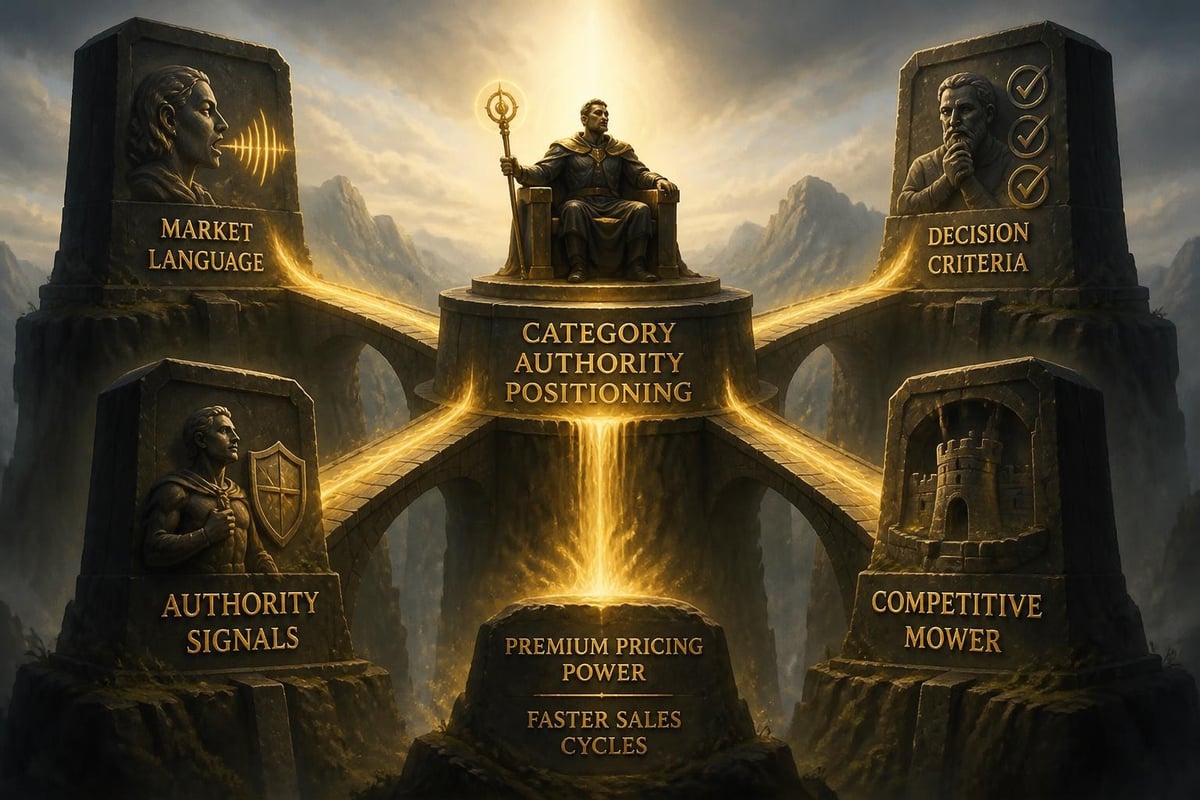
Positioning: From Expert to Category Authority
Most high-ticket service CEOs struggle to articulate what makes them different beyond credentials and case studies. An effective executive coach for CEO transformation works backward from the client's buying decision: what specific, urgent problem do you solve that justifies premium pricing?
This isn't about finding your "niche." You already have clients. It's about reverse-engineering why those clients chose you over alternatives, then building a positioning architecture that consistently attracts more of them. The coaching conversation shifts from "What do I do?" to "What market category am I defining and owning?"
Strategic positioning work typically surfaces:
- Language patterns your best clients use when describing their pre-purchase state
- Decision criteria that make price secondary to outcome certainty
- Authority signals that compress trust-building from months to weeks
- Competitive moats that aren't easily replicated by lower-priced alternatives
When executed properly, positioning improvements show up in sales conversations. You'll notice prospects arriving more pre-qualified, objections decreasing, and price resistance evaporating. This is the tangible business result that separates strategic coaching from therapeutic conversation.
Acquisition Systems: Building Sales Engines Beyond Your Personal Network
The transition from founder-led sales to systematic acquisition represents the single biggest scaling challenge for high-ticket service businesses. You can't hire a salesperson to "be you," and you can't clone your relationship-building approach. This is where an executive coach for CEO development must address both strategy and psychology simultaneously.
The psychological barrier often manifests as reluctance to document your sales approach because it feels mechanical or inauthentic. You've built trust through genuine relationships, and systematizing feels like it might compromise quality. This belief, while emotionally valid, creates a permanent growth ceiling at whatever volume you can personally handle.
The Sales System Architecture
Effective acquisition coaching helps you identify the coachable, transferable elements of your sales process while preserving the authentic relationship-building that justifies premium pricing. This typically involves:
- Qualifying frameworks that help team members identify ideal-fit prospects without your intuition
- Conversation maps that guide discovery without scripting, maintaining authenticity while ensuring consistency
- Objection libraries documenting how you've successfully addressed concerns across hundreds of conversations
- Close protocols that honor your values while maintaining healthy urgency and clear next steps
Recent research published in Frontiers in Psychology analyzing executive coaching effectiveness found that behavioral change interventions work best when they're anchored in specific, measurable business contexts rather than abstract leadership principles. Your sales system becomes that concrete context.
Delivery Excellence: Standardization Without Commoditization
Here's the paradox keeping you up at 2 AM: clients pay premium prices for customized, high-touch service, yet delivering true custom work every time makes scaling impossible. An executive coach for CEO operating at this level helps you see that standardization and customization aren't opposites but rather complementary forces in a well-architected service business.
The breakthrough comes when you recognize that clients aren't actually buying customization. They're buying certainty that you'll solve their specific problem. Your methodology can be consistent while the application remains tailored.
Consider three delivery models and their scaling characteristics:
| Model | Client Experience | Your Effort | Scaling Capacity |
|---|---|---|---|
| Pure Custom | Fully bespoke | High and variable | Limited to personal capacity |
| Guided Framework | Structured flexibility | Moderate and predictable | Scales with trained team |
| Platform + Coaching | Standardized with support | Low delivery, high strategy | Scales significantly |
Most high-ticket service founders resist moving from pure custom delivery because they've conflated their methodology with their value. Strategic coaching helps you separate these elements. Your value is in diagnosis, strategy, and decision-making. Your methodology is the repeatable framework that ensures consistent outcomes.
Building Your Repeatable Methodology
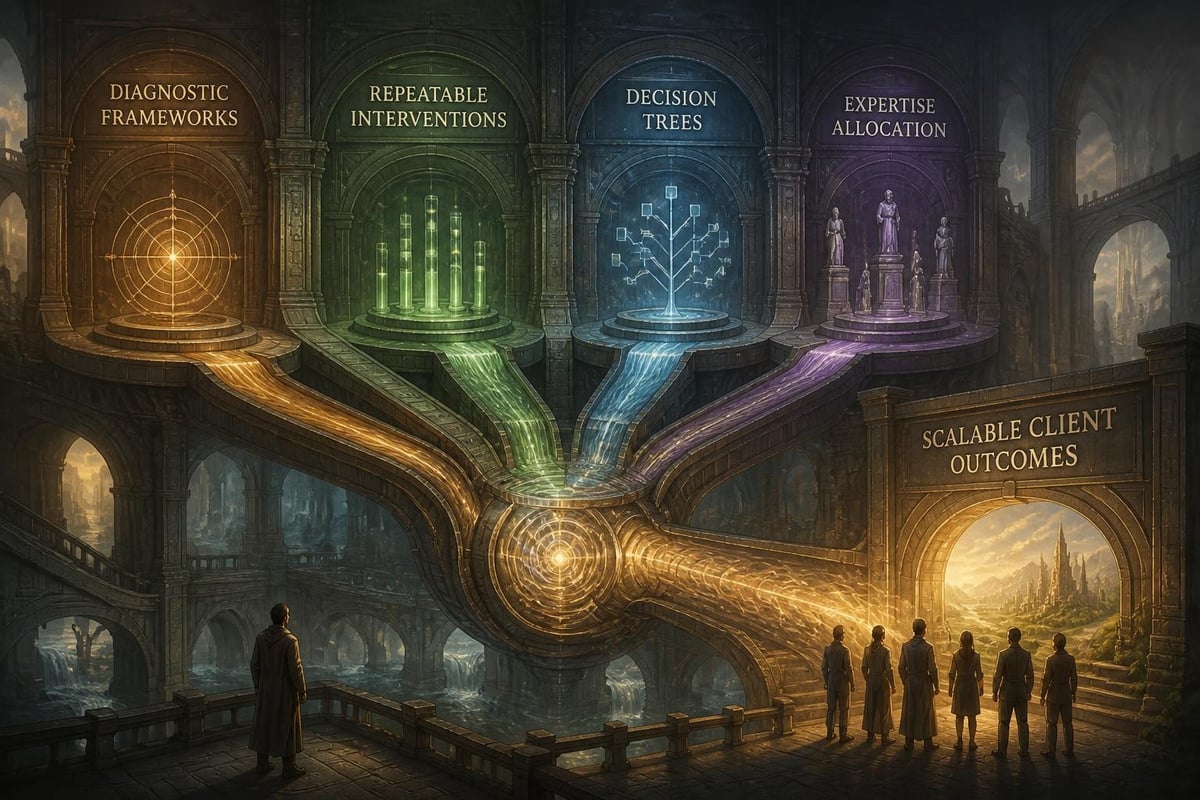
The coaching work here focuses on extraction and documentation. You've solved similar problems dozens of times. Those solutions contain patterns, decision trees, and sequence dependencies that can be mapped and transferred. Ongoing research from Case Western Reserve University on coaching effectiveness demonstrates that structure accelerates results without sacrificing the relationship-based trust essential to high-ticket services.
Your coach should push you to answer:
- What diagnostic questions do you ask in the first 30 days of every engagement?
- Which interventions consistently appear in successful client outcomes?
- What sequence matters, and where can clients choose their own path?
- Which decisions require your expertise versus team execution?
This extraction process typically reveals that 60-70% of your delivery can be systematized, freeing your time for the strategic 30-40% that truly requires CEO-level thinking. That shift alone can double your effective capacity without hiring.
Leadership Boundaries: The Permission You're Not Giving Yourself
Every founder operating as CEO faces a specific leadership crisis around the $500K revenue mark: you must transition from being the best doer to being the best decision-maker. This shift requires establishing boundaries that feel uncomfortable, even selfish, because they prioritize your strategic capacity over immediate client or team needs.
An executive coach for CEO transformation addresses this directly. The coaching relationship itself models the boundary-setting you need to practice with your team. You're paying for dedicated strategic time, protected from operational interruptions. That's exactly what you need to create internally.
The Three Boundary Categories That Enable Scaling
Time boundaries protect your capacity for strategic work. This means blocking substantial calendar time for thinking, planning, and high-leverage activities before filling space with meetings and client delivery. Most founders do this backward, fitting strategy into whatever time remains after everything else.
Decision boundaries clarify which choices require your input versus team autonomy. When everything flows through you for approval, you've created a bottleneck that chokes growth. Your coach should help you design decision frameworks that empower team members while protecting your strategic vision.
Energy boundaries acknowledge that not all revenue is created equal. Some clients, even profitable ones, drain energy that could be invested in higher-leverage activities. Data from Heidrick & Struggles on executive coaching ROI shows that CEOs who protect energy boundaries report better decision quality and faster business growth.
Implementing these boundaries typically surfaces guilt, particularly for women founders who've internalized being "always available" as part of excellent service. Strategic coaching helps you see that protecting your capacity is actually a client service issue. When you're overwhelmed and reactive, everyone gets a diminished version of your expertise.
Measuring What Matters: Beyond Feel-Good Metrics
One clear indicator separating strategic executive coach for CEO relationships from generic coaching is how rigorously you track business outcomes. If coaching conversations stay in the realm of insights, awareness, and personal growth without connecting to revenue, profit, or capacity metrics, you're investing in therapy, not strategic development.
According to a comprehensive meta-analysis on coaching science, effective coaching interventions demonstrate measurable change across multiple outcome categories. For high-ticket service CEOs, those categories should include operational, financial, and leadership metrics.
Your coaching engagement should track:
- Revenue per client: Are positioning improvements enabling higher pricing or expanded scope?
- Sales conversion rate: Are acquisition systems reducing friction and shortening cycles?
- Delivery efficiency: Are you reclaiming hours per client engagement through systematization?
- Team leverage: Are leadership boundaries enabling team members to operate more autonomously?
- Founder capacity: Are you protecting more hours for strategic work versus operational firefighting?
These aren't vanity metrics. They're direct indicators that coaching is translating to business architecture improvements. If your coach can't help you establish these measurement frameworks, they lack the business acumen required for CEO-level strategic work.
The ROI Calculation That Justifies Investment
High-ticket coaching fees range from $2,000 to $15,000+ monthly. That investment should return multiples through improved business performance. A simple framework: if coaching helps you increase average client value by 20%, reduce delivery time by 15%, and improve close rates by 10%, what's the annual revenue and profit impact?
For a business currently at $750K annual revenue with $250K profit, those modest improvements typically generate $150K-$300K in additional profit within 12 months. That's a 10-20X return on coaching investment, not including the compound effects of better systems and stronger positioning.
Selecting the Right Executive Coach for Your Service Business
Not all coaches are created equal, particularly when you need someone who understands both the strategic architecture of scaling service businesses and the founder psychology unique to women-owned companies. A recent literature review in Management Review Quarterly analyzing post-pandemic coaching trends emphasizes that industry context and business model expertise significantly impact coaching effectiveness.
Five Non-Negotiable Selection Criteria
Relevant business experience: Your coach should have direct experience scaling service businesses, preferably high-ticket offerings. Someone who's only worked in corporate environments or product businesses will miss critical context.
Frameworks over feelings: Look for structured approaches and proprietary methodologies, not just reflective listening and question-asking. You need someone who can diagnose operational issues and prescribe specific interventions.
Measurement orientation: Your coach should insist on tracking business metrics and tying coaching outcomes to tangible results. If they're uncomfortable discussing ROI, they're not operating at CEO level.
Boundary respect: Ironically, great coaches protect your time and energy, even from the coaching relationship itself. They should help you establish session frequency and engagement scope that serves your business, not maximize their billing.
Systems thinking: The best executive coach for CEO roles brings an architect's perspective, seeing how positioning, acquisition, delivery, and leadership interconnect rather than treating them as isolated improvement opportunities.
Many women founders I work with initially sought coaches who "understood their journey" emotionally but found greater value from coaches who understood their business architecturally. Empathy matters, but strategic clarity matters more when you're trying to scale past seven figures.
When to Engage an Executive Coach (And When to Wait)
Timing matters significantly in coaching effectiveness. Engaging too early means you're paying premium rates for guidance you could get from less expensive mentorship or group programs. Engaging too late means you've already built inefficient systems that now require expensive unwinding.
The optimal engagement window for an executive coach for CEO in high-ticket services typically opens when:
- You're consistently generating $20K+ monthly revenue but feeling maxed on personal capacity
- You've hired your first team members but struggle with delegation and quality consistency
- You're unclear which growth opportunities deserve your limited time and energy
- Your client results are strong but delivery feels increasingly unsustainable
- You're questioning your positioning as market competition intensifies
If you're still proving product-market fit or figuring out basic service delivery, invest in those fundamentals first. Coaching accelerates execution of known strategies; it doesn't replace the experimentation required to find your service-market fit initially.
Conversely, if you're already past $2M revenue with established systems, you may need specialized operators or fractional executives rather than coaching. At that scale, you're less focused on building initial frameworks and more on optimizing complex operations, which becomes a different engagement model.
The Integration Challenge: Making Coaching Stick
Here's what nobody tells you about executive coaching: the insights are easy; the implementation is brutal. You'll leave coaching sessions with crystal-clear priorities and renewed commitment, then get immediately buried in client emergencies, team questions, and operational fires. Within 48 hours, that clarity evaporates.
This integration challenge is why an effective executive coach for CEO development must include accountability structures and implementation support between sessions. The best coaching relationships I've observed incorporate:
- Weekly micro-commitments: Small, specific actions you'll complete before the next session, with clear success criteria
- Async communication: Brief check-ins via email or voice notes when you're stuck on implementation
- Template and tool libraries: Practical resources you can adapt immediately rather than building from scratch
- Team involvement: Selective inclusion of key team members in certain sessions to ensure organizational alignment
Strategic consultancies like those explored through case studies in high-ticket scaling demonstrate that frameworks only deliver results when they're embedded into daily operations, not just understood intellectually.
The 72-Hour Implementation Rule
Commit to implementing at least one coaching insight within 72 hours of each session. This might mean sending a positioning message to your email list, documenting one sales conversation element, creating a delivery checklist, or establishing a single boundary with your team.
The specific action matters less than the pattern of rapid implementation. This habit ensures coaching translates to business improvement rather than accumulating as unused insights. Your coach should push you on this metric: what percentage of session insights become implemented changes within one week?
The difference between executive coaching as professional development and as strategic investment comes down to how directly it addresses your specific bottlenecks. For women-owned high-ticket service businesses navigating the complex middle between founder-led hustle and truly scalable operations, you need frameworks that acknowledge both the operational realities and the leadership psychology of this transition. If you're ready to transform operational drag into clean scaling through the Profit Architecture approach, Rise Reign Rule specializes in exactly this challenge for service businesses generating $250K to $5M annually.


