
Executive Coaching and Leadership for Women-Led Firms
The growth ceiling at $250k to $5M revenue isn't about working harder. It's about leading differently. For women-owned high-ticket service businesses, the transition from hands-on operator to strategic CEO requires a fundamental shift in how you think, delegate, and show up. Executive coaching and leadership development isn't a luxury for companies at this stage; it's the strategic intervention that determines whether you scale cleanly or collapse under operational drag.
Why Executive Coaching and Leadership Matter for High-Ticket Service Businesses
Traditional leadership development focuses on Fortune 500 executives navigating corporate politics. But women founders running high-ticket service businesses face entirely different challenges: you're simultaneously the visionary, the closer, the delivery lead, and the culture keeper. This multiplicity creates unique bottlenecks that generic leadership training simply can't address.
The rigorous academic evidence on executive coaching outcomes demonstrates measurable improvements in leadership behaviors, strategic thinking, and personal characteristics that directly impact business performance. For service businesses where founder presence drives client acquisition and retention, these improvements translate immediately to revenue outcomes.
The Founder Bottleneck Crisis
Here's what executive coaching and leadership work solves at the growth stage:
- Decision paralysis: You've grown beyond gut instinct but haven't installed frameworks for rapid, consistent decision-making
- Talent ceiling: Your team performs at your capacity to lead them, not their own potential
- Boundary erosion: Client expectations, team needs, and market demands blur into constant availability
- Strategic drift: Daily operations consume the space needed for positioning and market authority
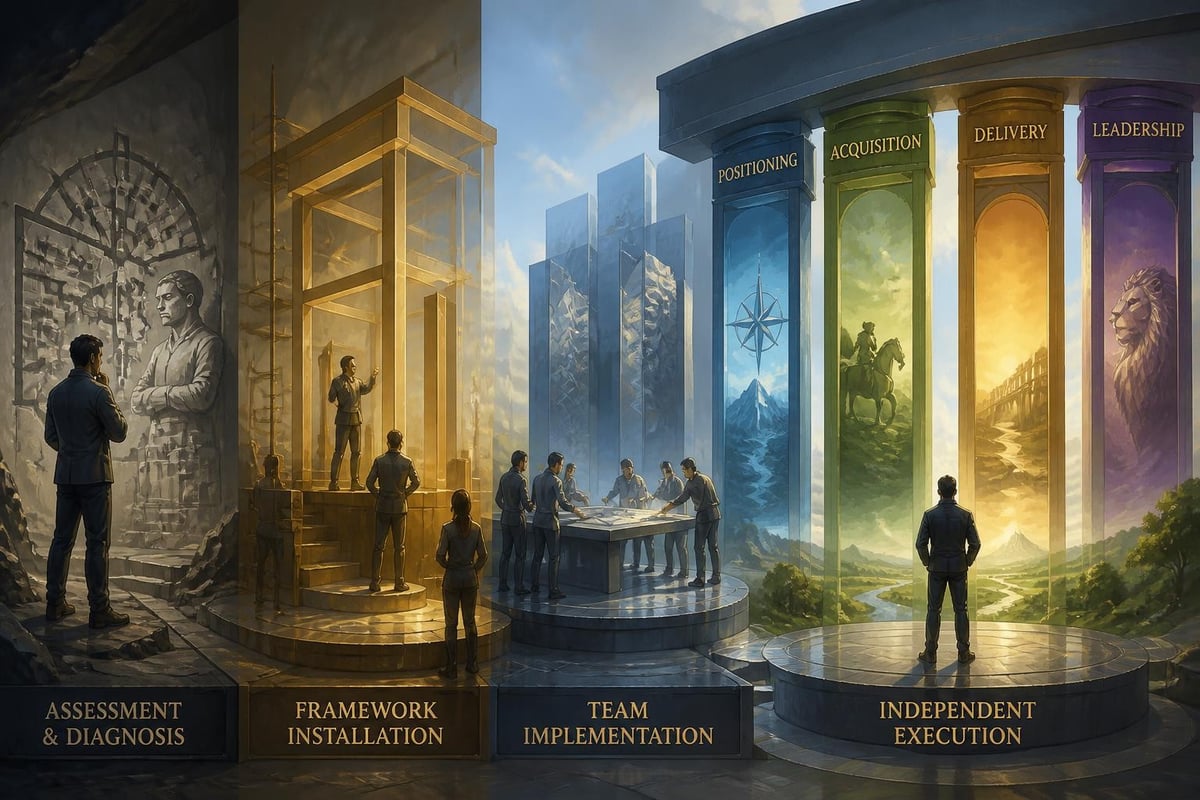
When Rise Reign Rule works with women-led businesses in this revenue range, the Leadership pillar of our Profit Architecture framework addresses these exact patterns. The framework isn't therapy and it isn't mentorship. It's strategic intervention focused on removing the human obstacles to clean scaling.

What Effective Executive Coaching Actually Looks Like
The executive coaching market has exploded with practitioners of wildly varying quality. Understanding what truly drives coaching effectiveness reveals that competence, business acumen, and structured frameworks matter far more than credentials alone.
For high-ticket service businesses, executive coaching and leadership development must address three specific domains:
Strategic Positioning as a Leader
Your market authority stems directly from how you position yourself. This isn't personal branding; it's strategic clarity about who you serve, what transformation you deliver, and why your voice matters in the conversation. Effective coaching helps you articulate this positioning in ways that attract ideal clients while repelling everyone else.
| Positioning Element | Operational Impact | Leadership Shift Required |
|---|---|---|
| Market Authority | Inbound lead quality increases | From "helpful expert" to "selective authority" |
| Thought Leadership | Sales cycle shortens | From "proving value" to "qualifying fit" |
| Pricing Confidence | Margin expansion | From "justifying fees" to "standing in value" |
The women founders in our client case studies consistently report that positioning work feels uncomfortable initially. That discomfort signals you're moving from operator mindset to CEO mindset, which is precisely the point.
Acquisition Systems That Scale Without You
Executive coaching and leadership work for service businesses must address how you sell. At $250k-$5M, you can't close every deal personally, but you also can't afford a traditional sales team. The leadership challenge is installing systems that maintain conversion rates while removing you from every sales conversation.
This requires:
- Documented decision frameworks that your team can execute without constant founder input
- Authority-based marketing that pre-qualifies prospects before sales conversations
- Boundary-based sales processes that protect your time while maximizing close rates
- Empowered client-facing team members who represent your standards without mimicking your personality
The Center for Creative Leadership's research on coaching effectiveness emphasizes that behavior change requires both individual development and system-level support. Your acquisition system is that structural support.
Delivery Excellence Through Leadership Boundaries
High-ticket service businesses live or die on client outcomes. But here's the paradox: founder over-involvement in delivery often diminishes results rather than enhancing them. Executive coaching and leadership development helps you recognize where your presence adds value versus where it creates dependency.
Building a Self-Managing Delivery System
The most sophisticated aspect of executive coaching and leadership work at this stage addresses how you transition from "best practitioner" to "delivery architect." This shift requires:
- Outcome frameworks that define success independently of specific methods
- Quality standards that your team can measure and maintain
- Client communication protocols that set expectations rather than react to demands
- Feedback loops that improve delivery without requiring your constant intervention
Women-led service businesses often struggle with this transition because our relationship orientation creates attachment to client relationships. Strategic coaching helps you distinguish between relationship value and relationship dependency.

The Leadership Pillar: Where Executive Coaching Drives Profit
The fourth pillar of Profit Architecture, Leadership, is where executive coaching and leadership development becomes profit strategy rather than personal development. This isn't about becoming a "better person." It's about installing the boundaries, frameworks, and behaviors that allow your business to scale beyond your personal capacity.
Boundaries as Business Infrastructure
Most leadership development treats boundaries as personal wellness. For high-ticket service businesses, boundaries are business infrastructure. Consider these boundary categories:
| Boundary Type | Business Impact | Without Leadership Coaching |
|---|---|---|
| Time Boundaries | Protects strategic work time | Constant firefighting, no growth initiatives |
| Access Boundaries | Increases perceived value | Over-availability diminishes authority |
| Scope Boundaries | Protects margin | Scope creep erodes profitability per client |
| Decision Boundaries | Accelerates execution | Bottleneck at founder for all decisions |
| Emotional Boundaries | Sustains leadership capacity | Burnout, inconsistent leadership presence |
When you work with Rise Reign Rule's strategic consultancy approach, we don't coach you to "set better boundaries." We install boundary infrastructure into your business model, pricing, contracts, and operating systems. The leadership work is learning to honor what the business requires rather than what feels comfortable.
Evidence-Based Executive Coaching Versus Motivational Speaking
The executive coaching market includes everything from certified organizational psychologists to Instagram motivational speakers. For women founders investing in executive coaching and leadership development, distinguishing effective intervention from expensive cheerleading matters enormously.
According to the ICF Coaching Futures Report for 2026, the coaching industry continues evolving toward greater professionalization and evidence-based practice. For high-ticket service businesses, this means selecting coaching that addresses:
Business Outcomes, Not Just Personal Growth
Effective executive coaching and leadership work at the $250k-$5M stage must directly impact:
- Revenue per client
- Margin per engagement
- Team utilization rates
- Founder time allocation
- Pipeline conversion rates
If your coaching focuses exclusively on mindset, confidence, or personal fulfillment without connecting to these business metrics, you're investing in the wrong intervention. The distinction between coaching and therapy matters here: coaching addresses performance in role, not healing from past wounds.
Framework Installation, Not Endless Discovery
Many executive coaching engagements stretch across years of weekly sessions focused on processing emotions and exploring patterns. For service business founders, this approach creates dependency rather than capability. Strategic executive coaching and leadership development should install frameworks you can execute independently:
- Decision frameworks you apply without the coach present
- Communication templates that maintain boundaries consistently
- Delegation protocols that empower team members
- Strategic planning rhythms that replace reactive management
The goal isn't lifelong coaching dependency. It's installing the architecture that makes the business scalable.
Selecting Executive Coaching That Matches Your Business Stage
Not all executive coaching and leadership development serves businesses at the same stage. A founder at $100k revenue needs different intervention than a founder at $2M revenue. For women-owned high-ticket service businesses between $250k and $5M, the coaching must address clean scaling specifically.
Red Flags in Executive Coaching Selection
- No business experience: Coaches who've never run a business often provide theoretically sound but operationally useless advice
- Credential obsession: Multiple certifications don't replace strategic business acumen
- Vague outcomes: "Become a better leader" isn't a measurable business result
- Endless engagement: Coaching that creates dependency rather than building capability
- One-size-fits-all: Generic frameworks that ignore your specific business model
Green Flags for Strategic Coaching
When evaluating executive coaching and leadership options, look for practitioners who:
- Ask detailed questions about your business model, margins, and bottlenecks before discussing mindset
- Reference specific frameworks they'll install, not just questions they'll ask
- Define success in business metrics, not emotional states
- Have direct experience scaling service businesses in your revenue range
- Integrate coaching with operational system installation
The women founders we work with at Rise Reign Rule often come to us after investing in coaching that felt good but changed nothing. The difference is strategic versus supportive coaching. Both have value, but at this revenue stage, strategy drives results.
Integrating Executive Coaching into Your Scaling Strategy
Executive coaching and leadership development shouldn't exist in isolation from your business operations. The most effective approach integrates leadership development with operational transformation across all four pillars of Profit Architecture.
The Integrated Development Model
Rather than separating "business strategy" from "leadership development," effective executive coaching and leadership work addresses both simultaneously:
- Positioning work develops both market authority and the leadership confidence to claim it
- Acquisition systems build both sales infrastructure and the boundaries to protect founder time
- Delivery excellence creates both client outcome frameworks and the leadership to delegate them
- Leadership boundaries establish both personal capacity and business infrastructure
This integration is why scheduling a strategic call with Rise Reign Rule differs from typical coaching discovery calls. We're diagnosing operational drag and founder bottlenecks simultaneously, because they're inseparable.
Professional Standards and Ethical Practice in Executive Coaching
As the coaching industry matures, professional standards and ethical frameworks increasingly matter. Organizations like EMCC Global provide competence frameworks and codes of ethics that protect both coaches and clients.
For women founders investing in executive coaching and leadership development, understanding these standards helps you select qualified practitioners:
Competence Standards to Verify
- Business acumen: Understanding of P&L, margins, client lifetime value, and business model economics
- Psychological safety: Ability to challenge without diminishing, push without breaking
- Confidentiality frameworks: Clear boundaries around what's shared and with whom
- Conflict of interest clarity: Transparent about any financial incentives beyond the coaching engagement
- Scope recognition: Knowing when issues require therapy, legal counsel, or financial advice instead
The Stanford Executive Program's integration of coaching demonstrates how elite business education increasingly recognizes coaching's role in leadership development. But they're equally clear about coaching's limits and appropriate scope.
Measuring Return on Executive Coaching Investment
Executive coaching and leadership development represent significant investment for service businesses at this stage. Measuring return requires connecting leadership shifts to business outcomes.
Quantifiable Coaching Outcomes
| Metric | Baseline Measurement | Post-Coaching Target | Business Impact |
|---|---|---|---|
| Founder Hours in Delivery | 60% of total time | 20% of total time | Capacity for strategic work |
| Decision Velocity | 5-7 days average | 24-48 hours | Faster execution, competitive advantage |
| Team Autonomy Score | 3/10 (high dependency) | 8/10 (empowered execution) | Scalability without founder presence |
| Pipeline Conversion | 25% close rate | 45% close rate | Better positioning and qualification |
| Average Client Value | $15k | $35k | Authority-based pricing confidence |
When you approach executive coaching and leadership as strategic investment rather than personal development expense, these metrics become your success criteria. The coaching should pay for itself in expanded capacity, increased margins, or accelerated growth within 90-180 days.
The Future of Executive Coaching for Women-Led Businesses
The executive coaching landscape continues evolving rapidly. Virtual delivery, AI-assisted feedback tools, and outcome measurement platforms are changing how coaching gets delivered and evaluated. For women-owned high-ticket service businesses, these changes create both opportunities and risks.
Emerging Coaching Models
- Hybrid coaching: Combining one-on-one executive coaching with group implementation support
- Framework-focused engagements: Shorter, intensive installations rather than ongoing open-ended relationships
- Integrated consultancy: Blending coaching with operational system installation
- Outcome-based pricing: Coaching fees tied to business results rather than time invested
This evolution aligns with what high-growth service businesses actually need: rapid, measurable transformation that removes bottlenecks and installs scalable systems. Executive coaching and leadership work is becoming less about ongoing support and more about strategic intervention.
Implementation: Making Executive Coaching Work in Your Business
Investing in executive coaching and leadership development only creates value if you actually implement the frameworks and insights. For women founders running high-ticket service businesses, implementation requires protecting space for strategic work.
The Implementation Framework
Your executive coaching investment succeeds or fails based on your implementation discipline:
- Block strategic time: Weekly non-negotiable time for framework implementation
- Assign accountability: Team member responsible for tracking and supporting implementation
- Measure baseline: Document current state metrics before starting coaching
- Install progressively: Implement one system completely before adding another
- Review outcomes monthly: Connect leadership shifts to business metric changes
The founders who achieve breakthrough results from executive coaching and leadership work treat it as business infrastructure installation, not personal development. They block time, assign resources, and measure outcomes with the same rigor they apply to any strategic investment.
Executive coaching and leadership development transforms women-owned high-ticket service businesses when it addresses operational drag and founder bottlenecks strategically, not just emotionally. The frameworks you install, boundaries you honor, and systems you build determine whether you scale cleanly or remain trapped in founder dependency. If you're ready to move from operator to CEO and install the Profit Architecture that makes your business scalable, Rise Reign Rule provides the strategic consultancy and framework installation that turns leadership development into profit expansion.


