
Executive Coaching Leadership Development For Growth
Most women-owned high-ticket service businesses hit the same wall between $500K and $2M in revenue: the founder becomes the ceiling. You're stretched across sales calls, client delivery, team management, and strategic planning. Every growth opportunity requires more of you, and there simply aren't more hours in the day. This is where executive coaching leadership development becomes not just valuable, but essential. When you invest in developing leadership capacity-both your own and your team's-you create the structural leverage needed to scale beyond your personal bandwidth.
The difference between businesses that plateau and those that scale cleanly comes down to leadership development. Not motivation, not hustle, not working weekends. Real leadership capacity that allows you to step out of operations without revenue dropping, that enables your team to make decisions without constant check-ins, and that builds the organizational muscle to handle complexity as you grow.
Why Traditional Leadership Training Fails Service Business Founders
Most leadership development programs are built for corporate environments with established hierarchies, dedicated HR departments, and formal management tracks. They teach theory divorced from the messy reality of running a lean service business where you're simultaneously CEO, lead salesperson, and quality control manager.
Here's what doesn't work:
- Generic workshops that ignore the specific challenges of women founders navigating authority and boundaries
- One-size-fits-all frameworks that assume you have layers of middle management
- Academic models that don't account for the emotional weight of payroll, client retention, and revenue responsibility
- Programs focused solely on you without addressing the systems that create founder dependency
Executive coaching leadership development, when done correctly, addresses the founder and the business system simultaneously. According to peer-reviewed research on coaching effectiveness, targeted coaching interventions improve not just individual behaviors but also organizational outcomes-exactly what service businesses need to break through growth ceilings.

The Real Leadership Gaps Holding Your Business Hostage
Before you can develop leadership, you need to diagnose where capacity is actually missing. In high-ticket service businesses, leadership gaps typically show up in predictable patterns:
Decision-making bottlenecks occur when your team waits for your approval on routine choices. This isn't because they're incapable-it's because you haven't clarified decision rights or built their confidence to act independently.
Delivery inconsistency happens when client outcomes vary based on who's delivering. Without leadership systems that codify your methodology and quality standards, every project becomes custom and founder-dependent.
Revenue volatility stems from sales processes that only work when you're personally running them. Your team can't replicate your authority, your client relationships, or your ability to close high-ticket deals because those capabilities live in your head, not in transferable systems.
Operational chaos emerges when growth outpaces your infrastructure. You're constantly firefighting because there's no leadership layer translating strategic priorities into executable team workflows.
These aren't personality problems or hiring mistakes. They're structural leadership deficits that executive coaching leadership development is specifically designed to solve. The strategic implementation of coaching programs requires understanding these organizational dynamics first.
Building Leadership Architecture That Scales
Executive coaching leadership development in a service business context means building what we call Leadership Architecture-the combination of founder capabilities, team empowerment, and operational systems that together create sustainable capacity.
This architecture rests on four interconnected elements:
Authority Development
Your ability to lead with clear, unapologetic authority directly impacts every other business function. Women founders especially face socialization that conflicts with the directness required to run a profitable business. You might soften directives, over-explain decisions, or seek consensus when clarity is needed.
Executive coaching helps you develop bounded authority-leadership that's both strong and sustainable. This means:
- Making decisions quickly without over-processing
- Communicating expectations without apologizing
- Holding boundaries with clients and team members
- Owning your expertise and pricing accordingly
When you strengthen your own authority, you model the leadership presence your team needs to develop. This cascades through every client interaction and internal conversation.
Decision Frameworks
Leadership development isn't about making every decision yourself-it's about building frameworks that enable good decisions at every level. The goal is strategic leverage: you focus on the 5% of decisions that truly require founder judgment while your team confidently handles the rest.
| Decision Type | Owner | Framework Required |
|---|---|---|
| Strategic positioning | Founder | Market authority, competitive advantage |
| Client acceptance | Senior delivery lead | Ideal client profile, capacity assessment |
| Process modifications | Project manager | Quality standards, efficiency metrics |
| Resource allocation | Operations manager | Budget parameters, priority hierarchy |
Creating these frameworks requires clarity you may not have yet. That's precisely what executive coaching surfaces-the implicit knowledge and judgment criteria you use instinctively but haven't formalized for others.
Capability Transfer
The most valuable leadership development focuses on making yourself replaceable in execution while becoming irreplaceable in vision. This requires systematically transferring your capabilities to team members through coaching, documentation, and structured practice.
Research from the Center for Creative Leadership shows that coaching integrated into daily work drives deeper capability development than isolated training events. In practice, this means:
- Shadowing and reverse-shadowing on client calls
- Documented playbooks for recurring scenarios
- Structured feedback loops that build judgment
- Permission to fail safely within defined boundaries
Your team develops leadership capacity by exercising it under your guidance, not by watching you do everything. If you're interested in strategic support for building these systems, start by identifying which capabilities create the biggest bottlenecks when you're unavailable.

The Executive Coaching Model for Service Business Growth
Traditional executive coaching focuses on individual leader development-helping executives become more effective in their current roles. For service business founders, executive coaching leadership development needs a different orientation: building leadership that enables business scaling, not just personal effectiveness.
Coaching Focus Areas for Founder-Led Businesses
Systems thinking helps you see your business as interconnected systems rather than isolated problems. When sales drop, is it actually a sales issue or a delivery problem creating bad referrals? When team members underperform, is it capability or unclear systems? Executive coaching develops your ability to diagnose systemically and intervene strategically.
Emotional regulation under pressure determines your leadership quality when stakes are high. Client crisis, cash flow stress, team conflict-these moments reveal and reinforce your leadership patterns. Coaching provides the space to examine your responses and build more effective patterns before you're in crisis mode.
Strategic delegation goes beyond task assignment to genuine empowerment. This requires trusting others with imperfect execution, creating feedback systems that improve performance without micromanaging, and tolerating the temporary efficiency loss that comes with capability building.
Boundary architecture, one of the four pillars we focus on at Rise Reign Rule, determines whether your business serves your life or consumes it. Executive coaching helps you design boundaries with clients, team members, and your own availability that enable sustainable high performance.
According to Harvard Business Review's analysis of effective executive coaching, the most impactful coaching relationships focus on behavior change tied to organizational outcomes, not just self-awareness or personal growth.
Measuring Leadership Development ROI
Service business owners need concrete evidence that leadership investment drives business results. Unlike corporate environments where coaching is a standard perk, your investment must generate measurable returns.
Track these leadership development indicators:
- Decision latency: How quickly can your team make routine decisions without founder input?
- Client delivery consistency: What's the variance in client outcomes across team members?
- Revenue per founder hour: Is revenue growth outpacing your personal time investment?
- Team retention and progression: Are team members developing into leadership roles?
- Founder replacement readiness: Could the business operate for 30 days without your daily involvement?
These metrics reveal whether executive coaching leadership development is building genuine capacity or just creating personal development without business impact. Link intelligence platforms like Trimy can help track engagement and conversion across different leadership development resources and programs you implement.
Integrating Coaching Into Your Operational Framework
Executive coaching leadership development fails when it exists separately from business operations. The coaching conversations happen, insights emerge, but nothing changes in how the business actually runs. Integration is everything.
Building Coaching Rhythms Into Business Cadence
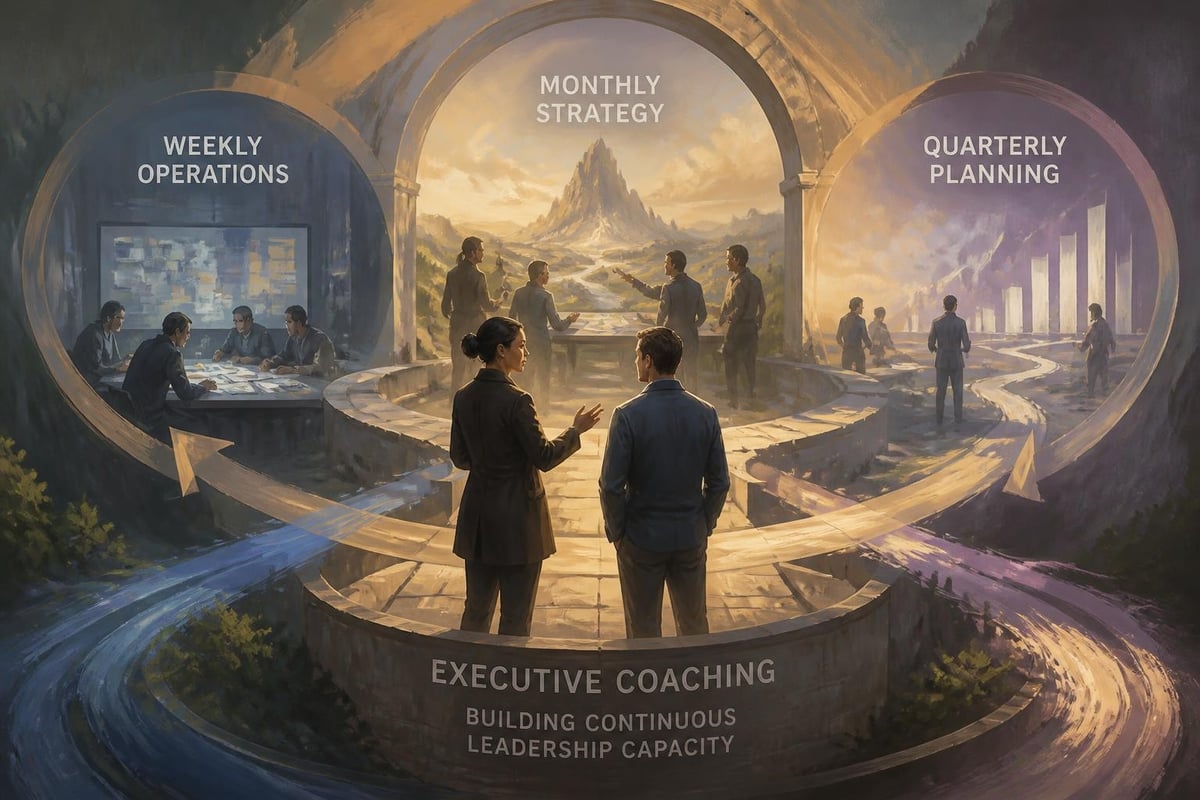
Leadership development needs to be embedded in your operational rhythm, not added as a separate activity. This means:
Weekly leadership debriefs where you and key team members examine decisions made, outcomes achieved, and patterns observed. These 30-minute sessions create rapid feedback loops that accelerate development.
Monthly strategic coaching focused on business-level challenges and opportunities. This is where you zoom out from daily operations to work on the business and your leadership role within it.
Quarterly capacity assessments evaluating whether leadership capability is keeping pace with business growth. Are bottlenecks shifting? Are team members ready for expanded responsibility? What new capabilities does the next growth stage require?
The American Psychological Association's research on organizational consulting emphasizes the importance of psychological safety in these coaching relationships. Your team needs to know that discussing challenges, admitting uncertainty, and requesting support won't be held against them.
Creating Leadership Development Pathways
Your team members need visible pathways showing how they can develop from execution roles into leadership positions. Without clear progression, talented people leave-taking the capabilities you've invested in developing.
Define leadership levels based on scope of responsibility and autonomy:
| Level | Scope | Decision Authority | Development Focus |
|---|---|---|---|
| Executor | Individual tasks | Process adherence | Technical mastery, quality standards |
| Coordinator | Project delivery | Resource allocation within projects | Client management, timeline ownership |
| Manager | Team function | Hiring, performance, process design | People development, strategic thinking |
| Leader | Business unit | P&L responsibility, strategic direction | Business acumen, executive presence |
Each level requires different coaching and development. Executors need skill building and quality feedback. Coordinators need judgment development and client relationship coaching. Managers need people leadership and strategic thinking. Leaders need business strategy and executive presence.
When you're working with consultancies that understand scaling dynamics, they help you design these pathways to match your business model and growth trajectory, not generic corporate structures.
Advanced Leadership Challenges in High-Ticket Services
Executive coaching leadership development in high-ticket services involves unique challenges that don't exist in product businesses or lower-price-point services. The relationship intensity, customization expectations, and revenue concentration create specific leadership demands.
Authority Transfer Without Trust Loss
High-ticket clients often buy you-your expertise, your track record, your reputation. Transferring delivery to team members can feel like bait-and-switch if not handled strategically. Yet sustainable scaling requires this exact transition.
Leadership development here means:
- Positioning team members as specialists executing your methodology (not replacements for you)
- Maintaining strategic oversight while delegating delivery
- Creating client communication that reinforces the team's expertise
- Building trust through outcomes, not just founder proximity
This requires developing your team's executive presence and client relationship capabilities while maintaining the authority that attracted clients initially.
Managing Complexity Without Losing Margins
As your business grows, complexity increases: more client types, more service variations, more team members, more edge cases. Without strong leadership, this complexity erodes margins through inefficiency and custom work.
Executive coaching leadership development builds your capacity to simplify strategically-saying no to complexity that doesn't serve profitability, standardizing where possible, and maintaining boundaries around scope.
According to Deloitte's 2024 human capital research, organizations that successfully scale develop leaders who can balance customization with systematization-exactly the skill high-ticket service founders need.
Navigating Gender Dynamics in Authority
Women-owned businesses face unique leadership challenges around authority, pricing, and boundaries. You may encounter clients who question your expertise, team members who resist your direction differently than they would a male founder, or internal resistance to assertive leadership.
Executive coaching creates safe space to:
- Examine and dismantle internalized limitations around authority
- Develop language and presence that communicates leadership clearly
- Navigate gender-based pushback without diluting your authority
- Model powerful leadership for other women watching your journey
This isn't about adopting masculine leadership styles-it's about developing authentic authority that's both effective and sustainable for you.
Selecting Executive Coaching That Drives Business Results
Not all executive coaching delivers business value for service business founders. Some coaches focus on personal development without business context. Others provide business consulting without leadership development. You need both, integrated.
What to Look For in Executive Coaching
Business model expertise matters enormously. A coach who understands high-ticket service business models, founder bottlenecks, and scaling challenges will provide more relevant guidance than someone from corporate backgrounds.
Systems orientation ensures coaching addresses root causes, not symptoms. You need coaches who can see how your leadership patterns create or solve business problems.
Accountability structures turn insights into implementation. The best coaching includes between-session accountability, progress tracking, and structured follow-up that ensures behavior actually changes.
Integration support helps you translate personal development into business systems. This might mean documenting your decision-making criteria, creating team coaching frameworks, or building leadership development pathways.
When you're evaluating potential coaches, ask specific questions: How have you helped service business founders scale beyond their personal capacity? What business metrics typically improve through your coaching? How do you ensure coaching translates into operational change?
If you want to explore how leadership development integrates with overall business scaling, look for partners who address leadership as one pillar of a comprehensive scaling framework.
Red Flags in Executive Coaching Programs
Avoid coaching that:
- Focuses exclusively on mindset without operational implementation
- Provides generic leadership frameworks without customization to your business model
- Lacks clear outcomes or success metrics
- Operates on undefined timelines without progress milestones
- Ignores the business systems that reinforce current leadership patterns
Executive coaching leadership development should make your business measurably more valuable and operationally stronger, not just make you feel more confident.
Building Your Leadership Development Timeline
Leadership capacity doesn't develop overnight. Understanding realistic timelines helps you invest appropriately and maintain commitment when progress feels slow.
Months 1-3: Foundation and Assessment
- Diagnostic work identifying current leadership gaps and bottlenecks
- Initial capability transfer on highest-impact processes
- Communication framework establishment with team
- Quick wins that demonstrate leadership development value
Months 4-8: Capacity Building
- Systematic transfer of founder responsibilities to team members
- Leadership framework implementation across core business functions
- Decision authority clarification and documentation
- Team member coaching skill development
- Boundary architecture refinement
Months 9-12: Autonomy Testing
- Extended founder absence periods testing business resilience
- Leadership crisis management without founder intervention
- Strategic planning capability development in senior team
- Business results measurement without founder direct involvement
This timeline assumes consistent investment and implementation. Sporadic coaching without operational follow-through extends timelines indefinitely.
Connecting Leadership Development to Business Outcomes
Executive coaching leadership development justifies investment only when it drives concrete business results. The connection should be clear and measurable.
Revenue Impact
Strong leadership enables revenue growth without proportional founder time increase. You can measure:
- Revenue per founder hour (should increase significantly)
- New client acquisition led by team members (not just founder)
- Client retention when delivered primarily by team
- Average deal size (often increases as founder focuses on strategy)
Operational Efficiency
Leadership capacity reduces operational friction and wasted time:
- Decision-making speed increases across the organization
- Project delivery becomes more consistent and predictable
- Team member productivity improves with clearer authority
- Client satisfaction remains high with less founder involvement
Founder Quality of Life
Often overlooked but critically important-sustainable leadership development should improve founder well-being:
- Working hours and schedule flexibility
- Stress levels and decision fatigue
- Business enjoyment and sense of purpose
- Personal time protection and work-life integration
If executive coaching leadership development isn't improving these dimensions, something's wrong with either the coaching or the implementation.
Executive coaching leadership development transforms founder-dependent service businesses into scalable, valuable companies by building genuine leadership capacity throughout the organization. When you invest in developing both your own leadership capabilities and the systems that enable team member growth, you create the leverage needed to scale beyond your personal bandwidth while maintaining the quality and authority that attracted clients initially. Rise Reign Rule specializes in helping women-owned high-ticket service businesses build this exact type of Profit Architecture-integrating leadership development with positioning, acquisition systems, and delivery frameworks that enable predictable, profitable scaling without founder burnout.


