
Executive Coaching Programme: Scale Without Sacrifice
You've built a remarkable service business. Revenue is climbing past $250k, client demand is strong, and your expertise is undeniable. Yet something feels fundamentally broken. You're working harder than ever, decisions pile up waiting for your approval, and the business seems incapable of running without your constant involvement. This isn't a staffing problem or a time management issue. This is a leadership capacity problem, and it's precisely why an executive coaching programme becomes essential at this inflection point. The gap between where you are and where you need to be isn't about doing more. It's about fundamentally transforming how you lead, decide, and architect your business for scalable profit.
Why Traditional Business Coaching Fails High-Ticket Service Founders
Most business coaching focuses on tactics: better funnels, sharper messaging, more aggressive sales techniques. While these elements matter, they completely miss the structural reality facing women-owned service businesses scaling past $500k in revenue.
The real constraint isn't your marketing strategy. It's your leadership architecture.
When you're personally embedded in every client delivery, approval process, and strategic decision, you've created what we call operational drag. An executive coaching programme addresses this fundamentally different challenge by rebuilding how you think about your role, your boundaries, and your business structure.
The Bottleneck You've Become
Consider this pattern: You hire talented people, but they still need your input on client situations. You document processes, yet exceptions always require your judgment. You block time for strategy, but client emergencies pull you back into execution.
This isn't failure. This is the predictable result of building a business around your expertise without simultaneously building your leadership capacity. IESE Business School's Executive Coaching Unit emphasizes that coaching at the executive level fundamentally differs from skills training because it addresses identity, decision-making frameworks, and strategic thinking patterns.
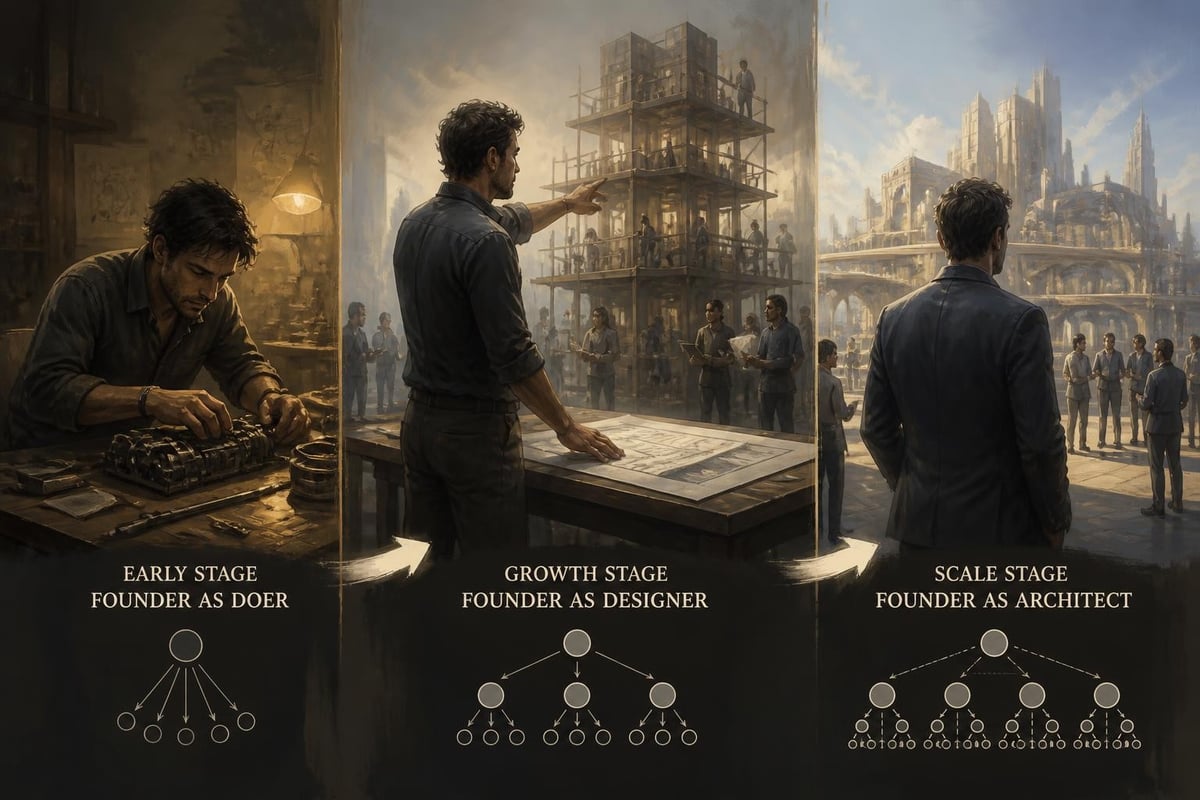
The Profit Architecture Framework for Executive Development
An effective executive coaching programme for high-ticket service businesses must address four interconnected pillars simultaneously. Partial solutions create partial results, which is why so many founders feel stuck despite investing in coaching, courses, and consulting.
Positioning: Building Market Authority That Doesn't Require You
Your market position should create client confidence independent of your personal involvement. When clients hire your firm because of your methodology, framework, and proven systems rather than access to you specifically, you've achieved positioning that scales.
This requires reframing your expertise from personal to institutional. An executive coaching programme helps you:
- Codify your decision-making frameworks so others can apply them
- Build intellectual property that transfers authority to your team
- Position yourself as architect rather than executor
- Create boundaries that protect strategic time without losing client confidence
The shift feels risky. Clients hired you for you, right? Actually, they hired you for results. Your job is ensuring those results happen whether you're personally in the room or not.
Acquisition: Sales Systems Built for Delegation
Revenue growth in high-ticket services typically depends on founder-led sales. You're the best closer, you understand nuance, you read situations instinctively. But this strength becomes a ceiling when every deal requires your personal involvement.
Through structured executive coaching, you develop sales systems that transfer your intuition into frameworks others can execute:
| Sales Component | Founder-Dependent | Systematized |
|---|---|---|
| Discovery calls | Founder reads client, adapts pitch | Diagnostic framework with branching logic |
| Objection handling | Founder improvises based on experience | Documented objection library with responses |
| Deal structure | Founder negotiates custom terms | Pricing matrix with clear authority levels |
| Proposal creation | Founder writes from scratch | Template library with customization guidelines |
This systematization doesn't reduce quality. It multiplies your effectiveness by allowing qualified team members to handle transactions while you focus on market-level strategy.
Delivery: Client Outcomes Without Your Direct Involvement
The delivery model you created when serving five clients cannot sustain fifty clients. Yet most founders resist changing what works, even as they drown in delivery obligations.
An executive coaching programme forces confrontation with this reality. HHL Leipzig Graduate School of Management structures their coaching around individualized development plans precisely because generic advice fails at the executive level. Your delivery transformation must account for your specific service model, client expectations, and team capabilities.
Key delivery shifts include:
- Moving from custom to configurable (mass customization, not commoditization)
- Building quality assurance systems that don't require your review
- Creating escalation frameworks so you handle exceptions, not everything
- Developing team members who can think like you in client situations
The final point matters most. You need people who understand your standards and can make judgment calls aligned with your vision. This doesn't happen through hiring alone. It requires deliberate leadership development, which is exactly what executive coaching programmes teach you to implement.
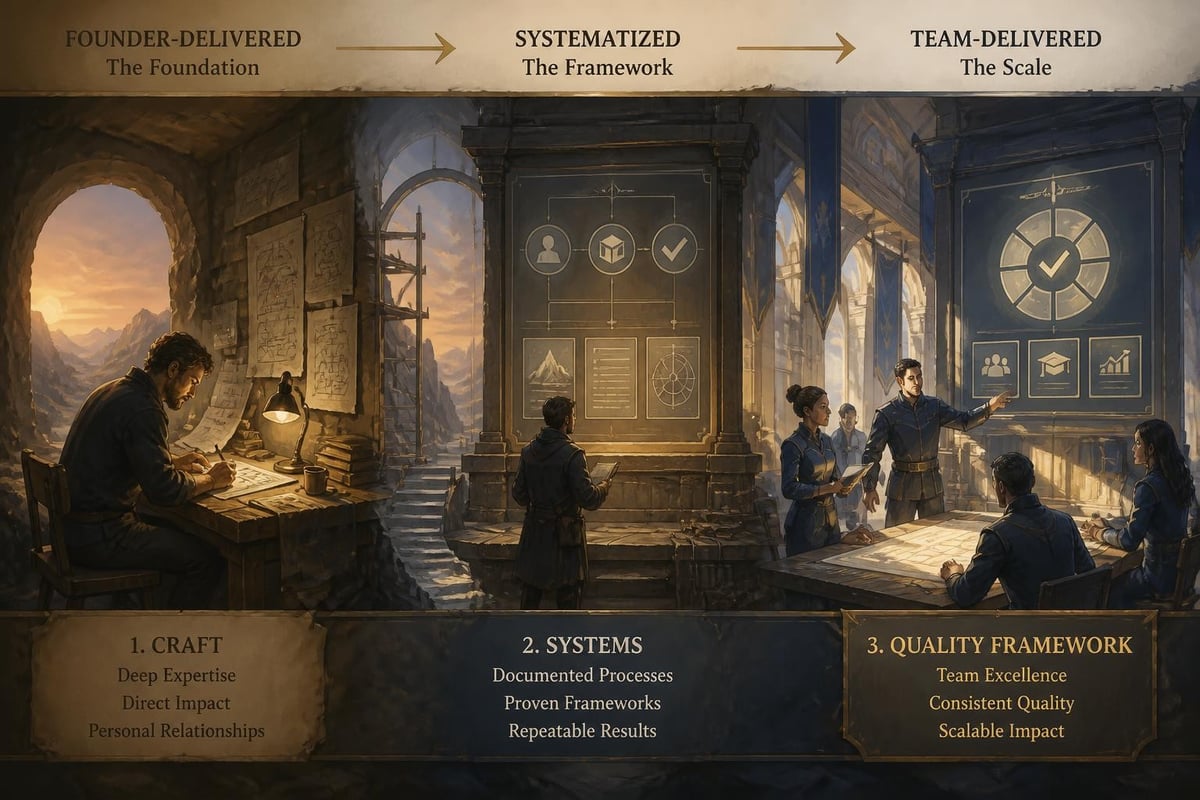
Leadership: Boundaries as Business Infrastructure
Here's what nobody tells you about scaling a service business: Your biggest competitive advantage becomes your greatest liability. Your responsiveness, your accessibility, your willingness to jump in and solve problems creates client loyalty at $250k in revenue. At $1M, these same behaviors create chaos.
The Boundary Paradox
Women-owned service businesses face unique pressure around boundaries. You've likely built your reputation on being available, caring deeply about outcomes, and going above and beyond. An executive coaching programme helps you navigate the uncomfortable transition from these founder behaviors to sustainable leadership practices.
The Hult International Business School coaching programs emphasize relational practice because executive-level change involves identity transformation, not just skill development. You're not just learning to set boundaries. You're becoming someone who values sustainable systems over heroic effort.
Strategic boundaries include:
- Communication boundaries: Response time expectations, communication channels, meeting schedules
- Decision boundaries: Clear authority levels for team decisions without founder approval
- Time boundaries: Protected strategic time that's truly protected
- Client boundaries: Service scope, revision limits, communication protocols
- Energy boundaries: Saying no to opportunities that don't align with strategic direction
Each boundary feels risky when you first implement it. Executive coaching provides the accountability and framework to hold these boundaries even when anxiety spikes.
Selecting an Executive Coaching Programme That Drives Business Results
Not all coaching delivers business results. Some programs focus heavily on mindset without connecting to operational reality. Others provide tactical advice without addressing the leadership transformation required for sustainable scaling.
Evaluation Criteria for Service Business Founders
When considering an executive coaching programme, evaluate these components:
Business Model Alignment: Does the coach understand high-ticket service businesses specifically? The dynamics of productized services, client delivery, and team leverage differ completely from product businesses or low-ticket models. Generic business coaching misses crucial nuances.
Framework Over Inspiration: Motivation fades. Frameworks persist. Look for executive coaching programs that provide structured methodologies you can implement, not just encouragement to think bigger.
Integration with Operations: The best executive coaching doesn't separate "leadership development" from "business building." Every coaching conversation should connect to specific operational challenges, decisions, or systems you're implementing.
Accountability Mechanisms: Transformation requires sustained behavior change. How does the programme ensure you actually implement rather than just discuss? Weekly check-ins, specific deliverables, and measurement systems separate effective coaching from expensive conversations.
Red Flags to Avoid
Watch for these warning signs when evaluating programmes:
- Focuses exclusively on mindset without operational systems
- Promises specific revenue outcomes (coaching affects decisions, not markets)
- One-size-fits-all approach without customization to your business model
- Lack of structure or clear development pathway
- Coach has never scaled a service business themselves
The Academy of Executive Coaching trains executive coaches globally, and their emphasis on unlocking potential through skill development reflects an important principle: effective coaching balances support with challenge, combining encouragement with rigorous accountability.
Implementation: Translating Coaching Insights into Business Systems
The gap between insight and implementation destroys most coaching value. You have a breakthrough conversation, see clearly what needs to change, feel energized about possibilities, then return to operational chaos and nothing shifts.
This pattern isn't your failure. It's a design flaw in how most coaching engagements are structured.
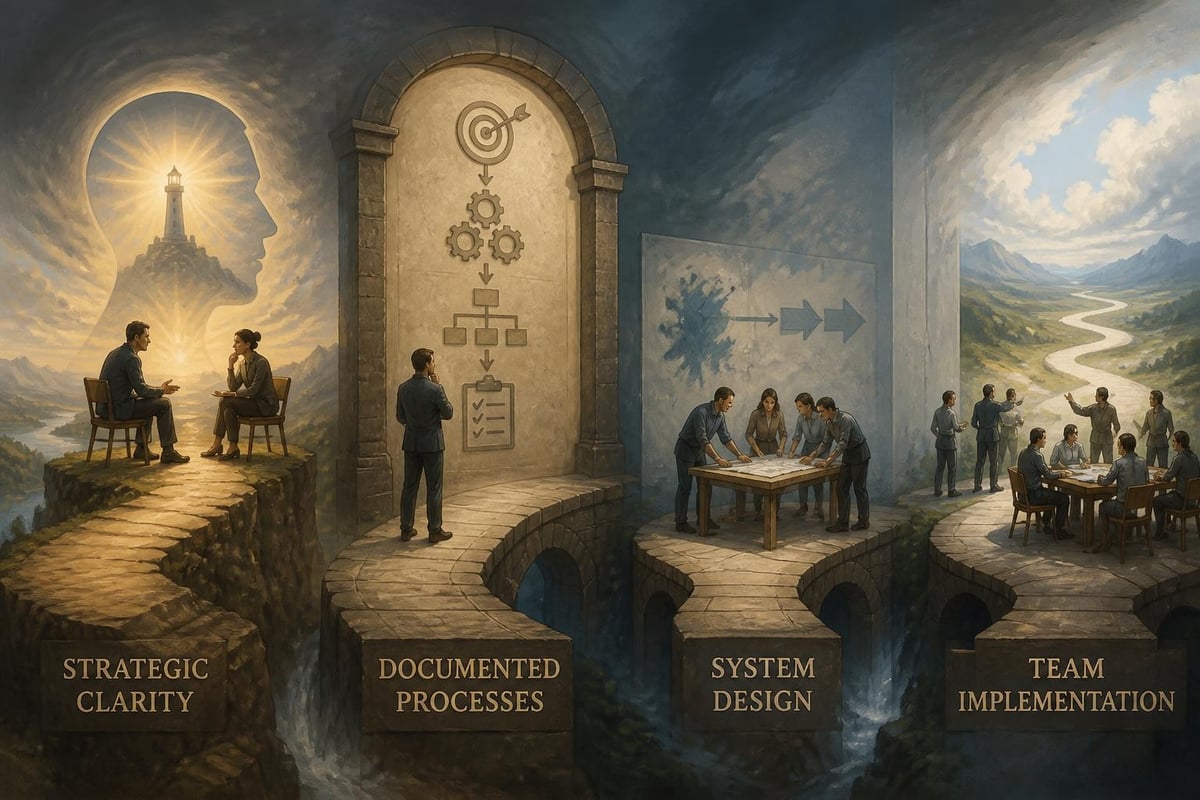
The Insight-to-System Process
Effective executive coaching programmes build this translation process directly into the engagement:
- Strategic Clarity Session: Identify the specific leadership constraint limiting growth
- Framework Development: Create the decision-making framework or process that addresses this constraint
- Documentation Sprint: Convert frameworks into teachable, transferable systems
- Team Implementation: Roll out systems with proper training and support structures
- Measurement Design: Define metrics that indicate whether the new system is working
- Iteration Cycles: Refine based on real-world results
This process ensures coaching insights become business infrastructure, not just interesting ideas. When you're evaluating programmes, ask specifically how they structure implementation support. Insights without implementation systems waste your investment.
The ROI of Executive Coaching at Different Revenue Stages
Financial investment in an executive coaching programme ranges from $15,000 to $100,000+ annually depending on intensity, duration, and coach expertise. For women-owned service businesses, this represents significant capital allocation requiring clear ROI justification.
Revenue Stage Analysis
| Revenue Stage | Primary Constraint | Coaching Focus | Expected ROI Mechanism |
|---|---|---|---|
| $250k-$500k | Founder doing everything | Role transition, initial delegation | Time freed for sales, 30-50% revenue increase |
| $500k-$1M | Inconsistent delivery quality | Systematization, team development | Margin improvement 10-15%, capacity for growth |
| $1M-$3M | Operational chaos, profit erosion | Leadership systems, boundaries | Profit margin recovery 15-20%, sustainable scaling |
| $3M-$5M | Team dysfunction, strategic drift | Executive presence, vision alignment | Retention improvement, strategic clarity enables new markets |
The Oxford Leadership programme focuses on aligning leader development with business priorities because executive coaching divorced from business outcomes wastes resources. Your coaching investment should directly address the specific constraint limiting your next growth phase.
Integration with Strategic Consulting: When You Need Both
Executive coaching develops your leadership capacity. Strategic consulting builds your business systems. The question isn't which you need but rather when you need each and how they work together.
Many women-owned service businesses between $250k and $5M benefit most from integrated approaches. Rise Reign Rule's services combine strategic consulting with executive development precisely because leadership capacity and business systems must evolve together. You can have brilliant strategy without the leadership capacity to execute it. You can have strong leadership without clear strategic direction. Neither situation produces results.
The Integration Model
Optimal outcomes typically follow this pattern:
Phase 1: Strategic Foundation (Months 1-2)
- Audit current business architecture
- Identify specific operational constraints
- Design target state systems
- Clarify leadership requirements
Phase 2: Leadership Development (Months 3-6)
- Executive coaching focused on required leadership shifts
- Progressive implementation of new systems
- Team development aligned with new structure
- Boundary establishment and enforcement
Phase 3: Optimization (Months 7-12)
- Refinement based on results
- Advanced delegation and authority transfer
- Strategic planning from new leadership foundation
- Measurement system implementation
This phased approach prevents the common failure pattern where coaching produces insights that can't be implemented because business systems don't support them, or where consulting delivers systems that fail because leadership capacity hasn't developed to sustain them.
Measuring Success Beyond Revenue Metrics
Revenue growth matters, but it's an insufficient success metric for an executive coaching programme. The most important transformations show up in operational indicators that predict sustainable scaling:
Founder Time Allocation: Track hours spent on execution versus strategy weekly. Target progression from 80% execution at programme start to 60% strategic work by month six.
Decision Volume: Count decisions waiting for your approval. Declining numbers indicate successful authority delegation and system implementation.
Response Time Expectations: Measure average team and client response time expectations. Increasing acceptable response windows demonstrate successful boundary implementation.
Team Confidence: Survey team members on decision-making confidence and clarity quarterly. Rising scores indicate effective framework transfer.
Profit Margin: Track gross and net margins monthly. If revenue grows but margins decline, systems aren't scaling properly regardless of coaching quality.
The Hult Ashridge Centre for Executive Coaching conducts research bridging science and practice in executive coaching, emphasizing measurement and evidence-based approaches. Your programme should include clear metrics reviewed regularly, not just subjective assessment of whether sessions feel valuable.
Common Resistance Patterns and How to Address Them
Every founder investing in an executive coaching programme encounters internal resistance. Recognizing these patterns helps you move through them rather than getting stuck.
"Nobody Can Do It Like I Do"
This belief feels true because it is true, initially. Nobody has your experience, intuition, or standards. But this statement conflates current capability with potential capability given proper systems and development.
The reframe: "Nobody can do it like I do yet, and my job is building systems that transfer my thinking to others so they eventually can."
"Clients Expect to Work With Me"
Sometimes true, often assumed. Test this by gradually introducing team members into client relationships with proper positioning. Most clients care about results, not specifically about your personal involvement in every task.
The reframe: "Clients hired me for outcomes. My job is ensuring those outcomes happen through whatever delivery model serves them best while allowing the business to scale."
"I'll Lose Quality Control"
Quality concerns are valid. Quality decline during scaling is real risk. But maintaining quality doesn't require your direct involvement in everything. It requires quality systems, training, and escalation frameworks.
The reframe: "I maintain quality through systems that define standards and catch issues, not through personally checking everything. My job is building quality infrastructure, not being quality infrastructure."
"This Is Just How Service Businesses Work"
Many service businesses operate with founder bottlenecks and operational chaos. That doesn't make it optimal or inevitable. It makes it common. An executive coaching programme helps you see beyond industry norms to what's actually possible with proper architecture.
The reframe: "Most service businesses run this way, which is exactly why most stay small. I'm building something different."
Working through these resistance patterns requires structured support. This is precisely why self-directed improvement often stalls. Executive coaching provides the external perspective and accountability to push through discomfort toward transformation.
An executive coaching programme becomes essential when your leadership capacity constrains business growth more than market opportunity does. The transition from founder-as-doer to founder-as-architect requires systematic development of new thinking patterns, decision frameworks, and operational boundaries. If you're ready to build a high-ticket service business that generates predictable profit without sacrificing your life to operational chaos, Rise Reign Rule provides the strategic consulting and executive development framework specifically designed for women-owned businesses scaling from $250k to $5M and beyond. The Profit Architecture methodology addresses positioning, acquisition, delivery, and leadership simultaneously because partial solutions create partial results, and you didn't build this business to stay stuck at the next level.


