
Group Coaching: The Scalable Model for High-Ticket Growth
You've built a thriving high-ticket service business, but now you're facing the ceiling. Every new client means more of your time, and there are only so many hours in a week. The solution isn't working harder or sacrificing quality-it's rethinking your delivery model entirely. Group coaching offers a strategic pathway to scale revenue without proportionally scaling your time, creating predictable profit while maintaining the transformational outcomes your clients expect.
Why Traditional One-to-One Models Create Bottlenecks
The premium service model works beautifully until it doesn't. When you're charging $15K to $50K per client engagement, the math seems straightforward: more clients equals more revenue. But this linear growth model traps you in a founder bottleneck that prevents sustainable scaling.
Here's what happens at the $250K to $500K revenue mark:
- Your calendar fills with client calls, leaving no time for business development
- Operational complexity multiplies with each unique client relationship
- You become the single point of failure for delivery excellence
- Profit margins compress as you add support staff to manage the load
The traditional consultancy model wasn't designed for scale. It was built for bespoke solutions and white-glove service. While that positioning commands premium pricing, it also creates operational drag that becomes unbearable as you push toward seven figures.

The Revenue Ceiling Nobody Talks About
Most women-owned service businesses hit a predictable wall between $500K and $1M. You can't work more hours, and hiring doesn't solve the fundamental problem-you're still trading time for money at the highest level. The business depends on your personal involvement in every client transformation.
This is where understanding group coaching best practices becomes essential. The shift isn't about lowering standards or reducing intimacy. It's about architecting delivery systems that multiply your impact while maintaining premium positioning.
Designing Your Group Coaching Framework
Group coaching works when you build it on a foundation of proven methodologies, not personality alone. Your expertise needs to be extractable, teachable, and replicable across a cohort of clients simultaneously.
The framework must address three critical components:
- Structured curriculum that delivers predictable outcomes
- Facilitation protocols that maximize collective intelligence
- Accountability mechanisms that ensure implementation
Without these elements, you're just hosting group calls. With them, you're running a transformation engine that produces results at scale.
| Framework Element | One-to-One Model | Group Coaching Model |
|---|---|---|
| Time Investment | 4-6 hours/client/month | 4-6 hours/cohort/month |
| Client Capacity | 8-12 active clients | 25-40 active clients |
| Revenue Potential | $300K-$600K annually | $750K-$2M annually |
| Founder Leverage | 1:1 ratio | 1:8-10 ratio |
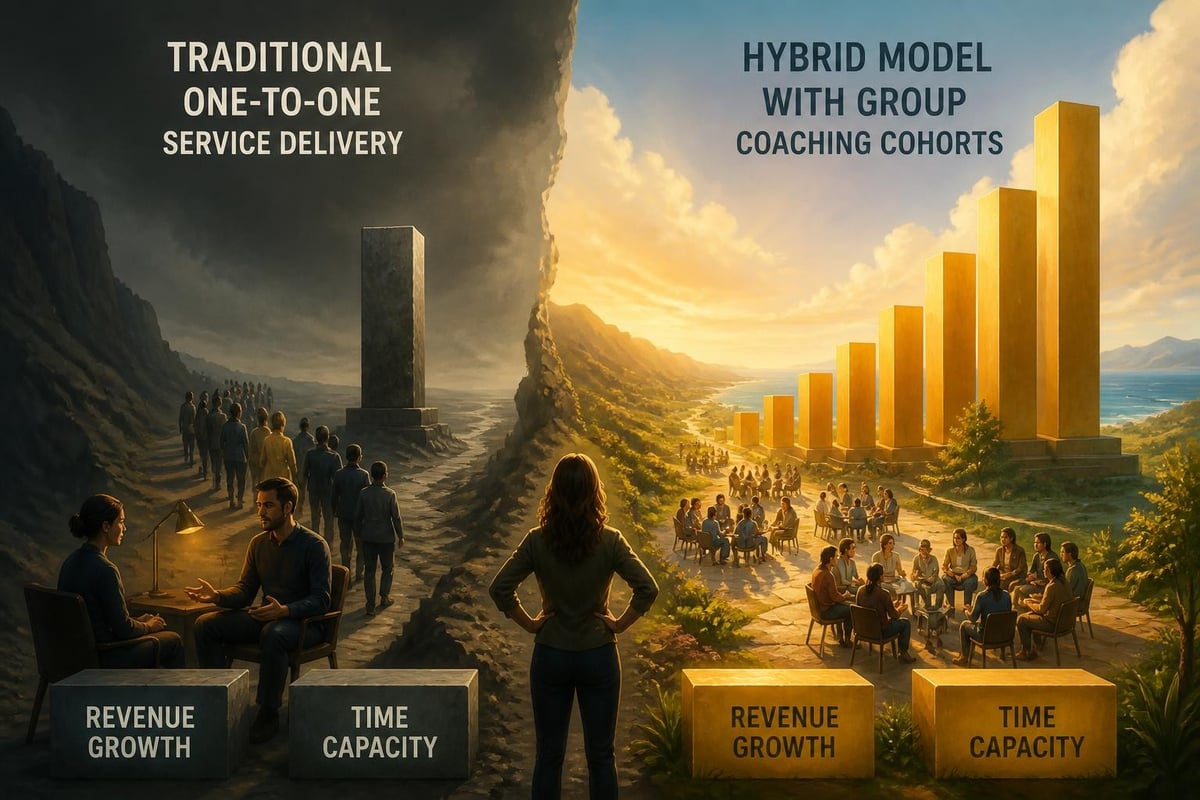
The economics shift dramatically. Instead of serving twelve $50K clients individually, you're serving four cohorts of ten clients each, maintaining premium pricing while quadrupling capacity.
Structuring Sessions for Maximum Impact
Effective group coaching session structure balances teaching, peer collaboration, and individual application. Most successful programs follow a 90-minute format split into distinct segments:
- Teaching segment (25 minutes): Introduce new concepts, frameworks, or strategies
- Application work (30 minutes): Guided exercises where participants apply to their businesses
- Hot seat coaching (25 minutes): Deep-dive problem-solving with 2-3 participants
- Accountability setting (10 minutes): Commitments and peer partnerships
This rhythm keeps engagement high while ensuring every participant receives value, regardless of whether they're in the hot seat. The peer learning dynamic often produces insights you couldn't deliver in individual sessions.
Pricing Strategies That Preserve Premium Positioning
The biggest mistake service providers make when launching group coaching is slashing prices to match perceived value. This undermines positioning and attracts the wrong clients-bargain hunters rather than committed implementers.
Your group coaching should be priced at 60-70% of your one-to-one fee, not 30-40%. If you charge $40K for private consulting, your group program should command $24K-$28K, not $10K. Here's why:
The value proposition isn't "cheaper access to you"-it's "accelerated transformation through collective intelligence plus expert facilitation." Participants gain your frameworks, direct coaching, and peer insights from a curated cohort of high-performers tackling similar challenges.
Cohort Curation Creates Compound Value
Premium pricing allows selective enrollment. When you're charging $25K for a group program, you can afford to be extremely choosy about who joins. This curation creates peer groups where every member adds value to every other member.
Consider the difference:
Low-ticket cohort ($2K-$5K): Wide skill ranges, inconsistent commitment, founder spends energy managing drama and motivating participation.
High-ticket cohort ($20K-$30K): Aligned experience levels, serious implementation focus, energy flows toward breakthrough thinking and strategic execution.
The Rise Reign Rule approach to scaling emphasizes clean systems over complex funnels. Group coaching pricing should reflect the caliber of transformation, not just access to your calendar.

Operational Architecture for Delivery Excellence
Group coaching fails when it's layered onto existing operations as "another thing to manage." Success requires deliberate infrastructure designed for leverage and consistency.
The Four-Pillar Delivery System
Your group coaching program needs operational architecture across four key areas:
- Positioning: How you message the program to attract ideal participants
- Acquisition: Sales systems that enroll cohorts efficiently without endless discovery calls
- Delivery: Curriculum, facilitation guides, and resource libraries that ensure consistent outcomes
- Leadership: Boundaries and protocols that protect your capacity while serving participants fully
Notice these pillars mirror the Profit Architecture framework that creates predictable scaling. This isn't coincidence-group coaching programs are businesses within your business, requiring the same strategic rigor.
Technology Stack for Seamless Experience
The right tools eliminate friction for both you and participants. Your tech stack should include:
- Community platform (Circle, Slack, or Mighty Networks) for asynchronous collaboration
- Video infrastructure (Zoom with cloud recording) for live sessions and replay value
- Content delivery system (Kajabi, Teachable, or Notion) for curriculum and resources
- Project management tool (Asana, ClickUp, or Monday) for tracking participant progress
Resist the urge to overcomplicate. Running effective group coaching sessions depends more on facilitation skill than fancy software. Start with Zoom, a Google Drive, and a Slack channel. Add complexity only when simplicity becomes the constraint.
Maximizing Client Outcomes Through Peer Dynamics
The secret advantage of group coaching isn't efficiency-it's enhanced outcomes through collective problem-solving. Research shows that narrative-collaborative group coaching develops social capital and accelerates participant growth beyond what individual coaching achieves.
Why groups outperform one-to-one in certain contexts:
Your participants are solving similar problems at similar scales. A woman running a $400K consulting firm gains more from hearing how a peer solved her sales system challenge than from your abstract advice. The specificity and relatability create immediate application opportunities.
Facilitating Breakthrough Conversations
Your role shifts from expert advisor to expert facilitator. Instead of having all the answers, you orchestrate environments where answers emerge from the group's collective intelligence.
Powerful facilitation techniques include:
- Strategic questioning: Ask the group to diagnose before prescribing solutions
- Pattern recognition: Connect themes across multiple participants' challenges
- Accountability pairing: Match members for between-session support and implementation
- Success amplification: Celebrate wins publicly to reinforce what's working
The best group coaching sessions feel like masterminds, not classrooms. Participants leave energized by insights from peers, not just from you.
Scaling Revenue Without Scaling Complexity
Here's the scaling math that makes group coaching irresistible for service businesses ready to break through revenue plateaus:
| Metric | Year 1 Traditional | Year 1 With Groups |
|---|---|---|
| One-to-One Clients | 12 @ $40K | 6 @ $40K |
| Group Program Revenue | $0 | 3 cohorts × 10 clients × $25K |
| Total Revenue | $480K | $990K |
| Your Weekly Capacity | 100% utilized | 70% utilized |
Notice you're serving fewer individual clients while more than doubling revenue. The freed capacity can drive business development, product creation, or simply margin for strategic thinking-the activities that actually grow businesses.
Creating Your Signature Program
The most successful group coaching programs have clear names, defined outcomes, and specific methodologies. Vague offerings like "Business Growth Accelerator" compete with thousands of similar programs. Specific frameworks tied to tangible results command premium pricing.
Your signature program should:
- Solve one specific, expensive problem your market experiences between $250K-$1M revenue
- Promise measurable outcomes participants can track (revenue increase, time savings, system implementation)
- Feature your proprietary methodology that competitors can't easily replicate
- Include defined touchpoints so participants know exactly what they're buying
Think about comprehensive group coaching guides that emphasize clarity over complexity. Participants need to understand the transformation journey before they invest $25K.
Integration With Your Existing Service Ladder
Group coaching shouldn't replace premium one-to-one work-it should complement it strategically. The most profitable service businesses use group programs to create a three-tier offer architecture:
Entry tier: DIY courses or low-touch programs ($2K-$5K) that attract leads and demonstrate methodology
Core tier: Group coaching programs ($20K-$30K) serving clients ready for guided implementation with peer support
Premium tier: One-to-one consulting or done-with-you services ($40K-$100K+) for clients requiring bespoke solutions or intensive support
This ladder allows clients to enter at their readiness level and ascend as their needs evolve. Some participants who join your group program will eventually invest in private consulting. Others will find group coaching delivers everything they need.
When to Recommend Group Versus Individual Engagement
Clear criteria prevent revenue leakage and ensure clients receive appropriate service levels. Consider these decision factors:
Ideal for group coaching:
- Clients implementing proven frameworks in their businesses
- Challenges with established best-practice solutions
- Leaders who benefit from peer perspectives and accountability
- Situations where collective problem-solving accelerates outcomes
Better for one-to-one:
- Highly confidential business situations
- Complex organizational dynamics requiring nuanced navigation
- Clients needing intensive behavior change or mindset work
- Custom strategy development without template solutions
Understanding what group coaching fundamentally offers helps you position it correctly within your service ecosystem. It's not inferior to private consulting-it's optimized for different needs and contexts.
Building Waiting Lists Before You Launch
The worst way to launch group coaching is opening enrollment and hoping people sign up. The best approach builds demand before you announce pricing or curriculum details.
Pre-launch sequence that creates urgency:
- Survey current clients and email list about challenges they're facing (60-90 days before launch)
- Share behind-the-scenes content about the program you're developing (45 days before)
- Invite applications to a waiting list with no commitment required (30 days before)
- Conduct 1:1 enrollment conversations with qualified waiting list members (14 days before)
- Open limited enrollment to waitlist first, then public (launch week)
This approach ensures you're enrolling your first cohort before investing heavily in curriculum development. The market validates demand before you build infrastructure.
If you struggle to enroll an initial cohort of 6-8 participants from your existing audience, your positioning needs refinement before scaling. Book a strategic consultation to diagnose what's preventing conversion.
Measuring Success Beyond Revenue Metrics
Group coaching programs succeed when they create client outcomes that generate testimonials, referrals, and repeat enrollment. Revenue is a lagging indicator-participant results are leading indicators.
Track these engagement metrics closely:
- Session attendance rates (target: 80%+ for high-ticket programs)
- Community participation (weekly active users, questions posted, peer support offered)
- Implementation completion (percentage finishing assigned work between sessions)
- Outcome achievement (participants hitting defined milestones or metrics)
Low engagement signals program design issues, not participant problems. If attendance drops below 70%, your content isn't delivering sufficient value or your facilitation isn't creating compelling experiences.
Building a Testimonial Engine
Your group coaching program should produce more powerful testimonials than one-to-one work because results emerge faster through peer acceleration. Create systematic processes for capturing transformation stories:
- Mid-program win documentation: Quick video or written testimonials when participants achieve breakthroughs
- Graduation case studies: Detailed before/after documentation with specific metrics
- Peer testimonials: Participants describing the value of cohort connections, not just your coaching
These testimonials become your primary sales asset. Prospective participants want proof that group dynamics won't dilute outcomes. Documentation from previous cohorts provides that proof compellingly.
Group coaching represents one of the cleanest paths to scaling service revenue while reclaiming your time and preserving transformation quality. The operational architecture required-clear positioning, efficient acquisition, systematic delivery, and strong boundaries-mirrors what every business needs between $250K and $5M revenue. If you're ready to install proven frameworks that eliminate founder bottlenecks and create predictable profit, Rise Reign Rule specializes in exactly this transformation for women-owned high-ticket service businesses.


