
Leadership Coaching Company: Strategic Growth Model
The leadership coaching industry reached $15.8 billion globally in 2026, yet most coaching businesses remain stuck in the founder-led, time-for-money trap. If you're running a leadership coaching company generating $250k to $5M annually, you've already proven market demand. What you need now isn't more clients-it's a system that scales without consuming every hour of your day. The difference between a coaching practice and a coaching business lies in strategic infrastructure, not just coaching excellence.
The Operational Reality of Scaling a Leadership Coaching Company
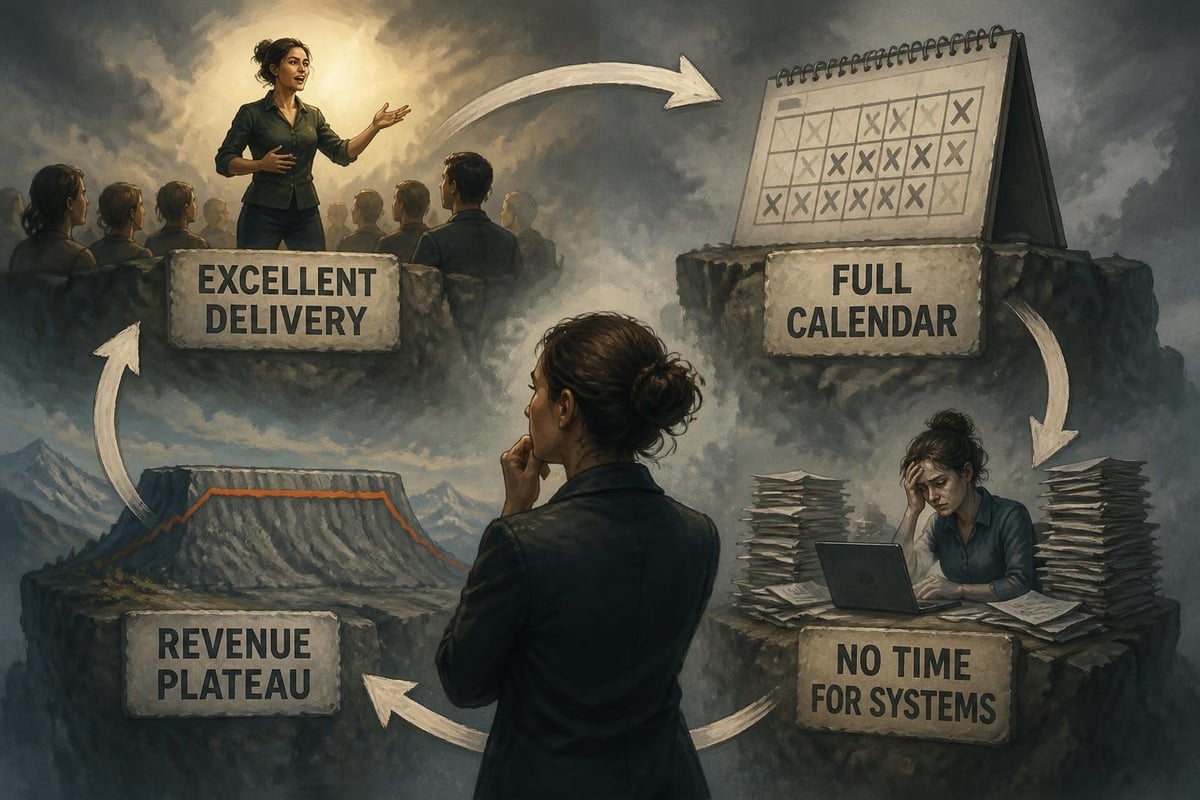
Most leadership coaching companies hit their first revenue ceiling around $400k. You're booked solid, delivering exceptional transformation, yet profit margins remain thin and burnout looms large. This isn't a coaching problem-it's an operational architecture problem.
Women-owned coaching businesses face a particularly insidious challenge: the expectation to remain accessible and personally involved in every client interaction. This cultural pressure creates what we call "operational drag," where your expertise becomes the bottleneck rather than the engine of growth.
The solution requires rethinking four critical business pillars simultaneously. According to Harvard Business Publishing's 2024 Global Leadership Development Study, organizations investing in integrated leadership development systems see 3.2x higher ROI than those using fragmented approaches. Your leadership coaching company should follow the same principle.
Breaking the Founder Bottleneck Pattern
Here's what operational drag looks like in practice:
- Custom proposals for every prospect that take 4-6 hours to create
- One-off coaching sessions without standardized frameworks
- Client communication scattered across email, text, and Voxer
- No clear hand-off protocols when you need to delegate
- Revenue that disappears the moment you take a vacation
Each symptom points to missing systems infrastructure. The pathway to scaling your high-ticket service business starts with acknowledging that great coaching and profitable operations require different skill sets.
Positioning Your Leadership Coaching Company for Market Authority
The coaching market is saturated with generalists. Your ability to command premium pricing ($10k+ engagements) depends entirely on positioning specificity. This goes far beyond a niche statement on your website-it's about owning a particular transformation in a particular market's mind.
The Profit Architecture of Market Positioning
Strategic positioning for a leadership coaching company operates on three levels:
Market Selection: Who experiences the exact problem you solve most acutely? For instance, women-owned professional service firms scaling past $1M face radically different leadership challenges than tech startup founders. Your positioning should speak to one group with surgical precision.
Transformation Ownership: What specific before-to-after state do you own? "Better leadership" is too vague. "From reactive people-pleaser to decisive CEO with clear boundaries" is ownable. The transformation should be both measurable and emotionally resonant.
Proof Mechanism: How do you demonstrate your methodology works? Case studies, proprietary frameworks with trademarked names, and outcome data create positioning moats that commodity coaching cannot cross.
| Positioning Element | Weak Approach | Strong Approach |
|---|---|---|
| Target Market | "Entrepreneurs and executives" | "Women-owned service firms, $500k-$3M revenue" |
| Core Problem | "Leadership challenges" | "Operational drag from founder bottlenecks" |
| Methodology | "Customized coaching" | "Profit Architecture™ framework" |
| Proof | "20 years experience" | "Average 34% profit increase in 6 months" |
When your positioning is sharp, your leadership coaching company stops competing on credentials and starts competing on proprietary methodology. This shift alone can double your close rate while reducing sales cycle length by 40%.
Acquisition Systems That Generate Predictable Revenue
Most leadership coaching companies treat sales as an art rather than a science. This approach works when you're hungry and scrappy. It fails catastrophically when you need predictable monthly revenue to support a team and operational infrastructure.
The pivot point is installing a sales system that works whether you're "feeling it" or not. Research from the ICF Thought Leadership hub indicates coaching businesses with documented sales processes grow 2.6x faster than those relying on founder charisma alone.
Building a Repeatable Client Acquisition Engine
Your acquisition system needs three components working in concert:
- Lead Generation Mechanism: Not random networking, but a systematic approach-whether that's strategic partnerships, content-driven inbound, speaking circuits, or outbound prospecting to a defined list
- Qualification Framework: Clear criteria that separate ideal clients from time-wasters before you invest hours in discovery calls
- Conversion Process: A documented sales conversation structure that moves qualified prospects to decision without high-pressure tactics
Here's what this looks like operationally:
- Monday morning, you review a dashboard showing leads by source and stage
- Tuesday through Thursday, your calendar has pre-blocked consultation slots
- Each conversation follows a documented framework (not a script, but a strategic arc)
- Friday, you analyze conversion data and identify bottlenecks in your pipeline
The goal isn't to remove the human element from sales. It's to create consistency so your leadership coaching company can forecast revenue, plan hiring, and invest in infrastructure with confidence.

Pricing Architecture for High-Ticket Services
Premium positioning requires premium pricing structure. Yet many coaching companies undercharge because they haven't built the value articulation to justify $15k-50k+ engagements.
Your pricing should reflect business transformation, not hourly coaching. When a client's leadership breakthrough generates $200k in additional profit through better team performance and decision-making, your $30k fee is a bargain. Frame it that way from the first conversation.
The leadership coaching company that thrives in 2026 packages transformation, not time. This means moving from "12 sessions over 6 months" to "The Confident CEO Intensive: a 90-day framework that installs decision-making systems, boundary protocols, and strategic thinking routines."
Delivery Systems That Create Consistent Client Outcomes
Here's the uncomfortable truth: exceptional coaching talent doesn't automatically translate to exceptional business outcomes. Your clients need more than breakthrough moments in 1:1 sessions-they need implementation systems that turn insights into sustained behavioral change.
A leadership coaching company scales when delivery becomes repeatable and transferable. This doesn't mean cookie-cutter programs. It means proprietary frameworks that guide customization within proven structures.
The Framework-Based Delivery Model
Consider how the Center for Creative Leadership approaches integrated coaching. They combine assessment tools, cohort learning, individual coaching, and organizational application projects. This integrated approach creates results that stick.
Your delivery system should include:
- Proprietary Assessment: A diagnostic tool that identifies specific leadership gaps and creates baseline metrics
- Core Framework: Your methodology broken into teachable modules (4-7 core components is optimal)
- Implementation Tools: Templates, checklists, and protocols clients use between sessions
- Accountability Mechanisms: Structured check-ins, progress tracking, and milestone reviews
- Support Infrastructure: How clients access you between sessions (office hours, Voxer, email response protocols)
| Delivery Component | Ad-Hoc Approach | Systematized Approach |
|---|---|---|
| Client Onboarding | Email with Zoom link | Welcome sequence, assessment, orientation call |
| Session Structure | "What do you want to work on?" | Framework-guided progression with flexibility |
| Between-Session Support | Reactive text responses | Defined office hours + async platform |
| Progress Tracking | Coach memory | Shared dashboard with metrics |
| Resource Delivery | "I'll send you something" | Resource library tied to framework stages |
When delivery is systematized, you can bring on associate coaches, create group programs, and build digital leverage without sacrificing quality. The peer-reviewed framework on maximizing ROI of leadership development shows that structured programs with clear measurement protocols deliver 4.1x better outcomes than unstructured coaching relationships.
Leadership: The Often-Ignored Business Pillar
The greatest irony in running a leadership coaching company? Many founders neglect their own leadership development in favor of client delivery. You cannot scale what you haven't modeled.
Strategic leadership for your business means making the shift from expert practitioner to CEO of a coaching enterprise. These roles require different mindsets, different time allocation, and different boundaries.
Boundaries as Business Infrastructure
Women-owned businesses particularly struggle with boundary-setting. The cultural expectation to be nurturing, accessible, and accommodating creates operational chaos. Your leadership coaching company needs explicit boundaries around:
- Communication channels: When and how clients can reach you
- Scope creep: What's included in your engagement vs. additional fees
- Decision-making authority: What you decide vs. what your team handles
- Time protection: Non-negotiable blocks for strategy, sales, and rest
Without these boundaries, you're running a high-stress job, not a scalable business. The research on CEO coaching and advisory structures shows that effective CEOs maintain strict boundary protocols and leverage teams for execution while they focus on strategy and relationships.
Building Your Leadership Team
Scaling past $1M in a leadership coaching company requires letting go of the "I can do it better/faster myself" mentality. Your evolution looks like this:
- $250k-$500k: You plus virtual assistant for administrative tasks
- $500k-$1M: Add associate coach or program manager to handle delivery components
- $1M-$3M: Build a small team (3-5 people) with specialized roles: sales, delivery, operations
- $3M-$5M: Install leadership layer between you and execution team
Each transition requires you to develop new capabilities. Moving from solo practitioner to team leader means learning delegation, quality control systems, and performance management. These aren't innate-they're learnable skills that deserve the same attention you give to developing your client-facing expertise.

Measurement Systems That Drive Profitable Decisions
You can't improve what you don't measure, yet most leadership coaching companies track only revenue and client count. Strategic growth requires a more sophisticated dashboard.
Key Performance Indicators for Coaching Businesses
Your metrics should tell you both what's happening and why it's happening:
Financial Metrics:
- Monthly recurring revenue vs. project-based income
- Profit margin by service offering
- Customer acquisition cost by channel
- Lifetime client value
- Cash flow runway (months of operating expenses in bank)
Operational Metrics:
- Lead-to-consultation conversion rate
- Consultation-to-client conversion rate
- Average sales cycle length
- Client onboarding time (from sale to first session)
- Program completion rate
Delivery Metrics:
- Client outcome achievement (based on stated goals)
- Session utilization rate
- Associate coach productivity (if applicable)
- Client satisfaction scores
- Referral rate
Track these monthly. Review quarterly with a critical eye toward bottlenecks and opportunities. The leadership coaching company that uses data to drive decisions outperforms intuition-based competitors by a factor of three.
According to psychology of leadership research, measurement itself changes behavior. When you track consultation conversion rates, you naturally improve sales conversations. When you measure client outcome achievement, you refine delivery methodology.
The Integration Point: Profit Architecture in Action
The four pillars-Positioning, Acquisition, Delivery, and Leadership-don't operate in isolation. They create a reinforcing system where strength in one area amplifies the others.
Sharp positioning makes acquisition easier (right-fit clients self-select). Systematized delivery frees leadership time for strategic growth. Strong boundaries prevent operational drag. Reliable acquisition systems justify investment in better delivery tools.
This is what we call Profit Architecture: the deliberate design of business infrastructure that generates predictable profit while reducing founder dependency. For a leadership coaching company, this means you can take a two-week vacation without revenue collapse, hire your first team member with confidence, and plan 12 months ahead instead of scrambling month-to-month.
The 90-Day Implementation Roadmap
Strategic transformation doesn't happen overnight, but it also shouldn't take years. Here's a focused 90-day sprint to install Profit Architecture foundations:
Month 1: Positioning and Measurement
- Document your proprietary methodology with a framework name
- Create ideal client profile with specific criteria
- Install basic metrics dashboard (start with 5-7 KPIs)
- Audit current pricing against market positioning
Month 2: Acquisition and Boundaries
- Document sales process from lead to signed contract
- Create consultation framework with qualification questions
- Define communication boundaries and client support protocols
- Build standard proposal template
Month 3: Delivery and Leadership
- Systematize client onboarding sequence
- Create resource library tied to your framework stages
- Block non-negotiable CEO time (strategy, sales, rest)
- Identify first delegation opportunity and document process
The goal isn't perfection. It's creating documented systems you can refine based on data. A leadership coaching company with imperfect-but-documented systems outperforms one relying on founder heroics every single time.
Advanced Scaling: Beyond the First Million
Once you've installed foundational Profit Architecture, the next evolution becomes possible: building a coaching business that runs without your daily presence in delivery.
This level requires sophisticated infrastructure:
- Multiple revenue streams (1:1 premium, group programs, corporate contracts, train-the-trainer licensing)
- Associate coach network with quality control systems
- Productized service offerings with documented delivery playbooks
- Strategic partnerships that provide client flow without marketing expense
- Team capable of handling operations, sales, and some delivery independently
The women-owned leadership coaching companies that scale to $3M+ treat their business as a product to engineer, not just a practice to run. They invest in operations consulting, they build IP that can be licensed, and they approach scaling with the same rigor they bring to client transformation.
This doesn't mean losing the personal touch that makes coaching powerful. It means architecting where you show up for maximum impact rather than maximum hours.
The Competitive Advantage of Systematic Excellence
In a crowded coaching market, your sustainable competitive advantage isn't your certification, your charisma, or even your track record. It's your business operating system. Clients can't easily replicate your Profit Architecture. Competitors can't copy your documented systems without years of testing and refinement.
When you combine coaching excellence with operational rigor, you create something rare: a leadership coaching company that delivers transformation at scale while protecting founder sanity and generating genuine profit. That's the definition of clean scaling-growth that feels expansive rather than exhausting.
Building a sustainable, profitable leadership coaching company requires more than exceptional coaching skills-it demands strategic infrastructure across positioning, acquisition, delivery, and leadership. When these four pillars work together through deliberate design rather than founder heroics, you create the conditions for predictable profit and genuine scale. If you're ready to install Profit Architecture in your women-owned high-ticket service business and break through the operational ceiling, Rise Reign Rule specializes in exactly this transformation for businesses generating $250k to $5M in revenue.


