
Why Revenue Growth Isn't Giving You Profitable Profits
You hit $20K last month. $22K the month before. On paper, you are winning.
So why does your bank account tell a different story?
This is the quiet crisis underneath a lot of female coaching businesses. The revenue number climbs and the woman behind it gets more exhausted, not more solvent. She is making more money and keeping less of it, and she cannot figure out why the math does not add up.
The math does add up. You are just looking at the wrong number.
Revenue is what comes in. Profit is what stays. And when every dollar that comes in goes right back out to contractors, software, ads, and the overhead you built to support a business that was supposed to support you, you don't have a revenue problem.
You have an infrastructure problem.
The Structure Underneath the Money Was Never Built to Hold It
The structure underneath the money was never built to hold it. It was built to spend it. You scaled the wrong things first. You added team members before systems. You invested in visibility before you clarified delivery. You built complexity when what you needed was constraint.
And now you are trapped in a machine that requires constant feeding.
This is where leadership team coaching becomes non-negotiable. Not because you need another training. Because you need a different operating system entirely. The kind that doesn't leak profit through every unsealed crack in your delivery model, sales process, and team structure.

Revenue Growth Without Profit Is Just Expensive Chaos
Let's get specific. You are doing $250K to $5M annually. You have clients. You have offers. You might even have a team.
But your profit margins are anemic. Maybe 10%. Maybe less. You are working harder than you did at $100K, and somehow you have less freedom, not more.
Here's what's happening underneath:
- Your delivery model requires too much of you personally
- Your team doesn't know how to make decisions without you
- Your sales process works, but it's not repeatable or delegable
- Your pricing doesn't account for the true cost of fulfillment
- You have no clear boundaries between client work and business building
Revenue is a vanity metric when it costs you more to generate than you keep. Profit is the only number that tells you if your business actually works.
Why High-Ticket Service Businesses Bleed Profit
High-ticket services should be the most profitable business model on earth. You charge premium prices. You work with fewer clients. You don't have inventory or physical products.
And yet, many women-owned service businesses operate at margins that would bankrupt a coffee shop.
The problem isn't your offer. It's your operating model.
When you price a $25K package, you probably calculated based on deliverables, market positioning, or what you think people will pay. What you didn't calculate was the hidden operational cost of delivering that transformation.
| Cost Category | What You Budgeted | What It Actually Costs |
|---|---|---|
| Your Time | 10 hours | 28 hours (including Slack, revisions, scope creep) |
| Team Support | $500 | $1,200 (contractors, tools, management overhead) |
| Software & Systems | $200 | $600 (because nothing talks to anything else) |
| Client Acquisition | $2,000 | $4,500 (ad spend, sales calls, follow-up sequences) |
You thought you were making $20K on that client. You actually made $8K. And that's before you paid yourself.
This is the gap that leadership team coaching is designed to close. Not by making you work harder, but by rebuilding the systems underneath the revenue so profit becomes the default outcome, not the exception.
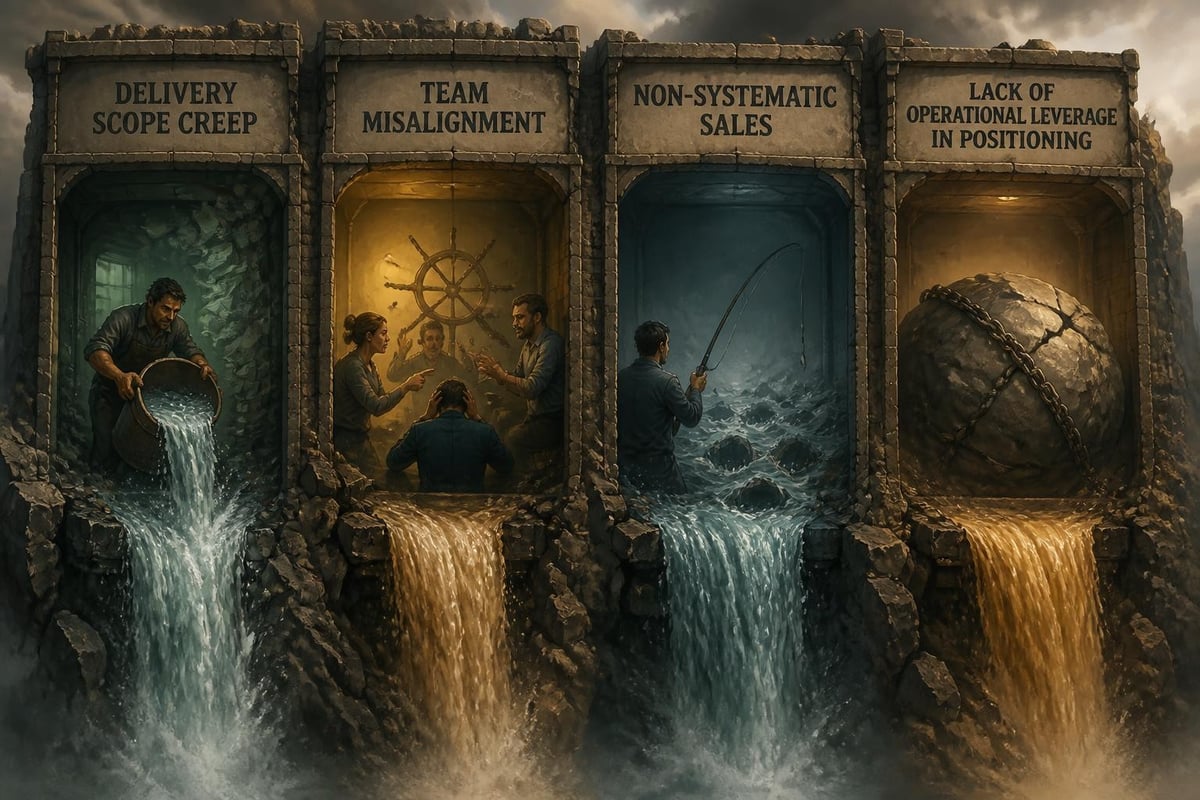
The Four Leaks Draining Your Profit
Most coaching businesses leak profit in predictable places. You can patch one or two, but unless you address the system, the leaks just move.
1. Delivery Without Boundaries
You sold a three-month package. Six months later, you are still answering Voxers. You included "unlimited access" because it sounded premium. Now it's costing you your profit margin and your sanity.
2. Team Without Accountability
You hired to get things off your plate. Instead, you are now managing people who don't understand the business well enough to make decisions. Every question comes back to you. You thought you were delegating. You are actually just explaining your work to someone else before doing it yourself.
3. Sales Without Systems
Your sales process works when you do it. But it doesn't transfer. Your team can't replicate your close rate. Your offers require too much customization. Every deal feels like a negotiation instead of an enrollment.
4. Positioning Without Profit Architecture
You are known for something. You have authority. But your market position doesn't translate into operational leverage. You are still trading time for money at a premium rate, which is just expensive employment.
What Leadership Team Coaching Actually Fixes
Let's be clear about what we are talking about. Leadership team coaching is not a feel-good workshop where everyone shares their feelings and leaves with a workbook they'll never open.
It is a strategic intervention designed to align your leadership team around the operational outcomes that drive profit.
The difference between coaching and consulting matters here. Consulting tells you what to do. Coaching builds the capacity in your team to make better decisions without you. When you understand the distinction between experience coaching and other modalities, you realize that sustainable profit comes from changing how your team thinks, not just what they execute.
The Real Work of Leadership Team Coaching
The six principles of leadership coaching provide a framework, but in practice, leadership team coaching for a scaling service business focuses on three operational outcomes:
- Decision-making clarity so your team stops defaulting every choice back to you
- Resource allocation alignment so you stop funding activities that don't generate profit
- Accountability structures so execution happens without your constant oversight
This is not theoretical. This is the difference between a $30K month where you keep $3K and a $30K month where you keep $15K.
When a leadership team operates with shared context and clear boundaries, they make faster decisions, waste less money, and deliver client outcomes without burning out the founder.
How to Know If You Need Leadership Team Coaching
You don't need leadership team coaching if you are still figuring out product-market fit. You need it when the business works, but the operations don't.
You need leadership team coaching if:
- You are generating consistent revenue but profit margins are shrinking
- Your team asks you questions they should be able to answer themselves
- You have contractors and employees but still feel like a solopreneur
- Your delivery model requires you to be present for every client touchpoint
- You are scaling revenue but your bank account isn't reflecting it
The key principles of effective executive coaching emphasize alignment with strategic goals. For a high-ticket service business, the strategic goal is not just revenue growth. It's profitable revenue growth. And that requires a leadership team that understands the difference.
The Leadership Team You Actually Need
Most founders hire the team they can afford, not the team they need. You bring on a VA, then a contractor, then maybe a part-time ops person. None of them understand the full business. None of them can see how their work connects to profit.
Leadership team coaching changes this. It creates a shared operating framework where every person on your team understands:
- What drives profit in your business model
- How their role contributes to that profit
- What decisions they own versus what needs your input
- How to prioritize when everything feels urgent
This is not about hierarchy. It's about clarity. When your team operates from the same strategic framework, they stop creating work for you and start creating leverage.
The Profit Architecture Framework and Leadership Alignment
At Rise Reign Rule, we install a framework called Profit Architecture. It consists of four pillars: Positioning, Acquisition, Delivery, and Leadership. Each pillar has to hold weight for the business to scale cleanly.
Positioning is your market authority. It's why people buy from you instead of someone cheaper.
Acquisition is your sales systems. It's how you turn attention into revenue predictably.
Delivery is your client outcomes. It's how you create transformation without burning out.
Leadership is your boundaries. It's how you protect profit while scaling operations.
Most businesses optimize one or two pillars and wonder why the structure collapses under growth. Leadership team coaching ensures all four pillars develop together.
| Pillar | Without Leadership Alignment | With Leadership Alignment |
|---|---|---|
| Positioning | Founder-dependent authority | Team amplifies market position |
| Acquisition | Only founder can close deals | Sales system operates without founder |
| Delivery | Every client requires founder | Team delivers outcomes independently |
| Leadership | Founder makes all decisions | Team operates within clear boundaries |
When your leadership team understands how these pillars connect, they make decisions that strengthen the whole structure, not just their individual function.

Case Studies: What Happens When Leadership Teams Align
The best way to understand the impact of leadership team coaching is to see what changes when teams move from misalignment to operational cohesion.
One example involves building trust and strategic focus within a senior leadership team, where coaching created the conditions for leaders to stop competing for resources and start collaborating around shared outcomes.
Another case study shows how a leadership team transformed from underperforming to high-performing through targeted coaching that aligned individual roles with organizational profit goals.
These transformations don't happen because someone attended a workshop. They happen because the leadership team developed shared language, clear decision rights, and accountability structures that outlast the coaching engagement.
What Changed in 90 Days
A typical leadership team coaching engagement for a high-ticket service business delivers measurable shifts in three months:
- Week 1-4: Diagnostic phase identifying where profit leaks through operational gaps
- Week 5-8: Installation of decision-making frameworks and accountability structures
- Week 9-12: Execution with real-time coaching on implementation challenges
The outcome is not just better meetings or improved communication. It's a leadership team that can operate the business without the founder in every conversation, which is the only way to scale profit, not just revenue.
The Difference Between Leadership Coaching and Founder Therapy
Let's address the elephant in the room. Leadership team coaching is not the same as working with a personal sales coach or getting individual founder support.
Individual coaching focuses on you. Your mindset, your blocks, your personal development. That has value, but it doesn't fix operational drag.
Leadership team coaching focuses on the system. How decisions get made. How resources get allocated. How accountability gets enforced. It builds the capacity of the entire leadership layer, not just the founder.
When you scale past $250K, your personal growth is necessary but not sufficient. You need a leadership team that can execute the business model without waiting for you to have a breakthrough.
The principles of coaching leaders apply to both contexts, but the application is fundamentally different. Individual coaching helps you become a better leader. Leadership team coaching helps your team become a better operating system.
How to Choose Leadership Team Coaching That Actually Works
Not all leadership team coaching delivers operational outcomes. Some facilitators focus on team dynamics without connecting it to business results. Others deliver consulting disguised as coaching, which creates dependency instead of capability.
What to look for:
- Business model expertise: The coach understands high-ticket service economics, not just leadership theory
- Systems thinking: The engagement focuses on how the team operates together, not just individual performance
- Accountability structures: You leave with frameworks your team can use without ongoing coaching
- Profit-linked outcomes: Success is measured by operational improvements, not just satisfaction scores
When choosing between mentoring and consulting approaches, remember that leadership team coaching should build internal capacity, not create external dependence.
Questions to Ask Before Engaging
Before you invest in leadership team coaching, get clear on what you actually need:
- Is my revenue problem or a profit problem?
- Does my team lack skills or do they lack decision-making clarity?
- Am I hiring coaching to fix my leadership or to build my team's capability?
- What operational outcome would justify this investment?
If you cannot answer these questions, you are not ready for leadership team coaching. You need strategic clarity first, execution support second.
The ROI of Leadership Team Coaching for High-Ticket Businesses
Let's talk about return on investment, because that's the only metric that matters when you are trying to keep more of what you make.
A typical leadership team coaching engagement costs between $15K and $50K depending on team size and engagement length. That sounds like a lot until you calculate what operational drag is actually costing you.
Example calculation for a $1M business with 15% profit margins:
- Current annual profit: $150K
- Profit lost to operational inefficiency: ~$200K (delivery overruns, team misalignment, founder bottleneck)
- Potential profit with aligned leadership team: $350K
If leadership team coaching recovers even 25% of that lost profit, you just added $50K to your bottom line. Every year. Compounding.
That's not ROI. That's infrastructure.
When Leadership Team Coaching Becomes Non-Negotiable
There's a moment in every scaling business where leadership team coaching shifts from "nice to have" to "the business will collapse without this."
That moment is when your personal capacity becomes the ceiling on your company's growth.
You cannot take another client without burning out. You cannot hire another person without creating more management overhead. You cannot launch another offer without diluting your delivery quality.
This is the founder bottleneck. And it doesn't get solved by working harder or hiring more people. It gets solved by building a leadership team that can operate the business without you in every decision.
Leadership team coaching creates that capacity. It transforms your team from people who execute tasks into leaders who own outcomes. And when that shift happens, profit stops being something you hope for and starts being something you architect.
Revenue growth without profit retention is just expensive chaos, and the solution isn't working harder or hiring more people. It's building a leadership team that can operate your business without bottlenecking every decision through you. If you are running a women-owned high-ticket service business generating $250K to $5M and you are tired of making more while keeping less, Rise Reign Rule installs the Profit Architecture framework that turns operational drag into predictable profit. The business works when the infrastructure underneath it finally holds what you have built.


