
Mentoring and Leadership: Scale Your Business Powerfully
The most successful women-owned service businesses don't scale through hustle alone. They scale through intentional mentoring and leadership that transforms both the founder and her team. When you're generating $250k to $5M in revenue, the gap between your current reality and your next level isn't about working harder. It's about leading differently and mentoring strategically. This shift creates the operational clarity and team leverage that turns founder-dependent businesses into profit machines.
The Hidden Cost of Leadership Gaps in High-Ticket Service Businesses
You've built something remarkable, but you're drowning in delivery. Your clients get results, yet you're still the bottleneck in every project. This scenario reveals a critical truth: technical expertise doesn't automatically translate into leadership capacity.
The founder bottleneck emerges when leadership development lags behind business growth. You mastered your craft, built authority, and created compelling offers. But now you need a completely different skill set to scale beyond yourself.
Why Traditional Leadership Training Fails Service Founders
Most leadership programs teach corporate frameworks designed for large organizations with established hierarchies. These models don't translate to boutique service businesses where you're simultaneously the visionary, the closer, and often still delivering client work.
What you actually need:
- Leadership practices that work with teams of 3-15 people
- Mentoring approaches that preserve your unique methodology
- Systems that delegate authority without sacrificing quality
- Boundaries that protect your capacity while empowering others
The evidence-based practices in mentoring for leadership development demonstrate that effective leadership emerges from structured developmental relationships, not generic management theory.
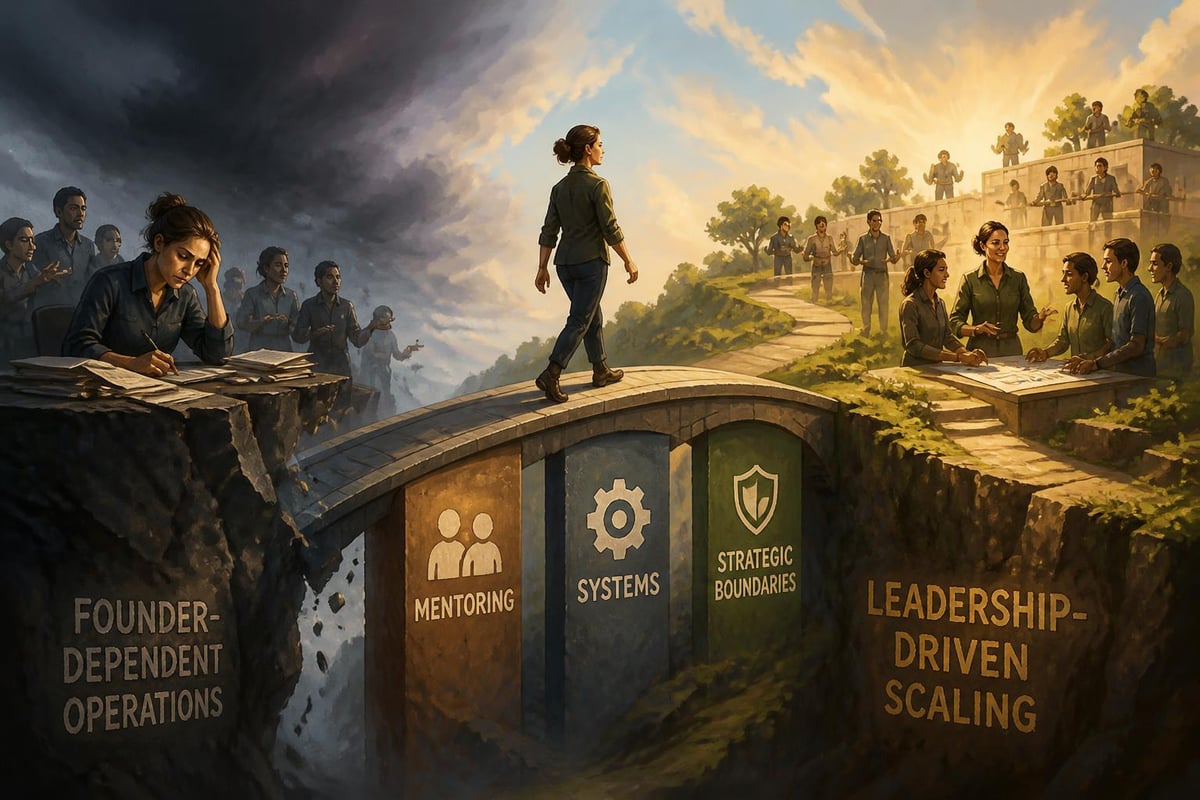
Building Your Leadership Capacity Through Strategic Mentoring
Mentoring and leadership function as two sides of the same scaling equation. Leadership without mentoring creates distance from your team and methodology. Mentoring without leadership creates dependency that prevents true leverage.
The strategic approach integrates both simultaneously. You develop leadership capacity by mentoring your team to own pieces of your methodology. This dual development accelerates growth while protecting quality.
The Four Stages of Leadership Development in Service Businesses
| Stage | Focus | Outcome | Timeline |
|---|---|---|---|
| Expert | Personal delivery | Client results through you | Years 1-2 |
| Manager | Process documentation | Repeatable systems | Months 3-6 |
| Leader | Team development | Leverage through others | Months 6-12 |
| Architect | Business design | Predictable profit | Ongoing |
Most service founders get stuck between Expert and Manager. They know they need systems but resist documenting because it feels like losing their magic. This resistance reveals a mentoring opportunity, not a leadership failure.
When you mentor someone to deliver your methodology, you're forced to articulate what makes it work. This articulation creates the foundation for systems. The comprehensive mentoring resources at Duke University emphasize how mentoring relationships accelerate both parties' development.
From Implicit Knowledge to Teachable Systems
Your expertise lives in your head as tacit knowledge accumulated through thousands of client interactions. Scaling requires externalizing this knowledge into frameworks others can apply.
The mentoring process for this transformation:
- Shadow and observe - Have team members watch you work with clients
- Narrate decisions - Explain your reasoning in real-time during delivery
- Co-create frameworks - Document patterns together with your team
- Transfer incrementally - Hand off pieces while maintaining quality standards
- Refine through feedback - Improve systems based on team experience
This approach preserves your methodology's integrity while building your leadership pipeline. You're not just delegating tasks; you're developing leaders who understand the why behind every decision.
Mentoring and Leadership as Competitive Advantage
In high-ticket service businesses, your mentoring culture becomes your scaling moat. Competitors can copy your positioning, pricing, and even your deliverables. They cannot replicate the leadership depth and team capability you've built through intentional mentoring.
The businesses generating consistent seven-figure revenue share a common characteristic: they've invested heavily in developing their people. This investment compounds in ways that marketing spending never can.

The ROI of Mentoring in Service Businesses
Traditional ROI calculations miss the multiplier effects of strong mentoring and leadership. When you develop a team member who can deliver 80% of your client results, you haven't just saved time. You've created:
- Delivery capacity for additional clients without hiring
- Quality assurance through shared standards and peer review
- Innovation pipeline as team members improve your methodology
- Client confidence in your business beyond your personal brand
- Exit optionality when your business isn't founder-dependent
The Gallup research on mentoring basics confirms that successful developmental relationships require structure, not just goodwill. You need intentional practices, not casual coffee chats.
Many service founders at Rise Reign Rule discover that their operational drag stems from underdeveloped mentoring systems. They're trying to scale delivery without scaling their leadership capacity simultaneously.
Creating Boundaries That Enable Leadership
Leadership in service businesses requires fierce boundaries. Without them, you'll stay trapped in delivery regardless of how much you mentor your team. Boundaries aren't about working less; they're about protecting the space for leadership activities.
Critical boundaries for scaling founders:
- Client access - Limited direct contact to preserve strategic capacity
- Decision authority - Clear frameworks for who decides what
- Meeting protocols - Structured communication that respects everyone's time
- Delivery responsibilities - Defined handoff points in your client journey
- Growth initiatives - Protected time for business development activities
These boundaries feel uncomfortable initially because they challenge your identity as the person who does everything. The shift from expert to leader requires releasing the dopamine hit of direct client work in favor of the delayed gratification of team development.
Implementing Mentoring Systems That Scale
Ad hoc mentoring doesn't scale. You need structured approaches that work whether you're present or not. The goal is creating a mentoring culture, not just mentor-mentee pairs.
The Elements of Effective Practice for Mentoring provides evidence-based frameworks for building sustainable mentoring programs. While designed for broader applications, the principles translate directly to service business contexts.
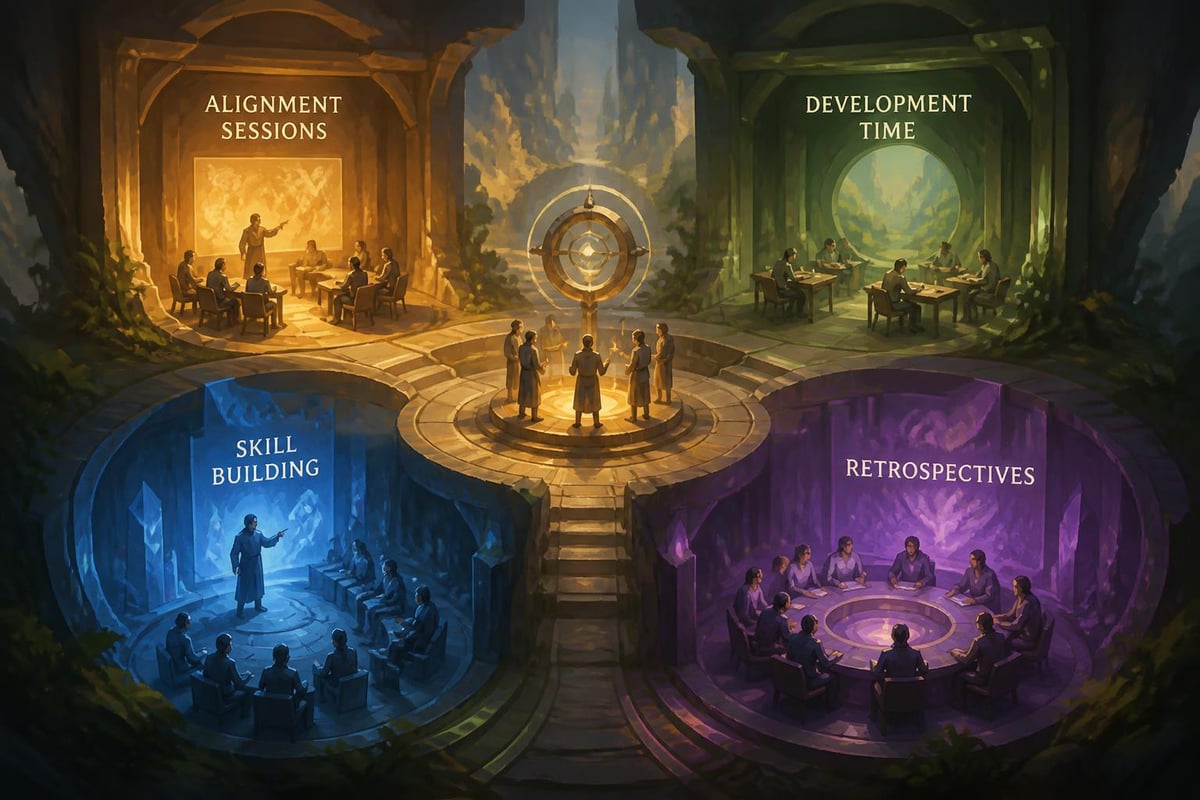
The Weekly Leadership Rhythm
Effective mentoring happens in consistent, predictable rhythms. One-off training sessions create temporary capability. Weekly practices build permanent capacity.
Your leadership rhythm should include:
- Monday alignment - 30 minutes reviewing priorities and potential obstacles
- Mid-week huddles - 15-minute check-ins on active client work
- Thursday development - 60 minutes for skills training and methodology refinement
- Friday retrospectives - 30 minutes celebrating wins and capturing lessons
This structure creates 135 minutes of dedicated mentoring time weekly. That's less than 7% of a 40-hour week, yet it delivers exponential returns through improved team capability.
The rhythm matters more than the duration. Consistency builds trust, competence, and eventually autonomy. Your team learns they'll have regular access to your expertise, which reduces interruptions during your focus time.
Developing Your Second-Tier Leadership
The most critical mentoring relationship in your business isn't with entry-level team members. It's with your first leadership hire - the person who will eventually mentor others.
This relationship requires different approaches than peer mentoring. You're not just transferring skills; you're developing someone who will replicate your mentoring capacity. The mentoring toolkit from the Society of Behavioral Medicine offers practical frameworks for navigating complex mentor relationships.
Key competencies for second-tier leaders:
- Methodology mastery - Deep understanding of your frameworks and why they work
- Quality discernment - Ability to recognize excellent work versus acceptable work
- Developmental thinking - Seeing potential in others and creating growth paths
- Boundary enforcement - Maintaining standards while supporting team members
- Strategic perspective - Connecting daily work to business objectives
These competencies develop over 12-18 months of intentional mentoring. You cannot rush this timeline. Quick promotions create leadership gaps that undermine your entire scaling strategy.
The Leadership Mindset Shift Required for Scaling
Mentoring and leadership demand a fundamental identity shift. You must evolve from the person with all the answers to the person who develops others to find answers. This transformation challenges every achievement that got you here.
You built your business on expertise. Clients hired you specifically because of your unique insights and capabilities. Now scaling requires stepping back from direct delivery, which can feel like abandoning what made you successful.
Overcoming the Expert's Dilemma
The expert's dilemma manifests as a persistent belief: "It's faster if I just do it myself." In the short term, this belief is absolutely true. In the long term, it's catastrophically false.
Every hour you spend doing work someone else could learn to do is an hour stolen from the strategic work only you can do. The math is brutal and unavoidable. If you bill $500/hour but spend time on $50/hour tasks, you're literally paying $450 for the privilege of staying busy.
The solution isn't working more hours. It's developing the discipline to mentor others while tolerating the initial inefficiency of knowledge transfer. Rise Reign Rule's approach to operational excellence addresses this exact transition point where founders must choose between comfortable expertise and uncomfortable leadership.
Sometimes this transition requires external support. Tools like DoReset can help founders dismantle the identity patterns that keep them trapped in delivery, creating space for new leadership behaviors to emerge.
From Reactive Problem-Solver to Proactive System-Builder
Leadership in scaling businesses means anticipating problems before they occur. You're designing systems that prevent fires rather than heroically extinguishing them. This shift requires completely different neural pathways than reactive problem-solving.
The transition framework:
| Reactive Mode | Proactive Mode |
|---|---|
| Respond to urgent issues | Build preventive systems |
| Fix individual problems | Identify pattern root causes |
| Work in the business | Work on the business |
| Solve for today | Design for scale |
| Personal heroics | Team capability |
The Northwestern University resources on mentoring excellence emphasize that effective mentoring requires this proactive orientation. You're not teaching people to do their current job better; you're preparing them for responsibilities they haven't yet assumed.
Creating Your Profit Architecture Through Leadership
Mentoring and leadership converge in what we call Profit Architecture - the structural foundation that enables predictable scaling. This isn't abstract theory. It's the practical framework that transforms founder-dependent service businesses into asset-building enterprises.
The four pillars of Profit Architecture each require specific leadership and mentoring approaches:
Positioning Pillar: Building Market Authority
Your positioning evolves as you scale. Initially, your personal brand drives authority. Eventually, your business's methodology and team capability must carry equal weight. This transition requires mentoring team members to represent your expertise publicly.
Leadership actions:
- Train team members to speak about your methodology with authority
- Create thought leadership opportunities for senior team members
- Develop case study narratives that highlight team expertise, not just yours
- Mentor others to write content that reflects your strategic perspective
This pillar challenges your ego directly. Can you celebrate when a team member gets credit for client results? That emotional capacity determines your scaling ceiling.
Acquisition Pillar: Systematizing Sales
Sales in high-ticket services often relies on founder charisma and personal relationships. Scaling requires transferring this capability to others while maintaining conversion rates. The mentoring challenge is teaching both the mechanics and the intuition of your sales approach.
Effective sales mentoring includes:
- Recording and reviewing actual sales conversations together
- Role-playing objection handling specific to your offer
- Documenting your qualification frameworks explicitly
- Creating decision trees for common scenarios
- Building feedback loops that improve the system continuously
The Center for Creative Leadership's insights on workplace mentoring highlight how mentoring programs must align with specific business objectives. Your sales mentoring should directly target conversion rate maintenance during scaling.
Delivery Pillar: Ensuring Client Outcomes
Client outcomes are non-negotiable in high-ticket services. Your mentoring in this pillar focuses on transferring the judgment calls that determine success or failure. Systems can guide, but people make the critical decisions that create transformational client results.
The delivery mentoring process:
- Observation cycles - Team members watch your client interactions before attempting their own
- Co-delivery periods - You work together on client accounts with decreasing involvement
- Quality reviews - Regular audits of work before it reaches clients
- Client feedback integration - Systematic capture of what's working and what needs adjustment
- Continuous improvement - Weekly refinement of delivery protocols based on real results
This pillar requires the highest mentoring investment because quality lapses destroy your business faster than anything else. You cannot delegate delivery until you've successfully transferred your quality standards.
Leadership Pillar: Establishing Boundaries
The leadership pillar closes the loop. Strong boundaries protect your capacity to mentor, lead, and think strategically. Without them, you'll revert to delivery work regardless of your intentions.
Boundary implementation through mentoring:
- Model saying no to requests that don't align with strategic priorities
- Teach team members to protect their own boundaries as they grow
- Create explicit decision-making frameworks that reduce your involvement
- Establish communication protocols that respect everyone's focus time
- Demonstrate that boundaries strengthen relationships rather than weakening them
Many founders discover they're not just building boundaries for themselves. They're creating a culture where boundaries enable better work for everyone. This realization often comes from exploring resources like understanding what you're not missing in your scaling journey.
Measuring Mentoring and Leadership Effectiveness
What gets measured gets managed. Your mentoring and leadership effectiveness must be quantifiable if you want to improve systematically. Vague assessments like "the team feels more capable" don't drive strategic decisions.
Key Performance Indicators for Leadership Development
Track these metrics monthly:
- Delegation ratio - Percentage of client work delivered without your direct involvement
- Decision velocity - Time from issue identification to resolution without escalation
- Revenue per team member - Total revenue divided by FTE count
- Quality maintenance - Client satisfaction scores as you reduce personal delivery
- Team retention - How long people stay as you develop them into larger roles
- Mentoring time investment - Hours spent on structured development activities
- System utilization - How often documented processes are followed versus ad hoc approaches
These metrics reveal whether your mentoring actually builds capacity or just creates comfortable routines without business impact. If delegation ratio isn't increasing quarterly, your mentoring isn't effective regardless of how many hours you're investing.
The 80% Rule for Leadership Readiness
A team member is ready for independent responsibility when they can deliver 80% of your results with 80% of your efficiency. Waiting for 100% keeps you trapped in delivery forever. The final 20% often takes years to develop and isn't necessary for successful scaling.
This rule requires calibrating your perfectionism. Your clients hired you for transformation, not perfection. If a team member can deliver the transformation with slightly different methods or pacing, you must give them room to operate.
The emotional work here is profound. You're releasing control over the details that made you successful. You're betting on systems and people instead of personal heroics. This transition separates founders who scale from founders who stay stuck at their current revenue ceiling.
Building Mentoring Sustainability as You Scale
The mentoring approaches that work at $500k revenue fail at $2M revenue. Your leadership development must evolve as your business grows. What starts as personal coaching becomes group training, then systemized onboarding, then culture that perpetuates itself.
The Evolution of Mentoring Infrastructure
Early stage ($250k-$750k):
- Personal mentoring from you to each team member
- Informal knowledge transfer through shadowing
- Weekly check-ins to address questions and concerns
Growth stage ($750k-$2M):
- Introduction of second-tier leaders who mentor others
- Documented processes that reduce dependency on you
- Group training sessions for common competencies
Scale stage ($2M-$5M):
- Formalized mentoring programs with structure and accountability
- Leadership development tracks for high performers
- Culture of mentoring where everyone develops someone else
The research on proactive mentoring from the National Center for Principled Leadership demonstrates that sustainable programs require intentional design, not just goodwill. As you scale, invest in the infrastructure that makes mentoring systematic rather than dependent on your personal availability.
This infrastructure becomes a recruiting advantage. Top talent seeks businesses where they'll be developed, not just employed. Your mentoring culture attracts people who want to grow, which creates a virtuous cycle of capability building.
Mentoring and leadership aren't soft skills that can wait until you have more time. They're the foundational capabilities that determine whether your business scales profitably or stays trapped in founder dependency. When you're ready to transform operational drag into predictable profit through proven frameworks, Rise Reign Rule specializes in installing the Profit Architecture that women-owned service businesses need to scale cleanly. The question isn't whether you'll develop these capabilities, but whether you'll do it strategically or learn through expensive mistakes.


