
One on One Leadership Coaching That Drives Revenue Growth
Every woman-owned service business hits the same invisible ceiling. You're billing $400k, maybe pushing toward seven figures, but you're trapped in delivery. Your calendar is a Jenga tower of client calls, team check-ins, and fires to put out. The business you built to create freedom has become a cage, and you're the first one locked inside. This is where one on one leadership coaching becomes the difference between plateauing at half a million and building a genuinely scalable enterprise.
The traditional advice tells you to hire more people, systematize faster, or work on your mindset. But here's what nobody mentions: your leadership operating system was built for a $150k business, not a million-dollar one. The skills that got you here, the instincts that built your client base, the hands-on approach that created your reputation, these same strengths are now choking your growth. You need a complete rebuild, not another productivity hack.
Why High-Ticket Service Founders Need Specialized Leadership Development
Generic executive coaching doesn't cut it for women running high-ticket service businesses. Your challenges are fundamentally different from corporate leaders or product-based entrepreneurs.
When you're selling $25k, $50k, or $100k engagements, every client relationship carries massive weight. You can't delegate your way out of expertise, but you also can't personally deliver every outcome. This paradox creates unique leadership demands that standard coaching frameworks completely miss.
Consider the operational reality of scaling from $250k to $2M in service revenue:
| Revenue Stage | Typical Team Size | Founder's Role | Leadership Challenge |
|---|---|---|---|
| $250k-$500k | 0-2 contractors | Chief everything officer | Doing all delivery + all sales |
| $500k-$1M | 3-5 team members | Delivery lead + strategist | Can't let go of client work |
| $1M-$2M | 6-12 employees | Architect + coach | Team dependent on founder input |
| $2M-$5M | 12-25 staff | Vision holder + system builder | Creating leaders, not doers |
Each transition requires you to kill a version of yourself that clients loved and team members relied on. One on one leadership coaching gives you a private space to grieve these deaths, rebuild your identity, and emerge as the leader your business actually needs.

The Founder Bottleneck Problem That Group Programs Can't Solve
You've probably tried group masterminds or cohort-based programs. They're valuable for network and exposure to new ideas, but they fail at the deeply personal work of leadership transformation.
Here's why: your specific bottleneck is uniquely yours.
Maybe you're brilliant at client strategy but terrible at holding team accountability. Perhaps you've built incredible delivery systems but your sales conversations still feel desperate. You might be phenomenal at vision-casting but paralyzed when it's time to make hard personnel decisions. These aren't problems you can workshop in a group of twelve founders.
The research-backed case for one-on-one coaching approaches shows that individualized development creates behavior change three times faster than group learning. In a high-ticket service business where your revenue is directly tied to your leadership capacity, speed matters enormously.
A career and leadership coach working one-on-one can spot the invisible patterns sabotaging your scale:
- The way you apologize when stating boundaries with clients
- How you rescue team members instead of coaching them through problems
- Your tendency to drop strategic work the moment a client email arrives
- The subtle people-pleasing that prevents you from raising prices
These micro-behaviors compound into massive revenue constraints. Group settings can't provide the focused attention needed to rewire them.
Four Pillars of Effective One on One Leadership Coaching for Service Businesses
The best coaching for high-ticket service founders addresses four interconnected domains. Miss any one, and you'll keep hitting the same ceiling.
Positioning: Leading From Authority Instead of Hustle
Your market position determines everything about how you lead. When you're positioned as a premium expert, you lead with boundaries and strategic selectivity. When you're positioned as a generalist hustler, you lead with accommodation and overdelivery.
One on one leadership coaching helps you make the internal shifts that external positioning requires:
- Owning your pricing without apology or justification
- Saying no to wrong-fit clients even when revenue feels tight
- Standing in your expertise instead of deferring to client opinions
- Setting the terms of engagement rather than accepting whatever clients demand
This isn't about affirmations or confidence-building exercises. It's about systematically identifying and eliminating the apologetic language, hesitant energy, and accommodating behaviors that signal you're not really a premium player.
Acquisition: Building Sales Systems That Don't Require You
Most service founders are exceptional closers. You can convert a qualified lead at 60%, 70%, even 80% because you're talented, intuitive, and genuinely invested in client outcomes.
This strength becomes your prison.
The business can't scale beyond your personal sales capacity, and you can't step back from sales without revenue collapsing. Leading effective one-on-one meetings with team members who handle sales requires you to transfer not just scripts, but your entire sales operating system into their minds.
One on one leadership coaching creates space to:
- Deconstruct your intuitive sales process into trainable steps
- Identify which parts genuinely require you versus which are habit
- Design coaching conversations that build sales capability in your team
- Hold yourself accountable to stepping back as they step up
The insights from executive coaches on transforming leadership consistently show that founders struggle most with delegation in revenue-generating activities. A skilled coach helps you see that protecting your sales role isn't protecting the business, it's limiting it.
Delivery: Creating Client Outcomes Without Doing the Work
High-ticket clients expect exceptional results. Early in your business, you delivered those results personally. At scale, you need to create them through your team, not despite them.
This requires a complete leadership mindset shift:
- From being the smartest person in the room to hiring people smarter than you in specific domains
- From quality control through personal review to quality control through systems and training
- From swooping in to fix problems to coaching team members through their own problem-solving
- From clients wanting specifically you to clients trusting your methodology and team
When you recognize the five signs your one-on-ones aren't working with your delivery team, you need coaching support to rebuild those conversations. Your team members should leave one-on-ones more capable, not more dependent.

Leadership: Boundaries That Protect Profit and Sanity
The final pillar is often the most uncomfortable. As a service business founder, you've likely built your reputation on being accessible, responsive, and deeply invested. These qualities created your initial success and now threaten your survival.
Boundary-setting isn't about becoming cold or unavailable. It's about strategic preservation of your highest-value contribution.
| Boundary Type | Looks Like | Protects |
|---|---|---|
| Time boundaries | No client calls after 4pm, no Slack on weekends | Strategic thinking space |
| Scope boundaries | Clear deliverables, change request process | Profitability per client |
| Access boundaries | Team handles tier-two questions, you handle tier-one only | Leadership capacity |
| Energy boundaries | Declining wrong-fit clients even when profitable | Brand positioning and team morale |
One on one leadership coaching provides the accountability structure to actually implement these boundaries. Your coach becomes the external spine holding you to commitments your people-pleasing instincts want to abandon.
When to Invest in One on One Leadership Coaching
Timing matters enormously. Invest too early, and you're solving problems you don't yet have. Invest too late, and you've already burned out your best team members or lost your competitive edge.
The right time for one on one leadership coaching is when you spot these signals:
- Revenue is growing but profit margins are shrinking
- You're hiring but still working the same hours (or more)
- Team members keep asking you questions they should be able to answer
- You're declining opportunities because you lack capacity, not interest
- The idea of a two-week vacation creates panic, not excitement
These aren't signs of failure. They're signs you've outgrown your current leadership operating system and need an upgrade. A personal development company focused on business scaling understands that this transition point is predictable and navigable with the right support.
The investment case is straightforward: if your leadership constraints are capping revenue at $750k when your market opportunity and delivery capacity could support $2M, what's the cost of waiting another year to address them?
Measuring ROI on Leadership Development
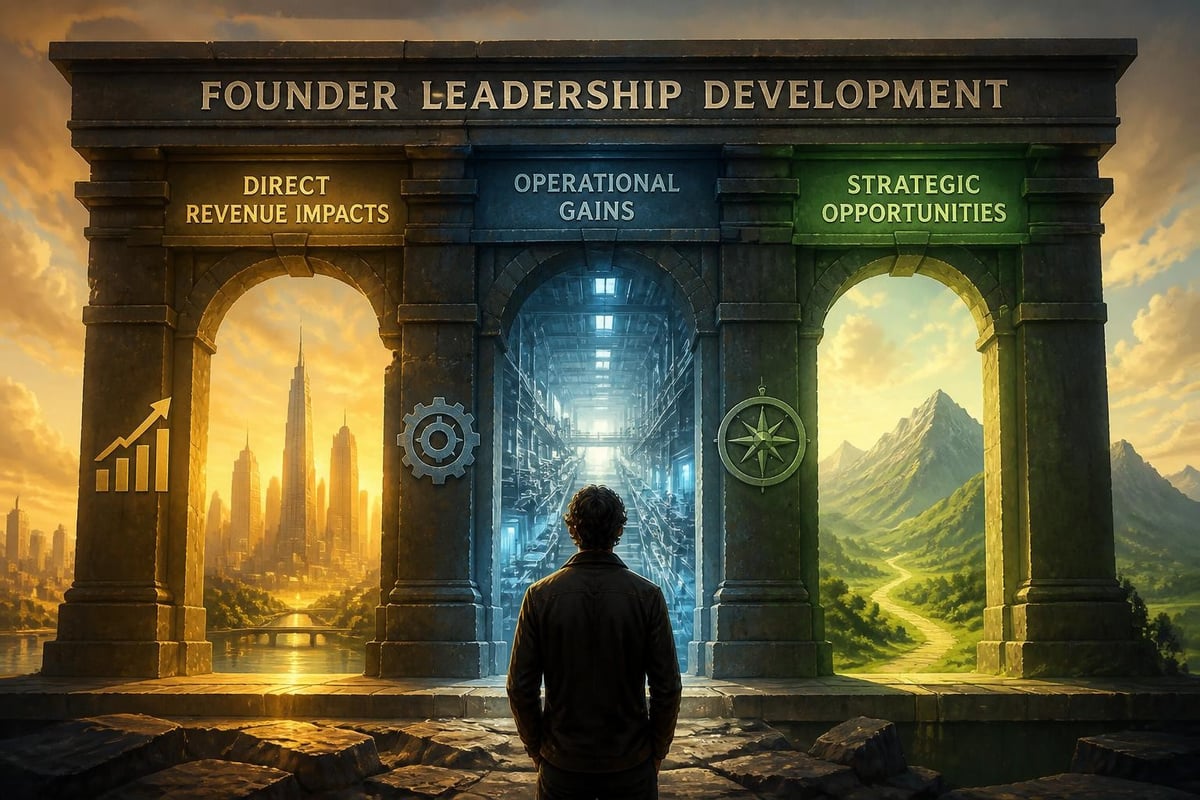
CFO-minded founders want to see numbers. Fair enough. Here's how to think about returns on one on one leadership coaching:
Direct revenue impact:
- Increased pricing confidence leading to 15-30% price increases
- Improved sales conversion as you lead from authority instead of desperation
- Larger deal sizes when you stop undervaluing your expertise
- New revenue streams you couldn't create while buried in delivery
Operational efficiency gains:
- Reduced founder hours per dollar of revenue (your goal: 50% reduction in 12 months)
- Lower team turnover as you shift from micromanagement to true leadership
- Faster decision-making with clear frameworks replacing rumination
- Decreased rework and scope creep through better boundary-setting
Strategic opportunity capture:
- Bandwidth to pursue partnership and collaboration opportunities
- Mental space to spot market trends and pivot positioning
- Capacity to build the content and thought leadership that compounds authority
- Time to work on the business instead of just in it
The CIPD guidance on measuring coaching effectiveness recommends tracking both leading indicators (behavior changes, capability development) and lagging indicators (revenue, profit, team retention). Your coach should help you establish these metrics upfront.
Selecting the Right One on One Leadership Coach
Not all coaching is created equal, and the wrong fit wastes both money and precious time. High-ticket service founders need coaches who understand your specific context.
Essential criteria for your shortlist:
- Service business experience: Product and corporate backgrounds don't translate. Your coach should understand recurring revenue models, client relationship dynamics, and delivery scalability challenges.
- Revenue-stage relevance: Someone who coaches Fortune 500 executives won't understand your $800k revenue constraints. Find coaches who work specifically with businesses in the $250k-$5M range.
- Gender-informed approach: Women-owned businesses face distinct challenges around authority, pricing, and leadership credibility. Your coach should acknowledge and address these realities, not pretend they don't exist.
- Systems orientation: Pure mindset coaching feels good but changes little. You need someone who helps you build actual systems, frameworks, and repeatable processes.
- Accountability structure: Weekly or biweekly sessions with clear homework, metrics tracking, and progress milestones. Therapy is monthly; coaching is weekly.
The SHRM perspective on executive coaching limits warns against coaching that becomes indefinite support rather than targeted development. Your engagement should have clear objectives, timelines, and graduation criteria.
Red flags to avoid:
- Coaches who can't articulate their methodology or framework
- Programs that are identical for every client regardless of context
- Resistance to tracking measurable business outcomes
- More focus on your childhood than your current leadership challenges
- Inability to provide client case studies or reference conversations
Integrating Coaching Insights Into Daily Leadership Practice
The gap between coaching sessions and actual behavior change is where most leadership development fails. You have a breakthrough conversation on Tuesday, and by Thursday you're back to your old patterns because the operational pressure hasn't changed.
Effective one on one leadership coaching builds integration mechanisms:
- Weekly implementation scorecards tracking specific behavior changes (not just completion of tasks)
- Real-time Voxer or Slack access for in-the-moment coaching when you're about to make a decision your old self would make
- Team-facing frameworks your coach helps you create, so your leadership changes are supported by new structures
- Monthly team feedback loops where your direct reports share observed changes, creating external accountability
- Quarterly business metric reviews connecting leadership shifts to actual revenue and profit outcomes
The evidence-based coaching practices research shows that coaching combined with structured action planning produces significantly better results than coaching conversations alone.
Your coach should help you create what we call "leadership circuit breakers" - automatic stops that prevent you from reverting to founder-as-bottleneck behavior:
- Before you answer a team question, ask: "What would you recommend?"
- Before you say yes to a client request, check: "Is this within our documented scope?"
- Before you join a meeting, confirm: "Am I the only person who can add value here?"
- Before you work past 6pm, ask: "Is this genuinely urgent or am I avoiding trust?"
These simple interventions, practiced consistently with coaching support, rewire your leadership operating system faster than any amount of insight alone.
The Compound Effect of Leadership Transformation
Here's what nobody tells you about one on one leadership coaching: the biggest returns come 12-24 months after the engagement ends.
The boundary-setting you practice today determines which clients you attract next year. The delegation muscle you build this quarter determines what your team is capable of in 18 months. The strategic thinking time you protect now determines whether you spot the market shift that defines your next growth phase.
Leadership development compounds like content marketing or relationship building. The effects are subtle at first, then suddenly everywhere.
Your team starts solving problems you didn't know they could handle. Clients stop pushing back on prices because your authority is palpable. Strategic opportunities appear because you finally have bandwidth to see them. Revenue grows while your hours shrink because you've built a business that doesn't require you to touch everything.
This is the promise of one on one leadership coaching done right: not just a better version of your current business model, but a fundamentally different operating system that makes clean scaling possible.
The alternative is continuing to trade your time and energy for revenue with incrementally better systems, hitting a hard ceiling somewhere between $750k and $1.5M, and eventually burning out or selling for less than the business could have been worth.
For women-owned high-ticket service businesses, leadership development isn't a luxury investment. It's the unlock that determines whether you build an asset or just buy yourself an exhausting job.
One on one leadership coaching transforms how you show up, make decisions, and build capacity in your high-ticket service business. When you're ready to break through the founder bottleneck and install the leadership operating system your revenue goals demand, Rise Reign Rule provides the strategic framework and expert guidance to make it happen. Our Profit Architecture methodology addresses positioning, acquisition, delivery, and leadership boundaries simultaneously, creating the integrated transformation that drives predictable profit and clean scaling for women-owned businesses doing $250k-$5M in revenue.


