
Strategic Coaching: The Catalyst for Scalable Businesses
You've built a successful high-ticket service business, crossed multiple six figures, maybe even pushed into the seven-figure territory. Yet here's the brutal truth: you're still the bottleneck. Every client engagement, every strategic decision, every operational hiccup still routes through you. The business doesn't scale because it can't run without you in the driver's seat. This is where strategic coaching becomes not just valuable, but mission-critical. Unlike traditional business coaching that focuses on mindset or motivation, strategic coaching is the deliberate application of coaching methodologies to unlock organizational systems, leadership capacity, and sustainable profit architecture.
The Strategic Coaching Difference: Systems Over Sessions
Traditional coaching often centers on individual breakthroughs and personal development. Strategic coaching operates at a different altitude entirely.
It's the intersection of three critical elements:
- Systems thinking: Understanding how business components interact and create leverage
- Operational rigor: Building processes that function without founder intervention
- Leadership architecture: Developing capacity across the organization, not just at the top
When you examine businesses stuck between $250K and $5M, the pattern becomes unmistakable. Founders are brilliant at delivery, exceptional at client relationships, and completely trapped by their own expertise. Coaching for talent development reveals that organizations using coaching strategically see measurable improvements in leadership pipelines and operational effectiveness.
The distinction matters because your time investment should yield compounding returns. One strategic coaching session that redesigns your sales system generates value forever. One mindset session generates value until your next emotional dip.

Why Founders Resist What They Need Most
The resistance to strategic coaching follows predictable patterns. You've succeeded this far through personal excellence, technical mastery, and sheer determination. The suggestion that you need coaching can feel like an indictment of your capabilities.
But consider these operational realities:
- You can't see your own blind spots. You're too close to your business model to identify structural inefficiencies.
- You lack the frameworks. Most service business founders are experts in their craft, not in scaling operations.
- You're optimizing the wrong metrics. Revenue growth without profit architecture just creates expensive chaos.
- You mistake activity for progress. Busy doesn't equal strategic, and tactical wins don't compound.
The World Economic Forum notes that coaching, particularly when embedded strategically, outperforms technology investments in driving employee performance. The same principle applies to founder performance. No CRM will fix a broken sales process. No project management tool will solve unclear client outcomes.
Profit Architecture: The Framework That Compounds
Strategic coaching without a framework is just expensive conversation. You need structured methodology that addresses the four weight-bearing walls of a scalable service business.
| Pillar | Bottleneck It Solves | Strategic Coaching Focus |
|---|---|---|
| Positioning | Competing on price, attracting wrong clients | Market authority, premium positioning, ideal client definition |
| Acquisition | Inconsistent pipeline, founder-dependent sales | Repeatable sales systems, conversion optimization, team enablement |
| Delivery | Scope creep, inconsistent outcomes, team chaos | Outcome frameworks, delivery systems, quality without founder involvement |
| Leadership | Founder burnout, unclear boundaries, team dependency | Decision frameworks, boundary systems, leadership capacity building |
This is the Profit Architecture approach, and it's designed specifically for women-owned high-ticket service businesses navigating the treacherous territory between startup scrappiness and enterprise-level operations.
Positioning: Where Strategic Coaching Starts
Your positioning determines everything downstream. If you're positioned as "another marketing consultant" or "business coach," you're competing in an ocean of sameness. Strategic coaching in this pillar focuses on excavating what makes you genuinely different and valuable.
The strategic questions that matter:
- Who pays premium prices without negotiation in your space, and why?
- What transformation can you guarantee that competitors can't or won't?
- How do you create category authority that makes you the obvious choice?
Most founders skip this work because it feels theoretical. They want tactics, not strategy. But tactics applied to weak positioning just accelerate your race to the bottom. Strategic coaching forces you to get this foundation right before scaling what doesn't work.
Building Acquisition Systems That Don't Need You
Here's where strategic coaching diverges sharply from traditional approaches. Your sales process should be a system, not a personality contest.
Current state for most service businesses:
You take discovery calls. You craft custom proposals. You negotiate pricing. You close deals. You onboard clients. Every single step requires your specific expertise, charisma, and availability.
Target state after strategic coaching:
Your business development system qualifies leads, delivers consistent value propositions, presents standardized (but customized) solutions, and converts prospects at predictable rates. With or without you in every conversation.
The shift requires adopting a coaching leadership style that develops team capability rather than maintaining founder dependency. You coach your business development team to handle objections, identify fit, and close business using frameworks you've built together.
The Numbers Tell the Truth
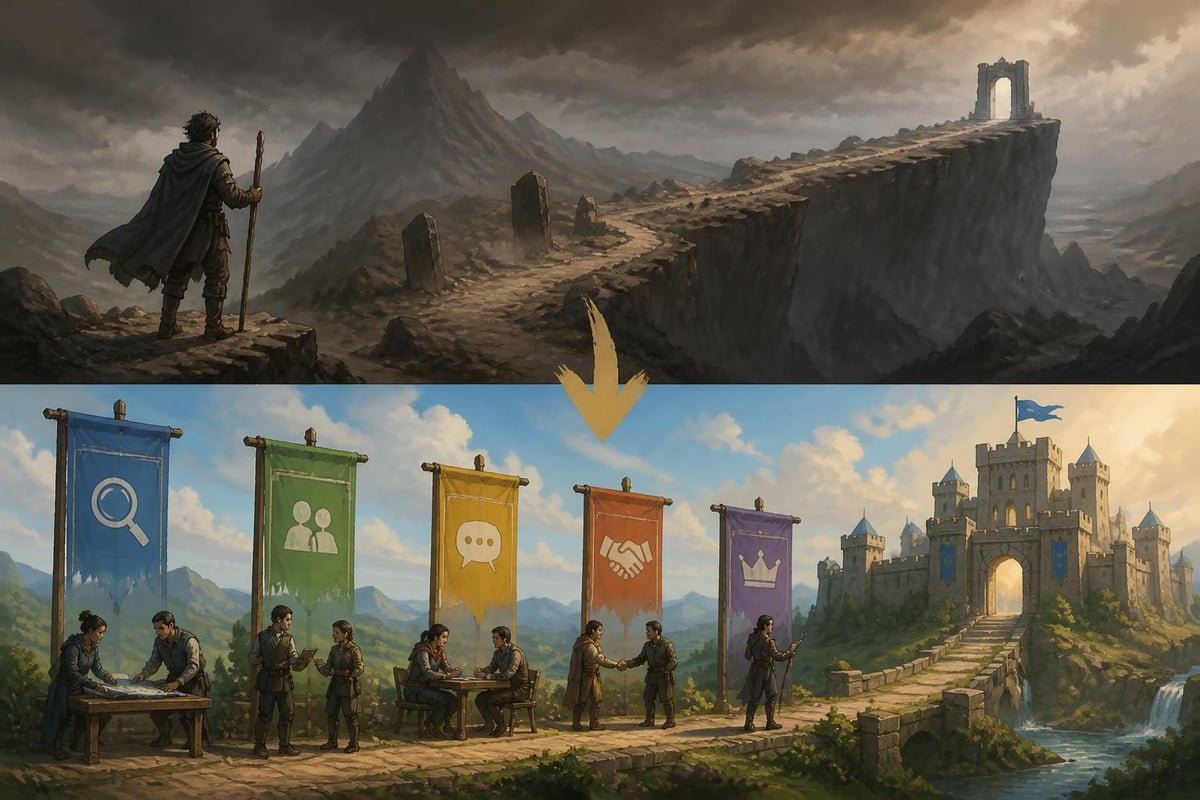
Consider two businesses, both generating $750K annually:
Business A (No Strategic Framework):
- Founder takes 8-12 sales calls weekly
- Conversion rate: 40% (because founder is exceptional)
- Average deal size: $15K
- Founder time on sales: 20 hours/week
- Team can't close deals independently
Business B (With Strategic Coaching & Systems):
- Team handles qualified leads using documented framework
- Conversion rate: 35% (slightly lower, but consistent)
- Average deal size: $22K (better positioning and packaging)
- Founder time on sales: 4 hours/week (strategy only)
- Team closes 80% of deals independently
Business A makes slightly more per deal and converts slightly better. Business B scales. The founder in Business B just reclaimed 16 hours weekly to work on delivery systems, strategic partnerships, or-revolutionary concept-actual rest.
Delivery Systems: The Unsexy Foundation of Scale
Strategic coaching in the delivery pillar addresses the most common profit killer in service businesses: scope creep masked as exceptional client service.
You pride yourself on going above and beyond. Your clients love you because you're so responsive, so accommodating, so willing to customize everything. And you're slowly suffocating under the weight of unsustainable promises.
The strategic coaching intervention focuses on:
- Outcome definition: What specific result are clients paying for? Not deliverables. Results.
- Delivery methodology: What's the proven process that generates those results reliably?
- Boundary frameworks: What's included, what's not, and how do you communicate that with confidence?
- Team enablement: How do team members deliver excellence without needing to ask you every question?
Stanford Medicine's approach to coaching within organizational development emphasizes assessment and methodology. The same rigor applies to service delivery. You need documented processes, quality checkpoints, and clear success metrics.
The Client Outcome Matrix
| Deliverable Focus | Outcome Focus |
|---|---|
| "We'll run 12 strategy sessions" | "Your team will make decisions 3x faster with 40% better outcomes" |
| "We'll redesign your brand identity" | "Your market positioning will command 2x higher fees within 90 days" |
| "We'll implement this software" | "Your operational efficiency will improve 60% with zero added headcount" |
Which one justifies premium pricing? Which one creates client dependency on deliverables versus results? Strategic coaching helps you make this shift systematically.
Leadership: Boundaries as Business Strategy
The leadership pillar is where strategic coaching becomes transformational for women-owned businesses specifically. Cultural conditioning teaches women to be accommodating, flexible, and relationship-focused. These are strengths until they become structural liabilities.
Boundary failures that destroy profitability:
- Answering client messages at all hours (because you're "accessible")
- Customizing every engagement (because every client is "unique")
- Extending timelines without additional fees (because you "care about results")
- Taking on scope beyond the agreement (because you "don't want them to fail")
These aren't character strengths. They're unexamined operational decisions that tank your margins and create unsustainable client expectations.
Strategic coaching in leadership focuses on building boundary systems that protect profit while maintaining exceptional outcomes. Deloitte's research on workplace microcultures demonstrates that culture and leadership development function as strategic levers for performance. Your internal culture of boundaries directly impacts external profitability.
Building Your Leadership Operating System
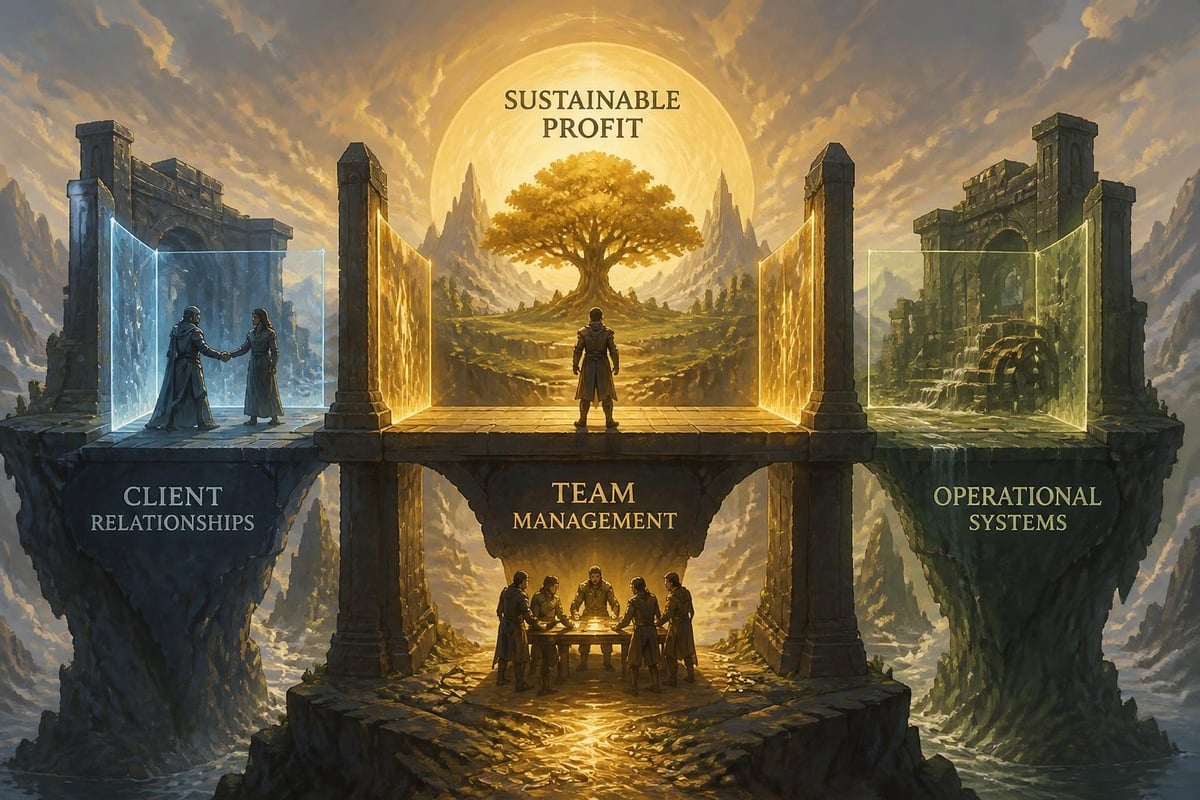
Strategic coaching develops your leadership operating system through three interconnected frameworks:
Decision Architecture:
- What decisions require your input versus team autonomy?
- What's your decision-making framework for strategic versus tactical choices?
- How do you prevent decision bottlenecks while maintaining quality?
Boundary Protocols:
- Communication boundaries (when, how, through what channels)
- Scope boundaries (what's included, change request processes)
- Time boundaries (availability, response times, project timelines)
Team Development:
- How do you coach team members to higher capability?
- What does progressive responsibility look like in your organization?
- How do you create accountability without micromanagement?
The Rise Reign Rule approach treats these as interconnected systems, not isolated initiatives. Your communication boundaries inform your delivery systems. Your team development strategy enables your acquisition scalability. Everything connects.
The ROI of Strategic Coaching: What Actually Changes
Let's discuss return on investment with brutal honesty. Strategic coaching is an investment of both money and founder attention. What's the measurable return?
Quantifiable impacts within 90-180 days:
- Founder time reclamation: 10-20 hours per week redirected from operations to strategy
- Revenue per hour improvement: 40-100% increase as you exit low-value activities
- Team velocity: 30-60% improvement in project completion without quality degradation
- Profit margin expansion: 8-15 percentage points through boundary enforcement and scope control
- Sales cycle reduction: 20-40% shorter from first contact to signed agreement
Qualitative transformations that compound:
Beyond the numbers, strategic coaching creates organizational capacity that generates returns indefinitely. Your team makes better decisions independently. Your clients get clearer outcomes. Your positioning attracts better-fit prospects. Your boundaries protect your energy and creativity.
Consider examining case studies from businesses that have implemented strategic frameworks. The pattern is consistent: initial discomfort (setting boundaries feels scary), rapid operational improvement (systems create breathing room), sustainable scaling (growth without proportional stress increase).
Implementation: Where Strategic Coaching Meets Reality
Theory is worthless without implementation discipline. Strategic coaching provides frameworks, but you must execute them with consistency.
The 90-day implementation cycle:
Weeks 1-2: Assessment and Architecture
- Current state analysis across all four pillars
- Identify the primary bottleneck choking growth
- Design the strategic framework specific to your business model
Weeks 3-6: Pilot and Iteration
- Implement the first system in controlled environment
- Document what works and what requires adjustment
- Train initial team members on new frameworks
Weeks 7-10: Scale and Systematize
- Roll out proven frameworks across full client base
- Build documentation and training materials
- Establish quality checkpoints and accountability measures
Weeks 11-12: Measurement and Optimization
- Review quantitative results against baseline
- Identify next bottleneck for subsequent cycle
- Refine systems based on real-world performance
This is where many founders falter. They love the strategy session, the breakthrough insights, the exciting frameworks. They struggle with the disciplined execution that follows.
Strategic coaching includes accountability structures precisely for this reason. Working with a team that understands the implementation challenges specific to women-owned service businesses makes the difference between exciting plans and actual transformation.
The Founder Evolution: From Doer to Architect
The ultimate goal of strategic coaching isn't making you better at doing the work. It's making you unnecessary for the work itself.
Your evolution looks like this:
Stage 1: Expert Doer You are the business. Your expertise, your relationships, your availability determine capacity and quality.
Stage 2: Manager You've hired team members who execute tasks under your direction. You're still involved in every client engagement and most decisions.
Stage 3: Leader Your team handles most client work independently. You focus on strategy, key relationships, and removing obstacles.
Stage 4: Architect You've built systems that generate outcomes reliably. Your focus is innovation, strategic partnerships, and market positioning. The business scales without your daily involvement.
Most founders get stuck between Stage 2 and Stage 3. They've hired help but haven't built systems. They've delegated tasks but not decision-making authority. Strategic coaching provides the frameworks that enable the Stage 3 to Stage 4 transition.
Strategic coaching transforms founder-dependent businesses into scalable enterprises through systematic frameworks across positioning, acquisition, delivery, and leadership. The investment pays dividends in reclaimed time, expanded margins, and sustainable growth that doesn't require your burnout as fuel. If you're ready to architect predictable profit and clean scaling in your high-ticket service business, Rise Reign Rule specializes in exactly this transformation for women-owned businesses generating $250K to $5M in revenue.


