
Strategic Leadership Coaching for High-Ticket Growth
Your business crossed $250k. Maybe you've even hit seven figures. But instead of feeling victorious, you're exhausted. Every client escalation lands on your desk. Your team asks permission for decisions you thought they'd own. Revenue is climbing, but profit margins are shrinking because you're the bottleneck in every process. This is the precise moment strategic leadership coaching becomes non-negotiable. Not the fluffy "mindset work" that leaves you feeling inspired but operationally stuck. Real coaching that rebuilds how you lead, delegate, and architect profit into your high-ticket service model.
Why Traditional Leadership Training Fails Women-Owned Service Businesses
Most leadership development programs were designed for corporate hierarchies, not the unique pressure cooker of founder-led service companies. You don't need another framework for "managing up" when you are the top. You need strategic leadership coaching that addresses the specific failure points in scaling a business where your expertise is the product.
The problem compounds when you're generating $500k to $5M in revenue. At this stage, your operational complexity has outpaced your leadership infrastructure. You have team members but no true organizational system. You have clients but no delivery process that works without your personal involvement.
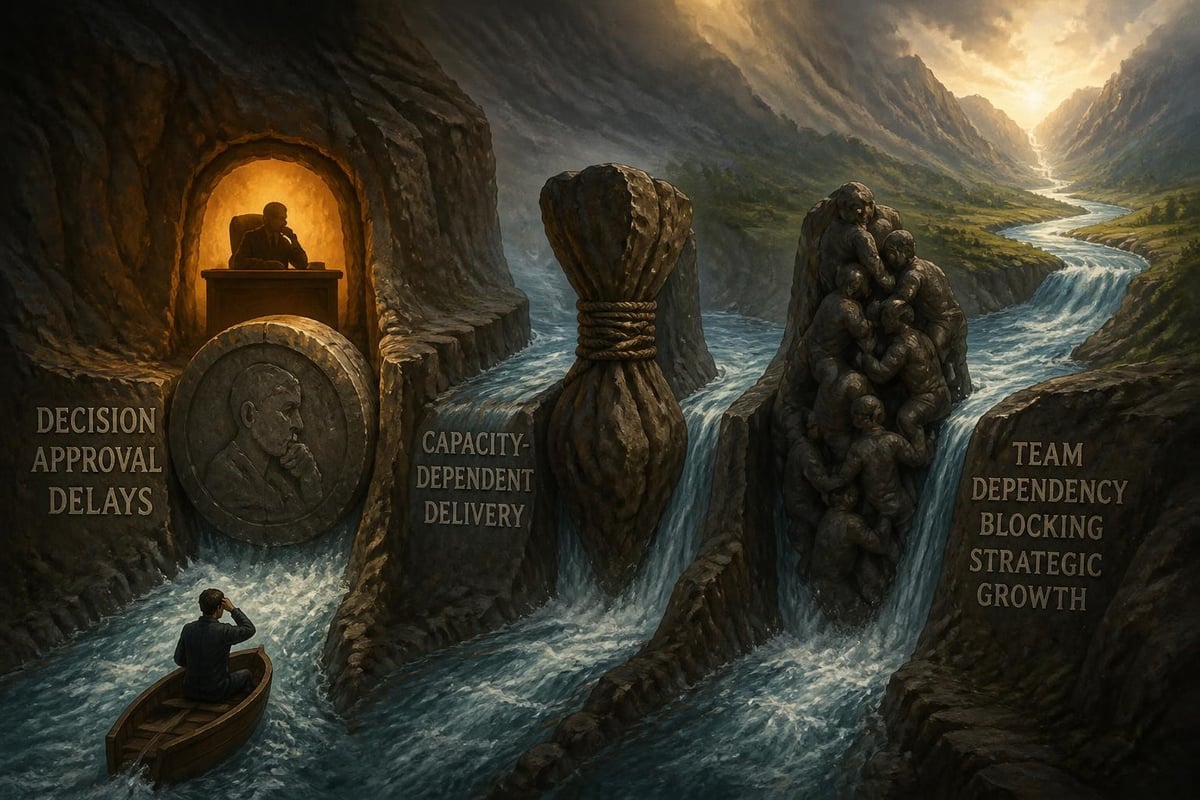
This creates three predictable bottlenecks:
- Decision-making delays because everything requires founder approval
- Inconsistent client outcomes tied directly to your personal capacity
- Team dependency that prevents you from working on strategic growth
Strategic leadership coaching targets these bottlenecks systemically, not symptomatically. Instead of teaching you how to be a "better communicator" in abstract terms, it rebuilds the actual mechanisms through which you lead. According to research from the Center for Creative Leadership on coaching cultures, organizations that embed coaching into their leadership model see 25% higher team performance and 39% better client satisfaction scores.
The Profit Architecture Connection
At Rise Reign Rule, we've identified that strategic leadership coaching must operate across four integrated pillars: Positioning, Acquisition, Delivery, and Leadership. Most coaches address only the fourth pillar, treating leadership as an isolated skill set. That's why their clients feel motivated after sessions but see no change in revenue or operational flow.
Real strategic leadership coaching rewires how you position authority in your market, how you acquire clients through systems instead of hustle, how you deliver outcomes without being the bottleneck, and how you set boundaries that protect profit. These aren't separate initiatives. They're interdependent mechanisms that either amplify each other or cancel each other out.
Consider a client who came to us generating $1.2M annually but taking home only $180k after expenses. Her leadership style was heroic: she jumped into every client crisis, personally reviewed every deliverable, and made herself available 24/7. Strategic leadership coaching didn't just address her "boundaries problem." We rebuilt her entire delivery model so client outcomes didn't require her direct involvement, then trained her to lead through systems rather than personal intervention.
Four Coaching Styles and When Each Unlocks Growth
Harvard Business Review's recent analysis of coaching styles and strategic application reveals that effective leaders don't use one coaching approach universally. They match method to growth stage and strategic objective. For high-ticket service founders, understanding which style to deploy (and when) directly impacts scaling velocity.
| Coaching Style | Primary Goal | Best Used When | Impact on Service Business |
|---|---|---|---|
| Directive | Skill transfer, immediate performance | Training new processes, crisis management | Builds team capability quickly, reduces founder dependency |
| Facilitative | Problem-solving ownership, critical thinking | Team has knowledge but lacks confidence | Develops decision-making autonomy, accelerates client delivery |
| Developmental | Long-term capability building, career growth | Scaling leadership team, succession planning | Creates organizational depth, enables founder to exit operations |
| Transformational | Identity shifts, strategic pivots | Repositioning, entering new markets, business model changes | Unlocks new revenue models, expands market authority |
Most founders default to directive coaching because it feels fastest. You tell your team exactly what to do, and it gets done right. But this creates learned helplessness. Your team stops thinking strategically because you've trained them to wait for your instructions.
Strategic leadership coaching teaches you to diagnose which style each situation requires. When onboarding a new account manager, directive coaching builds competence rapidly. But when that same account manager faces a client challenge six months later, facilitative coaching forces them to develop their own solutions. This is how you build a team that operates independently while maintaining your quality standards.
The Listening Advantage in Strategic Communication
One counterintuitive insight from strategic leadership coaching: the most powerful leaders talk less, not more. Stanford's research on leadership communication and listening demonstrates that strategic influence comes from asking better questions, not providing better answers.
For women-owned service businesses, this has immediate operational implications. Every hour you spend solving problems your team should own is an hour you're not spending on strategic positioning, partnership development, or business model innovation. Strategic leadership coaching rewires your default response from "let me fix that" to "what have you already considered?"
Questions that shift ownership:
- What outcome are we optimizing for here?
- What's your recommendation and why?
- What would you need to feel confident deciding this yourself next time?
- What's the cost of waiting versus deciding with imperfect information?
This questioning framework does double duty. It develops your team's strategic thinking while simultaneously freeing your calendar. Within 90 days, our clients typically see a 40% reduction in decision escalations, not because problems disappear, but because their teams develop the capability to resolve them independently.

Installing Boundaries as Strategic Infrastructure
The word "boundaries" triggers resistance in high-achieving founders. It sounds like limitation, like turning away opportunity, like being less responsive to clients who are paying premium fees. This is exactly backward. Strategic leadership coaching reframes boundaries as the infrastructure that enables premium positioning and sustainable profit.
When you answer client calls at 9 PM, you're not providing exceptional service. You're training clients to expect 24/7 access, which becomes the unspoken standard in your delivery model. When you personally jump on implementation calls "just this once," you're not being helpful. You're preventing your team from developing the capability to handle complex client scenarios.
Research from Harvard Business Review on leading like a coach emphasizes that the most effective leaders create "containers" for their teams to perform. Boundaries are those containers. They define what exceptional service actually includes, what decisions require founder involvement versus team autonomy, and what hours you operate within.
The Profit Architecture of Boundary Setting
Boundaries without systems create friction. If you tell your team they can't escalate decisions to you but haven't trained them on decision-making criteria, you've just created chaos. Strategic leadership coaching installs boundaries as part of integrated systems.
The four-layer boundary model for service businesses:
- Access boundaries: Define client communication channels, response times, and escalation paths
- Decision boundaries: Document what your team can decide independently versus what requires approval
- Delivery boundaries: Clarify scope, revision limits, and what constitutes "done" for each service
- Capacity boundaries: Set maximum concurrent clients, project timelines, and founder involvement thresholds
One of our clients implemented this model and discovered she'd been providing $40,000 worth of scope creep annually per client. Not because clients were demanding it, but because she had no system defining where service ended. Strategic leadership coaching helped her install clear service boundaries, communicate them confidently, and train her team to uphold them. The result: 23% profit margin increase with zero client attrition.
Many of the strategic results our clients achieve stem directly from boundary implementation. Not boundaries as restrictions, but as the scaffolding that allows high-ticket service delivery at scale without founder burnout.
Matching Coaching Programs to Growth Trajectories
Not all strategic leadership coaching looks the same, and it shouldn't. The CCL Strategic Leader Program demonstrates how research-informed coaching adapts to leader readiness and organizational complexity. For women-owned service businesses, the coaching model must match your current revenue stage and specific bottleneck.
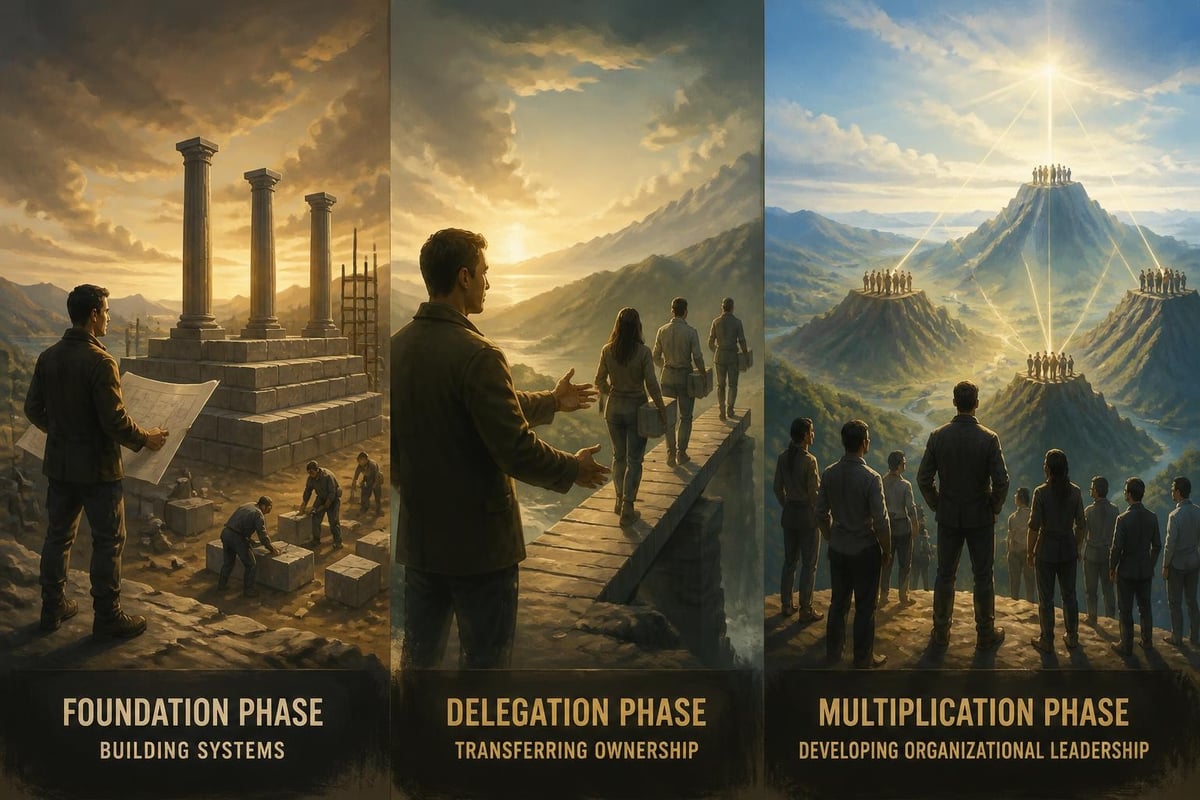
$250k–$500k: Foundation Stage
At this stage, you're likely still delivering most client work personally. Strategic leadership coaching focuses on creating your first leverage: documenting your delivery process, hiring your first team member, and establishing baseline systems. The coaching emphasis is on building repeatable processes and transitioning from "doer" to "director."
Your biggest risk is premature scaling. You hire team members before systemizing delivery, then spend all your time managing chaos instead of generating revenue. Coaching here prevents expensive mistakes by sequencing your infrastructure build correctly.
$500k–$2M: Delegation Stage
You have team members, but they're expensive assistants rather than autonomous operators. Strategic leadership coaching at this stage rebuilds how you delegate. Not just task assignment, but full ownership transfer including decision-making authority, quality standards, and client relationship management.
The transformation required is psychological as much as operational. You must release control over outcomes you've previously guaranteed personally. Coaching provides the frameworks and accountability to make this shift without sacrificing service quality. Most founders attempt this transition alone and revert to old patterns when the first client issue arises.
$2M–$5M: Multiplication Stage
At this level, strategic leadership coaching addresses organizational design. You need leaders who develop other leaders, systems that scale without your constant refinement, and a business model that generates profit independently of your daily involvement. The coaching focus shifts to strategic positioning, enterprise client acquisition, and building a leadership team that extends your vision.
This is where many successful founders plateau. They've built a thriving practice but can't break through to the next level because they're leading a $3M business with $500k leadership infrastructure. Strategic leadership coaching rebuilds that infrastructure to match your revenue reality and growth ambition.
The Coaching Culture Versus the Coaching Moment
Tactical coaching addresses immediate problems. Strategic coaching rebuilds organizational culture. The difference is fundamental. When you use coaching only to fix performance gaps, you're treating symptoms. When you embed coaching as your default leadership approach, you're rewiring how your entire organization thinks, decides, and performs.
The research on creating coaching cultures reveals that sustainable scaling requires coaching to become "how we operate," not "something leadership does quarterly." For high-ticket service businesses, this cultural shift determines whether you build an asset or remain self-employed at scale.
Indicators you've built a coaching culture:
- Team members coach each other through challenges before escalating
- Client issues are treated as learning opportunities, not just problems to solve
- Decision-making criteria are documented and applied consistently across the team
- Performance conversations focus on development, not just evaluation
- Strategic planning includes capability building, not just revenue targets
At Rise Reign Rule, we measure coaching culture through operational metrics, not sentiment surveys. How many decisions did your team make independently this month versus last quarter? What percentage of client deliverables required your personal review? How many hours did you spend in strategic work versus tactical execution? These numbers reveal whether coaching has become embedded or remains performative.
From Founder Dependency to Team Capability
The ultimate test of strategic leadership coaching is this: can your business deliver exceptional client outcomes when you're not directly involved? If the answer is no, you don't have a scalable business. You have an expensive job with employees.
This isn't about removing yourself from the business entirely. It's about shifting from operator to architect. You design the systems, develop the leadership team, and set the strategic direction. But daily delivery, client management, and operational execution flow through capable team members who own outcomes, not just tasks.
Making this transition requires more than delegation training. It requires rebuilding your value proposition around your strategic vision rather than your personal delivery. It means hiring differently, training systematically, and measuring team capability as rigorously as you measure revenue.
Measuring ROI on Strategic Leadership Coaching
Investment in strategic leadership coaching should produce measurable business outcomes, not just personal development wins. For high-ticket service businesses operating between $250k and $5M, the ROI shows up in four specific metrics that directly impact enterprise value.
| Metric | Before Coaching | After 12 Months | Business Impact |
|---|---|---|---|
| Founder operational hours | 50+ hours/week in delivery | 15-20 hours/week in strategy | 60% time reallocation to growth activities |
| Decision escalation rate | 80% require founder approval | 25% require founder approval | 4x faster execution, reduced bottlenecks |
| Profit margin | 15-25% | 35-45% | Higher take-home without revenue increase |
| Client delivery consistency | Varies by founder availability | Standardized regardless of founder involvement | Scalable service model, reduced founder dependency |
These aren't aspirational targets. They're the actual results our clients achieve when strategic leadership coaching addresses the right leverage points. The businesses featured in our case studies demonstrate these transformations across different service models, from consulting to agency to done-for-you implementation.
Calculate your current founder dependency cost:
Take your annual revenue and multiply by your profit margin. Now calculate what that same revenue would generate at 40% profit margins with proper systems and boundaries. The difference is your opportunity cost. For a business generating $1.5M at 20% margins ($300k profit), scaling to 40% margins means an additional $300k annually without acquiring a single new client.
That's the economic argument for strategic leadership coaching. But the personal ROI matters equally. How much is it worth to run a business that doesn't consume every weekend? To take a two-week vacation without your phone? To build enterprise value that exists independently of your daily presence?
Implementation Sequencing That Prevents Overwhelm
The failure mode of most leadership development is attempting too much simultaneously. You attend a conference, get inspired by 47 new strategies, try implementing all of them, and within six weeks you're back to old patterns because the change load exceeded your organizational capacity.
Strategic leadership coaching succeeds through disciplined sequencing. You don't rebuild positioning, acquisition, delivery, and leadership simultaneously. You identify the current constraint, address it systematically, then move to the next bottleneck.
The 90-day implementation cycle:
- Weeks 1-2: Diagnostic phase identifying your specific bottleneck (usually capacity, inconsistency, or margin)
- Weeks 3-6: System design for the primary constraint with documented processes and decision criteria
- Weeks 7-10: Team training and ownership transfer using coaching techniques rather than directive management
- Weeks 11-12: Measurement and refinement based on actual operational data
This rhythm allows change to stabilize before introducing the next layer. After the first 90-day cycle addresses your primary bottleneck, the second cycle tackles the constraint that's now become visible. Most founders need three to four cycles to fully rebuild their operational infrastructure and leadership model.
Speed matters less than sustainability. A change that sticks is worth far more than a dramatic transformation that reverts within 60 days. Strategic leadership coaching prioritizes permanence over pace, building capability that compounds rather than intervention that fades.
The Accountability Architecture
Coaching without accountability becomes expensive therapy. You feel better after sessions but your business metrics don't change. Strategic leadership coaching installs accountability at three levels: metric tracking, peer review, and external validation.
Metric tracking means defining specific operational and financial indicators that reveal whether your leadership changes are producing business results. Not vanity metrics like "team satisfaction scores," but hard numbers like decision velocity, client retention, and profit per engagement.
Peer review creates lateral accountability through cohorts of other founders at similar growth stages. You're not reporting to a coach in isolation. You're presenting progress to peers who understand your challenges and won't accept excuses.
External validation comes from client feedback and market response. If your leadership transformation is real, clients should experience measurably better outcomes. If they don't, your coaching has focused on internal processes without external impact.
The approach we take with clients integrates all three accountability layers, ensuring that leadership development translates to business transformation, not just personal growth.
Strategic Positioning Through Leadership Authority
Your leadership model is your market positioning. When you lead through heroic effort and personal availability, you signal that your business depends on you. Premium clients at the high ticket level invest in systems and teams, not individual dependency.
Strategic leadership coaching rebuilds your market authority by making your leadership infrastructure visible. You're not hiding systems to maintain the illusion of personal magic. You're showcasing capabilities that demonstrate you can deliver consistent outcomes regardless of your daily involvement.
This shift is particularly crucial for women-owned service businesses operating in competitive markets. When you position yourself as the sole expert who must personally deliver every engagement, you've capped your revenue at your personal capacity. When you position yourself as the architect of a system that produces expert-level outcomes through trained team execution, you've unlocked true scalability.
Authority markers that signal strategic leadership:
- Published frameworks and methodologies that your team executes
- Case studies showcasing client outcomes delivered by your team, not just you personally
- Thought leadership focused on systems and scalability, not individual expertise
- Service packages with defined scope, deliverables, and team roles
- Client testimonials that reference your team and systems, not just your personal brilliance
These positioning elements compound. Each one reinforces the others, building market perception that you operate a real business with institutional knowledge, not a practice dependent on founder availability. Strategic leadership coaching helps you develop these assets authentically while actually building the underlying infrastructure they represent.
Strategic leadership coaching transforms how you operate, delegate, and scale when it addresses the real constraints in your business model, not just your personal leadership skills. The founders who break through from mid-six figures to multi-million dollar enterprises don't just work on mindset. They rebuild their operational infrastructure, install profit-protecting boundaries, and develop teams that deliver consistent outcomes without founder dependency. If you're ready to architect predictable profit and clean scaling into your high-ticket service business, Rise Reign Rule offers a proven framework specifically designed for women founders navigating the complexity of operational growth between $250k and $5M in revenue.


