
Team Coaching Business: Scale Your Revenue to $5M
Building a successful team coaching business requires more than just coaching credentials and a vision. For women entrepreneurs operating in the high-ticket service space, the difference between a six-figure practice and a seven-figure enterprise lies in how you architect your profit systems. The marketplace is saturated with coaches offering vague promises, but the businesses breaking through to $5M revenue have cracked a specific code: they've transformed from selling time to installing transformation frameworks that scale.
Why Traditional Coaching Models Create Revenue Ceilings
Most coaching businesses plateau between $250k and $500k for a predictable reason. They're built on the founder's personal capacity to deliver one-on-one sessions, which creates an immediate bottleneck. When your team coaching business depends entirely on your availability, you've essentially purchased yourself an expensive job rather than built a scalable enterprise.
The math is unforgiving. Even at $10,000 per client with monthly commitments, you're maxing out around 15-20 active relationships before quality deteriorates. This model works until it doesn't, and the moment you want to scale, you face an impossible choice: compromise delivery standards or remain stuck.
High-ticket service businesses need a different architecture. According to research on team coaching benefits, effective coaching creates measurable improvements in team performance and interpersonal dynamics, but only when delivered through systematic frameworks rather than ad-hoc sessions.
The Operational Drag That Kills Growth
When you're running a team coaching business without proper systems, every new client adds exponential complexity. You're customizing proposals, reinventing delivery methods, and solving the same problems differently each time. This operational drag silently erodes profit margins and founder sanity.
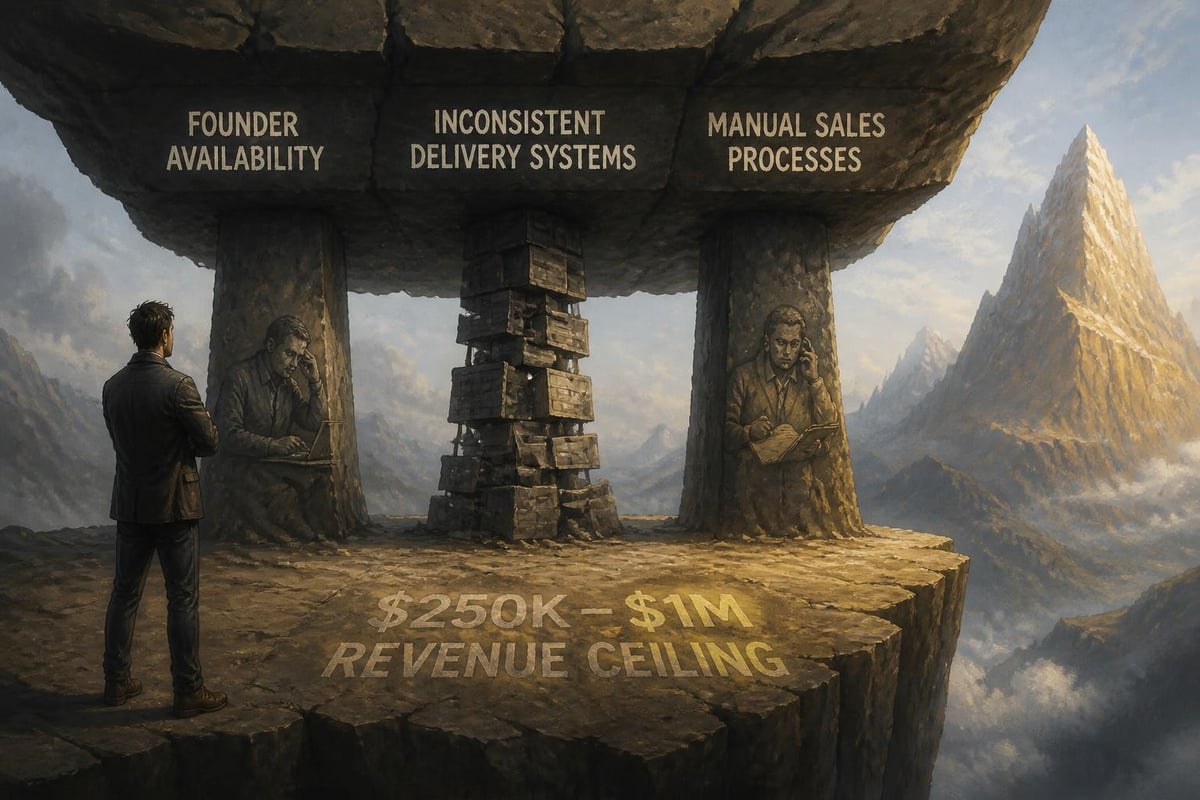
Consider these common bottlenecks:
- Sales conversations that require founder presence for closing
- Delivery frameworks that exist only in your head
- Client onboarding that's recreated for each engagement
- Team training that happens through osmosis rather than documentation
- Quality control that depends on your personal review
Each represents a scaling barrier that prevents your team coaching business from generating predictable profit. The solution isn't working harder or hiring more coaches. It's installing repeatable systems that function independently of your daily involvement.
Building Market Authority Through Positioning
Your team coaching business won't scale on generalist positioning. The million-dollar breakthrough happens when you claim a specific problem for a specific market. Women-owned service businesses generating $250k-$5M face distinct challenges that differ dramatically from startups or enterprise corporations.
This precision matters because it allows you to speak directly to operational realities your ideal clients face daily. You're not coaching "leadership teams" in the abstract. You're solving founder bottlenecks, installing profit systems, and creating clean scaling pathways for businesses at a specific inflection point.
| Positioning Level | Annual Revenue Impact | Market Differentiation |
|---|---|---|
| Generalist Coach | $150k-$300k | Low (High Competition) |
| Niche-Specific | $300k-$750k | Moderate (Clear Target) |
| Problem-Specific Framework | $750k-$5M | High (Category Creation) |
The businesses operating at the top tier have moved beyond selling "coaching" to installing proprietary methodologies. They've identified the specific operational gaps their market faces and built systematic solutions. This isn't about certification credentials. It's about becoming the obvious answer to a burning question.
When you examine successful team coaching case studies, you'll notice they focus on measurable business outcomes rather than coaching hours delivered. They're tracking revenue impact, team efficiency gains, and strategic clarity improvements.
Installing Sales Systems That Convert Without You
A scalable team coaching business needs acquisition systems that generate qualified leads and close high-ticket contracts without requiring founder intervention in every conversation. This seems impossible when you're used to personally nurturing every prospect, but it's the only path to seven figures.
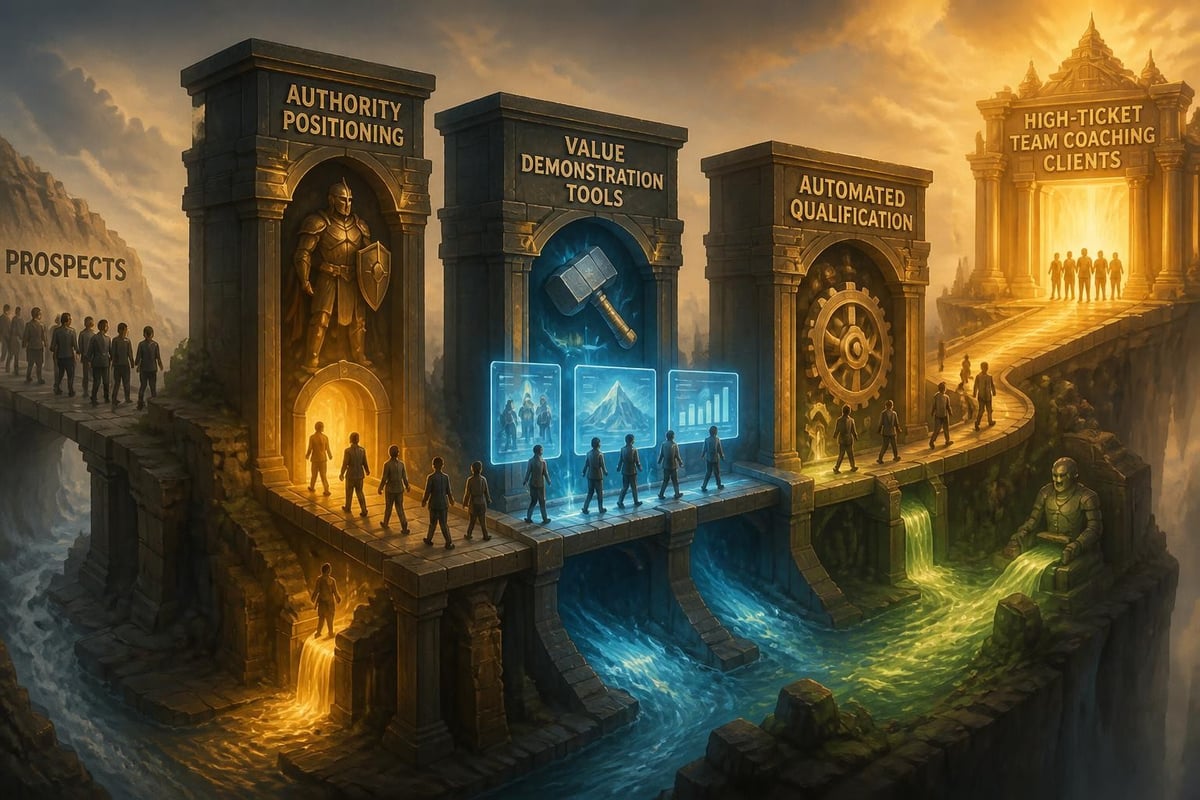
The Three-Stage Sales Architecture
Your sales system needs distinct layers that qualify, educate, and convert prospects systematically:
- Authority content that attracts your ideal client profile through search and social
- Value demonstration mechanisms that prove your framework solves their specific problem
- Conversion infrastructure that moves qualified prospects to enrollment decisions
The middle stage is where most team coaching business models break down. They generate awareness but can't prove value without exhausting founder time in discovery calls. The solution is creating demonstration assets that communicate your methodology's power before any human conversation happens.
This might include framework visualizations, case study breakdowns, diagnostic assessments, or methodology deep-dives. Each piece of content should answer the question: "Why is your approach different and why will it work for my specific situation?"
Understanding the psychological principles behind team coaching helps you structure these materials to address both logical business concerns and emotional decision-making factors.
Pricing Architecture for Predictable Revenue
High-ticket team coaching business models should structure pricing to create upfront cash flow and long-term engagement value. One-off workshops generate revenue spikes but kill predictability. Annual commitments with quarterly payments balance client risk tolerance with your cash flow needs.
Consider this pricing evolution:
- Launch phase: $15k-$25k for 90-day intensive programs
- Growth phase: $50k-$75k for annual transformation frameworks
- Scale phase: $100k-$250k for multi-year strategic partnerships
Each tier should deliver proportionally greater value through more comprehensive framework implementation, not just more coaching hours. You're selling business transformation outcomes, not time access.
Delivery Systems That Scale Beyond Your Capacity
The most sophisticated team coaching business operators have cracked a critical code: they've separated their unique methodology from their personal delivery. This doesn't mean removing yourself entirely. It means building systems that allow others to implement your framework with fidelity while you focus on strategy and quality control.
This requires documentation that most coaches resist creating. Your framework needs to exist outside your head in formats that others can execute. This includes:
- Diagnostic tools that identify which aspects of your methodology each client needs most
- Implementation playbooks that guide clients through framework adoption step-by-step
- Training curricula that bring team members up to speed on your approach
- Progress milestones that create accountability and measure transformation
- Quality standards that ensure consistent outcomes regardless of who's delivering
The practical applications of team coaching demonstrate how systematic approaches create better client outcomes than purely relationship-dependent models.
Building Your Delivery Team
Scaling your team coaching business beyond $750k requires adding delivery capacity without diluting quality. This isn't about hiring more coaches. It's about identifying which aspects of your framework require your specific expertise versus which components trained facilitators can handle.
| Delivery Component | Founder Role | Team Member Role |
|---|---|---|
| Strategic diagnosis | Lead and finalize | Conduct initial assessment |
| Framework customization | Review and approve | Draft customized plan |
| Implementation facilitation | Quarterback critical sessions | Execute standard methodology |
| Progress evaluation | Strategic review checkpoints | Weekly/monthly tracking |
| Outcome measurement | Client relationship ownership | Data collection and reporting |
This division allows you to maintain quality standards while expanding delivery capacity. You're still the strategic architect, but you've built systems that allow others to implement your vision effectively.
Leadership Boundaries That Protect Profitability
The hardest scaling challenge in any team coaching business isn't external. It's internal. Founders who've succeeded through personal hustle, availability, and saying yes to everything must fundamentally shift their leadership approach to break through revenue ceilings.
This means establishing boundaries that feel uncomfortable initially but create the space for systematic growth:
Client access boundaries define when and how clients engage with you versus your team. High-ticket services deserve responsiveness, but unlimited access creates dependency rather than transformation. Your framework should teach clients to solve problems using your methodology, not by texting you constantly.
Delivery scope boundaries protect against scope creep that erodes profitability. Every team coaching business engagement should have clear parameters around what's included and what requires additional investment. Generous delivery is admirable until it makes your business unsustainable.
Decision-making boundaries determine which choices require your input versus which your team handles independently. Early-stage founders touch everything. Seven-figure operators touch only strategic decisions that materially impact client outcomes or business direction.
The Profit Architecture Framework
For women-owned high-ticket service businesses, experience coaching combined with consulting creates more powerful outcomes than either approach alone. Your team coaching business should integrate these elements through a comprehensive profit architecture.
This framework addresses four critical pillars simultaneously:
- Market positioning that establishes authority and attracts ideal clients
- Sales acquisition systems that convert without founder bottlenecks
- Client delivery frameworks that produce consistent transformational outcomes
- Founder leadership boundaries that protect both profit and sustainability
When these four elements align, your team coaching business transitions from chaotic growth to predictable scaling. You're no longer reacting to whatever client needs emerge. You're proactively installing systems that produce consistent results.
Measuring What Matters in Your Coaching Business
Most team coaching business operators track the wrong metrics. They measure coaching hours delivered, client satisfaction scores, and renewal rates. These matter, but they're lagging indicators that tell you what already happened, not what's creating your results.
Leading indicators predict future revenue and identify operational issues before they become crises:
- Sales pipeline velocity: How quickly prospects move from awareness to enrollment
- Framework adoption rate: Percentage of clients fully implementing your methodology
- Delivery team utilization: How efficiently you're deploying coaching resources
- Profit per client: Revenue minus direct delivery costs for each engagement
- Founder time allocation: Hours spent on strategic work versus operational tasks
Building Your Metrics Dashboard
Your team coaching business needs a simple dashboard that answers three questions weekly:
- Are we generating enough qualified leads to hit revenue targets?
- Are clients achieving the transformation outcomes we promise?
- Is the founder's time allocation supporting strategic growth?
If any answer is no, you have a specific system to fix rather than a vague sense that things aren't working. This precision allows you to scale confidently because you can identify and solve problems systematically.
The difference between a $300k team coaching business and a $3M enterprise often comes down to measurement discipline. Successful operators know their numbers intimately and adjust systems based on data rather than feelings.
Strategic Partnerships That Multiply Impact
Scaling your team coaching business beyond individual client relationships requires strategic thinking about how your framework can reach more businesses simultaneously. This doesn't mean diluting your high-ticket model. It means architecting partnership structures that multiply your impact while maintaining pricing integrity.
Consider these partnership models:
- Corporate training contracts where you install your framework across multiple teams within larger organizations
- Association partnerships that position your methodology as the standard for specific industry groups
- Certification programs that train other coaches to deliver your framework under license
- Implementation partnerships with complementary service providers who need your expertise
Each represents a leverage point where one strategic relationship generates multiple high-ticket engagements. You're no longer trading hours for dollars. You're licensing intellectual property, training delivery partners, and creating systematic distribution channels.
Understanding coordination strategies in distributed teams becomes valuable as you build these partnership networks. Your team coaching business needs systems that maintain quality and consistency across multiple delivery contexts.
Technology Infrastructure for Scale
A seven-figure team coaching business requires technology infrastructure that automates routine operations and enables systematic delivery. This isn't about buying more software. It's about building a tech stack that supports your specific scaling needs.
Essential Technology Components
- CRM system that manages prospect relationships and tracks sales pipeline stages
- Client portal where teams access your framework resources and track progress
- Project management platform that coordinates delivery across multiple engagements
- Communication tools that facilitate coaching sessions and team collaboration
- Payment processing that handles high-ticket transactions and recurring billing
The key is integration. Your systems should talk to each other, eliminating manual data entry and creating visibility across your entire operation. When a new client enrolls, your CRM should automatically trigger onboarding sequences in your client portal and create project tracking in your delivery system.
For businesses exploring the distinction between mentoring and consulting approaches, technology helps blend these methodologies by providing both strategic frameworks and hands-on implementation support through digital platforms.
Creating Your 12-Month Scaling Roadmap
Transforming your team coaching business from current state to seven-figure operation requires a phased approach that builds capability systematically. Trying to implement everything simultaneously creates chaos. Strategic sequencing creates momentum.
Months 1-3: Foundation Phase
- Document your core framework in implementation-ready formats
- Install basic sales systems that qualify prospects without founder time
- Establish measurement infrastructure for key leading indicators
Months 4-6: Testing Phase
- Pilot your documented framework with 2-3 clients using team delivery
- Refine sales systems based on conversion data and feedback
- Begin building authority content that attracts ideal client profile
Months 7-9: Optimization Phase
- Scale delivery team based on pilot learnings and capacity needs
- Implement partnership strategies to multiply client acquisition
- Establish founder boundaries and delegation protocols
Months 10-12: Acceleration Phase
- Launch full team delivery model with quality control systems
- Activate strategic partnerships for expanded market reach
- Achieve predictable revenue rhythms with clean profit margins
This timeline assumes you're starting from a functioning team coaching business generating at least $250k annually. The path from startup to $250k requires different strategies focused on proving your methodology works and attracting initial clients.
Common Scaling Mistakes to Avoid
Every team coaching business operator makes predictable errors when attempting to scale. Recognizing these patterns helps you navigate growth more efficiently:
Hiring too early before systems exist creates expensive chaos. Team members can't deliver your framework if it only exists in your head. Document first, then hire delivery capacity.
Discounting pricing to attract more clients destroys positioning and profitability. High-ticket businesses scale through better clients at higher prices, not volume at lower margins.
Avoiding difficult boundaries keeps founders trapped in operational delivery. Your discomfort with saying no costs you the leverage needed to scale.
Neglecting client outcomes in favor of new sales creates referral deserts. Your best marketing is transformed clients telling their networks about your framework's power.
Research on motivational challenges in team environments highlights how organizational context affects team performance, reminding us that your internal operations directly impact client results.
The most successful team coaching business operators embrace these mistakes as learning opportunities rather than fatal flaws. Scale requires experimentation, and experimentation produces valuable failures alongside breakthrough successes.
Building a scalable team coaching business demands more than coaching expertise. It requires installing profit architecture that addresses positioning, acquisition, delivery, and leadership systematically. When you're ready to transform operational drag into predictable growth and break through founder bottlenecks, Rise Reign Rule provides the strategic framework and implementation support that women-owned high-ticket service businesses need to scale cleanly from $250k to $5M revenue.


