
Team Coaching Courses: Scale Leadership Excellence
When you're running a high-ticket service business between $250k and $5M in revenue, the leadership demands multiply faster than your team's capacity to meet them. Your senior client strategists need more than performance reviews and quarterly check-ins. They need collective capability that elevates every project, every client interaction, and every strategic decision. That's where team coaching courses become not just professional development, but a strategic lever for clean scaling and predictable profit.
Why Team Coaching Differs From Individual Executive Coaching
Individual coaching targets personal growth, behavioral shifts, and leadership presence. Team coaching, by contrast, focuses on the interdependent system your people create together. Harvard Business Review research shows that coaching your team as a collective makes it stronger, because high-performing teams share mental models, communication rhythms, and accountability structures that individual coaching simply can't build.
For women-owned service firms scaling complex delivery, this distinction matters enormously. Your client outcomes depend on seamless handoffs between strategists, implementers, and account leads. When one person optimizes their performance in isolation, you risk creating silos. When the whole team develops shared language, decision-making protocols, and conflict resolution skills, you eliminate founder bottlenecks and operational drag.

The ROI Case for Structured Team Development
Team coaching courses equip leaders to facilitate collective performance improvements that cascade through the business. Consider these outcomes:
- Reduced escalation loops: Teams self-correct instead of waiting for founder intervention
- Faster decision velocity: Shared frameworks replace endless Slack threads
- Consistent client experience: Every team member delivers within defined standards
- Leadership bench strength: Senior contributors step into coaching roles naturally
When you invest in team coaching courses for your leadership layer, you're installing repeatable capability that compounds. One trained team coach can develop three project teams. Those teams then model healthy dynamics for newer hires. The skill becomes organizational, not personal.
What Accredited Team Coaching Courses Cover
Quality team coaching courses follow evidence-based competencies that integrate team development research, systems thinking, and practical facilitation skills. Most accredited programs structure curriculum around four core domains:
Foundation: Team Dynamics and Development Models
Participants learn how teams form, mature, and sustain performance. You'll study Tuckman's stages, Lencioni's dysfunctions, and psychological safety frameworks. The goal is diagnostic fluency: Can you identify when a team is stuck in norming versus genuinely performing?
Contracting and Stakeholder Alignment
Team coaching isn't therapy. It's a business intervention. Courses teach you how to contract with sponsors, define outcomes, establish confidentiality boundaries, and align team goals with organizational strategy. For high-ticket service businesses, this means linking team development to client retention rates, delivery margins, or proposal win rates.
Facilitation and Intervention Design
You learn to design and lead team sessions that surface hidden conflicts, build shared vision, and create collective commitments. Techniques include:
- Structured dialogue protocols (e.g., Liberating Structures)
- Real-time feedback loops during live projects
- Reflective practice that links action to learning
- Accountability frameworks that outlive the coaching engagement
Measurement and Sustainability
The best team coaching courses teach you to measure what matters: team effectiveness scores, collaboration frequency, decision quality, and ultimately business outcomes. You'll also learn how to embed coaching practices into team rituals so development continues after formal sessions end.
| Course Component | Business Benefit | Skill Gained |
|---|---|---|
| Team diagnostics | Identify root causes of delivery delays | Systems thinking |
| Contracting frameworks | Align coaching to revenue goals | Stakeholder management |
| Facilitation practice | Run high-impact team sessions | Process design |
| Metrics and dashboards | Prove ROI to leadership | Data-driven coaching |
Choosing Between Academic, Professional, and Vendor-Led Programs
The team coaching course market offers three broad pathways, each with different depth, cost, and time commitment.
University-Based Executive Education
Programs like Brown University's Team Coaching Program and the University of Texas at Dallas Team Coaching Practitioner Program blend academic rigor with practical application. You'll engage with peer cohorts, earn continuing education credits, and often receive ICF-aligned training hours.
Best for: Founders and senior leaders who want credibility, structured learning, and access to research-backed methodologies. Expect 6-12 month commitments and tuition in the $8,000-$15,000 range.
Professional Body Accreditation Tracks
Organizations like the International Coaching Federation and EMCC accredit team coaching training providers that meet global standards. These courses lead to formal credentials (e.g., ICF Team Coaching Certification) recognized across industries.
Best for: Practitioners building a coaching practice or consultancies adding team coaching to their service portfolio. Programs range from intensive 4-day modules to year-long certification tracks.
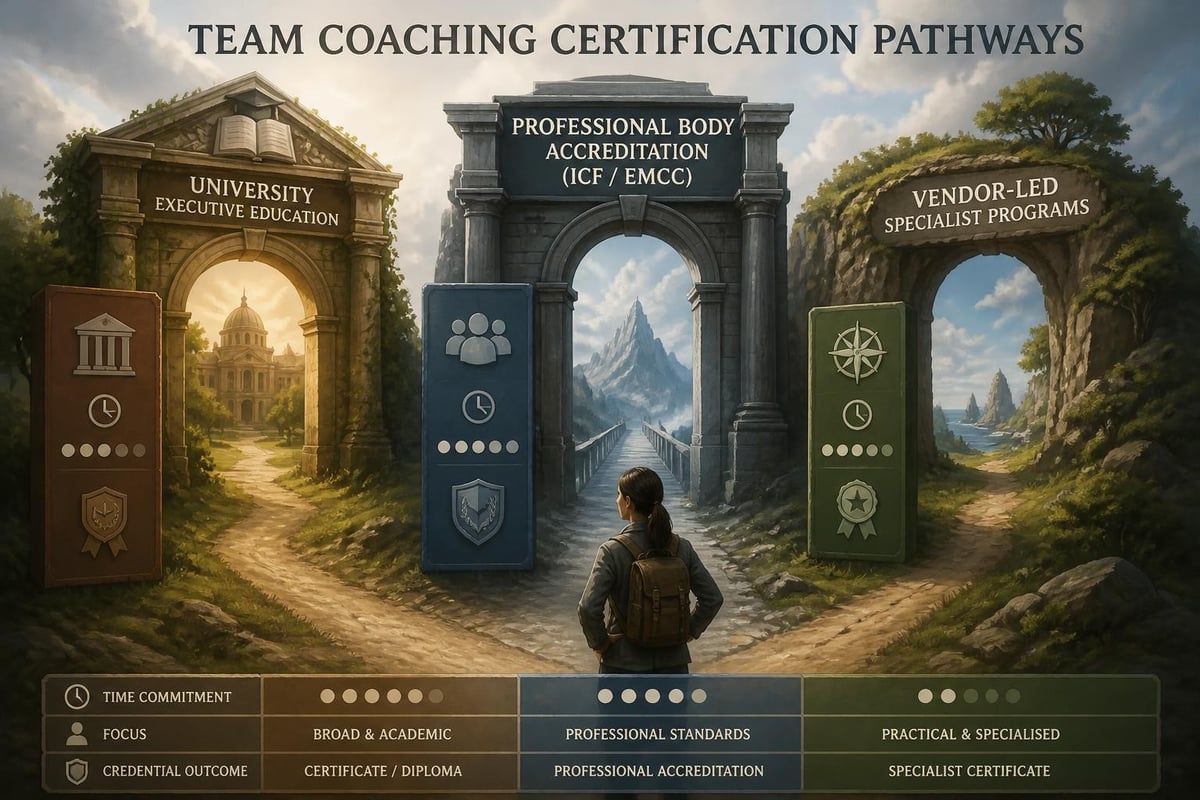
Specialist Vendor Programs
Providers like Team Coaching Global offer focused certificate syllabi that emphasize immediate application. These courses prioritize frameworks you can deploy within weeks, often with live practice coaching real teams.
Best for: Leaders who need fast capability-building for active team challenges. Shorter timelines (2-6 months) and modular formats let you learn while scaling.
How to Integrate Team Coaching into Your Service Delivery Model
For women-owned high-ticket service businesses, team coaching courses aren't just about developing your internal team. They become a delivery differentiator when you embed coaching practices into client engagements.
Positioning: Market Authority Through Team Capability
When your positioning strategy emphasizes outcome certainty, team coaching creates proof. Imagine telling prospects: "Our project teams undergo quarterly coaching sessions that optimize collaboration, so your engagement stays on scope and schedule." That's not fluff. That's operational excellence made visible.
Acquisition: Sales Systems That Highlight Team Strength
High-ticket buyers evaluate not just your founder's expertise, but your team's capacity to deliver without constant oversight. Team coaching courses give you language to articulate how your team works, not just what they know. In discovery calls, you can describe:
- Structured team retrospectives that surface delivery risks early
- Peer coaching protocols that accelerate junior team members
- Conflict resolution frameworks that prevent project derailments
These details build buyer confidence and justify premium pricing.
Delivery: Client Outcomes Through Team Performance
When your delivery teams practice the skills taught in team coaching courses, client outcomes improve measurably. You'll see:
- Faster onboarding: New team members integrate through peer coaching, not just documentation
- Proactive problem-solving: Teams surface issues in standups before clients notice
- Consistent quality: Shared standards and real-time feedback loops reduce rework
| Client Impact Area | Before Team Coaching | After Team Coaching |
|---|---|---|
| Project delivery variance | ±15% of estimate | ±5% of estimate |
| Client escalations per quarter | 8-12 | 2-4 |
| Team member retention | 68% annually | 87% annually |
| Referral rate from completed projects | 22% | 41% |
Leadership: Boundaries That Protect Founder Capacity
The most powerful ROI from team coaching courses comes when founders stop being the only coach. You train senior team members to coach project teams, which removes you from every tactical decision. This isn't delegation. It's capability multiplication.
Your leadership pillar shifts from "I solve every problem" to "I build problem-solvers." Team coaching courses give your emerging leaders the tools to facilitate team growth, hold peers accountable, and model the culture you're building. That's how you scale without operational drag.
Building a Coaching Culture: Beyond the Initial Course
The Center for Creative Leadership finds that organizations with strong coaching cultures outperform peers on engagement, innovation, and financial metrics. But culture doesn't emerge from a single course. It requires intentional practice embedded in daily work.
Rituals That Sustain Team Coaching Skills
After completing team coaching courses, high-performing service businesses install these practices:
- Weekly team reflections (15 minutes): What worked, what didn't, what we're learning
- Monthly peer coaching triads: Three team members rotate coach, client, observer roles
- Quarterly team visioning sessions: Realign goals, celebrate progress, reset commitments
- Annual team coaching intensives: Deep work on strategic shifts, role evolution, capability gaps
These rituals cost almost nothing but compound dramatically. Each cycle strengthens the team's capacity to self-diagnose, experiment, and improve.

Measuring Team Coaching Impact on Business Outcomes
Track these leading indicators to prove ROI from team coaching courses:
- Decision latency: Time from issue identification to resolution
- Collaboration index: Cross-functional project involvement frequency
- Psychological safety scores: Anonymous team surveys (Google's Aristotle research model)
- Client satisfaction trends: NPS or CSAT correlated to team coaching milestones
- Revenue per team member: As teams self-manage, capacity expands without headcount
When you connect team development to hard numbers, investment in team coaching courses becomes strategic, not discretionary.
Selecting the Right Team Coaching Course for Your Business Stage
Not all team coaching courses suit every revenue level or operational maturity. Here's how to choose:
Early Stage ($250k-$750k Revenue)
Focus: Founder-led team coaching to establish culture and systems from the start.
Best course type: Short, practical vendor programs that teach facilitation basics and team diagnostic tools. You need skills you can apply immediately with your 3-5 person team.
Investment range: $2,000-$5,000 for a foundations certificate.
Growth Stage ($750k-$2.5M Revenue)
Focus: Developing senior team members as internal coaches to reduce founder dependency.
Best course type: Professional body accredited programs that lead to recognized credentials. Your emerging leaders gain external validation and can coach multiple project teams.
Investment range: $5,000-$10,000 per participant, often with cohort discounts.
Scale Stage ($2.5M-$5M Revenue)
Focus: Embedding coaching capability across leadership layers and integrating with talent development.
Best course type: University executive education that combines team coaching with strategic leadership, change management, and organizational development. You're building institutional capability, not just individual skills.
Investment range: $10,000-$15,000 per participant, plus leadership team alignment sessions.
Common Mistakes When Implementing Team Coaching Training
Even well-intentioned founders stumble when deploying team coaching courses. Avoid these pitfalls:
- Training without infrastructure: Sending one person to a course doesn't change team dynamics. You need leadership commitment, scheduled practice time, and visible sponsorship.
- Treating coaching as crisis intervention: Team coaching works best as ongoing development, not firefighting. Start before you're desperate.
- Neglecting stakeholder alignment: If your exec team doesn't understand what team coaching is (and isn't), they'll undermine it with competing priorities.
- Failing to connect coaching to business metrics: "Feel-good team building" gets defunded quickly. Always link team coaching to delivery quality, client retention, or margin improvement.
The research on developing internal team coaches emphasizes that successful programs integrate coaching into existing workflows, leadership behaviors, and performance management. Standalone courses create knowledge; integrated systems create results.
Who Should Attend Team Coaching Courses in Your Organization
Strategic deployment of team coaching training maximizes impact. Prioritize these roles:
- Founders and C-suite: You set the tone. If you don't practice team coaching, no one else will.
- Practice leads and senior managers: They coach 2-4 project teams each and multiply your capability.
- Client-facing team leads: Those managing complex, high-touch engagements benefit most from facilitation and conflict resolution skills.
- Emerging high-performers: Team coaching training accelerates leadership readiness and retention.
Consider sending pairs or triads together. Shared language and peer accountability accelerate adoption. When multiple leaders return from the same team coaching course, they can co-design implementation and support each other through early, awkward practice.
The Future of Team Coaching in High-Ticket Service Businesses
As remote and hybrid work becomes permanent, team coaching skills matter more, not less. Distributed teams need explicit practices for building trust, managing conflict, and creating shared accountability. The implicit cues of co-located work no longer carry the load.
Forward-thinking service businesses are embedding team coaching into:
- Client delivery protocols: Every engagement includes team retrospectives and coaching check-ins
- Talent acquisition: Hiring for "coachability" and collaborative capacity, not just individual expertise
- Leadership development pathways: Team coaching certification becomes a prerequisite for senior roles
- Strategic planning: Annual planning sessions use team coaching methods to surface diverse perspectives and build genuine buy-in
Team coaching courses give you the frameworks to lead this evolution deliberately. You're not waiting for culture to emerge organically. You're architecting it with the same rigor you apply to client delivery systems.
What to Expect During Your First Team Coaching Course
Curiosity about the learning experience itself often holds leaders back from enrolling. Here's what typically unfolds:
Pre-work: Most programs assign readings on team development theory, a self-assessment of your current coaching capability, and often a 360-degree feedback exercise from your team.
Live sessions: Expect a blend of didactic teaching (20%), demonstration coaching (30%), and supervised practice (50%). You'll coach real teams (often fellow participants' teams) under instructor observation with real-time feedback.
Between-session application: Quality courses require you to apply frameworks with your actual team, document observations, and bring challenges to the next session. This isn't theoretical learning. It's performance improvement through deliberate practice.
Final assessment: Many accredited team coaching courses culminate in a live coaching session you facilitate, recorded and evaluated against competency standards. Some also require a written case study demonstrating how you applied team coaching to a business outcome.
The intensity surprises most participants. You're developing muscle memory for noticing team dynamics, intervening skillfully, and holding space for difficult conversations. That doesn't happen in webinars. It requires committed practice.
Team coaching courses transform how high-ticket service businesses develop collective capability, eliminate founder bottlenecks, and deliver consistent client outcomes at scale. When you approach team coaching as strategic infrastructure rather than discretionary development, the ROI shows up in delivery margins, client retention, and leadership capacity. If you're ready to install systematic frameworks that drive predictable profit and clean scaling in your women-owned service business, Rise Reign Rule specializes in operationalizing these exact capabilities through our Profit Architecture methodology. Let's build the team systems that free you to lead, not manage.


