
Team Coaching Services: Scale Your Business
The six-figure revenue mark feels like a celebration, but the seven-figure journey reveals an uncomfortable truth: your team can't scale what they don't collectively own. Women founders in high-ticket service businesses hit this wall repeatedly. You've hired talented people, yet every decision still flows through you. Deadlines slip. Client delivery feels inconsistent. Revenue growth stalls because your team operates as skilled individuals rather than a synchronized unit. This operational drag isn't a people problem; it's a coaching gap. Team coaching services address the systemic challenges that individual training can't touch, transforming fragmented efforts into cohesive performance that drives predictable profit.
Why Individual Coaching Fails Growing Service Businesses
Most founders invest in individual development first. You send your operations manager to a project management course. Your sales lead gets one-on-one executive coaching. Your delivery team attends technical workshops.
Each person returns with new skills, yet nothing fundamentally changes.
Here's the reality: individual growth doesn't automatically translate to team performance. When team members optimize for their own domains without shared context, you create silos. Marketing develops campaigns that sales can't convert. Sales promises deliverables that operations can't fulfill. Everyone works harder while results plateau.
The Collective Capability Gap
High-ticket service businesses require collective intelligence that individual coaching can't build. Your team needs to:
- Navigate complex client situations together
- Make aligned decisions when you're not in the room
- Hold each other accountable to shared standards
- Adapt delivery methods without compromising quality
- Resolve conflicts that impact client outcomes
This is where team coaching services become non-negotiable. According to research from the Center for Creative Leadership's team coaching approach, teams that engage in structured coaching demonstrate measurably improved collaboration and effectiveness compared to teams relying solely on individual development.

The Four Pillars of Effective Team Coaching Services
Not all team coaching services deliver results. The difference lies in addressing systemic patterns rather than surface behaviors.
Pillar One: Shared Mental Models
Your team operates from invisible assumptions about how work should happen. One person believes "quality means triple-checking everything." Another thinks "speed demonstrates competence." These conflicting models create friction that slows every project.
Effective team coaching services surface these hidden frameworks. Through facilitated dialogue, teams build common language around:
- What "done" actually means for deliverables
- How decisions get made at different authority levels
- When to escalate versus resolve independently
- What client success looks like beyond contract fulfillment
This alignment eliminates the constant re-negotiation that drains founder energy. Your team starts operating from shared principles rather than competing priorities.
Pillar Two: Productive Conflict Protocols
Here's what most founders miss: avoiding conflict isn't professional; it's expensive. When team members suppress disagreements to maintain surface harmony, critical information gets buried. Projects proceed on flawed assumptions. Client issues escalate unnecessarily.
Team coaching services teach teams to engage conflict as data rather than threat. This means:
- Distinguishing between productive tension (different perspectives on the best path) and destructive conflict (personal attacks or territorial behavior)
- Establishing protocols for raising concerns before they become crises
- Building skills to challenge ideas without challenging belonging
- Creating feedback loops that strengthen rather than damage relationships
As highlighted in Forbes' exploration of team coaching benefits, teams that learn to navigate interpersonal dynamics effectively see measurable improvements in both performance and satisfaction.
Pillar Three: Collective Accountability Systems
Individual accountability asks "Did you complete your task?" Collective accountability asks "Did we achieve the outcome that matters?"
This shift transforms team dynamics. When a client project struggles, the conversation changes from blame assignment to systemic problem-solving. Team members start monitoring for breakdowns before they impact delivery.
| Individual Accountability | Collective Accountability |
|---|---|
| Focus on task completion | Focus on outcome achievement |
| Success measured by role | Success measured by team impact |
| Problems are someone's fault | Problems are system signals |
| Improvement happens in silos | Improvement elevates everyone |
Team coaching services install accountability structures that make collective responsibility natural rather than aspirational. This includes establishing clear outcome metrics, creating peer feedback rhythms, and building decision-making frameworks that distribute authority appropriately.
Pillar Four: Adaptive Capacity Development
The market shifts. Client needs evolve. Your team must adapt without needing you to orchestrate every change.
This requires meta-skills that individual training rarely addresses:
- Sensing emerging patterns in client feedback
- Experimenting with delivery modifications safely
- Learning from failures without defensiveness
- Integrating new approaches into existing systems
Team coaching services build these capabilities through structured reflection practices. Teams develop the muscle to observe their own performance, diagnose breakdowns, and implement improvements collectively.
When Team Coaching Services Deliver Maximum ROI
Not every team challenge requires coaching. Sometimes you need better systems. Sometimes you need different people. Team coaching services generate the highest return when specific conditions exist.
Signal One: Revenue Growth Outpaces Team Cohesion
You've scaled from $250K to $1M, but your team still operates like a startup. Roles blur. Communication breaks down. Everyone works frantically without clear priorities.
This is the classic founder bottleneck that high-performance coaching addresses at the individual level, but team coaching tackles systemically. When growth exposes coordination gaps, team coaching services install the collaborative infrastructure that individual development can't provide.
Signal Two: Talented People Produce Mediocre Collective Results
You've hired skilled professionals, yet project outcomes feel inconsistent. Some clients rave; others express disappointment about the same service offering.
The problem isn't individual capability; it's collective execution. Team coaching services help teams standardize excellence without sacrificing the adaptive judgment that high-ticket services require.

Signal Three: You Can't Unplug Without Performance Degrading
The ultimate test: can your team maintain standards when you're unreachable for two weeks?
If the answer is no, you don't have a team; you have talented individuals orbiting a founder sun. Team coaching services specifically develop the collective judgment and mutual accountability that enable true autonomy.
Research from Case Western Reserve University's team coaching approach demonstrates that transformational team coaching builds the trust and collaboration necessary for teams to perform independently of founder involvement.
Signal Four: Cross-Functional Projects Consistently Stall
Marketing, sales, and delivery operate as separate kingdoms. Cross-functional initiatives sound great in planning meetings but dissolve in execution. Each department optimizes for its own metrics while integrated client outcomes suffer.
This is where team coaching services integrate with strategic frameworks to break down silos. Effective coaching helps teams see how their work connects to broader business outcomes, creating natural collaboration rather than forced cooperation.
Selecting Team Coaching Services That Actually Work
The team coaching market ranges from facilitators running trust falls to strategic partners installing performance infrastructure. Here's how to distinguish substance from theater.
What to Look For: Business Context Expertise
Generic team coaching applies HR frameworks designed for corporate environments. Your high-ticket service business operates differently. You need coaches who understand:
- The unique pressure of founder-led scaling
- How service delivery complexity impacts team dynamics
- The difference between employee engagement and business performance
- How to build teams that protect client outcomes, not just complete tasks
Ask potential coaches about their experience with businesses in your revenue range. Request case studies from service businesses specifically. The patterns that work in product companies or enterprise organizations rarely translate directly.
What to Avoid: Purely Behavioral Approaches
Some team coaching services focus exclusively on improving interactions: better communication, stronger relationships, increased psychological safety.
These matter, but they're insufficient.
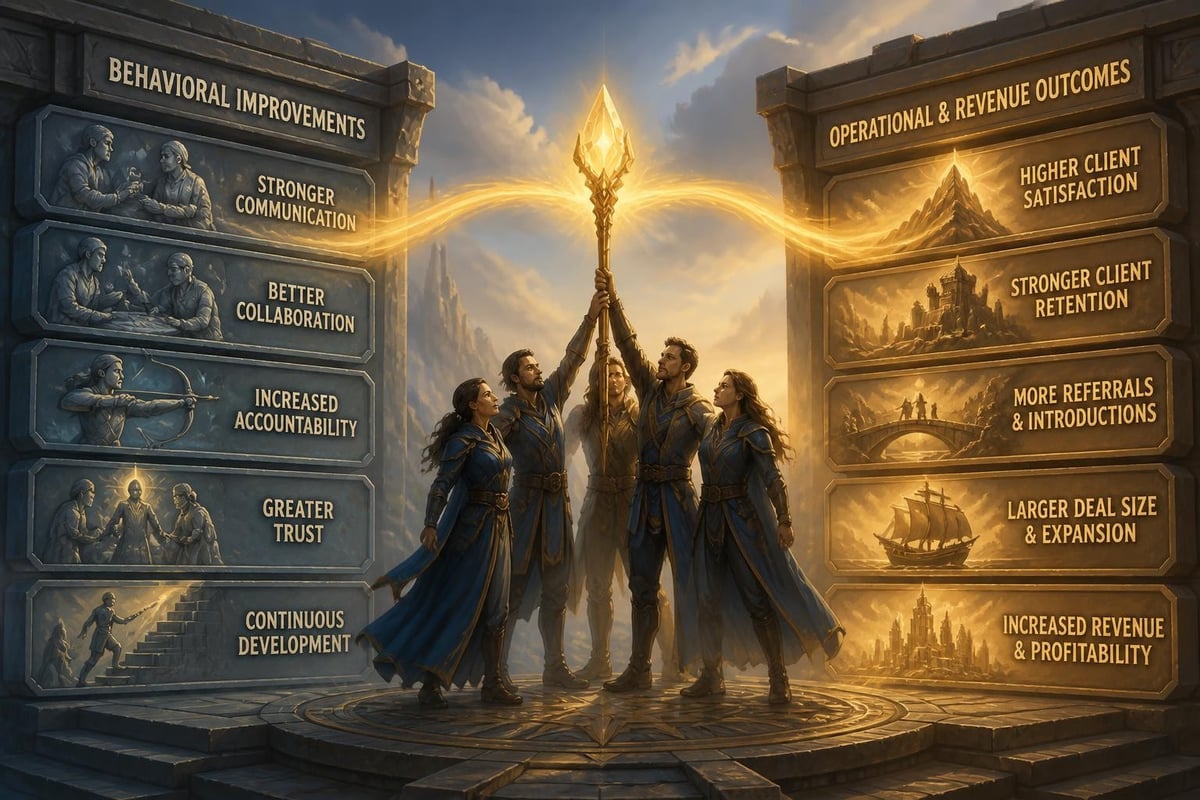
Your team doesn't exist to have great meetings; it exists to deliver profitable client outcomes. Effective team coaching services connect behavioral improvements to business results. Every intervention should trace back to operational impact.
The Framework Integration Requirement
Team coaching services deliver maximum value when integrated with strategic frameworks rather than operating as standalone interventions.
For women-owned high-ticket service businesses, this means connecting team development to:
- Positioning work (ensuring team members can articulate and defend your market authority)
- Acquisition systems (aligning team coordination around sales processes)
- Delivery excellence (standardizing client outcomes without sacrificing customization)
- Leadership boundaries (distributing decision rights appropriately)
This integration is what separates developmental coaching from transformational coaching. According to insights on systemic approaches to team coaching, addressing team dynamics within business context produces substantially better results than isolated behavioral work.
Implementation Strategies for Maximum Impact
Buying team coaching services is easy. Getting your team to engage meaningfully requires strategic implementation.
Strategy One: Start With Voluntary Pilots
Mandating team coaching creates resistance. Instead, invite your most collaborative team segment to pilot the process. When others observe tangible improvements, adoption becomes organic rather than forced.
This approach also generates proof points. You'll quickly identify which coaching methodologies work for your specific culture and which need modification.
Strategy Two: Connect Coaching to Concrete Challenges
Don't position team coaching as general professional development. Frame it as the solution to specific business problems your team already recognizes:
- "We're implementing team coaching to eliminate the bottleneck in our client onboarding process"
- "This coaching engagement will help us standardize delivery quality across all client engagements"
- "We're bringing in team coaching to reduce the decision-making delays that push project timelines"
When team members see direct relevance to their daily frustrations, engagement increases dramatically.
Strategy Three: Establish Clear Success Metrics
Measure what matters:
| Metric Category | Example Measurements |
|---|---|
| Client Outcomes | Net Promoter Score, renewal rates, testimonial quality |
| Operational Efficiency | Project completion timelines, revision rounds, escalation frequency |
| Team Autonomy | Decisions made without founder input, initiative ownership |
| Revenue Impact | Client lifetime value, referral rates, upsell conversion |
Share these metrics with both your team and your coaching partner. Regular progress reviews keep everyone accountable to outcomes rather than activities.
Beyond the Engagement: Sustaining Team Performance
Most team coaching services operate as time-bound engagements: twelve weeks, six months, occasionally a year. The real question is what happens after the coaching relationship ends.
Building Internal Coaching Capacity
Strategic team coaching services don't create dependency; they transfer capability. Your team should emerge with:
- Facilitation skills to run their own reflection sessions
- Diagnostic frameworks to identify performance breakdowns
- Intervention protocols to address issues early
- Continuous improvement rhythms that become cultural
This is where understanding the difference between mentoring and consulting approaches becomes critical. The best team coaching services teach teams to coach themselves.
Installing Sustainable Practices
Transformation requires habit change. Effective team coaching services help you install practices that outlast the engagement:
- Weekly team huddles with structured check-in protocols
- Monthly retrospectives analyzing both wins and breakdowns
- Quarterly strategic reviews connecting team performance to business goals
- After-action reviews for every major client engagement
These rhythms keep teams reflecting on and improving their collective performance long after formal coaching concludes.
Recognizing When to Re-Engage
Team coaching isn't one-and-done. As your business scales, new coordination challenges emerge. Recognize the signals that warrant re-engagement:
- Revenue jumps significantly (team structures that worked at $500K fail at $2M)
- You add new service lines (cross-functional complexity increases)
- Key team members change (group dynamics reset)
- Performance plateaus despite individual effort (system-level constraints emerge)
Treating team coaching services as an ongoing capability investment rather than a one-time fix positions your business for sustained scaling without founder burnout.
The Profit Architecture Connection
For women-owned high-ticket service businesses, team coaching services deliver maximum impact when connected to comprehensive operational frameworks.
This is where Profit Architecture creates competitive advantage. Team coaching alone might improve communication. Team coaching integrated with strategic positioning, sales systems, delivery excellence, and leadership boundaries transforms your entire business operating system.
When your team understands how their collective performance connects to market authority, revenue predictability, client outcomes, and sustainable scaling, every coaching intervention multiplies its impact. The collaborative skills they develop get immediately applied to high-value business challenges rather than remaining abstract capabilities.
Many founders explore experience coaching for themselves while simultaneously investing in team development. This parallel approach accelerates transformation because leadership behavior shifts alongside team capability development.
Building a high-performing team isn't about hiring better people or implementing more processes; it's about developing collective capability that scales beyond founder involvement. Team coaching services provide the strategic intervention that transforms talented individuals into cohesive units capable of delivering consistent client outcomes and predictable profit. If you're ready to eliminate the operational drag and founder bottlenecks limiting your business growth, Rise Reign Rule specializes in installing the Profit Architecture framework that turns team potential into measurable performance for women-owned service businesses scaling from $250K to $5M and beyond.


