
Transformation Company Guide: Fixing Founder Bottlenecks
A transformation company is a consulting or advisory firm that redesigns how a business operates, sells, delivers, and leads so it can grow without relying on the owner for every decision. For a high-ticket service business, that usually means finding the founder bottlenecks that cap revenue and replacing them with systems, clear roles, and firm boundaries.
The label covers a wide range of providers. Some focus on technology and software rollouts. Others work on leadership, culture, or sales. This guide explains what the work involves, how the process runs, who leads it, and how to pick a partner if you run a service business between $250k and $5M.
What a Transformation Company Actually Does
A transformation company diagnoses where a business is leaking time, money, or momentum, then installs new structures to fix it. The deliverable is a changed operating model, not a report that sits in a shared drive.
The work typically falls into a few buckets:
- Strategy and positioning: clarifying who you serve, what you are known for, and why clients pay your price.
- Process and systems: documenting and rebuilding how leads become clients and how clients become results.
- Leadership and team: defining roles, decision rights, and accountability so work moves without the founder in every loop.
- Technology and data: choosing tools that support the process rather than adding more admin.
Scale matters here. Accenture reported in 2024 that most surveyed global organizations planned to invest more than 5% of total revenue in change initiatives over the next three years, a sharp rise from three years earlier. Change spending is now a normal line item, which means the question is no longer whether to transform but whether the money produces results.
For a $1M service firm, the same logic applies at a smaller scale. You do not need a 40-person consulting team. You need a focused fix for the two or three constraints that stop growth.
The Transformation Process in Business, Step by Step
The transformation process in business is a sequence of diagnosing, designing, installing, and reinforcing change until it becomes the way work gets done. Skipping any stage is how most efforts stall.
- Diagnose the constraint. Map where decisions, approvals, and client touchpoints pile up. In founder-led firms, the pile usually has one name on it.
- Define the target state. Set measurable outcomes: profit margin, sales cycle length, delivery capacity, hours the founder works in the business.
- Design the system. Build the offers, sales steps, delivery workflows, and decision rules that produce those outcomes.
- Install and train. Put the systems into live use with the team, not on paper. Roles, handoffs, and tools get tested against real client work.
- Reinforce and adjust. Review the numbers on a set rhythm, fix what slips, and retire habits that pull decisions back to the founder.
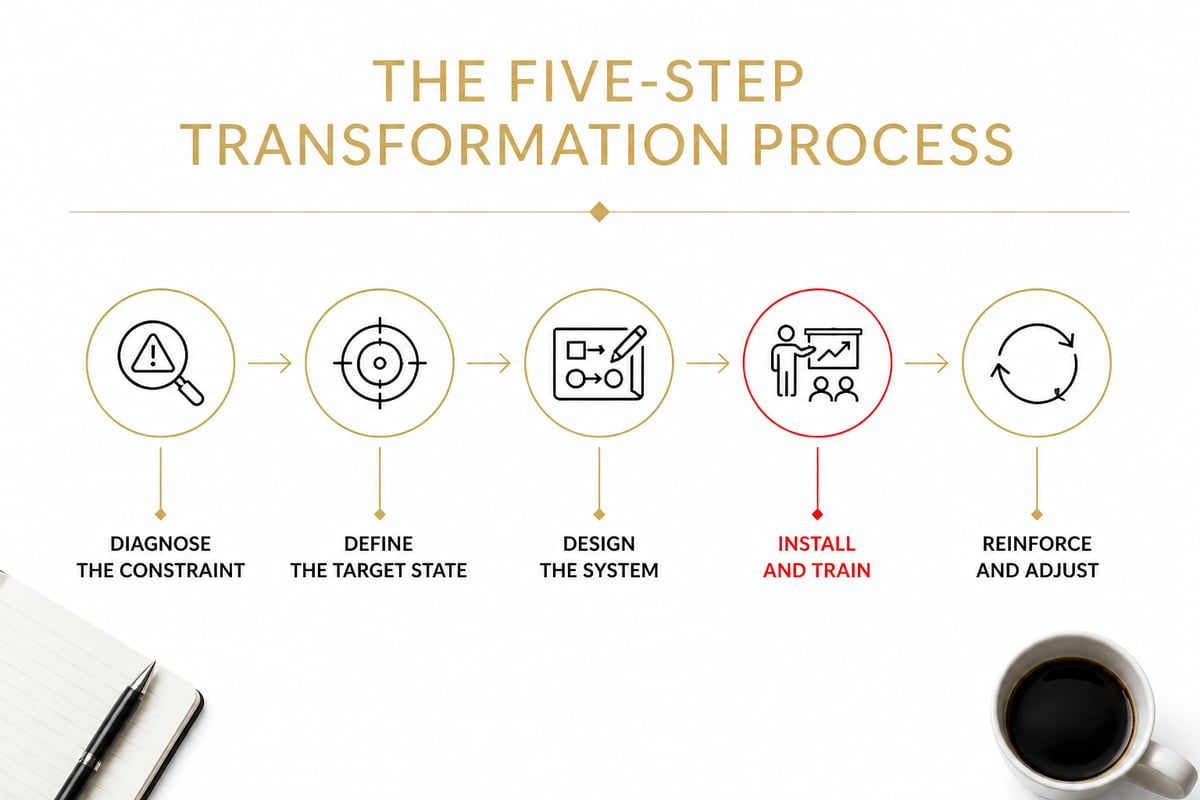
Most failures happen at step four or five. A beautiful framework that nobody owns reverts within a quarter. That is why the strongest partners stay through installation rather than handing over a deck and leaving.
Who Leads Digital Transformation and Business Change?
In large companies, a chief executive sponsors the change, and a chief digital officer, chief operating officer, or dedicated transformation office runs it day to day. In a founder-led business, the founder is the sponsor by default, and that is exactly where the trouble starts.
When the owner sponsors, designs, approves, and executes every change, the transformation becomes one more task competing for the same scarce hours. The better model is to split the roles:
- The founder owns vision, key relationships, and final decisions on strategy.
- An operator or senior lead owns day-to-day delivery of the change.
- An outside partner brings structure, pressure-tested frameworks, and an objective view of where the founder is the constraint.
Trust at the top matters more than most owners expect. KPMG found that digitally mature enterprises were far more likely to report high levels of trust in their leaders. Teams follow change when they believe the person asking for it will back them up, hold boundaries, and decide consistently. In a small firm, that trust is built through clear expectations and follow-through, not slogans.
Founder Bottlenecks: The Constraint Most Service Firms Share
A founder bottleneck is any process where growth depends on one person's time, approval, or personal relationships. In high-ticket service businesses, it shows up long before the revenue plateaus, usually as exhaustion.
Here are the common signs:
- Every proposal, scope change, or pricing exception waits for you.
- Clients ask for you by name, even after a handoff to your team.
- Revenue grows, but your hours grow faster than your profit.
- Team members bring problems to you instead of solutions.
- You cannot take a full week off without something breaking.
Operational drag is the cost of all this friction: slow approvals, rework, unclear ownership, and a team that waits instead of acts. It rarely appears on a profit and loss statement as a line item. It appears as missed margin and a founder who feels busy but underpaid for her own role.
Women-owned service firms often carry an extra layer. Many founders built their reputation on being endlessly responsive, which wins early clients and then becomes the ceiling. Boundaries are not a personality trait to develop later. They are an operating requirement, and they belong in the system design. For more on that thread, the women's leadership articles on Rise Reign Rule cover it in depth.
Why Transformations Fail (and What Prevents It)
Transformations fail mostly because the change is bigger than the capacity to absorb it, and because nobody owns the follow-through. The tools are rarely the problem.
KPMG reported that most large enterprises were pursuing two or more organizational transformations at the same time. Running several initiatives at once splits attention and exhausts teams. A small firm that tries to rebrand, rebuild its sales process, hire two people, and switch software in one quarter is doing the same thing at a smaller scale.
What prevents it:
- One constraint at a time. Fix the biggest bottleneck first, then move to the next.
- Named owners. Every new process has one person responsible, and it is not always the founder.
- Short feedback loops. Review metrics every two to four weeks so drift gets caught early.
- Boundaries written down. Decision rights, response times, and scope limits stored where the team can see them.
- Realistic pacing. Protect delivery quality while you install changes, because clients will not wait for your reorganization.

The Four Pillars That Remove Founder Dependence
A durable fix for a service business works across four connected areas: positioning, acquisition, delivery, and leadership. Rise Reign Rule organizes this as Profit Architecture, a framework built for women-owned high-ticket service businesses with revenue between $250k and $5M.
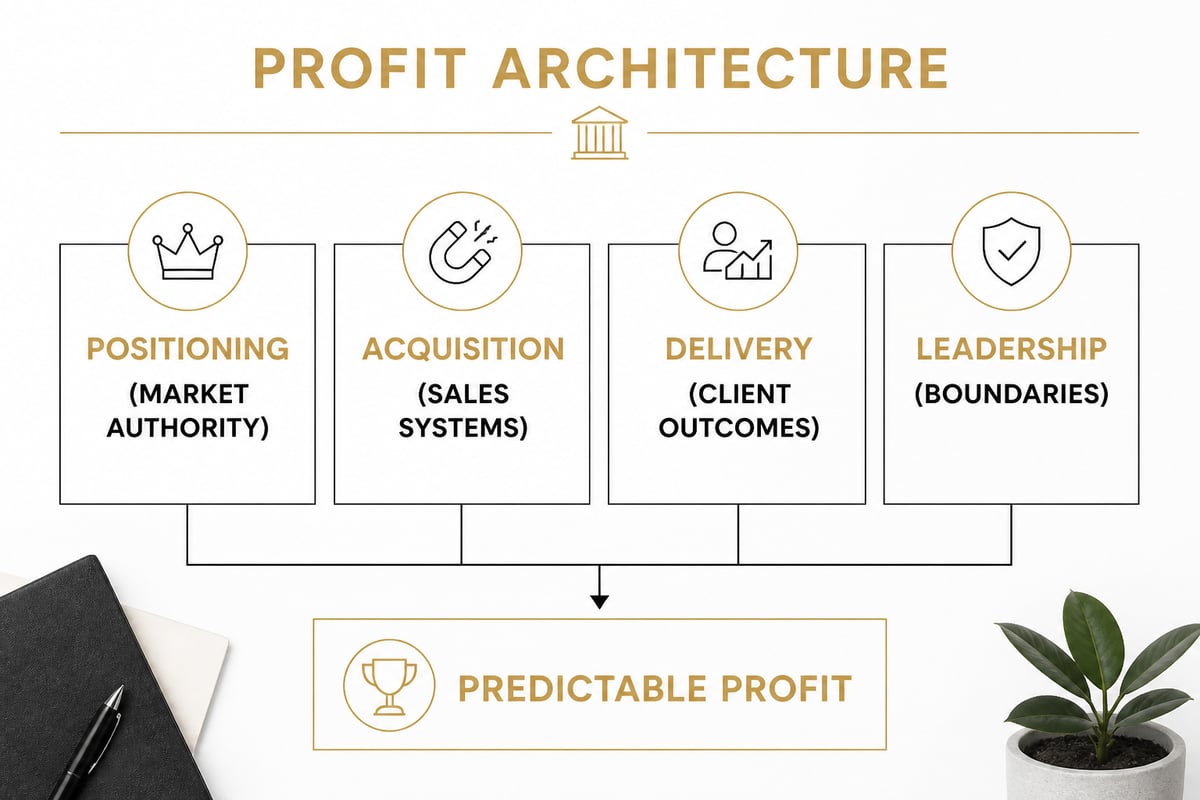
Positioning: Market Authority
Positioning decides who comes to you and what they expect to pay. Clear authority in a narrow market shortens sales cycles and reduces discounting. Vague positioning forces the founder into long explanatory calls that only she can run.
Acquisition: Sales Systems
A sales system turns interest into signed work through repeatable steps: qualification, discovery, proposal, and follow-up. When these steps are documented, someone other than the founder can run the early stages, and the founder joins only where her expertise changes the outcome.
Delivery: Client Outcomes
Delivery is where margin is made or lost. Standard workflows, defined scopes, and clear handoffs protect quality while freeing the founder from being the default fixer. Clients should get results from the system, not from heroic last-minute effort.
Leadership: Boundaries
Leadership sets the rules everything else depends on: who decides what, how fast, and with what limits. Without it, the first three pillars decay as soon as a client pushes or a team member hesitates. With it, the business behaves consistently when the founder is not in the room.
The four pillars work as a set. A strong sales system feeding a weak delivery process creates unhappy clients faster. Great delivery with fuzzy positioning keeps you underpriced. That interdependence is the reason piecemeal fixes disappoint.
How to Choose a Transformation Company for a Service Business
Choose a partner whose size, specialty, and method match the problem you actually have. A global firm built for enterprise software rollouts will not fit a $900k advisory practice, and a generic business coach may not install anything lasting.
Use these questions to compare options:
| Question | What a good answer looks like |
|---|---|
| Who do you serve? | A clear client profile that resembles your revenue range and model |
| What do you install? | Named systems and deliverables, not general advice |
| How do you measure progress? | Specific metrics such as margin, sales cycle, and founder hours |
| Who does the work? | A defined mix of partner guidance and your team's ownership |
| What happens after launch? | A reinforcement plan, not a handoff and goodbye |
Also check evidence. Look for case examples, testimonials, and media features. Rise Reign Rule lists its press mentions on its as featured in page, and its services page outlines what working together involves, so you can compare it against the criteria above.
Be wary of three red flags: promises of overnight growth, proposals that never mention your team, and any approach that requires you to stay the central decision-maker for every step. If the fix keeps you as the bottleneck, it is not a fix.
Coaching and consulting often overlap, and a fair number of founders benefit from both. If you want to understand the difference before you decide, these pieces on coaching for business owners and how to find a business coach lay out what to expect.
What to Measure So the Change Sticks
Measure a few numbers that reflect profit and founder dependence, and review them on a fixed schedule. Too many metrics create the same overload you are trying to remove.
A practical starting set:
- Net profit margin: the clearest signal that scaling is clean rather than just busy.
- Sales cycle length: days from first conversation to signed agreement.
- Founder hours in delivery: the number that should fall as systems take hold.
- Client outcome rate: how often clients hit the result you sold them.
- Decisions escalated to the founder: a count of how many items reach you that should not.
Set a baseline before you change anything, then track monthly. If margin rises while founder hours fall, the system is working. If revenue climbs but both margin and hours stay flat, you have added volume without fixing the structure.
It also helps to watch the cost side. Coaching and consulting spend should be judged against measurable return, and the discussion of the ROI of coaching is a useful frame for setting those expectations.
Quick Wins You Can Start This Month
You can reduce founder dependence before hiring any outside help by auditing your calendar and handing off the lowest-risk decisions first. Small proof builds the confidence your team needs.
- Track one week of decisions. Write down every approval you give. Sort them into "only I can decide" and "someone else could."
- Write three decision rules. For example, discounts up to a set percentage can be approved by the account lead, and scope changes under a set size need no sign-off.
- Document one repeatable process. Pick the one you explain most often and write it as a checklist.
- Set response-time boundaries. Decide when clients and team can expect answers, and tell them.
- Hold a weekly 30-minute metrics review. Use the five numbers above and nothing else.
These steps cost almost nothing, and they reveal how deep the dependence runs. If you find that most decisions sit in the "only I can decide" column, that is useful data for choosing a partner.
Some owners also need a thinking partner at the leadership level, not only process help.
FAQ
What is McKinsey transformation?
It refers to the change programs run by McKinsey & Company, a global management consulting firm, which typically help large organizations redesign strategy, operations, or technology. Those engagements are built for enterprise scale. A founder-led service firm usually needs a narrower, more hands-on approach.
Do I need a transformation company or a business coach?
It depends on whether your problem is mostly structural or mostly personal. If you need sales systems, delivery workflows, and decision rules installed, a transformation firm fits. If the main challenge is your own mindset and leadership habits, coaching may be the better starting point, and many owners use both.
How long does a business transformation take?
There is no universal timeline, because it depends on how many constraints you fix and how fast your team adopts new habits. Most efforts work best when staged one constraint at a time rather than rushed. For a specific engagement length, ask the provider directly through the Rise Reign Rule contact page.
Start this week by listing every decision that reached you in the past five days and marking the ones someone else could have made. That single exercise shows you where operational drag lives in your business. If you want help turning that list into a working system, Rise Reign Rule installs Profit Architecture for women-owned high-ticket service firms, so your positioning, sales, delivery, and leadership boundaries produce predictable profit without relying on you for every call.


