
Women Executive Coaching: Scale Your High-Ticket Business
The most successful women-owned service businesses share a common inflection point. Somewhere between $250k and $750k in revenue, the strategies that built the business begin to strangle it. The founder who excelled at delivery now drowns in operations. The leader who commanded premium fees finds herself trapped in a cycle of feast or famine. This is precisely where women executive coaching becomes not just valuable, but essential for breakthrough growth.
Why Traditional Business Coaching Fails Women-Owned Service Businesses
Most business coaching follows a one-size-fits-all model designed for product companies or startups seeking venture capital. These frameworks ignore the unique dynamics of high-ticket service businesses where the founder's expertise is the product, relationships drive revenue, and operational complexity scales faster than cash flow.
Women executive coaching addresses three critical gaps that generic coaching overlooks:
- Revenue ceiling syndrome where growth plateaus because every dollar requires founder time
- Positioning paradox where expertise doesn't translate into market authority or premium pricing
- Leadership isolation where the founder lacks peer-level strategic thinking partners
The difference becomes stark when you examine outcomes. Traditional coaching might help you optimize your calendar or refine your messaging. Women executive coaching rebuilds your business architecture to support seven-figure scale without adding founder hours.

The Founder Bottleneck That Blocks Scale
Every high-ticket service business reaches a moment where the founder becomes the constraint. You're the closer on sales calls. You're the deliverer of signature services. You're the quality controller, the client whisperer, the brand ambassador, and the operations manager simultaneously.
This isn't a time management problem. It's a business design problem that requires executive-level thinking to solve. Effective executive coaching aligns strategic goals with operational realities, creating pathways to scale that preserve quality while removing founder dependency.
The numbers tell the story. Research on women's leadership challenges reveals that confidence gaps and systemic barriers compound at every revenue level. Without structured support, talented founders stall not from lack of capability but from lack of strategic infrastructure.
The Four Pillars of Executive-Level Business Architecture
Women executive coaching worth investing in should fundamentally restructure how your business operates. This goes far beyond mindset work or accountability partnerships. You need a comprehensive framework that addresses every aspect of scaling.
Positioning: Building Unshakeable Market Authority
Your positioning determines whether prospects choose you or compare you. When positioning is weak, you compete on price, availability, or relationship. When positioning is strong, you command premium fees and attract ideal clients who pre-sold themselves.
Strategic positioning for women-owned service businesses requires:
- Category creation or domination in a specific niche where you can own the conversation
- Evidence architecture that proves outcomes through case studies, methodologies, and proprietary frameworks
- Authority platforms that position you as the expert, not just another service provider
- Boundary clarity that repels wrong-fit clients before they waste your time
Most founders underestimate how dramatically stronger positioning impacts revenue. The same service delivered by the same person can command 2-3x higher fees simply through strategic repositioning. Women leaders who thrive in executive roles understand that authenticity paired with strategic positioning creates unstoppable momentum.
Acquisition: Sales Systems That Scale Without You
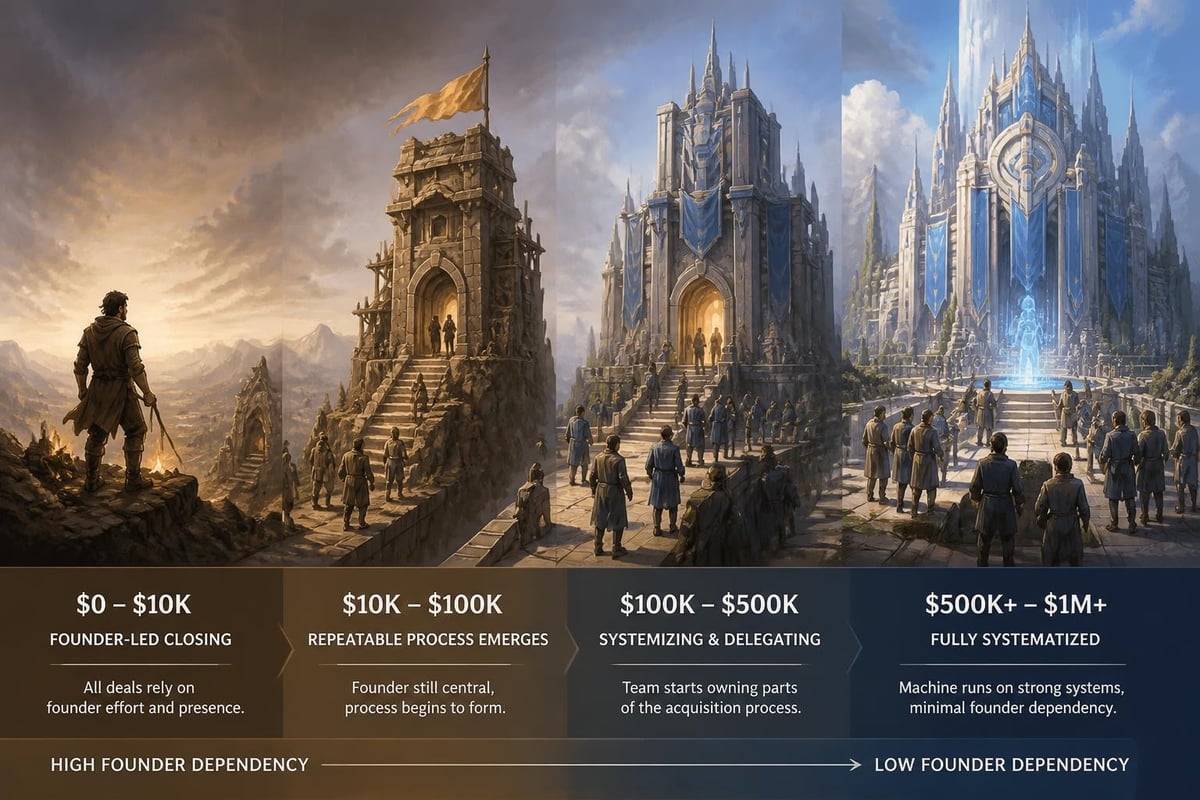
The sales system that got you to $250k will choke you at $500k and completely fail at $1M. Women executive coaching should install predictable acquisition systems that generate consistent revenue without founder involvement in every conversation.
| Revenue Stage | Typical Sales Model | Required Transformation |
|---|---|---|
| $0-$250k | Founder closes 100% of deals | Build repeatable sales process |
| $250k-$750k | Founder closes 70%+ of deals | Train team to close, founder qualifies |
| $750k-$2M | Founder closes 30-50% of deals | Systematized pipeline, founder closes strategic only |
| $2M+ | Founder rarely closes | Full sales team, founder focuses on partnerships |
The transformation from founder-dependent sales to systematic acquisition requires specific skills: offer architecture, conversion optimization, team training, and pipeline management. This is where understanding the distinction between mentoring and consulting becomes crucial. You don't need someone to teach you sales tactics; you need strategic guidance to build systems.
Delivery: Client Outcomes at Scale
The signature service that built your reputation becomes your scaling nightmare if it requires your personal delivery. Women executive coaching must address how to maintain premium outcomes while removing yourself from day-to-day execution.
Deliverability transformation involves:
- Codifying your intuitive expertise into teachable methodologies
- Building delivery teams that can execute your frameworks
- Creating quality assurance systems that don't require founder review
- Designing client experiences that feel premium without being founder-intensive
Research shows that women in technical fields often experience confidence gaps despite strong performance. This same dynamic appears in service delivery. Founders doubt whether anyone else can deliver results, so they stay trapped in delivery long after they should transition to leadership.
The solution isn't to lower standards. It's to build systems that codify excellence and make it repeatable through trained team members. Your job shifts from doing the work to ensuring the system produces consistent outcomes.
Leadership: The Boundaries That Enable Growth
The least discussed but most critical pillar of women executive coaching centers on leadership boundaries. Without clear boundaries around time, energy, decision-making authority, and strategic focus, every other system collapses.
Effective boundaries in high-ticket service businesses include:
- Client boundaries that define what's included, when you're available, and how escalations work
- Team boundaries that clarify decision rights, approval processes, and communication norms
- Market boundaries that identify who you serve and who you refer elsewhere
- Capacity boundaries that protect margin, prevent burnout, and sustain long-term performance
Coaching tips for female executives frequently emphasize boundary-setting as foundational to sustainable leadership. The businesses that scale cleanly do so because founders establish and enforce boundaries that protect strategic focus.
Operational Drag: The Hidden Profit Killer
Between $250k and $2M in revenue, most service businesses experience operational drag. This manifests as increasing complexity that consumes profit margins, founder time, and team energy without producing proportional revenue growth.
Common sources of operational drag:
- Customized delivery for every client instead of systematic processes
- Reactive firefighting instead of proactive system improvement
- Manual tasks that should be automated or eliminated
- Unclear team roles that create duplication and gaps
- Scattered tools and platforms that don't integrate
Women executive coaching identifies and eliminates operational drag by installing clean systems. This means choosing between good opportunities to protect capacity for great ones. It means saying no to custom projects that break your delivery model. It means investing in infrastructure before it feels urgent.
The financial impact is dramatic. Eliminating operational drag typically recovers 15-30% of revenue as profit that was previously consumed by inefficiency. For a $500k business, that's $75k-$150k in annual profit improvement without adding a single new client.
The Profit Architecture Framework in Practice
Strategic women executive coaching builds what we call Profit Architecture: the systematic integration of positioning, acquisition, delivery, and leadership into a cohesive scaling system. This framework transforms founders from technicians working in the business to CEOs leading strategic growth.
Assessment: Understanding Your Current State
The first phase of executive coaching involves honest assessment of where operational drag, founder bottlenecks, and system gaps constrain growth. This diagnostic work identifies:
- Revenue ceiling analysis showing exactly where founder dependency limits scale
- Positioning audit revealing gaps in market authority and competitive differentiation
- Systems inventory documenting what exists, what's broken, and what's missing
- Leadership capacity assessment measuring strategic focus versus tactical firefighting
Most founders discover they're spending 60-80% of time on activities that don't scale. Experience-based coaching helps you see these patterns clearly and prioritize ruthlessly.

Design: Building Your Scaling Infrastructure
With clear assessment, women executive coaching moves to strategic design. This phase creates the blueprint for systematic scaling across all four pillars.
| Pillar | Design Deliverables | Timeline |
|---|---|---|
| Positioning | Authority platform, niche definition, messaging framework | 30-60 days |
| Acquisition | Sales process, conversion assets, pipeline management | 60-90 days |
| Delivery | Service methodology, team training, quality systems | 90-120 days |
| Leadership | Boundary protocols, decision frameworks, strategic planning | Ongoing |
The design phase requires patience. Founders eager for immediate revenue gains often want to skip infrastructure building. But attempting to scale without proper architecture creates chaos that costs far more than the time invested in design.
Implementation: Installing Systems That Stick
The breakdown between strategy and execution kills most transformation initiatives. Women executive coaching must include hands-on implementation support, not just strategic advice.
Implementation excellence requires:
- Sequenced rollout that doesn't overwhelm team capacity
- Training and enablement so team members can execute new systems
- Measurement and feedback loops that show what's working and what needs adjustment
- Founder discipline to stay in strategic leadership rather than reverting to tactical execution
Many founders need dedicated sales coaching during implementation to rebuild acquisition systems. Others need operational support to redesign delivery. The specific needs vary, but the principle remains constant: strategy without execution is fantasy.
Measuring What Matters: Key Performance Indicators for Scale
Women executive coaching should establish clear metrics that indicate progress toward clean scaling. Vanity metrics like social media followers or email list size matter far less than operational indicators that predict sustainable growth.
Critical KPIs for high-ticket service businesses:
- Founder utilization rate measuring percentage of time spent on strategic versus tactical work
- Sales close rate showing conversion efficiency independent of founder involvement
- Delivery margin calculating profit per client after all delivery costs
- Client lifetime value demonstrating retention and expansion revenue
- Pipeline predictability forecasting revenue 60-90 days forward with accuracy
- Team productivity measuring revenue per team member as the business scales
The goal isn't to maximize every metric. It's to understand trade-offs and make strategic decisions. Sometimes accepting a lower close rate makes sense if it means the founder can focus on high-leverage activities. Sometimes reducing client lifetime value makes sense if it improves delivery margin and scales capacity.
The Investment Thesis for Executive Coaching
Women executive coaching represents a significant investment, typically ranging from $20k to $100k+ depending on scope and duration. For founders accustomed to bootstrapping, this price point can trigger resistance.
The return calculation is straightforward. If coaching eliminates operational drag worth 20% of revenue and removes founder bottlenecks blocking growth to the next revenue level, the financial return happens within 6-12 months for most businesses.
Consider a $500k business stuck at plateau:
- Current state: $500k revenue, 15% profit margin, founder working 60 hours weekly
- Post-coaching: $800k revenue, 25% profit margin, founder working 40 hours weekly
- Financial gain: $300k additional revenue + $50k margin improvement = $350k value created
- Time gain: 20 hours weekly freed for strategic focus or personal life
The investment in women executive coaching pays for itself multiple times over when it successfully breaks through founder bottlenecks and installs systematic scaling infrastructure. The businesses that don't make this investment often stall for years, trapped in the same revenue range while burning out the founder.
Selecting the Right Executive Coach for Your Business
Not all women executive coaching delivers equal value. The market includes everything from mindset coaches with no business experience to high-level strategists who've scaled multiple seven-figure service businesses themselves.
Evaluation criteria for selecting a coach:
- Proven track record scaling service businesses specifically (not product companies or e-commerce)
- Proprietary framework or methodology rather than generic coaching approaches
- Focus on systems and infrastructure, not just mindset and accountability
- Understanding of high-ticket sales dynamics and premium positioning
- Ability to support implementation, not just strategy development
- Industry expertise relevant to your specific service category
Ask for case studies, client references, and specific examples of how they've solved problems similar to yours. The right coach should be able to articulate exactly how they'll address your founder bottlenecks and operational drag with proven frameworks.
Common Pitfalls to Avoid When Scaling
Even with excellent women executive coaching, certain predictable pitfalls threaten scaling success. Awareness of these traps helps you navigate around them.
The premature team expansion trap: Hiring ahead of systems creates chaos. Team members need clear processes to execute. Without documented systems, you're hiring people to figure things out through trial and error, which is expensive and inefficient.
The shiny object syndrome: New marketing channels, partnership opportunities, or service offerings constantly tempt founders away from disciplined execution. Strategic focus means protecting your roadmap against distractions.
The perfectionism paralysis: Waiting for perfect systems before implementing prevents progress. The goal is systematic improvement through iteration, not flawless execution from day one.
The delegation without training mistake: Handing off responsibilities without proper training and support sets team members up to fail. Then founders take tasks back, reinforcing the bottleneck.
The boundary erosion cycle: Initially strong boundaries gradually weaken through exceptions and special cases. Before long, you're back to custom delivery and always-on availability that prevents scaling.
Strategic coaching helps you anticipate and avoid these pitfalls through structured accountability and experienced guidance. The path to seven figures is well-documented; you don't need to learn through costly mistakes.
Women executive coaching transforms capable founders into strategic CEOs who lead scalable, profitable businesses instead of exhausting service delivery operations. The frameworks, systems, and boundaries you install today determine whether your business reaches its full potential or plateaus indefinitely. If you're ready to eliminate operational drag and break through founder bottlenecks in your high-ticket service business, Rise Reign Rule specializes in installing the Profit Architecture framework that creates predictable profit and clean scaling for women-owned businesses generating $250k to $5M in revenue.


