
Business Group Coaching: Scale High-Ticket Services
When your high-ticket service business hits $250k in revenue and you're still the bottleneck in every client delivery, every sales conversation, and every strategic decision, you've discovered the paradox of growth. You built something valuable, but now that value depends entirely on your personal capacity. Business group coaching offers a solution that individual consulting and traditional training programs can't match: collective transformation that addresses systemic challenges while building peer accountability and shared intelligence.
For women-owned service businesses scaling between $250k and $5M, the founder bottleneck isn't just about time management. It's about operational architecture. When your business lacks clear systems for positioning, client acquisition, delivery excellence, and leadership boundaries, adding more clients only amplifies the chaos. Group coaching creates the container for building these systems while leveraging the collective experience of peers facing identical scaling challenges.
The Strategic Case for Business Group Coaching
Traditional one-on-one coaching focuses on individual performance, but scaling a high-ticket service business requires organizational transformation. You're not just improving your personal effectiveness; you're redesigning how your entire operation functions when you're not in the room.
Research from Harvard Business Review on collective team coaching demonstrates that coaching teams as a collective strengthens performance more effectively than individual interventions alone. The same principle applies to peer groups of business owners: shared challenges surface patterns that individual sessions miss.

Consider what happens in a typical business group coaching cohort focused on service scaling:
- Pattern recognition: When five founders share their client acquisition challenges, you discover the root cause isn't about marketing tactics but unclear positioning that makes selling difficult
- Accountability leverage: Public commitments to peer groups generate follow-through rates 3-4x higher than private goals
- Solution diversity: Each member brings solutions that worked in their context, creating a repository of tested strategies
- Blind spot elimination: Peers spot the operational drag you've normalized because it's invisible from inside your business
The personal development company model has evolved beyond generic mindset work. Today's most effective programs integrate strategic business frameworks with group dynamics, creating environments where founders develop both capability and accountability simultaneously.
How Business Group Coaching Solves Founder Bottlenecks
The founder bottleneck manifests in four predictable ways across high-ticket service businesses. Business group coaching addresses each through structured peer learning and facilitated implementation.
Positioning Paralysis
You can't scale what you can't articulate. When founders describe their services in vague terms like "strategic consulting" or "transformational coaching," they create a sales process that depends entirely on their personal credibility and charisma. This works until you want to hire delivery team members, build referral systems, or create marketing that converts without lengthy discovery calls.
In group coaching settings, peers push each other toward clarity. When someone says "I help businesses grow," the group naturally asks: "Which businesses? From what revenue to what revenue? Solving which specific problem?" This collective pressure toward specificity builds positioning that scales beyond the founder's personal network.
Market authority emerges when your positioning makes a clear promise to a defined audience. Group coaching accelerates this because you're testing positioning language with a built-in focus group of business owners who represent your market sophistication level.
Acquisition Inconsistency
Feast-or-famine revenue cycles plague service businesses because most founders use relationship-dependent sales systems. You network, nurture connections, have great conversations, and occasionally someone becomes a client. This works at $250k. It breaks catastrophically at $1M.
Business group coaching creates accountability for installing repeatable acquisition systems:
| Relationship Sales | Systematic Sales |
|---|---|
| Revenue depends on founder's network size | Revenue depends on predictable lead sources |
| Conversion requires founder's involvement | Junior team members can close deals |
| Scale limited by founder's time | Scale limited only by lead volume |
| Inconsistent monthly revenue | Predictable revenue patterns |
The group environment forces visibility. When every member reports weekly sales metrics, you can't hide behind "just had a slow month." The collective intelligence identifies exactly where your acquisition funnel breaks down, whether that's lead generation, qualification, presentation, or close.
Delivery Dependency
The highest-revenue founder bottleneck occurs in delivery. You've sold premium services based on your personal expertise, but now you're working 60-hour weeks delivering client results while your business development suffers. You can't hire your way out because "what you do" lives entirely in your head.
Group coaching participants gain two advantages here. First, articulating your delivery process to peers forces you to codify what's currently intuitive. Second, seeing how other founders structure delivery reveals possibilities you hadn't considered.
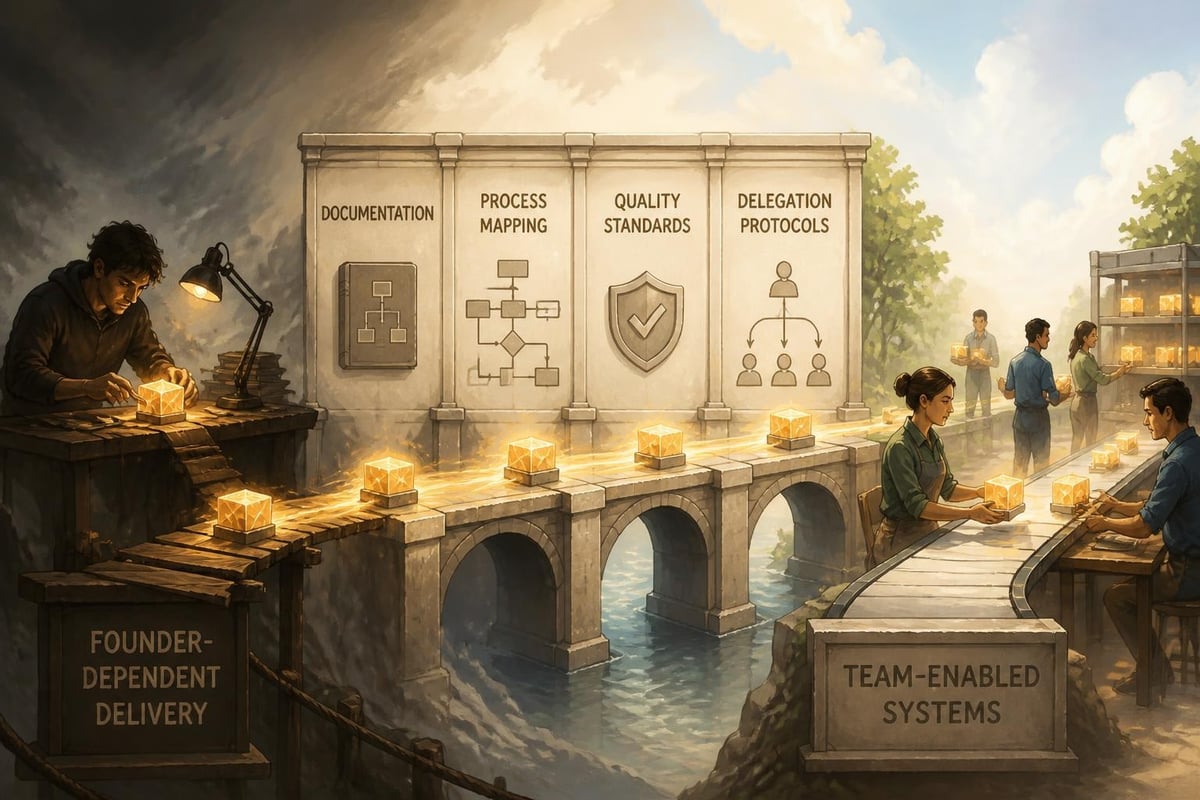
A career and leadership coach working with executive clients might discover that their six-month engagement can be restructured into three phases: diagnostic (can be standardized), strategy development (requires senior expertise), and implementation support (can be delegated to junior coaches). This revelation typically emerges from group discussion, not solo reflection.
Client outcomes become systematic when you identify the non-negotiable elements that create results versus the customization that merely feels personalized. Business group coaching provides the safe environment to test these distinctions with peers who understand high-touch service delivery.
Leadership Boundaries
The invisible bottleneck is your inability to say no. No to scope creep, no to client requests that fall outside your engagement terms, no to "quick questions" that consume hours, no to being available 24/7. These missing boundaries don't just drain your time; they train clients to expect unlimited access, making your service fundamentally unscalable.
Group coaching creates a culture of healthy boundaries because you witness peers modeling them. When a cohort member shares how they implemented client communication windows or scope change protocols, it gives you permission to do the same. The peer accountability ensures you actually implement rather than just acknowledging the idea is good.
Evidence from the American Psychological Association's workplace health research links boundary-setting and workplace interventions to improved psychological health and organizational outcomes. For service business founders, professional boundaries directly impact both personal wellbeing and business sustainability.
Designing Effective Business Group Coaching Programs
Not all group coaching delivers results. The structure determines whether you get genuine transformation or expensive networking.
Cohort Composition Matters
Effective business group coaching requires strategic homogeneity in participant selection. Revenue stage matters more than industry. A $300k web design agency faces more similar challenges to a $350k consulting firm than to a $3M design agency. The problems at each revenue stage are architecturally different.
Ideal cohort characteristics:
- Revenue range within 50% variance ($300k–$450k, not $200k–$2M)
- All service-based businesses (not mixing product and service models)
- Similar business maturity (established businesses, not startups)
- Committed owners (not employees attending on behalf of founders)
- Gender-aligned when addressing industry-specific challenges women founders face
The strategic consultancy approach at Rise Reign Rule demonstrates how focused targeting creates better outcomes. Women-owned service businesses between $250k and $5M face predictable patterns around credibility, pricing, and scaling that differ from challenges male founders face or product businesses encounter.
Framework Over Flexibility
The most effective business group coaching programs balance structure with customization. A proprietary framework ensures everyone builds on the same foundation while applying principles to their specific context.
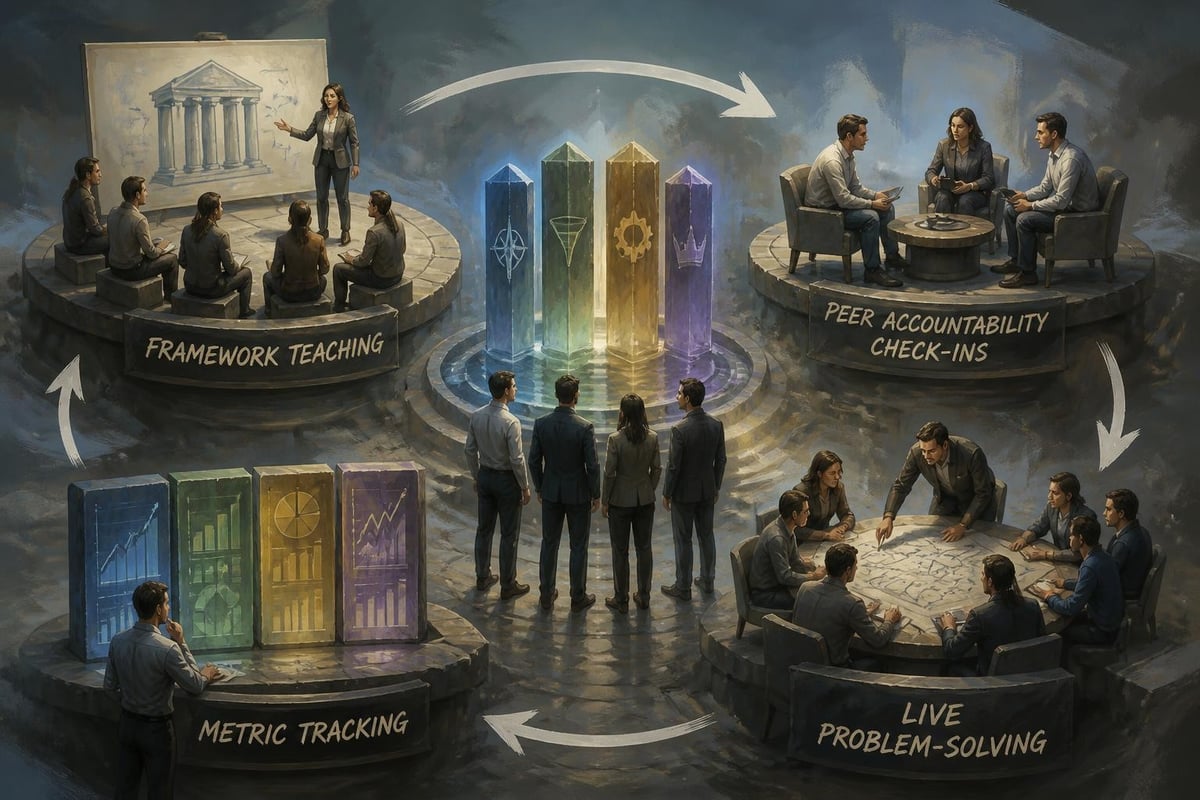
Consider a framework that addresses:
- Positioning clarity - Who you serve, what problem you solve, why you're the authority
- Acquisition systems - Repeatable processes from lead generation through client onboarding
- Delivery excellence - Documented systems that create consistent client outcomes
- Leadership capacity - Boundaries, delegation, and decision-making protocols
Each element builds on the previous one. You can't install effective acquisition systems without clear positioning. You can't scale delivery without acquisition volume. You can't maintain quality without leadership boundaries.
This systematic approach mirrors evidence from CIPD's research on workplace learning practices, which shows that structured learning interventions integrated into operational work create better retention and application than ad-hoc training.
Implementation Accountability
Group coaching fails when it becomes a discussion forum without action. The distinction between valuable networking and transformational coaching is mandatory implementation with public tracking.
Effective programs include:
- Weekly metric reporting (revenue, pipeline, client outcomes)
- Public commitment to specific implementations
- Peer review of work products (positioning statements, sales materials, process documentation)
- Consequence for non-participation (not punitive, but natural exclusion from group benefits)
- Facilitated problem-solving focused on removal of implementation barriers
When a cohort member commits to documenting their delivery process and reports progress weekly, the group naturally asks better questions: "What's blocking you?" rather than "That sounds hard." This shift from sympathy to solution-finding drives results.
The ROI Equation for Business Group Coaching
High-ticket service businesses should evaluate business group coaching investments through a specific lens: capacity unlocked per dollar spent.
If you're currently the bottleneck in $400k of annual revenue, working 50 hours per week delivering client work, your hourly value is approximately $154. Every hour you reclaim through systematization, delegation, or boundary-setting represents that value. More importantly, every hour you redirect to business development, strategic partnerships, or offer refinement has 3-5x multiplier effects.
Direct Financial Returns
Calculate potential returns across four dimensions:
| Metric | Before Coaching | After Implementation | Annual Value |
|---|---|---|---|
| Founder delivery hours | 30 hrs/week | 15 hrs/week | $120k capacity |
| Sales conversion rate | 30% | 45% | $75k revenue |
| Average client value | $15k | $20k | $60k revenue |
| Client acquisition cost | $3k | $1.5k | $22.5k savings |
These numbers reflect typical outcomes for founders who implement systematically rather than conceptually. The difference emerges from group accountability: your peers know if you're executing or just learning.
Indirect Strategic Benefits
Beyond direct revenue impact, business group coaching creates strategic advantages that compound over time:
- Faster decision-making from access to collective intelligence and pattern recognition
- Reduced costly mistakes by learning from peers' failed experiments
- Network effects as cohort members refer clients, partners, and opportunities
- Mental resilience from peer support during inevitable scaling challenges
- Strategic confidence that enables bigger bets and faster growth
Research on developing effective internal coaching capability shows that structured coaching interventions improve both performance outcomes and participant confidence. The same mechanisms that make internal coaching effective apply to peer group business coaching.
Selecting the Right Business Group Coaching Program
The market for group coaching ranges from $3k weekend intensives to $50k year-long programs. Price alone doesn't indicate quality. Evaluate potential programs across five dimensions.
Framework Specificity
Generic business coaching that promises to "help you grow your business" lacks the operational specificity needed for service business scaling. Look for programs built around frameworks that address your exact bottleneck: founder-dependent operations.
Ask potential programs:
- What is your proprietary framework called and what are its components?
- How does your approach specifically address service business scaling versus product businesses or startups?
- What's your documented success rate with businesses at my revenue stage?
- Can I see the curriculum outline and implementation milestones?
Programs that can't answer these questions specifically will deliver generalized value at best.
Facilitator Expertise
The coach running your cohort should have direct operational experience scaling service businesses, not just coaching credentials. Certifications matter less than pattern recognition born from doing the work themselves.
Ideal facilitator credentials include:
- Founded and scaled a service business past $1M personally
- Worked with 20+ businesses in your revenue range
- Can cite specific case examples of addressing positioning, acquisition, delivery, and leadership bottlenecks
- Maintains active involvement in service business operations (not purely a coach)
The quality gap between someone who's studied business scaling and someone who's solved these problems in their own operations is vast. Your facilitator should bring operational scars, not just theoretical knowledge.
Cohort Structure and Size
Intimacy matters in group coaching. Programs with 30+ participants become workshops, not coaching. You want 6-12 members maximum, ensuring everyone gets attention each session and peer relationships develop depth.
Confirm structural details:
- How many participants per cohort?
- What's the meeting frequency and duration?
- Is there individual coaching included or purely group sessions?
- What happens if I miss a session?
- How are cohorts composed (revenue stage, industry, gender)?
Programs that promise community access to hundreds of members rarely deliver the accountability that drives implementation. Small, focused cohorts create the productive discomfort that generates change.
Duration and Commitment
Transformation requires time. One-month programs create awareness, not new operational systems. Look for 6-12 month engagements that allow for multiple implementation cycles with feedback and refinement.
Elite programs like Stanford's executive education offerings typically run for extended periods because behavioral change and organizational transformation follow longer timelines than skill acquisition. Your business group coaching program should reflect similar understanding.
The commitment requirement should feel slightly uncomfortable. If it's easy to say yes, it's probably not demanding enough to drive results.
Success Metrics and Tracking
How does the program measure progress? Feelings-based check-ins don't scale businesses. Look for programs that track concrete operational metrics:
- Revenue and profit margins
- Founder hours in delivery versus development
- Sales conversion rates and pipeline value
- Client outcome metrics and satisfaction scores
- Team capacity and delegation percentages
Programs that can't articulate their tracking methodology or success metrics lack the operational rigor needed for service business scaling.
Implementing Business Group Coaching Insights
Participation alone doesn't create results. The value emerges from ruthless implementation of frameworks within your specific operational context. Here's how high-performing participants maximize their investment.
Weekly Implementation Sprints
Treat each week between sessions as a focused implementation sprint. Your cohort session identifies the next bottleneck and provides the framework solution. Your sprint implements that solution before the next session, bringing results and problems to the group.
This rhythm creates momentum. You're not accumulating ideas to implement "someday." You're building systems week by week, validating what works through peer review and real client interactions.
Documentation as Learning
Every process you document, positioning statement you refine, or boundary you set should be captured as a reusable asset. Business group coaching reveals gaps in your operational documentation. The peer pressure to explain "how you do what you do" forces clarity that benefits both your current operations and future team training.
Create living documents for:
- Your client qualification criteria and deal evaluation process
- Delivery phase breakdowns with inputs, outputs, and quality standards
- Communication protocols and client expectation-setting scripts
- Decision-making frameworks for common situations
These artifacts become your operational manual, enabling delegation and scale.
Peer Accountability Partnerships
Beyond full cohort sessions, establish one-on-one accountability partnerships with another member. Weekly 20-minute check-ins between sessions dramatically increase implementation rates. You're not reporting to a coach you want to impress; you're reporting to a peer who knows your excuses because they use the same ones.
These partnerships work best when pairing complementary strengths. If you excel at strategic thinking but struggle with tactical execution, partner with someone whose strength is implementation discipline.
Metrics Transparency
Share your real numbers with your cohort. Not vanity metrics, not rounded estimates, but actual revenue, profit margins, founder hours, and conversion rates. This vulnerability creates psychological commitment to improvement and enables the group to provide relevant guidance.
The businesses that transform through group coaching are those willing to expose their operational reality. The businesses that waste the investment are those who share selectively, protecting their image while limiting their learning.
Business group coaching transforms high-ticket service businesses by replacing founder bottlenecks with operational systems that scale independently of your personal capacity. When you combine strategic frameworks with peer accountability and collective intelligence, you solve positioning, acquisition, delivery, and leadership challenges faster than any solo effort allows. If your women-owned service business is ready to move from operational drag to predictable profit through proven systems, Rise Reign Rule specializes in installing the exact frameworks that eliminate founder dependency and create clean scaling for businesses earning $250k to $5M annually.


