
Career and Leadership Coach: Scale Your Expertise
The high-ticket service industry has witnessed unprecedented growth, but success at scale demands more than exceptional coaching skills. If you're a career and leadership coach generating between $250,000 and $5 million annually, you've already proven your expertise. Yet the very skills that built your practice-deep client relationships, personalized guidance, intensive one-on-one sessions-can become the barriers preventing your next level of growth. The paradox is real: your commitment to excellence creates the bottleneck that limits your impact and income.
The Evolution of High-Ticket Coaching in 2026
The coaching industry has matured dramatically. Gone are the days when a certification and a website guaranteed client flow. Today's career and leadership coach must navigate sophisticated buyer expectations, prove measurable ROI, and compete in an increasingly crowded marketplace.
The market has shifted in three critical ways:
- Clients demand quantifiable outcomes, not just transformational experiences
- Corporate buyers expect integration with talent development strategies
- Premium pricing requires systematic delivery, not ad-hoc approaches
Research from Harvard Business Review on what makes leadership development programs succeed reveals that coaching initiatives fail when they lack clear measurement frameworks and accountability structures. The most successful programs integrate coaching into broader organizational systems rather than treating it as a standalone intervention.

Why Traditional Coaching Models Hit Revenue Ceilings
You've experienced this firsthand. Your calendar fills with back-to-back sessions. Clients achieve remarkable results. Referrals arrive consistently. Yet your revenue plateaus because you've maximized your available hours.
The traditional career and leadership coach model operates on three limiting assumptions:
- Quality requires your personal involvement in every client interaction
- Customization means starting from scratch with each engagement
- Premium pricing justifies unlimited access to your time and attention
These beliefs feel noble, but they're operationally devastating. Understanding how coaching fits into broader consulting practices demonstrates that sustainable coaching businesses balance personalization with systematic processes.
Building Profit Architecture for Coaching Businesses
The gap between a skilled career and leadership coach and a scalable coaching business lies in architecture. Without intentional systems, you're building on sand regardless of how talented you are.
Profit Architecture consists of four interdependent pillars:
| Pillar | Function | Coaching Application |
|---|---|---|
| Positioning | Market Authority | Specialized methodology that differentiates your approach |
| Acquisition | Sales Systems | Predictable lead generation and conversion processes |
| Delivery | Client Outcomes | Repeatable frameworks that produce consistent results |
| Leadership | Boundaries | Operational structure that protects your capacity |
Positioning: Beyond Generic Leadership Coaching
Every career and leadership coach claims to help professionals advance. The question is: why should a high-value client choose you specifically?
Market authority in 2026 requires precision positioning. Instead of serving "executives who want to level up," you might specialize in "women CTOs scaling engineering teams from 15 to 150 people" or "service business founders transitioning from operator to CEO."
This specificity feels risky. You worry about turning away opportunities. But strategic positioning frameworks actually expand your market by making you the obvious choice for your ideal clients while repelling poor-fit prospects who drain resources.
The most successful coaches develop proprietary methodologies. These aren't just marketing gimmicks but genuine frameworks that organize your expertise into teachable, repeatable systems. Your methodology becomes intellectual property that scales beyond your personal hours.
Acquisition: Systematic Client Generation
Hope is not a strategy. Neither is relying on referrals as your primary growth engine.
A scalable career and leadership coach business requires predictable acquisition:
- Inbound systems that attract qualified leads through content, speaking, and strategic partnerships
- Outbound processes that create opportunities through targeted relationship building
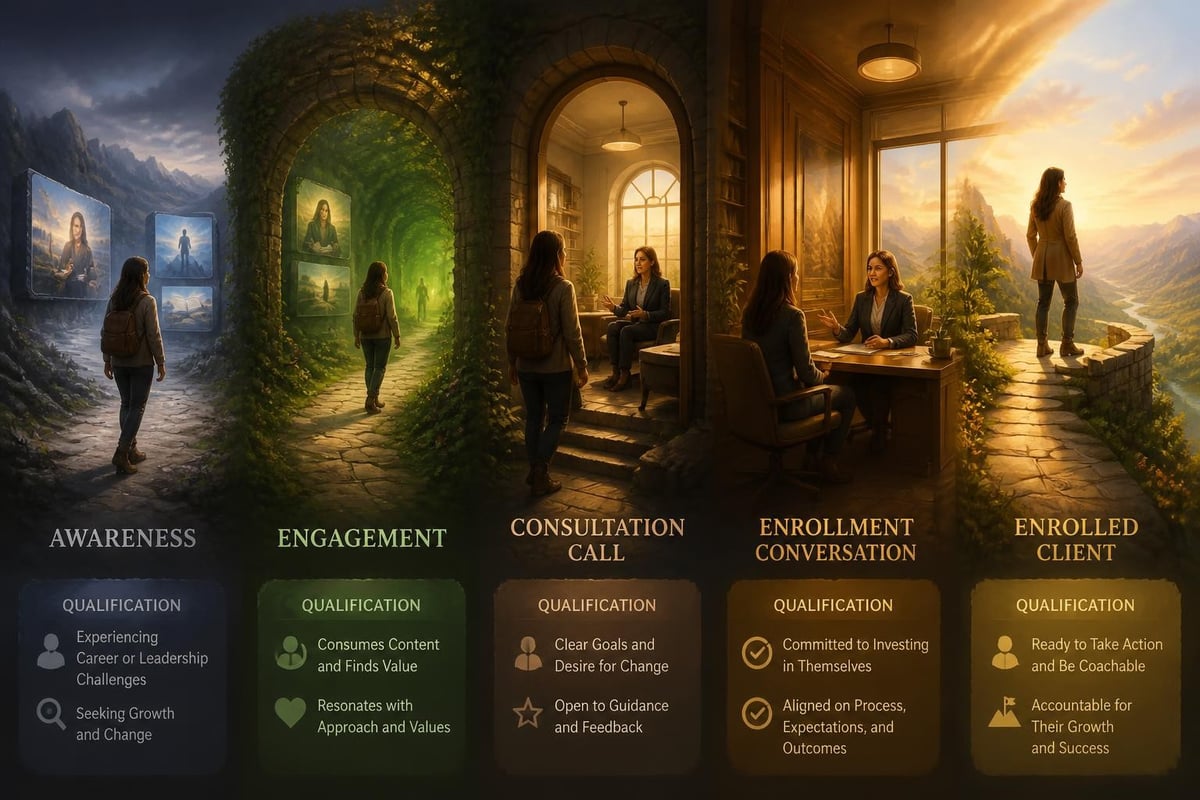
- Conversion frameworks that move prospects from awareness to enrollment with minimal friction
- Pricing structures that reflect value while supporting your profit goals
The MIT Sloan research on career advancement shows that organizations increasingly view coaching as strategic investment rather than discretionary spending. This shift creates opportunities for coaches who can articulate ROI in business terms.
Your sales system should qualify prospects rigorously. Not everyone who can afford your fees should become a client. Fit matters more than dollars when you're building for sustainable scale.
Delivery Systems That Scale Without Sacrificing Quality
This is where most coaching businesses break. You know your one-on-one work produces extraordinary results. The idea of systematizing feels like commoditization.
The truth is more nuanced. A career and leadership coach can absolutely maintain premium quality while creating leverage through intelligent delivery design.
The Three-Tier Delivery Model
Sophisticated coaching practices offer multiple engagement levels:
- Signature programs with group coaching and framework-based curriculum
- Private intensives for high-touch transformation
- Implementation support through team members or associates
This structure serves different client needs while protecting your capacity for highest-value activities. Group coaching formats can actually enhance outcomes by creating peer accountability and diverse perspectives.
Your frameworks become the backbone of delivery. Instead of reinventing approaches for each client, you apply proven methodologies while customizing application to individual contexts. The framework stays consistent; the implementation varies.
Measuring What Matters
Outcome tracking separates professional practices from amateur efforts. Every career and leadership coach should implement systematic measurement:
- Pre-engagement assessments that establish baseline metrics
- Progress checkpoints aligned with coaching milestones
- Quantifiable results tied to client business outcomes (revenue, team performance, time reclaimed)
- Qualitative feedback captured through structured intervals
Stanford's approach to 360-degree assessment in coaching provides excellent models for rigorous evaluation. These tools not only improve your coaching but also generate case studies and testimonials that fuel acquisition.
Leadership: Setting Boundaries That Protect Profit
The final pillar often receives the least attention but determines whether your business sustains or burns you out. Leadership in this context means self-leadership-the discipline to enforce boundaries that protect your business model.
Common boundary failures among high-performing coaches:
- Unlimited text and email access outside scheduled sessions
- Extending sessions beyond contracted time
- Taking on clients who aren't truly qualified
- Discounting fees for "special circumstances"
- Saying yes to opportunities that don't align with strategy
Each violation seems minor in isolation. Cumulatively, they destroy profitability and create resentment.
Building Your Leadership Operating System
Effective leadership coaching cultures start with leaders who model the behaviors they teach. As a career and leadership coach, your business itself must demonstrate the principles you advocate.
Your operating system should codify:
- Client communication policies and response timeframes
- Session scheduling parameters and rescheduling fees
- Scope boundaries for each service tier
- Referral protocols for out-of-scope requests
- Team delegation standards as you grow
This isn't rigidity-it's respect. For yourself, your family, your team, and ironically, for your clients. Clear containers create better outcomes than nebulous availability.
The discipline extends to personal development. Just as personal growth frameworks emphasize continuous improvement, successful coaches invest in their own development through supervision, peer coaching, and skills training.

Integration with Broader Business Strategy
A career and leadership coach operating at the highest level understands that coaching exists within ecosystem context. Your clients don't separate professional development from business performance, talent retention, or organizational culture.
This systems view creates strategic opportunities:
- Partner with HR consultancies to provide coaching as part of leadership development programs
- Collaborate with recruiters who place executives needing transition support
- Align with business consultancies addressing strategy or operations
Research from the World Economic Forum on coaching's role in employee performance demonstrates that coaching delivers superior ROI when integrated with other talent initiatives rather than operating in isolation.
For coaches serving founders and executives, understanding business fundamentals becomes non-negotiable. You can't effectively coach a CEO through scaling challenges if you don't understand unit economics, organizational design, or market positioning. This is why many top coaches develop consulting capabilities alongside coaching expertise.
The Team Question: When and How to Expand
Solo practices offer simplicity but limit scale. The transition to team-based delivery represents a critical inflection point for any career and leadership coach with growth ambitions.
Signs you're ready to build a team:
- Consistent waitlist of qualified prospects
- Clear methodology that others can learn and apply
- Financial reserves to invest in hiring and training
- Willingness to shift from practitioner to leader
The first hire often involves a choice:
| Role | Advantages | Challenges |
|---|---|---|
| Associate Coach | Expands delivery capacity, maintains coaching focus | Requires intensive training, quality control concerns |
| Operations Manager | Frees your time, improves systems | Doesn't directly generate revenue, learning curve |
| Client Success Coordinator | Enhances client experience, administrative relief | May not address capacity constraints immediately |
There's no universal answer. The right choice depends on your specific bottleneck. If you're turning away qualified clients, an associate coach makes sense. If you're drowning in administrative work, operations support becomes priority.
Successful team building requires investing in people development. Your team members need coaching too-not just on your methodology but on performance management and client relationship skills.
Interestingly, integrating wellness and mindset work can enhance your team's effectiveness. Resources like The Father Forge demonstrate how physical fitness and mental resilience training complement professional coaching, creating more sustainable performance for both coaches and their clients.
Technology and Tools for Modern Coaching Practice
The right technology stack amplifies your effectiveness without adding complexity. A career and leadership coach in 2026 should leverage:
Essential platforms:
- CRM system for pipeline management and client tracking
- Scheduling software that eliminates back-and-forth
- Video conferencing with recording capability for session review
- Assessment tools for 360-degree feedback and personality inventories
- Project management for tracking client milestones and deliverables
- Payment processing that handles subscriptions and payment plans
Avoid technology for technology's sake. Each tool should solve a specific problem or create measurable efficiency.
Many coaches under-utilize their existing tools. Your CRM can automate follow-up sequences, trigger milestone celebrations, and generate reports showing client progress. Your scheduling platform can buffer your calendar, enforce boundaries, and integrate with payment systems.
The goal isn't to become a technology expert but to create seamless client experiences while reducing your administrative burden. Business coaching service delivery becomes far more profitable when technology handles repetitive tasks.
Financial Modeling for Coaching Businesses
Revenue goals mean nothing without understanding the math beneath them. A career and leadership coach scaling to multi-million dollar revenue needs financial clarity.
Key metrics to track monthly:
- Client acquisition cost (CAC) per channel
- Lifetime client value (LCV) across service tiers
- Session capacity utilization rate
- Operating expense ratio
- Profit margin by service offering
- Cash flow runway
Your pricing should reflect value delivered, not hours invested. The shift from hourly billing to value-based pricing represents a mindset evolution as much as a pricing strategy.
Consider this comparison:
| Pricing Model | Annual Revenue Potential | Scalability | Time Freedom |
|---|---|---|---|
| Hourly coaching | $150,000 - $300,000 | Low | Minimal |
| Package-based programs | $300,000 - $750,000 | Medium | Moderate |
| Signature methodology + tiers | $750,000 - $5,000,000+ | High | Significant |
The numbers assume similar market positioning and client willingness to pay. The difference lies entirely in business model design.
Marketing Evolution: From Referrals to Predictable Demand
Word-of-mouth referrals built your practice. They won't scale it.
A career and leadership coach targeting $1 million plus revenue requires multi-channel visibility:
- Content marketing that demonstrates expertise and methodology
- Speaking engagements that establish authority
- Strategic partnerships with complementary service providers
- Targeted outreach to ideal client profiles
- Case studies and testimonials that prove outcomes
The coaching statistics and trends for 2026 reveal that buyers conduct extensive research before engaging coaches. Your online presence must answer their questions and build confidence throughout the buyer journey.
Content shouldn't be random. Develop a content strategy aligned with your methodology pillars. If you coach executives on delegation, create content addressing delegation challenges, frameworks, and success stories. Each piece should move prospects closer to recognizing you as the solution.
Authenticity matters more than polish. Your ideal clients aren't seeking perfection-they're seeking someone who understands their specific challenges and can guide them to resolution.
Addressing the Sustainability Question
The coaching industry faces an unspoken challenge: burnout. The very empathy and commitment that makes someone an effective career and leadership coach can deplete them without proper boundaries and renewal practices.
Sustainable practice design includes:
- Strategic calendar management with white space for thinking and planning
- Peer support through coaching supervision or mastermind groups
- Personal boundaries that protect family time and health
- Regular sabbaticals for deep renewal and skill development
- Energy management that recognizes emotional labor in coaching work
You cannot pour from an empty cup. The cliché exists because it's true. Leadership coaching programs that ignore practitioner wellness eventually fail regardless of methodology quality.
Building a business that serves your life rather than consuming it requires intentional design. This means getting comfortable with "good enough" in areas outside your zone of genius and investing in support that creates leverage.
The path from talented career and leadership coach to scalable coaching business demands both strategic thinking and operational discipline. You've built expertise that transforms lives; now it's time to build systems that multiply your impact without multiplying your hours. If you're ready to install the Profit Architecture framework and break through the revenue ceilings limiting your practice, Rise Reign Rule specializes in helping women-owned high-ticket service businesses eliminate founder bottlenecks and achieve predictable, profitable scale. Your coaching expertise deserves a business model worthy of it.


