
Coaching and Performance: Scale Without the Bottleneck
The most successful women-owned service businesses between $250k and $5M revenue share a common secret: they've mastered the relationship between coaching and performance. Not the fluffy motivational kind, but strategic coaching that transforms operational drag into predictable profit. When you're scaling a high-ticket consultancy or service business, every percentage point of performance improvement translates directly into revenue gains, client retention, and founder freedom. The difference between businesses that plateau and those that scale cleanly lies in how deliberately they architect performance systems rather than relying on hustle alone.
Why Traditional Coaching Fails High-Ticket Service Businesses
Most coaching programs promise transformation but deliver nothing more than cheerleading sessions and vision board exercises. That's not what drives performance in a women-owned business doing $250k to $5M annually.
The fundamental problem is misalignment. Generic business coaching ignores the unique bottlenecks that emerge when you're the primary rainmaker, strategist, and quality control all at once. Your business doesn't need another mindset guru; it needs systematic performance improvement across four critical pillars.
The Operational Drag That Kills Growth
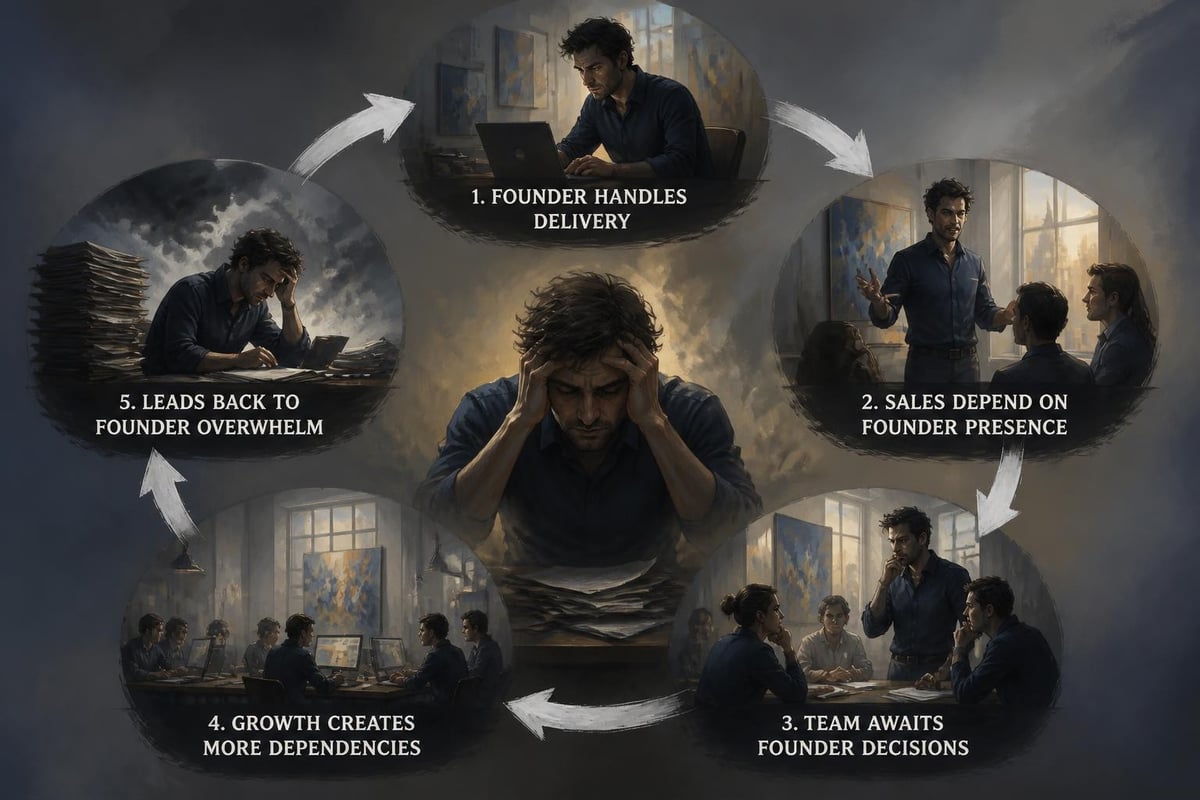
Operational drag manifests in predictable patterns:
- Client delivery consumes 60-80% of founder time
- Sales processes rely entirely on founder charisma
- Team members wait for your direction on routine decisions
- Revenue growth creates proportional stress increases
- Profit margins shrink as you scale
When coaching and leadership development focuses exclusively on personal growth without addressing structural issues, performance actually deteriorates. You become a more confident version of someone doing the wrong work.
The Four Pillars of Performance Architecture
Strategic coaching and performance improvement in high-ticket service businesses requires a framework that addresses the entire revenue engine, not just isolated components. This is where Profit Architecture becomes transformative.
Positioning: Market Authority as Performance Multiplier
Your market position directly impacts every performance metric downstream. When prospects see you as the obvious choice rather than one option among many, your sales cycle compresses, your close rates improve, and your pricing power increases.
Recent research on actionable planning and aspirational clarity in leadership coaching confirms that clarity of direction matters more than rapport-building exercises. Performance accelerates when positioning is precise.
| Weak Positioning | Strong Positioning | Performance Impact |
|---|---|---|
| "Business coach for women" | "Profit Architecture for women-owned services ($250k-$5M)" | 3x higher qualified lead rate |
| Generic service menu | Proprietary framework | 40% shorter sales cycles |
| Industry-agnostic | Specific revenue band + structure | 2x close rate improvement |
Strong positioning doesn't narrow your market; it sharpens your performance. When you stop trying to serve everyone, you start converting at rates that transform your revenue predictability.
Acquisition: Sales Systems That Scale Without You
The sales bottleneck destroys performance faster than any other factor. If you're the only person who can close deals, you've built a job, not a business.
Effective coaching models for workplace performance emphasize systems over personality. Your sales process should be a documented, repeatable system that produces consistent results regardless of who executes it.
Strategic coaching and performance optimization in acquisition means:
- Documenting your natural sales conversations into a framework others can follow
- Creating decision points where prospects self-qualify or disqualify
- Building sales assets that do the heavy lifting before conversations begin
- Installing feedback loops that improve conversion rates monthly
- Establishing boundaries that prevent low-fit prospects from consuming time
When Rise Reign Rule works with women-owned service businesses, acquisition system installation typically increases revenue by 30-50% within six months without adding founder hours. That's performance improvement.
Delivery: Client Outcomes as the Ultimate Performance Metric
Your delivery system is where coaching and performance intersect most visibly. Every client engagement either proves or disproves your positioning claims.
The performance question isn't "Did the client like working with us?" It's "Did the client achieve measurable outcomes that they'll tell others about?"
Studies examining transformational coaching in sport performance demonstrate that technical-tactical efficiency improves dramatically when coaching follows structured frameworks rather than intuitive responses. The same principle applies to service delivery.
High-performing delivery systems include:
- Onboarding sequences that set clear outcome expectations
- Milestone frameworks that track progress objectively
- Communication protocols that prevent scope creep
- Transition planning that ensures implementation after engagement
- Case study processes that capture results systematically
When you architect delivery for outcomes rather than hours, performance metrics shift from "How busy am I?" to "How many clients achieved breakthrough results?"

Leadership: The Boundaries That Enable Performance
The least discussed but most critical element of coaching and performance in women-owned businesses is leadership boundaries. Without them, every performance system you build will eventually collapse under the weight of exceptions.
Why Boundaries Matter More Than Strategy
You can have perfect positioning, bulletproof acquisition systems, and elegant delivery frameworks, but if you can't hold boundaries, none of it matters. Performance degrades when:
- Clients push deadlines and you accommodate
- Team members escalate decisions you've delegated
- Prospects negotiate your pricing and you concede
- Partners request favors that drain resources
- You sacrifice weekends to "save" situations
Strategic coaching focused on performance helps you recognize that boundaries aren't about being difficult; they're about protecting the systems that produce results. When you establish clear operating principles and defend them consistently, everyone's performance improves.
| Boundary Type | Without It | With It |
|---|---|---|
| Client Communication | 24/7 availability expectation | Scheduled touchpoints, 48-hour response standard |
| Scope Management | Continuous project expansion | Change order process, documented additions |
| Decision Rights | All decisions route through founder | Clear authority levels, defined escalation criteria |
| Pricing Integrity | Negotiation on every deal | Published rates, limited discount authority |
The effectiveness of coaching correlates directly with boundary implementation. Coaches who help you set boundaries without enforcing accountability deliver no performance improvement.
Measuring What Actually Matters
Coaching and performance initiatives fail when measurement focuses on activity rather than outcomes. Hours logged, sessions completed, and action items checked don't predict business results.
Performance Metrics for High-Ticket Service Businesses
Track these instead:
Positioning Metrics:
- Inbound qualified lead percentage (target: 60%+ of pipeline)
- Average days from first contact to proposal (target: under 14)
- Win rate on qualified opportunities (target: 50%+)
Acquisition Metrics:
- Cost per qualified lead (track trend over time)
- Conversion rate by stage (identify drop-off points)
- Average contract value (should increase with better positioning)
Delivery Metrics:
- Client outcome achievement rate (percentage hitting defined success criteria)
- Net Promoter Score (measure referral likelihood)
- Case study conversion rate (percentage becoming documented success stories)
Leadership Metrics:
- Founder hours in delivery vs. strategy (shift ratio quarterly)
- Decision velocity (days to resolve standard issues)
- Boundary violation frequency (track and address patterns)
When you measure these systematically, coaching conversations shift from "How do I feel about this?" to "What does the data tell us?" That's when performance accelerates.
The Profit Architecture Approach to Coaching and Performance
The difference between generic business coaching and strategic performance consulting lies in integration. Most coaches address one pillar in isolation, creating improvements that don't compound.

Profit Architecture recognizes that positioning impacts acquisition, acquisition funds delivery improvements, delivery proves positioning claims, and leadership boundaries protect the entire system. When you improve one pillar, you create leverage across all four.
How Strategic Coaching Differs From Traditional Methods
Traditional coaching asks: "What do you want to achieve?" Strategic performance coaching asks: "What systems will produce that outcome predictably?"
Traditional coaching delivers: Motivation and accountability Strategic performance coaching delivers: Frameworks and metrics
Traditional coaching measures: Completion and satisfaction Strategic performance coaching measures: Revenue, profit, and founder time reclaimed
The work coaching that drives results in women-owned service businesses doesn't separate personal development from business architecture. Your leadership capacity grows because you're installing systems that reduce decision burden, not through affirmations.
When to Invest in Performance Coaching
Timing matters enormously. Coaching and performance interventions deliver maximum ROI at specific inflection points:
$250k-$500k Revenue: You're proving market fit but drowning in delivery. Performance coaching should focus on delivery systematization and initial acquisition frameworks. The goal is creating space for strategic work.
$500k-$1M Revenue: You have demand but inconsistent profitability. Performance coaching should architect your positioning and acquisition systems while installing leadership boundaries. The goal is predictable profit.
$1M-$3M Revenue: You're scaling but losing margin or sanity. Performance coaching should optimize all four pillars simultaneously, with emphasis on founder extraction from operations. The goal is clean scaling.
$3M-$5M Revenue: You're building enterprise value. Performance coaching should focus on leadership development beyond the founder and system documentation for potential exit. The goal is transferable equity value.
Investing in coaching before you have revenue traction wastes resources. Waiting until you're in crisis mode costs opportunity. The sweet spot is when you have proven demand but unclear systems.
Building Your Performance Coaching Strategy
Strategic coaching and performance improvement isn't a one-time intervention. It's an ongoing discipline that becomes embedded in how you operate.
Start by auditing your current state across the four pillars:
Positioning Audit: Can a prospect articulate what makes you different in 30 seconds? If not, you have positioning drag.
Acquisition Audit: Could someone else on your team close a qualified prospect using your current process? If not, you have a sales bottleneck.
Delivery Audit: Do 80%+ of clients achieve documented outcomes they'll reference others? If not, you have delivery inconsistency.
Leadership Audit: Can you take a two-week vacation without client emergencies? If not, you have boundary failures.
The areas where you answered "no" represent your highest-leverage coaching opportunities. Address them in order of revenue impact, not comfort level.
Selecting the Right Coaching Partnership
Not all performance coaching delivers results. Evaluate potential partners on these criteria:
- Framework over feelings: Do they bring proprietary methodology or just ask questions?
- Metrics over motivation: Do they track business outcomes or satisfaction scores?
- Systems over sessions: Do they install operational improvements or just facilitate thinking?
- Integration over isolation: Do they address how pillars connect or optimize one area?
- Accountability over affirmation: Do they challenge weak thinking or validate everything?
The coaching investment that transforms performance is the one that makes itself obsolete by building internal capability. You're not buying dependency; you're buying accelerated learning and system installation.
The Compound Effect of Systematic Performance Improvement
When you approach coaching and performance as interconnected system design rather than motivational conversations, results compound exponentially. A 10% improvement in positioning yields 15% better acquisition, which funds 20% delivery enhancement, which proves positioning claims more effectively.
This is why women-owned service businesses that install Profit Architecture typically see:
- 30-50% revenue growth in the first year without proportional stress increases
- 15-25 percentage point margin improvements through operational efficiency
- 50-70% reduction in founder delivery hours while maintaining or improving outcomes
- 2-3x improvement in qualified lead generation through positioning clarity
- 40-60% shorter sales cycles with higher close rates and contract values
These aren't hockey stick projections. They're the natural result of eliminating operational drag and founder bottlenecks through systematic performance improvement.
The question isn't whether strategic coaching improves performance. Recent research confirms it does, measurably and repeatedly. The question is whether you'll continue scaling through hustle or architect systems that produce predictable profit.
Performance improvement without operational redesign is temporary. You'll revert to old patterns as soon as accountability disappears. But when coaching installs frameworks that make high performance the default rather than the exception, growth becomes sustainable.
Strategic coaching and performance optimization transforms women-owned service businesses from founder-dependent operations into scalable, profitable enterprises that deliver consistent client outcomes. When you architect systems across positioning, acquisition, delivery, and leadership, you create compound improvements that eliminate bottlenecks and operational drag. Rise Reign Rule specializes in installing this Profit Architecture for women-owned high-ticket service businesses earning $250k-$5M annually, creating predictable profit and clean scaling without sacrificing your life to your business.


