
Work Coaching: Scale Your High-Ticket Service Business
You've built a successful high-ticket service business, crossing the quarter-million revenue mark and eyeing seven figures. Yet somehow, you're working harder than ever while profit margins refuse to cooperate. The invisible ceiling pressing down on your growth isn't market saturation or competition-it's the absence of strategic work coaching that transforms founders from execution engines into business architects. For women-owned service businesses generating $250k to $5M annually, this gap between revenue and scalability represents the single most expensive blind spot in your operation.
The Hidden Cost of Running Your Business Without Work Coaching
Most high-ticket service founders operate under a dangerous misconception: that experience in delivering client results automatically translates to building a scalable business. This assumption costs you approximately $150,000 annually in lost profit-conservatively.
Without structured work coaching, you're bleeding resources through:
- Inconsistent client acquisition that creates feast-or-famine revenue cycles
- Delivery systems that require your personal involvement in every engagement
- Team members who execute tasks but don't drive outcomes
- Strategic decisions made in reactive mode rather than from intentional design
- Leadership capacity consumed by operational firefighting instead of growth initiatives
The distinction matters enormously. Research on workplace coaching effectiveness demonstrates measurable improvements in both individual performance and organizational outcomes when coaching frameworks are properly implemented.

The Operational Drag Phenomenon
Operational drag manifests when your business architecture hasn't evolved alongside your revenue. You're running a million-dollar operation with systems designed for $300k. Every client engagement requires custom workflows. Every team decision needs your input. Every sales conversation depends on your personal credibility.
This isn't an execution problem-it's an architectural one. Work coaching addresses the fundamental question most founders avoid: What business model actually supports your revenue goals without requiring 60-hour weeks?
| Revenue Stage | Common Bottleneck | Coaching Focus Area |
|---|---|---|
| $250k–$500k | Founder-dependent delivery | Systemizing client outcomes |
| $500k–$1M | Inconsistent sales pipeline | Acquisition architecture |
| $1M–$3M | Leadership capacity | Strategic delegation frameworks |
| $3M–$5M | Market positioning | Authority and differentiation |
Building Your Profit Architecture Through Strategic Work Coaching
The Profit Architecture framework transforms how high-ticket service businesses scale by addressing four interconnected pillars simultaneously. Traditional business coaching treats these elements separately-marketing over here, operations over there, leadership as an afterthought. That fragmented approach explains why most consultants deliver advice that sounds brilliant but doesn't translate to sustainable profit growth.
Positioning: Establishing Unshakeable Market Authority
Your positioning determines whether prospects view you as a premium solution or just another option. Work coaching in this pillar focuses on crystallizing the specific transformation you deliver and to whom.
High-ticket service businesses thrive when they can articulate:
- The precise problem they solve (not the service they offer)
- The measurable outcome clients achieve (not the process they follow)
- The unique mechanism that delivers results (not generic best practices)
- The ideal client profile who values this transformation (not everyone who can afford it)
Consider how team coaching services differ fundamentally from individual coaching-the complexity scales, the stakeholders multiply, and the implementation challenges compound. Your positioning must reflect this sophistication rather than generic "business coaching for entrepreneurs" language that positions you against every life coach with a certification.
Acquisition: Installing Repeatable Sales Systems
The sales conversation in high-ticket services ($10k–$100k+ engagements) requires a completely different architecture than transactional offerings. Work coaching here focuses on building systems that generate qualified opportunities without your constant personal networking.
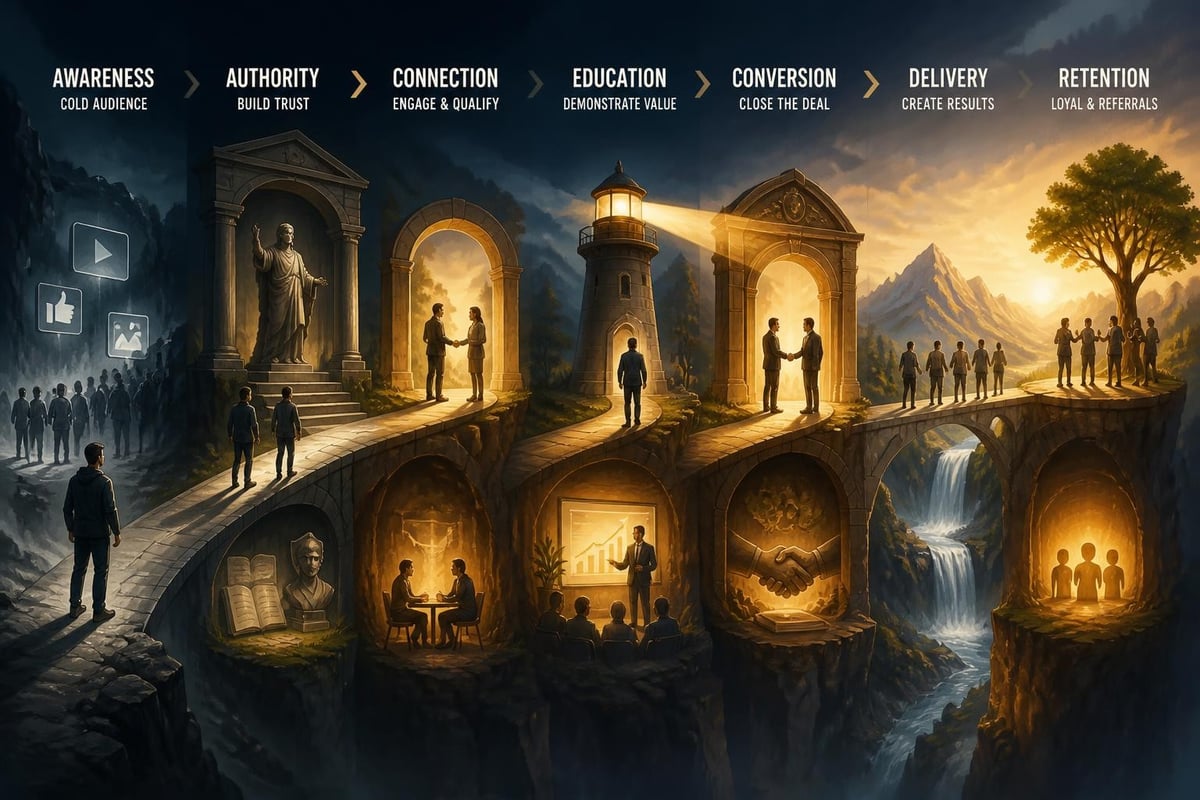
Most founders confuse activity with architecture. They're posting on social media, attending networking events, and scheduling discovery calls-all while wondering why revenue remains unpredictable. The missing element is a systematized approach that separates lead generation, qualification, nurture, and conversion into distinct processes with clear ownership.
Your acquisition architecture should answer:
- Where do qualified prospects discover your authority before you ever speak?
- What filtering mechanism ensures only serious buyers reach your calendar?
- How does your sales process educate prospects on the value of your specific methodology?
- What conversion touchpoints exist beyond the initial sales conversation?
Growing your authority through strategic content and engagement-whether through platforms like Viewpals for social proof or thought leadership publications-creates the top-of-funnel awareness that feeds systematic acquisition. However, awareness without architecture just creates busywork.
Delivery: Guaranteeing Consistent Client Outcomes
Here's where most high-ticket service businesses hemorrhage profit: delivery systems that depend entirely on founder genius rather than transferable methodology. You've probably experienced this trap-clients hire you specifically, your team can't replicate your results, and you become the constraint on your own growth.
MIT's research on coaching and feedback emphasizes the importance of ongoing, structured development rather than ad-hoc interventions. This principle applies equally to your client delivery framework. Work coaching transforms your intuitive expertise into documented processes that produce consistent outcomes regardless of who executes them.
| Delivery Element | Founder-Dependent Version | Scalable Architecture |
|---|---|---|
| Client onboarding | Custom kickoff calls | Standardized discovery framework |
| Project methodology | Reactive problem-solving | Phase-gated delivery system |
| Quality assurance | Founder review of everything | Defined success metrics + check-ins |
| Team execution | Constant founder oversight | Clear ownership + autonomy protocols |
The transformation from artisan to architect requires documenting what you do instinctively, identifying the decision frameworks that drive outcomes, and building feedback loops that catch issues before they escalate. This isn't about removing your expertise-it's about embedding it into systems that scale beyond your personal capacity.
Leadership: Establishing Strategic Boundaries
The leadership pillar addresses the most overlooked element in scaling high-ticket services: your decision-making architecture as founder. Without clear boundaries around what you own versus what you delegate, every growth initiative adds complexity rather than capacity.
Work coaching in leadership focuses on three critical boundaries:
Time boundaries determine what activities deserve your personal attention versus what should be systematized or delegated. Most founders spend 60% of their time on tasks worth $50/hour while critical $500/hour strategic work sits untouched.
Decision boundaries establish which decisions require your input and which your team should own autonomously. When every choice flows through you-from client communication tone to vendor selection to team schedule adjustments-you've built a business that can't function without you.
Energy boundaries protect your capacity for the high-value strategic thinking that actually grows your business. Saying yes to every speaking opportunity, networking event, and collaboration request feels productive but leaves zero space for the focused work that compounds over time.
Leadership team coaching becomes essential as you scale because the boundaries that worked at $250k create bottlenecks at $1M. What you personally execute versus what you orchestrate through others must evolve alongside revenue.
Implementing Work Coaching Without Losing Momentum
The resistance to implementing structured work coaching typically sounds like this: "I don't have time to build systems-I'm too busy serving clients." This mindset guarantees you'll still be saying the same thing three years from now at the same revenue level, just more exhausted.
Strategic implementation happens in focused sprints rather than complete business overhauls. You address the highest-leverage constraint first, install the framework, stabilize the new system, then move to the next bottleneck.
The 90-Day Implementation Sprint
Here's how work coaching transforms a business in one focused quarter:
Weeks 1-3: Diagnostic and Design
- Map current workflows across all four Profit Architecture pillars
- Identify the single biggest constraint blocking scale (usually delivery or acquisition)
- Design the specific framework that addresses this constraint
- Establish success metrics that matter (profit per client, founder hours required, conversion rate)
Weeks 4-9: Build and Test
- Implement the new framework with one client or one process
- Document what works and what breaks
- Refine based on real-world feedback rather than theory
- Train team members on the new approach
Weeks 10-12: Scale and Stabilize
- Roll out the framework across all relevant engagements
- Monitor metrics to ensure improvement holds
- Address edge cases that emerge
- Create maintenance protocols so gains don't erode
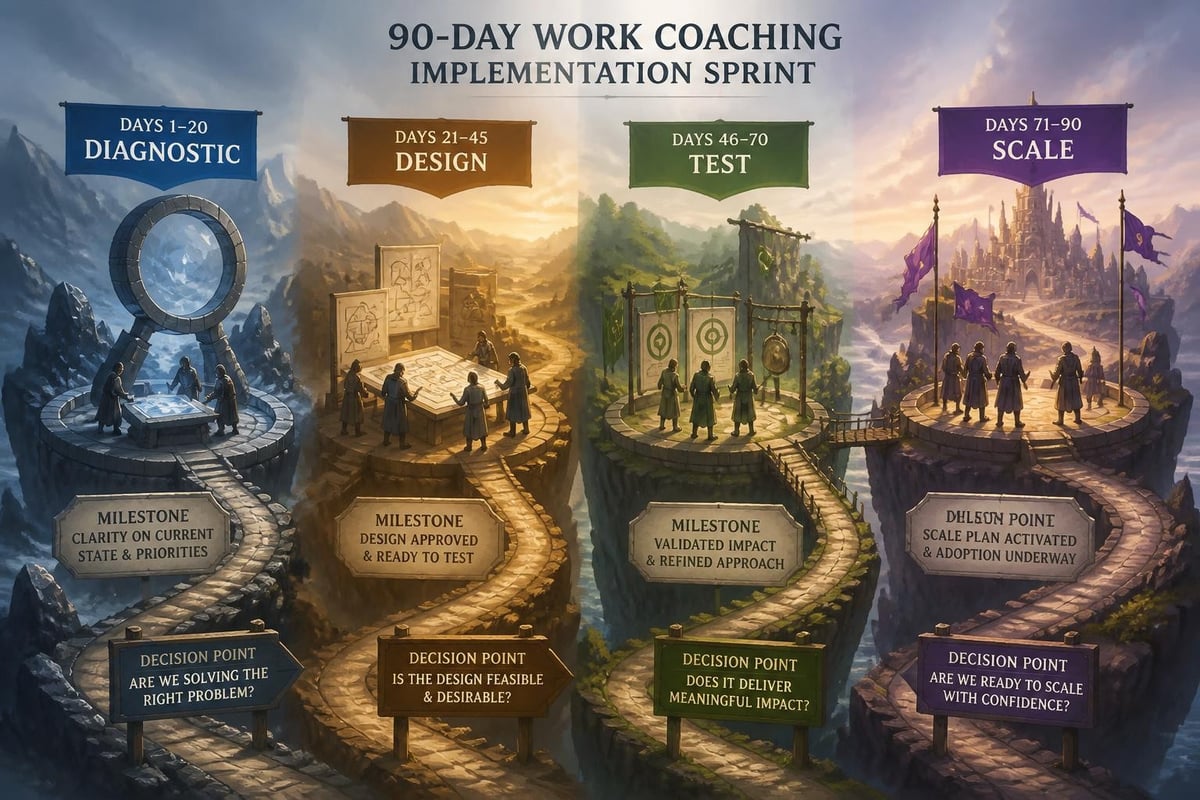
This approach delivers measurable profit improvement within a single quarter while building the muscle for continuous optimization. Studies examining workplace coaching impacts consistently show that structured interventions outperform ad-hoc advice precisely because they follow systematic implementation frameworks.
The ROI Equation Every Founder Should Calculate
Work coaching represents an investment that either pays for itself five times over or delivers marginal value depending entirely on implementation quality. The difference lies in how you measure return.
Traditional (and useless) ROI metrics:
- Number of systems documented
- Hours spent in coaching sessions
- Action items completed
- Team members trained
Actual ROI metrics that matter:
- Profit per client engagement
- Founder hours required per $100k revenue
- Client acquisition cost
- Percentage of revenue from referrals/repeat clients
- Months of operating expenses in reserve
Calculate your current baseline across these metrics before engaging any work coaching relationship. A founder generating $750k revenue while working 55 hours weekly has a fundamentally different constraint than one doing $750k in 30 hours but plateaued on growth. The coaching focus must address your specific bottleneck, not generic business improvement.
When Work Coaching Fails (And Why)
Most failed coaching engagements share common patterns worth understanding before you invest:
- Advice without architecture: Consultant delivers brilliant ideas with zero implementation framework
- Generic solutions: Cookie-cutter approaches that ignore your business model specifics
- Accountability without ownership: You're checking boxes on someone else's agenda rather than building your unique Profit Architecture
- Symptom focus: Addressing surface problems (marketing isn't working) while missing root causes (positioning is unclear)
- No measurement: Feelings-based assessment of progress rather than data-driven validation
The services offered by strategic consultancies should explicitly address these failure modes with clear deliverables, custom frameworks, and measurable outcomes tied to your specific revenue and profit goals.
Selecting the Right Work Coaching Partnership
Your choice of work coaching partnership will either accelerate your path to predictable seven-figure profit or consume time and capital with minimal return. The distinction reveals itself in how potential partners approach your initial conversation.
Red flags that indicate generic coaching:
- Questions focus on your goals and vision (rather than current business architecture)
- Proposed solution sounds identical regardless of your business model
- Success stories reference personal transformation over profit improvement
- Timeline to results is vague or extends beyond six months
- Investment structure disconnected from outcome delivery
Green lights that indicate strategic partnership:
- Deep questions about your current systems, metrics, and constraints
- Framework specifically designed for high-ticket service businesses at your revenue stage
- Case studies demonstrating measurable profit and capacity improvements
- Clear 90-day milestones with defined deliverables
- Investment tied to the value of solving your specific bottleneck
The sophistication of your work coaching partner should match or exceed your business complexity. If you're delivering $50k engagements to enterprise clients, you need strategic guidance from someone who understands that operational reality-not generic business coaching designed for solopreneurs.
The Compounding Effect of Strategic Work Coaching
Here's what separates transformative work coaching from incremental improvement: the frameworks you install compound over time rather than requiring constant maintenance. A properly designed Profit Architecture becomes more efficient as you scale, not more complex.
Consider the trajectory difference over 24 months:
Without strategic work coaching:
- Month 0: $60k monthly revenue, 50 founder hours weekly
- Month 12: $75k monthly revenue, 55 founder hours weekly
- Month 24: $85k monthly revenue, 60 founder hours weekly (if you haven't burned out)
With Profit Architecture implementation:
- Month 0: $60k monthly revenue, 50 founder hours weekly
- Month 12: $100k monthly revenue, 35 founder hours weekly
- Month 24: $175k monthly revenue, 30 founder hours weekly
The difference isn't working harder or even working smarter-it's working on fundamentally different activities. Strategic work instead of execution work. Architecture instead of firefighting. Leadership instead of task management.
This compounding effect explains why businesses that invest in proper work coaching early accelerate past competitors who wait until crisis forces change. You're building capacity while others are managing chaos.
Moving From Insight to Implementation
Understanding that your business needs better systems differs entirely from knowing which system to build first and exactly how to install it. This gap between awareness and action is where most high-ticket service founders remain stuck-recognizing the problem but uncertain about the solution sequence.
The strategic question isn't whether you need work coaching but rather what specific framework addresses your highest-leverage constraint right now. A founder drowning in delivery can't focus on acquisition improvements. A leader struggling with team delegation won't benefit from advanced positioning refinements.
Your next step depends on honest assessment of where operational drag hits hardest:
- If you're working 50+ hours weekly despite strong revenue, your constraint is delivery architecture
- If revenue fluctuates unpredictably month to month, you need acquisition systems
- If profit margins shrink as revenue grows, examine both positioning and delivery efficiency
- If you can't envision doubling revenue without doubling your hours, leadership boundaries need installation
The frameworks that transform these constraints don't emerge from generic business advice or incremental improvements to current approaches. They require strategic work coaching that addresses your specific business model, revenue stage, and growth trajectory with customized Profit Architecture.
Transforming your high-ticket service business from founder-dependent operation to scalable enterprise requires more than good intentions and harder work-it demands strategic frameworks installed through expert work coaching. The Profit Architecture approach addresses positioning, acquisition, delivery, and leadership simultaneously because these elements interact in ways that make isolated improvements ineffective. If you're ready to eliminate operational drag and build predictable profit systems in your women-owned service business, Rise Reign Rule specializes in exactly this transformation for businesses generating $250k to $5M annually.


