
Essential Coaching Skill for High-Ticket Service Founders
Every woman founder scaling a high-ticket service business eventually faces the same paradox: the expertise that built your quarter-million-dollar revenue becomes the ceiling that prevents you from reaching seven figures. You're brilliant at delivering transformation for clients, yet you're drowning in delivery. The missing link isn't another course on leadership or strategy. It's a specific coaching skill that allows you to replicate your judgment, develop your team's decision-making capacity, and extract yourself from the day-to-day operations that keep you trapped. This singular capability transforms you from the smartest person in every room into the architect of sustainable profit.
The Founder Bottleneck Nobody Talks About
When your business crosses $250K in annual revenue, something shifts. The scrappy hustle that got you here starts creating drag. You've hired people, but they constantly need you. Client delivery still requires your personal touch. Sales conversations wait for your calendar. Strategic decisions pile up on your desk.
The real problem isn't capacity. It's coaching skill.
Most founders confuse delegation with dumping. They hand off tasks without transferring the thinking framework that ensures quality outcomes. Your team executes, but they don't think like you. So every decision escalates back to you, creating the exact bottleneck you hired to eliminate.
Research published in Frontiers in Psychology demonstrates that effective workplace coaching significantly improves performance, goal attainment, and skill development. But here's what the research doesn't tell you: coaching skill isn't just for developing others. It's the operational framework that allows your business model to scale without requiring more of your time.
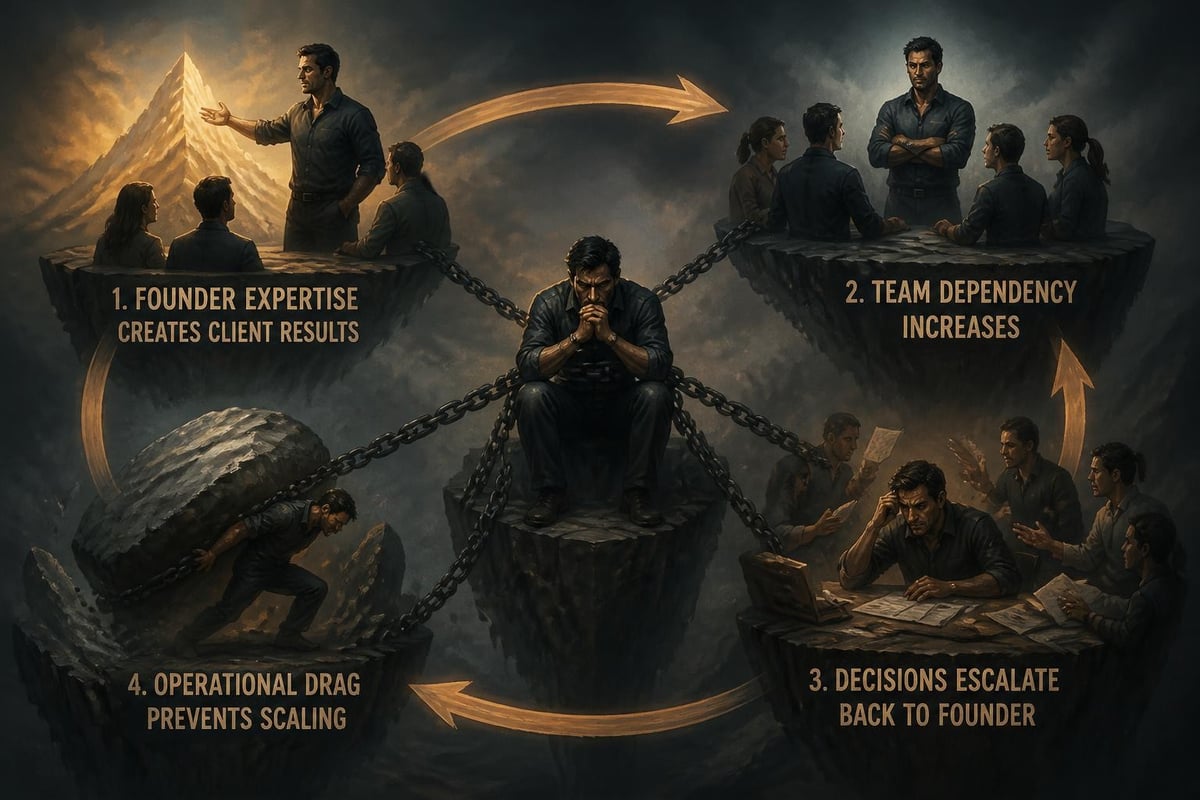
Three Warning Signs Your Coaching Skill Gap Is Costing Six Figures
You know you have a coaching deficit when:
- Team members ask permission instead of sharing decisions they've made. They're waiting for you to think for them rather than developing their own judgment muscle.
- Client outcomes vary wildly depending on who touches the account. Without your direct involvement, quality becomes inconsistent because your thinking hasn't been systematized.
- You feel indispensable to operations. The business can't run smoothly for three consecutive days without you jumping in, which means you've built a glorified job, not a business asset.
Each symptom points to the same root cause: you haven't installed the coaching skill that transfers your expertise into repeatable frameworks your team can execute independently.
The Profit Architecture of Coaching Skill
Strategic coaching skill isn't soft leadership fluff. It's operational infrastructure. When implemented correctly, it directly impacts your profit margins by reducing delivery costs, increasing team capacity, and allowing you to shift focus to revenue-generating activities.
Think about your current cost structure. How many hours do you spend fixing team mistakes, redoing client work, or stepping into situations that shouldn't require founder-level attention? Each hour represents profit leakage. Your hourly value should be spent on positioning, acquisition strategy, and high-level client relationships-not coaching basic decision-making.
The solution requires building what we call Coaching Infrastructure into your delivery systems. This framework ensures that your coaching skill becomes embedded in how work flows, not just in scheduled one-on-one conversations.
The Four Pillars of Embedded Coaching
| Pillar | Traditional Approach | Coaching Infrastructure |
|---|---|---|
| Decision Rights | Founder approves everything | Clear frameworks define who decides what |
| Quality Control | Founder reviews all work | Peer review plus spot-check audits |
| Client Escalations | Everything goes to founder | Tiered response protocols with coaching |
| Skill Development | Hope people figure it out | Structured question frameworks build judgment |
Most founders think coaching means scheduling weekly check-ins. That's performance management, not coaching infrastructure. Real coaching skill embeds learning into the workflow so development happens during execution, not in separate conversation bubbles.
Harvard Business Review's research on coaching styles reveals that effective coaches adapt their approach based on the situation and the team member's development level. But adaptation requires something most founders haven't built: a mental model for diagnosing what type of coaching the moment demands.
Building Your Coaching Diagnostic Framework
The coaching skill gap shows up most clearly in how founders respond when team members bring them problems. Without a diagnostic framework, you default to solving. You're fast, you're brilliant, and you just gave away another opportunity to develop someone's capability.
Here's the reframe: Every problem your team brings you is actually a coaching opportunity disguised as an operational issue.
The question isn't "How do I solve this?" The question is "What coaching skill does this moment require?"
The GROW Model Applied to Service Delivery
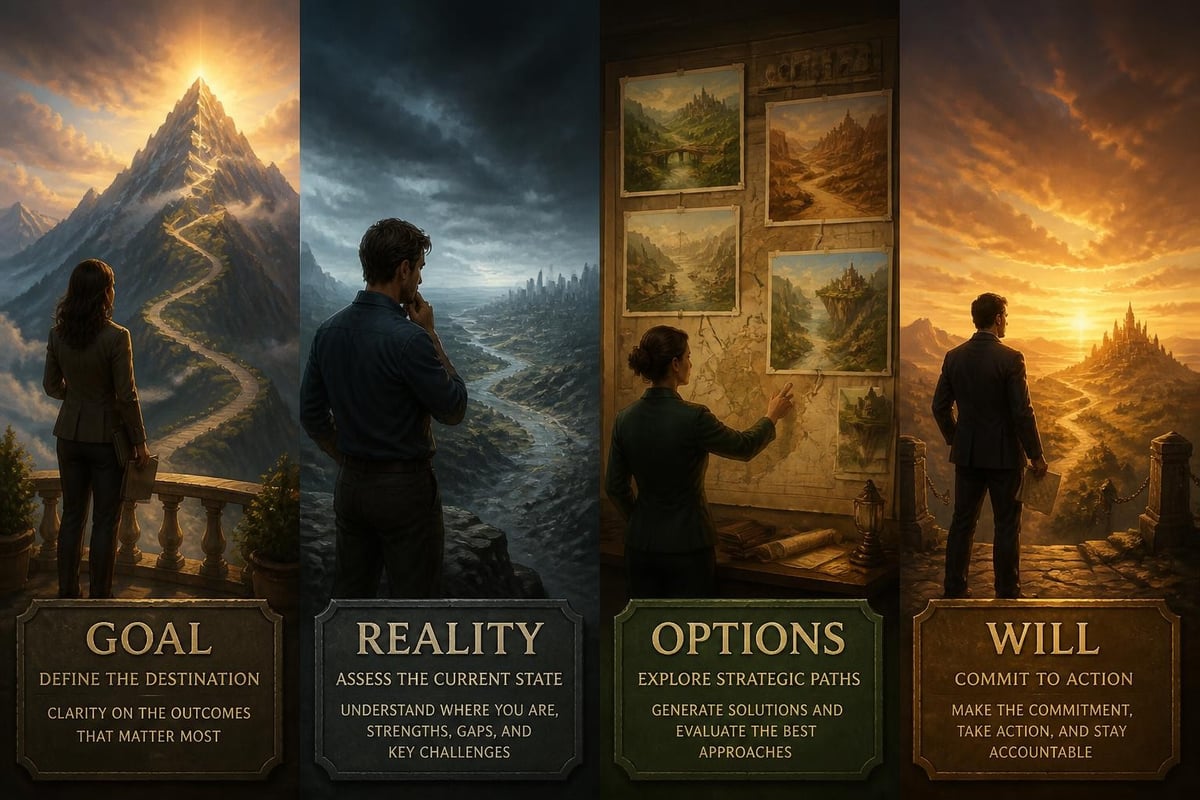
Imperial College London's overview of the GROW coaching model provides a reliable structure: Goal, Reality, Options, Will. But most founders have never applied this to client delivery systems.
Here's how it works in practice:
- Goal: What outcome is the team member trying to achieve? (Not just task completion-the strategic outcome.)
- Reality: What's actually happening right now? What have they already tried?
- Options: What are three possible approaches? What would happen if they chose each one?
- Will: What will they do? When? How will they know it worked?
This four-question sequence takes two minutes. It builds judgment faster than solving for them, and it creates a repeatable pattern your team internalizes.
The founder who masters this coaching skill reclaims 10-15 hours weekly previously spent firefighting. That's 40-60 hours monthly redirected toward strategic work. At $500/hour effective billing rate, that's $20K-$30K in monthly opportunity cost recovered.
The Feedback Loop That Builds Repeatable Excellence
Coaching skill without feedback is like strategy without execution-useless. The most powerful coaching happens in the feedback you give after observing performance, not in the theoretical conversations beforehand.
Most founders avoid feedback because they confuse it with criticism. But strategic feedback is the accelerant that turns good team members into extensions of your thinking. The key is structure.
The SBI Model for High-Stakes Coaching Moments
The Center for Creative Leadership's SBI feedback model provides the exact framework: Situation, Behavior, Impact.
Situation: "In yesterday's client call with the $50K prospect..."
Behavior: "...when she asked about implementation timeline, you said 'we're flexible' without anchoring to our methodology..."
Impact: "...which positioned us as order-takers instead of strategic advisors and likely cost us pricing power."
This three-part structure delivers coaching that sticks because it connects specific actions to business outcomes. Your team member doesn't just hear what to do differently. They understand why it matters commercially.
Compare that to vague feedback like "be more confident" or "take ownership." Those phrases feel like coaching but teach nothing. They create frustration, not capability.
When you develop this coaching skill, your team starts self-correcting before mistakes reach clients. They internalize your commercial thinking because you've made the invisible visible through structured feedback.
Motivational Interviewing: The Coaching Skill That Unlocks Ownership
Here's the uncomfortable truth about scaling service delivery: you can't care more about your team's development than they do. Founders who try to force growth create dependent employees who perform only under direct supervision.
The research on motivational interviewing published in NIH's database reveals powerful techniques for building intrinsic motivation. Originally developed for health behavior change, these same principles apply to professional development.
The core insight: People support what they create. When team members articulate their own development goals and design their own growth paths, they own the outcomes.
Four Motivational Interviewing Techniques for Service Founders
- Open-ended questions: Instead of "Do you want to lead client onboarding?" ask "What aspects of client onboarding energize you? What parts drain you?"
- Reflective listening: "It sounds like you're frustrated when clients don't implement our recommendations, and you're wondering if there's a way to increase follow-through."
- Affirming strengths: "You've consistently delivered results even when timelines compressed. That resilience is exactly what we need in senior roles."
- Eliciting change talk: "What would be different six months from now if you developed this capability? What would that make possible for you?"
This coaching skill transforms compliance-based teams into ownership-based cultures. Team members stop waiting for you to tell them what to develop. They start bringing their growth plans to you, dramatically reducing the mental load of "managing development."
For women-owned service businesses navigating the specific challenges of career advancement and leadership development, this approach builds the internal leadership pipeline essential for scaling beyond founder capacity.
Installing Coaching Rhythms Into Your Operating System
Coaching skill doesn't scale if it only happens when problems explode. The founders who successfully extract themselves from operations build coaching rhythms into their weekly operating systems.
This isn't about adding more meetings. It's about designing moments where coaching happens predictably, preventing fires rather than fighting them.
The Weekly Coaching Architecture
| Rhythm | Duration | Purpose | Coaching Skill Applied |
|---|---|---|---|
| Monday Alignment | 15 min per team lead | Clarify week's priorities and decision-making authority | Delegation + Boundary Setting |
| Mid-week Obstacle Clearing | 30 min async or live | Address emerging blockers before they become crises | Problem-solving coaching (GROW) |
| Friday Reflection | 10 min written | Capture decisions made, lessons learned, wins | Feedback + Recognition |
Notice none of these rhythms are labeled "coaching sessions." That's intentional. The moment you announce "coaching time," people perform for you. When coaching is woven into operational rhythms, real learning happens.
This structure also creates the documentation trail that eventually becomes your training systems. The questions you ask repeatedly become the frameworks new team members learn. Your coaching skill literally scales into institutional knowledge.

The Leadership Boundary That Makes Coaching Possible
Here's what nobody tells you about developing coaching skill: it requires you to stop being the hero. The founder who jumps in to save the day, rescue the client, or fix the mistake is actively undermining their team's development.
This is the hardest transition for high-performers who built their businesses on personal excellence. Your identity is wrapped up in being the best. But at scale, being the best is the opposite of building the best.
Strategic coaching skill means tolerating productive struggle.
You watch your team member work through a challenge that would take you five minutes to solve. It takes them forty-five minutes. They make small mistakes along the way. The outcome is 80% as good as if you'd done it yourself.
And you celebrate, because you just transferred capability. Next time, it'll take them thirty minutes and hit 85%. Six months from now, they'll do it faster and better than you because they're fully focused on that domain while you've moved to higher-value work.
The boundary is clear: you coach the thinking, not the doing. The moment you grab the keyboard or take over the client call, you've failed the coaching opportunity.
For founders committed to personal development and organizational scaling, this boundary work is essential. Your business can't outgrow your leadership capacity, and your leadership capacity can't expand if you're still executing entry-level work.
Coaching Skill as Competitive Advantage
Most service businesses compete on founder expertise. That's a fragile position. When your competitive advantage walks out the door if you take a vacation, you don't have a business-you have a dependency trap.
The businesses that scale cleanly past $1M build competitive advantage on organizational capability, not individual brilliance. Coaching skill is how you architect that transformation.
Consider two $500K service businesses:
Business A: Founder delivers 70% of client work personally. Team executes tasks. Revenue per employee is $125K. Profit margins are 35% but require founder working 55 hours weekly.
Business B: Founder delivers 20% of client work, focusing on complex strategy. Team owns client outcomes through structured frameworks. Revenue per employee is $180K. Profit margins are 42% and founder works 35 hours weekly.
The difference isn't talent. It's not luck. It's coaching infrastructure that transforms team capacity into deliverable outcomes without founder intervention.
Business B's founder has mastered the coaching skill that makes expertise transferable, judgment teachable, and quality consistent across the team. That's the definition of clean scaling.
From Tactical Questions to Strategic Thinking
The most valuable coaching skill you can develop isn't giving better answers. It's asking better questions. Questions that reveal thinking gaps, surface assumptions, and build the mental models your team needs to operate at higher levels.
Here's the progression most founders need to make:
Tactical: "Did you send that proposal?" (Checking task completion)
Transitional: "What's your strategy for positioning that proposal to emphasize ROI?" (Guiding execution)
Strategic: "Based on this prospect's stated priorities and budget authority, what outcomes would make this project a case study worth 10x the investment? How would you structure the proposal to make that obvious?" (Building strategic thinking)
That third question takes longer to ask and answer. But it develops the capability that allows team members to think like business owners, not task executors.
When your team starts bringing you strategic recommendations instead of asking permission, you've successfully transferred the coaching skill that unlocks scale. They're no longer waiting for you to think. They're thinking alongside you, and increasingly, ahead of you in their domains of expertise.
Coaches who specialize in emotional intelligence and communication, like those at Pernett Coaching & Consulting LLC, understand that this level of development requires addressing both cognitive frameworks and emotional patterns that drive behavior.
Measuring the ROI of Coaching Infrastructure
You can't manage what you don't measure. If coaching skill is truly operational infrastructure, it needs operational metrics.
Stop measuring coaching success by how good the conversations feel. Start tracking these business outcomes:
- Decision velocity: How many decisions get made without founder involvement? Track weekly.
- Escalation rate: What percentage of client or operational issues require founder intervention? Should decrease monthly.
- Rework hours: How much time is spent fixing mistakes versus executing new work? Coaching reduces rework.
- Revenue per team member: As capability increases, productivity increases. This should trend upward quarterly.
- Founder time allocation: Hours spent in delivery vs. strategy. Coaching should shift this ratio dramatically.
These metrics tell you whether your coaching skill is actually working or just creating the illusion of development.
One founder we worked with tracked a 67% reduction in escalations over six months after implementing structured coaching frameworks. That translated to 12 hours weekly reclaimed. She redirected those hours to partnership development, which opened a new $240K annual revenue stream. The coaching skill paid for itself 10x over.
When you work with strategic consultancies focused on operational excellence, these metrics become your compass for knowing whether infrastructure changes are actually moving the profit needle or just shuffling deck chairs.
The Coaching Skill That Transforms Your Business Model
At the highest level, coaching skill isn't just how you develop people. It's how you transform your entire business model from founder-dependent to systematically scalable.
Every high-ticket service founder reaches the point where personal delivery becomes the constraint. You can't take more clients. You can't raise prices enough to compensate for your time scarcity. Growth means either working more hours (unsustainable) or replicating your capability (terrifying).
Coaching skill is the bridge. It's how you take the implicit expertise living in your head and make it explicit, teachable, and repeatable. It's how you go from being the talent to being the architect of talent development.
This transformation doesn't happen in a weekend workshop. It's built through consistent application of structured frameworks, disciplined boundary-holding, and relentless focus on transferring capability rather than completing tasks.
The founders who master this don't just scale revenue. They build business assets that generate profit independent of their daily presence. That's the ultimate return on coaching skill: a business that works without you working in it.
Mastering coaching skill transforms founder bottlenecks into leadership leverage and operational drag into systematic profit. It's the infrastructure that allows your expertise to scale beyond your personal capacity. When you're ready to install the frameworks that create predictable profit and clean scaling in your high-ticket service business, Rise Reign Rule provides the strategic architecture specifically designed for women founders navigating the $250K to $5M revenue journey. Our Profit Architecture framework addresses the exact operational and leadership challenges holding your next level of growth hostage.


