
Executive Coaching Websites That Convert Premium Clients
Your executive coaching website isn't just a digital business card. It's the single most powerful asset for converting organizational decision-makers and senior leaders into premium clients. Yet most executive coaching websites fail spectacularly at this mission. They showcase credentials without demonstrating outcomes, list services without clarifying value, and leave six-figure opportunities on the table because the strategic architecture simply isn't built for conversion. For women-owned high-ticket coaching practices generating $250k to $5M annually, your website must function as both authority signal and sales system simultaneously.
The Hidden Cost of Generic Executive Coaching Websites
The executive coaching industry generates over $15 billion annually, yet individual practitioners struggle to capture sustainable market share. The problem isn't your coaching methodology or client results. It's that your website communicates like everyone else's: vague promises, generic positioning, and zero differentiation.
Decision-makers evaluating executive coaching services are making decisions worth $25,000 to $200,000 per engagement. They're not comparing your credentials to other coaches. They're assessing whether your specific approach solves their precise organizational pain point better than alternatives including internal development programs, consultant teams, or simply doing nothing.
Your executive coaching website must answer three questions within 8 seconds:
- Who exactly do you serve? (Industry, role, revenue stage, specific challenge)
- What measurable outcome do you deliver? (Not "leadership development" but "30% reduction in executive turnover within 12 months")
- Why should they believe you? (Proof mechanisms, not testimonials that sound like everyone else's)
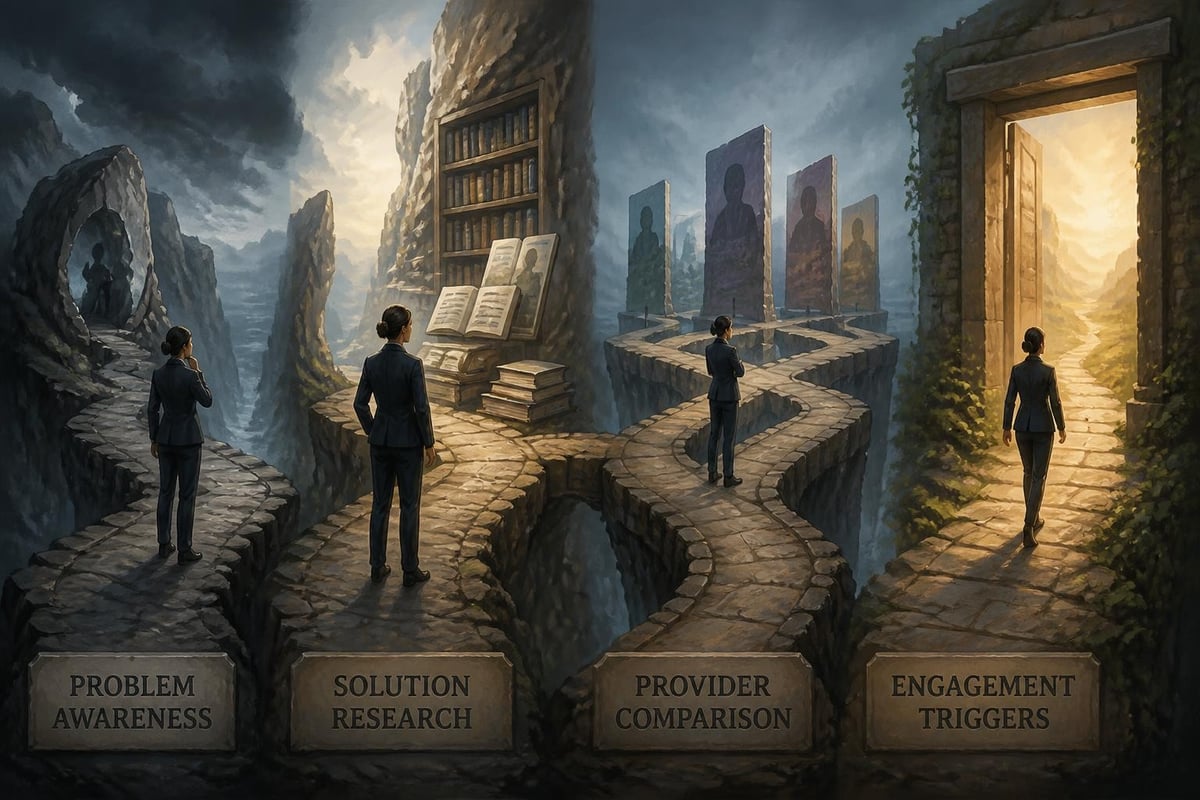
Positioning Architecture for Premium Buyers
Generic positioning kills conversion on executive coaching websites. "I help leaders reach their full potential" tells organizational buyers absolutely nothing about whether you solve their specific problem. Harvard Business Review research on executive coaching confirms that corporate sponsors select coaches based on specialized expertise in specific transition moments or leadership challenges, not generalist capability.
Your homepage must establish vertical authority immediately. Consider these positioning frameworks:
| Weak Positioning | Strategic Positioning |
|---|---|
| "Executive coaching for leaders" | "Executive coaching for private equity-backed CEOs scaling from $10M to $50M ARR" |
| "Leadership development programs" | "90-day turnaround coaching for newly promoted VPs managing teams for the first time" |
| "Helping executives achieve goals" | "Succession preparation for founders exiting within 18-24 months" |
The tighter your positioning, the higher your perceived value and the easier your sales conversations become. This principle applies equally whether you're coaching individuals or building executive coaching leadership development programs for organizations.
Conversion Elements That Transform Browsers Into Buyers
Executive coaching websites convert when they function as sales systems, not brochures. Every page should move qualified prospects toward a specific next action while disqualifying poor-fit leads early in the process.
Above-Fold Strategy
Your hero section must communicate value proposition, social proof, and next action simultaneously. Use this formula:
[Specific Outcome] for [Precise Audience] without [Common Frustration]
Example: "Six-figure revenue increase for women-owned service firms without adding team overhead"
Immediately follow with a trust indicator: client logos, certification credentials from recognized bodies, or a quantified result. Then present one clear call-to-action for your ideal buyer journey stage.
Most executive coaching websites offer "schedule a call" to cold traffic. This works only if your brand awareness is exceptional. For everyone else, offer a diagnostic tool, assessment, or strategic guide that demonstrates your methodology while qualifying the prospect.
Service Architecture That Sells
Your services page isn't a menu. It's a decision tree that guides different buyer types toward appropriate engagements.
Structure your offerings by buyer motivation, not delivery format:
- Transformation Intensive - For executives needing rapid capability development before a known inflection point
- Strategic Partnership - For leaders managing ongoing complexity requiring sustained support
- Organizational Program - For HR/Talent sponsors deploying coaching across multiple executives
Each service tier should specify:
- Exact client profile and starting point
- Measurable outcomes with timeframes
- Investment range (even if "starting at $X")
- What's included and what's not
- Next step (application, consultation, diagnostic)
Notice how Rise Reign Rule structures service offerings around buyer outcomes rather than practitioner credentials.
Proof Mechanisms Beyond Testimonials
Every executive coaching website features glowing testimonials. They've become wallpaper. Sophisticated buyers need proof systems that demonstrate your methodology, not just client satisfaction.
Deploy these trust signals strategically:
- Case studies with metrics - "How a Series B CTO reduced team attrition from 34% to 9% in six months"
- Process transparency - Show your diagnostic framework, assessment tools, or coaching arc
- Content that demonstrates expertise - Weekly insights that reveal your strategic thinking
- Client rosters (with permission) - Logos of organizations or recognizable brands
Consider developing a case study library that allows prospects to filter by industry, challenge type, or executive level. This positions you as an established practice with repeatable systems, not a solo practitioner hoping for referrals.

Technical Foundation for Professional Credibility
Executive coaching websites must perform flawlessly across devices, load instantly, and meet accessibility standards. Corporate buyers often evaluate websites from secure networks with restrictions. A slow, broken mobile experience signals operational carelessness that undermines your premium positioning.
Performance and Accessibility Standards
Page speed directly impacts conversion rates. A three-second load time reduces mobile conversion by 53%. For executive coaching websites where engagement decisions involve five and six-figure commitments, technical performance is non-negotiable.
Implement these baseline standards:
- Core Web Vitals optimization - Largest Contentful Paint under 2.5 seconds, First Input Delay under 100ms
- Mobile-first responsive design - 67% of corporate decision-makers research on mobile devices during commutes
- WCAG 2.1 AA compliance - Meeting Web Content Accessibility Guidelines isn't just ethical; it's increasingly legally required and expands your addressable market
Privacy and Data Protection
Executive coaching involves sensitive conversations about leadership challenges, organizational politics, and personal development areas. Your website must demonstrate that you handle information with appropriate care.
Required privacy infrastructure:
- SSL certificate (HTTPS) across all pages
- Privacy policy that addresses client confidentiality specifically
- Cookie consent management (especially for European or California prospects)
- Clear data handling practices for assessment tools or diagnostic submissions
The International Association of Privacy Professionals provides guidance on client data handling relevant to professional services. For high-ticket practices, privacy violations destroy reputational capital instantly.
Content Strategy That Builds Market Authority
Your executive coaching website should publish strategic insights that demonstrate your thinking process, not generic leadership advice available everywhere. Content marketing for professional services works when it reveals your proprietary frameworks and positions you as the obvious choice for your specific niche.
Thought Leadership Architecture
Stop writing about what executives should do. Start writing about how you help them do it.
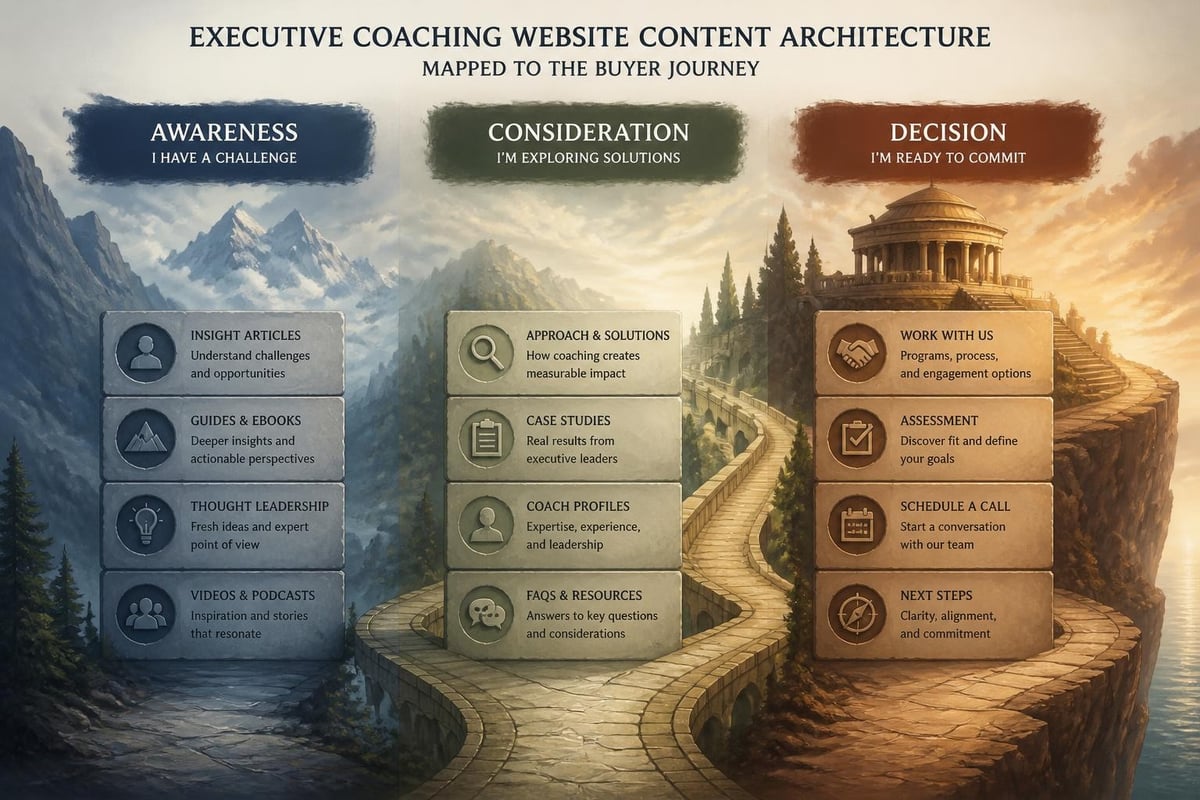
The Content Marketing Institute research shows professional services buyers consume an average of 13 pieces of content before engaging. Your content library should map to the buyer journey:
| Awareness Stage | Consideration Stage | Decision Stage |
|---|---|---|
| Industry trend analysis | Methodology explainers | Service comparison guides |
| Leadership challenge diagnostics | Case study deep-dives | ROI calculators |
| Research summaries | Process walkthroughs | Client onboarding previews |
Publish weekly. Consistency signals operational capability. A website with six blog posts from 2024 suggests a practice that can't maintain client load and thought leadership simultaneously.
SEO for Organizational Buyers
Executive coaching websites must optimize for how corporate sponsors actually search. HR directors and talent VPs don't search "best executive coach." They search "executive coaching for newly promoted VPs" or "leadership development for PE portfolio companies."
Your SEO strategy should target:
- Vertical-specific phrases - "executive coaching for healthcare CFOs" converts better than "executive coaching"
- Outcome-based queries - "reduce executive turnover" or "improve board presentation skills"
- Local + service combinations - Local SEO fundamentals matter for regional practices
Build topic clusters around your methodology pillars. If your framework includes "strategic thinking development," create a hub page with supporting content on decision frameworks, scenario planning, and strategic communication.
User Experience Patterns That Convert Corporate Buyers
Corporate decision-makers evaluating executive coaching websites have different behavioral patterns than B2C buyers. They're often researching on behalf of others, comparing multiple providers simultaneously, and building internal business cases for coaching investments.
Information Architecture for Multiple Stakeholders
Your executive coaching website serves three distinct audiences simultaneously:
- The executive being coached - Wants to understand your approach and evaluate personal fit
- The organizational sponsor - Needs to justify ROI and ensure alignment with development goals
- The procurement/HR team - Requires process clarity, pricing transparency, and contract structure
Nielsen Norman Group UX research on professional services sites confirms that navigation must accommodate multiple user journeys without creating confusion.
Implement these UX patterns:
- Role-based navigation - "For Executives" and "For Organizations" pathways from homepage
- Pricing transparency - Even ranges like "$15,000-$45,000 depending on scope" reduce sales friction
- Clear engagement process - Numbered steps from inquiry to kickoff eliminates uncertainty
- FAQ sections - Address procurement questions, confidentiality concerns, and logistics separately from coaching methodology
Conversion Point Optimization
Every page should have one primary conversion goal and a secondary fallback. Your homepage converts differently than your about page, which converts differently than a blog post.
Strategic CTA placement by page type:
| Page Type | Primary CTA | Secondary CTA |
|---|---|---|
| Homepage | Schedule strategy session | Download diagnostic guide |
| About page | View case studies | See service options |
| Services page | Apply for coaching | Book consultation |
| Blog posts | Subscribe to insights | Explore related articles |
| Case studies | Discuss similar engagement | Contact team |
Notice the progression. You're not asking for marriage on the first date. You're building a logical pathway from awareness to engagement that respects the corporate buying process.
Integration With Your Business Operating System
Your executive coaching website doesn't exist in isolation. It's one component in your complete client acquisition system. For women-owned high-ticket service businesses, your website must integrate seamlessly with your CRM, scheduling system, email marketing platform, and delivery infrastructure.
Marketing Automation Architecture
Connect your website to automated nurture sequences:
- Lead magnet downloads trigger educational email series
- Consultation requests route to appropriate team member based on inquiry type
- Blog subscribers receive weekly strategic insights
- Assessment completions generate personalized resource recommendations
This automation transforms your website from passive brochure into active acquisition engine. Rise Reign Rule's approach to sales systems demonstrates how strategic consultancies build predictable revenue through integrated acquisition architecture.
Analytics and Optimization Framework
You can't improve what you don't measure. Executive coaching websites should track conversion metrics at every stage:
- Traffic sources - Which channels bring qualified prospects vs. browsers?
- Page performance - Which service descriptions drive inquiries? Which create confusion?
- Content effectiveness - What topics generate engagement and sharing?
- Conversion paths - How many touchpoints before scheduling consultation?
- Lead quality - Which sources produce clients vs. tire-kickers?
Implement heat mapping to see where visitors focus attention. Run quarterly content audits to identify underperforming pages. Test different positioning statements, service descriptions, and call-to-action language systematically.
Corporate Program Pages That Win Enterprise Contracts
If you offer organizational coaching programs, your executive coaching website needs dedicated architecture for corporate sponsors. These buyers have completely different evaluation criteria than individual executives.
Enterprise-Level Content Requirements
HR and talent development executives need different proof points. They're asking:
- How do you maintain consistency across multiple executives?
- What reporting and metrics do we receive?
- How does this integrate with our existing development programs?
- What's the implementation timeline and internal resource requirement?
Your corporate program pages should include:
- Program overview - Structure, duration, participant profile
- Outcomes framework - Individual and organizational metrics
- Implementation process - Timeline from agreement to completion
- Case study - Similar organization size/industry with quantified results
- Partnership approach - How you collaborate with internal talent teams
Consider offering downloadable program guides or Harvard Business School's executive coaching frameworks as supporting resources for organizational buyers building internal business cases.
Pricing and Proposal Process
Corporate buyers expect different pricing models than individual clients. Your executive coaching website should clarify:
- Per-participant pricing vs. program fee structures
- Volume considerations - How rates adjust for 5 vs. 50 executives
- Customization options - Which elements adapt to organizational context
- Payment terms - Net-30, milestone billing, or other corporate-friendly structures
Being transparent about your engagement process and commercial terms eliminates back-and-forth and positions you as a sophisticated practice that understands corporate procurement.
Building Your Website as a Strategic Asset
Executive coaching websites should evolve with your practice. What works at $300k in revenue creates bottlenecks at $2M. Your digital presence must scale alongside your business model.
Website maturity stages for coaching practices:
- Foundation ($250k-$500k) - Clear positioning, professional design, basic proof mechanisms, lead capture
- Growth ($500k-$1.5M) - Content library, case studies, automated nurture, multiple service tiers
- Scale ($1.5M-$5M) - Team bios, program architecture, corporate offerings, partner integrations
Your website becomes the central hub for your entire market authority system. Every speaking engagement, podcast appearance, and article you publish should link back to strategic pages that move prospects toward engagement.
This is exactly the type of operational infrastructure that creates "founder bottlenecks" when neglected. Your website should generate qualified inquiries predictably, not require constant manual intervention. When you're spending 10 hours weekly updating website copy or manually responding to unqualified inquiries, you're not building the profit architecture that enables clean scaling.
Your executive coaching website is either a strategic revenue engine or an expensive digital placeholder. The difference lies in treating it as a complete acquisition system built on positioning clarity, conversion architecture, and operational integration. When you align your digital presence with your unique methodology and ideal client profile, premium inquiries become predictable rather than random. If you're a women-owned high-ticket service business ready to eliminate founder bottlenecks and install revenue systems that scale without adding complexity, explore how Rise Reign Rule transforms operational drag into profit architecture through our four-pillar framework.


