
Leadership Coaching Programme: Scale Your High-Ticket Firm
You've built a successful high-ticket service business, but you're trapped in the daily operations. Your team looks to you for every decision, your calendar controls your revenue, and scaling feels impossible because you're the primary asset. This founder bottleneck isn't a staffing problem or a time management issue. It's a leadership gap that requires structured intervention. A leadership coaching programme specifically designed for your business model can transform you from the person doing all the work into the strategist orchestrating predictable growth.
Why Traditional Leadership Development Fails High-Ticket Service Founders
Most leadership programmes target corporate executives navigating organizational politics and managing large teams. That's not your reality. You're running a lean operation where every team member directly impacts client outcomes and revenue. Generic leadership training wastes your time with irrelevant case studies and frameworks built for Fortune 500 complexity.
Your leadership challenges are distinct and urgent:
- Decision fatigue from being the final authority on everything from client strategy to invoice disputes
- Revenue vulnerability tied directly to your personal capacity and availability
- Quality control anxiety because no one delivers client work quite like you do
- Team dependency where even experienced hires constantly seek your approval
- Strategic starvation as operational demands consume time needed for business development
A properly structured leadership coaching programme addresses these specific pain points rather than teaching you how to navigate corporate hierarchies you'll never encounter.

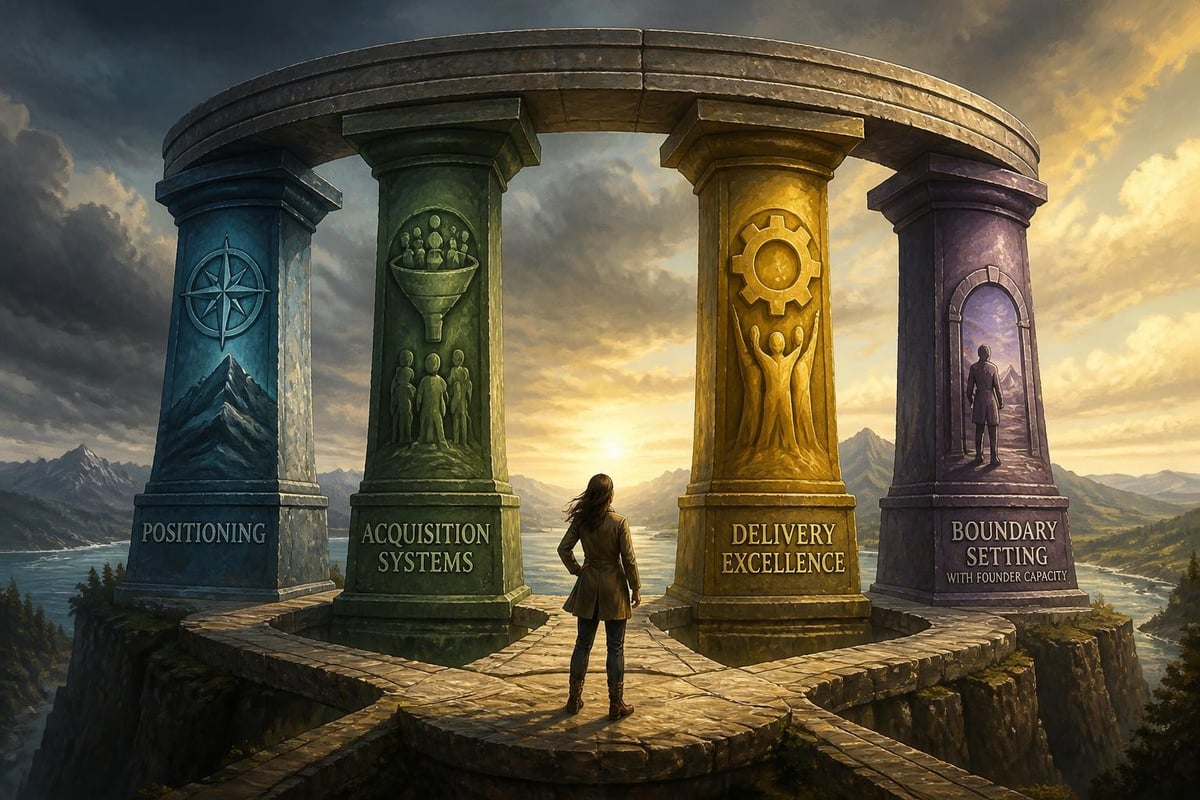
The Four Pillars of Effective Leadership Coaching for Service Businesses
The most impactful leadership coaching programme for high-ticket service founders builds capabilities across four interconnected domains. These aren't theoretical concepts but practical skill areas that directly affect your bottom line and operational freedom.
Strategic Positioning and Authority
Your leadership effectiveness starts with how you position yourself in the market. When you're unclear about your unique value proposition or constantly explaining what you do, your team mirrors that confusion. Creating a supportive coaching environment requires first establishing clarity about your market authority and strategic direction.
This pillar focuses on:
- Defining your proprietary methodology so team members can articulate your approach
- Establishing thought leadership that attracts ideal clients without your constant involvement
- Creating intellectual property that separates your expertise from your personal delivery
- Building market positioning that commands premium pricing and selective client relationships
When you're confident in your positioning, you make faster decisions, set clearer boundaries, and empower your team to represent your brand without micromanagement.
Acquisition Systems and Sales Leadership
Most service founders excel at selling their own expertise but struggle to build sales systems others can execute. Your leadership coaching programme must address this critical gap. You need frameworks for leadership development that translate your intuitive sales process into repeatable systems.
| Sales Leadership Component | Founder-Dependent Approach | Systemized Approach |
|---|---|---|
| Lead Qualification | Gut feel and personal assessment | Documented criteria and scoring system |
| Discovery Process | Customized conversation flow | Structured framework with key questions |
| Proposal Development | Created from scratch each time | Templates with customization parameters |
| Objection Handling | Personal persuasion and flexibility | Protocol-based responses and authority levels |
Building these systems requires you to develop new leadership capabilities around process documentation, performance metrics, and coaching your sales team through real opportunities without taking over.
Delivery Excellence and Delegation
This is where most high-ticket founders hit their hardest wall. You've spent years perfecting your client delivery approach, and delegating it feels like risking everything you've built. A robust leadership coaching programme helps you move from artisan to architect.
The transformation involves:
- Documenting your delivery methodology so it becomes transferable knowledge rather than personal magic
- Creating quality benchmarks that define excellent work without requiring your judgment on every deliverable
- Building feedback loops where team members improve through structured reviews rather than crisis interventions
- Establishing client communication protocols that maintain relationships without your constant presence
- Designing escalation pathways so you handle true exceptions rather than routine decisions
According to research on key principles of effective executive coaching, alignment with strategic goals is essential. Your delegation framework must serve your scaling objectives, not just offload tasks you dislike.
Leadership Boundaries and Personal Capacity
The most overlooked element of a leadership coaching programme for service founders is boundary setting. You didn't build your business to answer Slack messages at 10 PM or make yourself perpetually available to anxious clients. Yet here you are.
Effective boundary work addresses:
- Time sovereignty: Protecting strategic thinking time and personal recovery time
- Decision authority: Defining what decisions require your input versus team autonomy
- Client access: Creating service delivery structures that don't depend on your real-time availability
- Revenue diversification: Building income streams beyond your personal billable hours
- Energy management: Aligning your calendar with your natural productivity rhythms
These aren't luxury items or self-care indulgences. They're operational requirements for sustainable scaling. When you're depleted, distracted, or resentful, your leadership suffers and your team performance follows.
Designing Your Leadership Coaching Programme Structure
Generic coaching arrangements rarely produce meaningful results for busy founders. You need a programme structure that fits your operational reality and business model. The comprehensive guide on leadership development coaching programs emphasizes the importance of identifying the right coaches and setting specific goals.
Programme Duration and Intensity
Most effective leadership coaching programmes for high-ticket service founders run 6-12 months. Shorter engagements address immediate problems but rarely install lasting systems. Longer programmes allow you to implement changes, measure results, and refine your approach.
Consider these structure options:
- Intensive quarterly model: Deep-dive sessions at the start of each quarter with bi-weekly check-ins for accountability
- Monthly strategic sessions: Dedicated time for big-picture leadership development with weekly implementation support
- Project-based approach: Focused programmes around specific transitions like hiring your first COO or launching a group offering
- Ongoing advisory relationship: Continuous access for real-time decision support as challenges emerge
The right structure depends on your current revenue, team size, and specific bottlenecks. A $500K founder with two team members needs different intensity than a $3M business with fifteen employees.
Accountability Mechanisms and Measurement
Your leadership coaching programme must include rigorous accountability. Without it, you'll create beautiful frameworks that sit unused while you revert to familiar patterns. Effective measurement tracks both leading indicators (behaviors and activities) and lagging indicators (business results).
| Metric Category | Example Measurements | Collection Frequency |
|---|---|---|
| Time Allocation | Hours in strategic vs. operational work | Weekly |
| Team Autonomy | Percentage of decisions made without founder input | Monthly |
| Revenue Leverage | Revenue per founder hour worked | Monthly |
| Client Delivery | Projects completed without founder involvement | Monthly |
| Strategic Progress | Implementation rate of quarterly initiatives | Quarterly |
These metrics reveal whether your leadership development is actually changing your business or just making you feel productive. According to best practices for building internal coaching programs, defining clear purposes and securing commitment are essential for success.
Selecting the Right Leadership Coach for Your Business
Not every executive coach understands high-ticket service businesses. Corporate coaches may encourage you to hire extensively or implement enterprise software that's overkill for your operation. Startup coaches might push aggressive growth tactics that compromise your premium positioning.
Your ideal leadership coaching programme partner should demonstrate:
- Service business expertise: Direct experience with professional services, consulting, or agency models
- High-ticket understanding: Familiarity with complex sales cycles, premium pricing, and sophisticated client relationships
- Operational focus: Ability to address systems and processes, not just mindset and motivation
- Female founder context: Understanding of the specific challenges women face in business leadership
- Revenue-stage relevance: Experience with businesses in the $250K-$5M range, not startups or enterprises
Ask potential coaches about their proprietary frameworks and methodologies. The best coaches don't just ask powerful questions-they bring structured approaches based on repeated client success. Explore the services available from consultancies specializing in your business model.
Implementing Leadership Frameworks Across Your Team
Your personal leadership development creates limited impact if your team doesn't evolve with you. The most effective leadership coaching programme includes strategies for cascading new frameworks throughout your organization.
Training Your Team on New Systems
When you implement a leadership coaching programme, you'll develop new decision-making frameworks, quality standards, and communication protocols. Your team needs structured training on these new systems, not just passive exposure.
Effective training approaches include:
- Framework workshops: Dedicated sessions explaining new systems and the reasoning behind them
- Shadowing opportunities: Team members observe you using new frameworks in real situations
- Guided practice: Supervised application of new approaches with your feedback
- Documentation libraries: Written resources team members can reference independently
- Regular reinforcement: Ongoing team meetings that reinforce key frameworks
The research on making leadership development work emphasizes that context, content, and application must align. Your team training should reflect your actual business challenges, not generic scenarios.
Managing the Transition Period
Changing your leadership approach disrupts established patterns. Team members accustomed to constant access may feel abandoned when you set boundaries. Those who relied on your decision-making may struggle with new autonomy. Your leadership coaching programme should prepare you for this transition resistance.
Common transition challenges:
- Team members escalating minor issues to test your commitment to new boundaries
- Initial quality dips as team members execute work you previously handled
- Client confusion when their primary contact shifts from you to team members
- Your own discomfort watching others do things differently than you would
- Revenue anxiety as you invest time in systems rather than billable work
Expect this transition to take 3-6 months. During this period, your coach helps you maintain consistency when reverting to old patterns feels easier than pushing through discomfort.

Measuring ROI on Your Leadership Development Investment
A leadership coaching programme represents a significant investment of time and money. You need clear evidence it's producing returns. Unlike tactical consulting that might immediately boost revenue, leadership development creates compounding returns over time.
Financial Returns
Track these financial metrics quarterly:
- Founder revenue per hour: Your total revenue divided by hours you personally work
- Non-founder revenue percentage: Income generated by team members without your direct involvement
- Profit margin improvement: Net profit percentage as operational efficiency increases
- Client lifetime value: Average revenue per client as delivery quality and systems improve
- New client acquisition cost: Cost to acquire clients as your positioning and systems strengthen
Most founders implementing a comprehensive leadership coaching programme see these metrics improve 15-30% within the first year, with continued growth in subsequent years.
Operational Returns
Financial metrics tell part of the story. Equally important are operational improvements that create founder freedom and business sustainability:
- Percentage of client projects completed without your involvement in delivery
- Number of days you can be unavailable without business disruption
- Team member tenure and satisfaction scores
- Decision velocity (time from question to resolution)
- Strategic initiative completion rate
These operational wins often precede financial returns. When you're spending 60% of your time on strategy instead of 20%, revenue growth follows naturally.
Personal Returns
Don't discount the personal quality-of-life improvements from effective leadership development. You started your business for freedom and impact, not to create an exhausting job. Your leadership coaching programme should measurably improve:
- Schedule control: Ability to take vacation without business crisis
- Energy levels: Reduction in decision fatigue and emotional exhaustion
- Relationship quality: Time and presence for important personal relationships
- Creative capacity: Mental space for innovation and strategic thinking
- Life satisfaction: Overall alignment between your business and desired lifestyle
These improvements aren't selfish indulgences. They're business assets. Burnt-out founders make poor decisions, repel top talent, and eventually sabotage their own businesses.
Common Leadership Coaching Programme Mistakes to Avoid
Even well-intentioned founders sabotage their leadership development by making predictable mistakes. Awareness of these patterns helps you avoid them.
The information collection trap: Attending every webinar and reading every book about leadership without implementing anything. Knowledge without application creates no value.
The perfectionism delay: Waiting to delegate until you've created the perfect system documentation. Your team needs 80% clarity to start learning, not 100% perfection.
The scattered focus: Working on positioning one month, sales systems the next, then delivery processes, without seeing any single initiative through to completion. Depth beats breadth in leadership development.
The lone wolf approach: Trying to transform your leadership in isolation without coaching support, peer accountability, or team involvement. Sustainable change requires external perspective and support.
The silver bullet fantasy: Expecting one framework or technique to solve all your leadership challenges. Effective programmes address multiple interconnected capabilities over time.
Examine real-world applications through case studies showing how founders navigate these common pitfalls during their leadership development journey.
Integration with Your Broader Business Architecture
Your leadership coaching programme shouldn't exist in isolation from your overall business strategy. The most powerful results emerge when leadership development integrates with your positioning, acquisition systems, and delivery frameworks.
Consider how leadership improvements cascade:
- Stronger positioning enables clearer team communication about your value proposition
- Better acquisition systems reduce your personal involvement in closing sales
- Refined delivery processes allow team members to produce excellent client outcomes
- Healthier boundaries protect the strategic thinking time needed for continued innovation
This integration creates what successful founders call "Profit Architecture"-the interconnected systems that generate predictable revenue without constant founder intervention. When these elements align, your business scales cleanly rather than simply getting larger and more chaotic. Learn more about this integrated approach at Rise Reign Rule.
The distinction between founders who successfully scale and those who remain trapped in their businesses often comes down to systematic leadership development. A properly designed leadership coaching programme gives you the frameworks, accountability, and external perspective needed to make this transition. Without it, you're relying on trial and error, learning expensive lessons through avoidable mistakes.
Building a leadership coaching programme that actually transforms your business requires more than good intentions and occasional coaching calls. It demands structured frameworks, rigorous accountability, and integration with your overall business architecture. When you're ready to remove the founder bottlenecks limiting your growth and install the systems that create predictable profit and clean scaling, Rise Reign Rule offers the strategic consultancy and Profit Architecture framework designed specifically for women-owned high-ticket service businesses. The question isn't whether to invest in your leadership development, but whether you're ready to commit to the structured approach that produces results.


