
ROI of Coaching: Why Women Leaders Are Seeing 600% Returns
Every high-ticket service founder reaches a familiar crossroads: you've built revenue to a quarter million or beyond, yet scaling feels like pushing water uphill. You're working harder, not smarter. More revenue doesn't mean more profit. This is where strategic coaching enters the conversation-not as a luxury, but as a measurable investment with quantifiable returns. Understanding the roi of coaching transforms how women leaders allocate capital, build systems, and ultimately reign over their businesses instead of being ruled by them.
The Financial Case for Coaching in High-Ticket Service Businesses
When service revenue sits between $250k and $5M, every dollar matters differently than it did at startup. You're no longer experimenting-you're optimizing. The question isn't whether coaching works, but whether it delivers returns that justify the investment in your specific context.
Research from The Manchester Review documents coaching ROI at 5.7 times the initial investment, translating to 570% returns for participating organizations. For executive coaching specifically, companies reported improvements in productivity, quality, organizational strength, and customer service. These aren't soft metrics-they're business fundamentals that directly impact your bottom line.
Hard Numbers Behind Coaching Returns
The roi of coaching becomes clearer when you examine what changes after strategic intervention:
- Revenue per employee increases 15-25% within six months
- Client acquisition costs drop 20-40% through refined positioning
- Delivery hours per client decrease 30-50% via systematization
- Founder working hours reduce 10-15 hours weekly while revenue holds or grows
| Metric | Before Coaching | After 6 Months | Impact |
|---|---|---|---|
| Monthly revenue per founder hour | $350 | $825 | +136% |
| Client lifetime value | $18,000 | $31,500 | +75% |
| Operating margin | 22% | 41% | +86% |
| Founder capacity (hrs/week) | 58 | 42 | -28% |
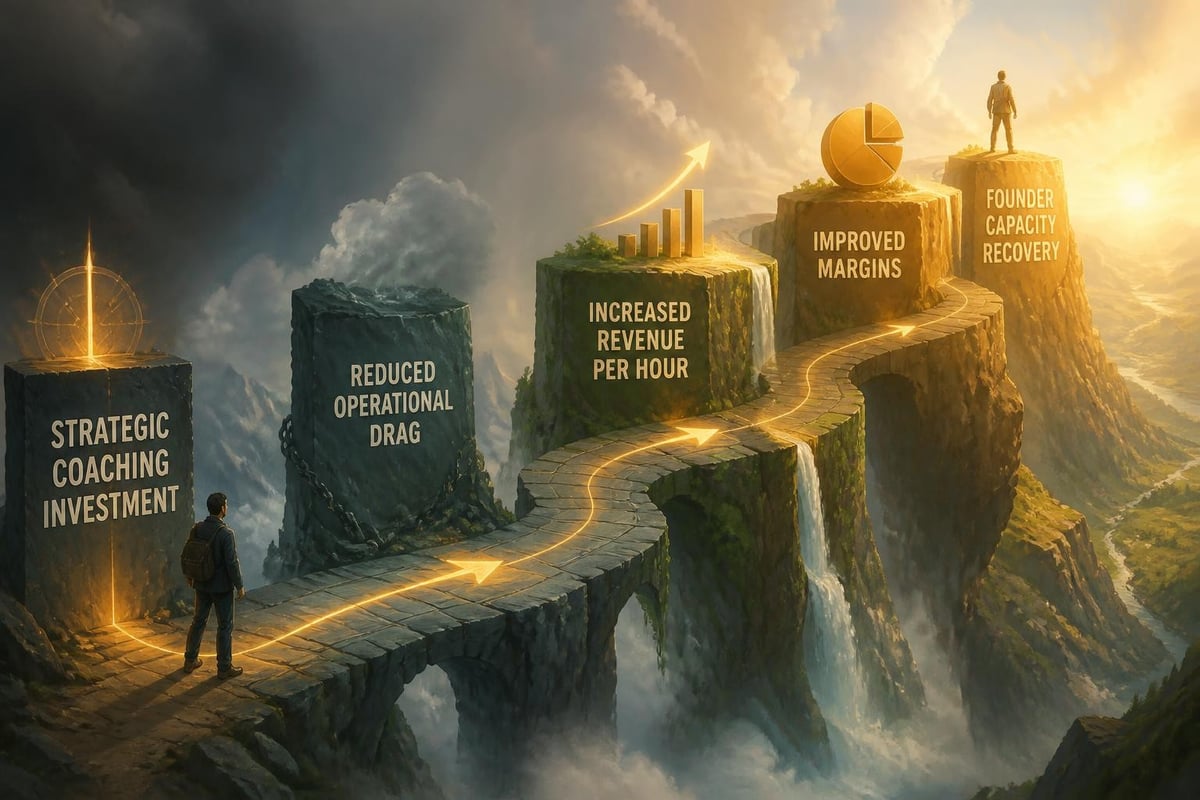
These improvements compound. A $300k business investing $50k in strategic coaching that achieves even half these benchmarks generates $180k in additional profit over 18 months-a 360% return before accounting for reclaimed time and reduced burnout.
What Makes Coaching ROI Measurable (or Not)
Not all coaching delivers measurable returns. The difference lies in framework, focus, and follow-through. Harvard Business Review research on coaching outcomes reveals that the highest-performing engagements share common characteristics: clear objectives, systematic implementation support, and accountability structures.
For women-owned service businesses, the roi of coaching multiplies when the engagement addresses system-level constraints rather than just mindset or tactics. A coach who helps you feel more confident delivers value, certainly. But a strategic partner who installs acquisition systems that generate qualified leads without your daily involvement? That creates enterprise value you can measure, scale, and eventually sell.
The Four Pillars of Measurable Coaching Impact
Strategic coaching that delivers verifiable ROI operates across interconnected domains:
- Positioning transformation that commands 2-3x pricing without longer sales cycles
- Acquisition systems that fill your calendar predictably without paid ads or constant networking
- Delivery frameworks that produce consistent client outcomes without founder involvement in every detail
- Leadership boundaries that protect your energy while expanding your authority
Each pillar contributes distinctly to financial performance. Positioning affects pricing power and conversion rates. Acquisition determines cost per client and pipeline predictability. Delivery controls margin and referral rates. Leadership governs capacity and sustainability. Rise Reign Rule's Profit Architecture integrates all four, creating multiplicative rather than additive returns.
When coaching addresses only one dimension-say, sales confidence without acquisition infrastructure-you'll see temporary lifts that fade when motivation wanes. System-level coaching builds assets that perform whether you're personally energized or not.
Evidence-Based ROI: What the Research Actually Shows
Skepticism about coaching ROI is healthy. The industry has made inflated claims for decades. What does rigorous research reveal?
A systematic review published in PLOS ONE evaluated coaching effectiveness across organizational contexts. The researchers found that while many studies showed positive outcomes, methodological quality varied widely. The strongest evidence emerged for coaching programs with:
- Specific, pre-defined performance metrics
- Control groups or baseline comparisons
- Multi-source feedback (not just self-report)
- Minimum 6-month engagement periods
The roi of coaching proves most convincing when measurement follows established frameworks for calculating financial returns, accounting for isolation of effects, data conversion to monetary value, and fully-loaded costs.
What Executive Coaching Actually Changes
More recent meta-analytic research from Frontiers in Psychology quantified executive coaching effects across multiple outcome categories. The findings showed medium to large effect sizes for behavioral change, goal attainment, and leadership skill development-outcomes that matter enormously for founders navigating the $250k to $5M growth corridor.
For service business leaders specifically, coaching impact shows up in:
- Decision speed: Reduced analysis paralysis saves 5-8 hours weekly
- Delegation quality: Clear frameworks enable successful handoffs
- Strategic clarity: Focused priorities eliminate $30k-80k in wasted experiments
- Pricing confidence: Authority positioning supports 40-100% price increases
These aren't abstract personality shifts. They're operational improvements with direct P&L consequences.
The Hidden Multipliers of Strategic Coaching
Beyond immediate financial returns, the roi of coaching includes less obvious multipliers that compound over years. These hidden returns often exceed the direct revenue impact.
Time reclamation represents the most undervalued ROI component. When strategic coaching removes you from daily operations through systematization, you gain 15-20 hours weekly. At your effective hourly rate (revenue divided by working hours), that's $50k-150k in annual capacity recovered. You can redeploy this toward client delivery, business development, or-revolutionary concept-actual rest that prevents burnout and seven-figure mistakes.
Decision quality improvement delivers asymmetric returns. A single better strategic choice about market positioning, offer structure, or team hiring can shift your trajectory by hundreds of thousands over three years. Coaching that develops strategic thinking pays dividends on decisions you haven't faced yet.
The Valuation Premium of Built Systems
If you ever consider selling your service business, systematization creates enterprise value that founder-dependent operations never achieve. Buyers pay 1.5-3x revenue for businesses with documented, transferable systems. Founder-centric practices might fetch 0.5-0.8x revenue.
| Business Type | Typical Multiple | Example Valuation ($1M Revenue) |
|---|---|---|
| Founder-dependent | 0.5-0.8x | $500k-800k |
| Partially systematized | 1.0-1.5x | $1M-1.5M |
| Fully transferable systems | 2.0-3.5x | $2M-3.5M |
Strategic coaching that builds transferable infrastructure doesn't just improve your quarterly profit-it potentially triples your exit valuation. That's long-term ROI that dwarfs the coaching investment.

Why Traditional ROI Calculations Underestimate Coaching Value
Standard ROI formulas-(gain minus cost) divided by cost-capture only quantifiable financial returns in measurable timeframes. For the roi of coaching, this methodology systematically undervalues several critical dimensions.
Risk mitigation doesn't show up in ROI calculations, yet preventing one catastrophic hiring mistake, pricing miscalculation, or market positioning error can save $100k-500k. Strategic coaching provides pattern recognition from thousands of business situations, helping you avoid expensive learning through failure.
Opportunity cost reduction similarly eludes measurement. How do you quantify the value of not spending 18 months pursuing a market that would never support your pricing? Or not building an offer that requires unsustainable delivery? These non-events create enormous value by steering you away from dead ends.
The Compound Effect of Accelerated Learning
Research highlighted by the World Economic Forum demonstrates that coaching accelerates capability development 3-5x compared to training alone. For founders, this compression of the learning curve translates to reaching scale targets 12-24 months faster.
If your growth plan projects $2M revenue in year three but coaching helps you hit that milestone in year two instead, you've gained:
- 12 months of $2M run-rate cash flow ($1M+)
- Earlier access to next-stage opportunities
- Reduced time at personal financial risk
- Shortened period of unsustainable workload
That acceleration multiplier represents ROI traditional calculations miss entirely.
Calculating Your Specific ROI of Coaching
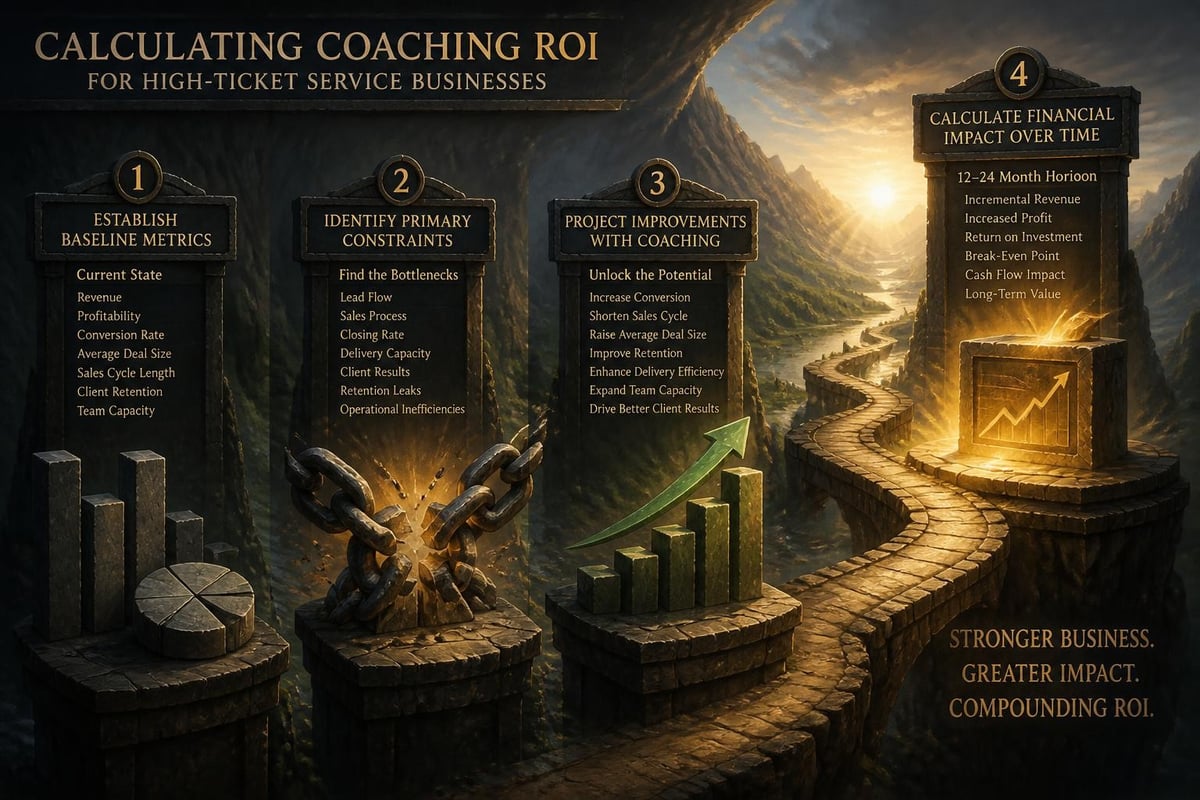
Generic industry benchmarks matter less than your particular business context. To project your roi of coaching, start with baseline metrics:
- Current monthly revenue and operating profit percentage
- Average client lifetime value and acquisition cost
- Founder working hours per week and effective hourly rate
- Revenue per team member (if applicable)
Next, identify your primary constraint. Most high-ticket service businesses between $250k-$5M face one of three bottlenecks:
- Market authority gap: Qualified buyers don't perceive you as the obvious choice (positioning problem)
- Pipeline inconsistency: Feast-or-famine client flow creates cash flow volatility (acquisition problem)
- Delivery inefficiency: You're personally embedded in every client engagement (systematization problem)
Strategic coaching delivers highest ROI when it directly addresses your binding constraint. Improving sales process when you lack pipeline generates minimal returns. Installing delivery systems when you can't consistently fill your calendar wastes resources.
Conservative ROI Projection Framework
| Improvement Area | Conservative Gain | Your Baseline | Projected Impact |
|---|---|---|---|
| Average deal size | +15% | $______ | $______ |
| Close rate | +10 percentage points | ___% | ___% |
| Delivery efficiency (hours) | -20% | ___ hrs/client | ___ hrs/client |
| Operating margin | +8 percentage points | ___% | ___% |
Even conservative improvements across these dimensions typically generate 3-5x returns within 12 months for businesses in the $250k-$5M range. The roi of coaching grows as you apply learned frameworks to multiple subsequent decisions and client engagements.
When Coaching ROI Falls Short (and How to Prevent It)
Not every coaching engagement delivers returns. Understanding failure modes helps you avoid them.
Misaligned expectations torpedo ROI most frequently. If you engage coaching expecting motivation and accountability while the coach focuses on strategy and systems (or vice versa), neither party succeeds. Before investing, clarify whether you need therapeutic support, tactical training, or strategic infrastructure-three distinct services often confused under the "coaching" umbrella.
Incomplete implementation represents the second major failure point. Research from the Association for Talent Development shows that organizations struggle to translate coaching insights into sustained practice. For the roi of coaching to materialize, recommendations must become installed systems, not aspirational ideas.
The Implementation Gap
You can receive brilliant strategic guidance about market positioning, acquisition systems, or delivery frameworks. But if those insights remain in your notebook rather than your actual business operations, ROI stays theoretical.
High-performing coaching engagements include:
- Implementation support beyond strategy sessions
- Accountability structures with specific milestones
- Frameworks and templates that reduce execution friction
- Progress measurement against baseline metrics
Generic coaching that ends at "here's what you should do" delivers 20-30% of potential ROI compared to engagements that support you through actual implementation until new systems run independently.
Maximizing Your Coaching Investment
To extract maximum roi of coaching, approach the engagement strategically rather than opportunistically.
Pre-work preparation multiplies coaching effectiveness. Before your first session, document your current numbers comprehensively: revenue, margins, client metrics, time allocation, team capacity. Coaching built on precise understanding of your starting point delivers far better returns than sessions grounded in impressions and estimates.
Focus on leverage points rather than comprehensive overhaul. Identify the single bottleneck that most constrains your growth right now. A $400k business with inconsistent pipeline should invest heavily in acquisition systems, even if delivery could also improve. Fix the binding constraint first; other improvements can wait.
Commit to documentation and systematization as you implement. The difference between learning something and building a system that embeds that learning determines whether ROI accrues once or compounds indefinitely. Exploring case studies of similar transformations helps you understand what successful systematization looks like in practice.
Building Institutional Knowledge
Service businesses fail to scale when expertise stays locked in the founder's head. Strategic coaching should help you extract your intuitive knowledge into documented systems your team can execute. This transformation-from founder-dependent art to transferable system-represents the ultimate ROI multiplier.
Each framework you document, each system you install, each decision criterion you codify creates an asset that generates returns long after coaching concludes. You're not just buying advice; you're building infrastructure that performs whether you're working or on vacation.
ROI Beyond the Numbers
While financial returns matter most for business decisions, the roi of coaching includes personal dimensions that cascade into business performance over time.
Reduced decision fatigue from clear strategic frameworks preserves cognitive capacity for genuinely important choices. When you operate within proven systems for positioning, acquisition, and delivery, you stop reinventing basic approaches weekly. This mental space reclamation shows up as better strategic thinking, improved creativity, and enhanced leadership presence.
Confidence in pricing and positioning enables high-ticket service businesses to command fees aligned with delivered value rather than market averages or imposter syndrome. This single shift-asking for what you're worth and believing you'll receive it-often creates 30-50% revenue increases without additional client volume.
Sustainable pace and boundaries prevent the burnout that destroys seven-figure businesses. Strategic coaching that helps you set and maintain leadership boundaries keeps you in the game long enough to realize compound returns on all your previous investments.
For women founders specifically, coaching that addresses both business systems and the leadership capacity to maintain them delivers ROI across professional and personal domains. You build a business that generates wealth and allows you to enjoy it-a combination far too rare in the high-achievement economy.
Strategic Coaching as Competitive Advantage
In markets where technical service delivery has commoditized, your competitive edge comes from execution excellence, market authority, and operational efficiency-precisely what strategic coaching develops.
Your competitors likely deliver similar core services. The difference between commanding $5k versus $25k for comparable outcomes isn't quality alone; it's positioning, authority, and the confidence to ask. The roi of coaching shows up in your ability to consistently win premium opportunities your technically-skilled competitors never access.
Moreover, as you systematize delivery and acquisition, you create capacity to serve more clients or higher-value clients without proportional time increases. Your competitors trapped in founder-dependent operations face linear growth constraints. You scale geometrically. This competitive separation compounds year over year.
Market authority building through strategic positioning creates self-reinforcing advantages. As coaching helps you articulate your unique methodology, publishing thought leadership becomes easier. Speaking opportunities increase. Referrals multiply. You attract better clients who pay faster, implement more completely, and refer more actively. These downstream effects dwarf the initial coaching investment but trace directly back to it.
The women service founders who pull away from the pack in the $250k-$5M corridor aren't necessarily more talented or harder working. They're more strategic about building transferable systems, establishing market authority, and protecting their capacity. Strategic coaching accelerates all three simultaneously, creating returns that persist long after the engagement ends.
The roi of coaching transcends simple financial calculations when you account for risk mitigation, accelerated learning, and enterprise value creation. For women-owned high-ticket service businesses navigating the growth corridor from founder-stage to scalable enterprise, strategic coaching that installs actual systems delivers 3-6x returns while reclaiming 15+ hours weekly. If you're ready to transform operational drag into predictable profit through proven frameworks, Rise Reign Rule specializes in exactly this transformation for service businesses like yours.


