
Testimonial Coaching: Transform Client Wins into Revenue
When you're scaling a high-ticket service business past $250k, you already know your work delivers transformation. Your clients get results. They're happy. But here's the frustrating truth: happy clients don't automatically translate to compelling testimonials that close deals. That gap between satisfied customers and persuasive social proof? That's where testimonial coaching becomes your secret weapon. This strategic practice transforms casual client feedback into structured, emotionally resonant stories that position you as the only logical choice in your market.
Why Generic Testimonials Kill Your Conversion Potential
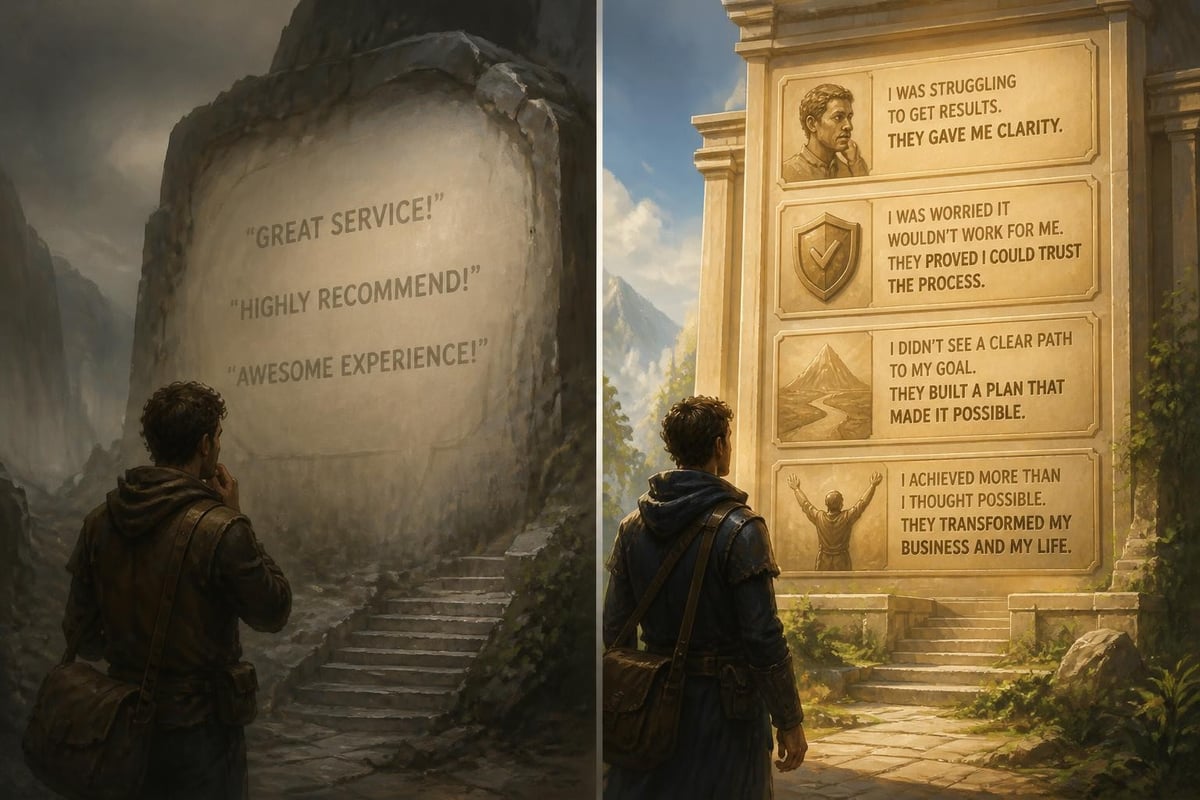
Most service providers collect testimonials the lazy way. They send a generic email asking, "How was your experience?" The client responds with something polite but forgettable: "Great experience, highly recommend!" This kind of vague praise does nothing to overcome buyer skepticism or differentiate your methodology.
Here's what weak testimonials cost you:
- Extended sales cycles because prospects can't visualize their own transformation
- Price resistance when buyers don't understand the specific value delivered
- Positioning confusion that makes you look like every other consultant in your space
- Missed opportunities to address common objections before they arise
The women-owned businesses we work with typically operate in crowded markets where everyone claims similar results. When your testimonials sound identical to your competitors', you're forcing prospects to make decisions based on price rather than unique value.
The Psychology Behind Persuasive Social Proof
Research on persuasion and social influence confirms what savvy business owners already know intuitively: people trust peer experiences more than marketing claims. But not all testimonials carry equal weight. The most persuasive social proof shares specific characteristics that trigger buyer confidence.
Effective testimonial coaching leverages these psychological principles systematically. When you guide clients through structured reflection, you're not putting words in their mouths. You're helping them articulate the transformation they genuinely experienced in language that resonates with prospects facing similar challenges.
Think about your own buying behavior. When you invest $15k, $50k, or $100k+ in a strategic partnership, you're not swayed by "it was great!" You need to see evidence that someone with your exact problem, in your specific situation, achieved measurable outcomes using a proven methodology.
The Testimonial Coaching Framework That Drives Revenue
Testimonial coaching is a structured interviewing process that extracts strategic stories from your best client relationships. Unlike casual feedback collection, this approach systematically uncovers the narrative elements that influence buying decisions in high-ticket markets.
The Pre-Interview Preparation Phase
Before you ever speak with a client, you need strategic clarity. Which specific aspects of your coaching skill and methodology do prospects question most? What objections appear repeatedly in sales conversations? Where does your positioning need reinforcement?
Create a strategic question bank organized around:
- The client's situation before working with you (pain points, failed attempts, stakes)
- Their decision process (why you versus alternatives, hesitations overcome)
- The implementation experience (what made it work, methodology specifics)
- Measurable outcomes (revenue impact, time savings, operational improvements)
- Unexpected benefits (secondary transformations they didn't anticipate)
This framework ensures every testimonial you collect serves a specific strategic purpose. You're not gathering generic praise. You're building an arsenal of proof points that address real buying obstacles.
Conducting the Strategic Interview
The actual coaching conversation requires skill. You're balancing genuine curiosity with strategic direction. The goal is authentic stories that happen to perfectly address prospect objections.
Start by creating safety. Explain that you're documenting their journey to help others facing similar challenges. Most successful clients genuinely want to help peers avoid the struggles they experienced. This frame makes the conversation generous rather than transactional.
| Interview Phase | Questions to Ask | Strategic Purpose |
|---|---|---|
| Before State | "What was the breaking point that made you seek help?" | Helps prospects recognize themselves in the story |
| Selection Process | "What made our approach different from other options you considered?" | Differentiates your methodology from competitors |
| Implementation | "What specific framework or tool created the biggest shift?" | Positions proprietary systems as valuable IP |
| Results | "If you had to quantify the impact in time or revenue, what would you say?" | Provides concrete ROI evidence |
| Reflection | "What would you tell someone considering this but feeling hesitant?" | Directly addresses common objections |
The magic happens when you dig three levels deep. Initial answers are usually surface-level. "It helped us get organized." Push further: "What does 'organized' actually mean in terms of your day?" Then deeper still: "How did that change impact your revenue or your life outside work?"

Transforming Raw Interviews into Strategic Assets
Research on testimonials and digital persuasion demonstrates that specific narrative elements significantly increase persuasive impact. Your coaching interview produces rich material, but raw transcripts don't convert prospects. You need to craft that content strategically.
The Story Extraction Process
Listen to your interview recording multiple times with different filters. First pass: identify quotable phrases that sound authentic and emotionally resonant. Second pass: map content to your sales objections document. Third pass: find the transformation arc that creates narrative tension and resolution.
The most powerful testimonials follow this structure:
- Relatable struggle: "I was working 60-hour weeks and still hitting revenue ceilings"
- Failed alternatives: "I tried three different business coaches who just gave me more to do"
- The shift: "The Profit Architecture framework showed me I had a delivery problem, not a marketing problem"
- Specific outcome: "Within 90 days, we increased client capacity by 40% without hiring"
- Unexpected benefit: "Now I pick my kids up from school three days a week"
Notice how this testimonial addresses multiple buying concerns: time investment fears, methodology differentiation, measurable results, and quality-of-life impact. That's testimonial coaching at work.
Adapting Testimonials for Different Platforms
One strategic interview should yield multiple assets. Effective customer testimonial strategies recognize that different channels require different formats and emphasis.
Your website needs credibility-building social proof that establishes trust through design and placement. Pull the most impressive metric-driven quotes for homepage placement. Your sales conversations need objection-specific stories you can reference at precise moments. Case studies require full narrative arcs with before/after detail.
Building a Testimonial Coaching System That Scales
As your business grows past seven figures, ad-hoc testimonial collection becomes insufficient. You need a systematic approach that generates fresh social proof continuously without founder bottleneck.
Timing Your Testimonial Requests Strategically
The best testimonial coaching conversations happen at specific milestone moments. Right after a major client breakthrough, when emotions and memory are fresh. Not at project end when details have faded and enthusiasm has normalized.
Optimal interview timing points:
- Immediately after a significant measurable win (revenue increase, operational breakthrough)
- When a client unpromptedly shares an excited update
- At the halfway point of a program when perspective exists but momentum is high
- During renewal conversations when they're actively choosing to continue
Build these touchpoints into your client delivery systems as standard checkpoints, not special requests. When testimonial coaching is part of your operational rhythm, you never face the feast-or-famine cycle of social proof.
Delegating Without Losing Strategic Value
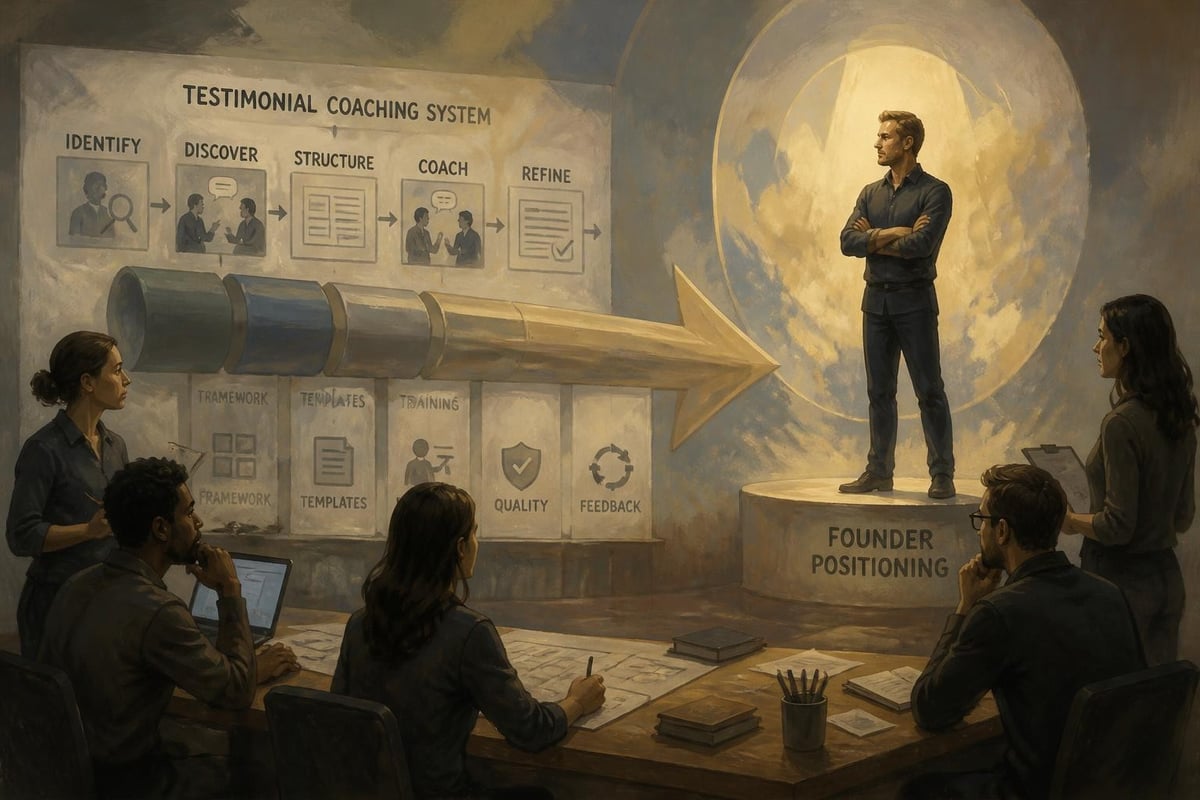
Many founders resist delegating testimonial collection because they fear losing quality or authenticity. The solution is testimonial coaching training for your team. Create interview scripts, provide example questions for different client archetypes, and establish clear quality criteria.
Your team member conducts the interview using your framework. You review recordings and extract strategic narratives. This division of labor removes the scheduling burden from your calendar while ensuring stories still serve positioning goals.
| Task | Founder Role | Team Role |
|---|---|---|
| Strategic planning | Define which positioning points need reinforcement | Document upcoming client milestones |
| Interview execution | Train on questioning techniques | Conduct scheduled interviews |
| Content extraction | Review recordings, identify strategic quotes | Transcribe and organize raw content |
| Asset creation | Approve final testimonials | Draft initial versions following templates |
| Distribution | None | Place testimonials across website, proposals, case studies |
This system ensures testimonial coaching happens consistently even during busy growth phases. The framework maintains quality while removing founder dependence.
Ethical Considerations and Authenticity Standards
As you become more skilled at testimonial coaching, you'll face temptation to over-edit or guide clients toward specific language. Resist this. Research on influencer marketing and trust shows that audiences increasingly detect and reject manufactured authenticity.
Your job in testimonial coaching isn't to fabricate stories. It's to help clients articulate genuine experiences in language that connects with prospects. There's a meaningful difference between "tell me about your revenue increase" and "can you say you doubled revenue even if it was really 60% growth?"
The Authenticity Litmus Test
Before publishing any testimonial, ask yourself: Would this client say exactly this if I weren't in the room? If you've changed meaning or exaggerated outcomes, you've crossed the ethical line. If you've simply helped them express what they genuinely experienced more clearly, you've done testimonial coaching correctly.
Smart prospects can smell manufactured testimonials. They notice when every client mysteriously uses identical language to describe their experience. They get skeptical when outcomes sound too perfect. Authentic variation in voice and experience actually increases credibility.
Maintain authenticity by:
- Using client's actual words and phrases whenever possible
- Including minor challenges or learning curves alongside wins
- Seeking permission before editing or condensing their statements
- Offering to share draft testimonials for approval before publishing
- Accepting when a client's genuine experience doesn't fit your current narrative needs
This ethical approach builds long-term positioning strength. Your featured client work becomes more credible because it reflects real complexity, not marketing fantasy.
Measuring Testimonial Impact on Revenue Performance
Testimonial coaching is an investment of time and energy. Like any business activity, it should connect to measurable outcomes. Track how strategic social proof affects your acquisition economics.
Key Performance Indicators to Monitor
Start by establishing baseline metrics before you implement systematic testimonial coaching. What's your current average sales cycle length? What percentage of qualified prospects convert? What objections appear most frequently in lost-deal debriefs?
After building your testimonial asset library and deploying it strategically, watch for movement:
- Sales cycle compression: Do deals close faster when proposals include relevant testimonials?
- Objection reduction: Do prospects raise fewer concerns about specific aspects of your methodology?
- Conversion rate improvement: Does a higher percentage of qualified leads become clients?
- Price sensitivity decrease: Are prospects more comfortable with your investment levels?
The most sophisticated operators create testimonial-to-objection maps. For every common buying obstacle, they have three testimonials that directly address it. When that objection surfaces in conversation, they reference specific client stories by name.
Advanced Applications Beyond Sales Collateral
Once you've mastered testimonial coaching for conversion purposes, you can leverage the practice for strategic positioning in unexpected ways. The deep client conversations reveal patterns about your unique value that you might miss otherwise.
Mining Testimonials for Positioning Insights
When you conduct testimonial coaching interviews consistently, you'll notice themes. Maybe five clients independently mention that your "boundary-setting framework" created unexpected business breakthroughs. That's market signal about positioning differentiation you should amplify.
Perhaps clients consistently credit outcomes to aspects of your methodology you barely mention in marketing. That's strategic intelligence. Your positioning and market authority should reflect what clients actually value, not what you assume matters most.
Use testimonial patterns to:
- Identify proprietary language that resonates (adopt client phrasing in marketing)
- Discover unexpected buyer motivations (what truly drove their purchase decision)
- Uncover competitive weaknesses (what didn't work before they found you)
- Spot delivery improvements (where methodology could strengthen)
- Validate pricing strategy (when clients emphasize ROI unprompted)
This intelligence gathering function makes testimonial coaching valuable beyond social proof collection. You're essentially conducting ongoing qualitative market research with your best customers.
Creating a Referral Generation Engine
Testimonial coaching conversations naturally lead to referral discussions. When a client has just spent 30 minutes reflecting on their transformation and articulating specific outcomes, they're primed to think about peers facing similar challenges.
End every testimonial interview with: "Who else do you know dealing with the operational bottlenecks you had before we worked together?" You've just created the context that makes referral generation feel natural rather than transactional.
The most successful high-ticket service businesses don't separate testimonial collection from referral cultivation. They're the same strategic conversation. You're helping clients process their journey while simultaneously positioning them as trusted advisors to their network.
Implementation Timeline and Resource Requirements
If you're convinced testimonial coaching deserves a place in your operational systems, you're probably wondering about practical implementation. How much time does this actually take? What skills do you need to develop? When should you start seeing returns?
The First 90 Days
Month one focuses on framework development and first interviews. Create your strategic question bank based on current sales objections. Identify your three best recent client relationships for pilot interviews. Conduct those conversations yourself before delegating to team.
Week-by-week breakdown:
- Weeks 1-2: Build question framework, map objections to information needs, schedule three pilot interviews
- Weeks 3-6: Conduct pilot interviews (one every 1-2 weeks), refine questioning approach based on what yields best content
- Weeks 7-10: Extract testimonials from pilot interviews, create multiple asset versions (quotes, short stories, full case studies)
- Weeks 11-12: Deploy new testimonials across touchpoints, train team member on interview process, establish ongoing schedule
By day 90, you should have 6-9 strategic testimonial assets in circulation and a delegatable system for ongoing collection. The initial time investment is significant (15-20 hours total) but creates compounding returns.
Resource Allocation for Sustainable Operations
Once established, testimonial coaching requires modest ongoing resources. Budget approximately 2-3 hours monthly for interview execution and content creation. If you're generating 3-5 new qualified leads weekly, this investment delivers meaningful conversion impact.
Consider whether you'll handle interviews internally or work with specialists. Some consultancies offer done-for-you testimonial coaching as part of broader positioning services. This can accelerate results if you lack internal capacity or interview experience.
Testimonial coaching transforms satisfied clients into strategic positioning assets that compress sales cycles and differentiate your methodology. When you systematically extract and deploy authentic transformation stories, you're not just collecting social proof-you're building market authority that compounds over time. If operational bottlenecks and founder dependencies are limiting your scaling potential, Rise Reign Rule helps women-owned high-ticket service businesses install the systems and frameworks that create predictable profit growth. Our Profit Architecture approach addresses the exact challenges that make testimonial coaching and other strategic practices difficult to implement consistently.


