
Coaching in Business: Build Scalable Growth Systems
The most successful high-ticket service businesses share a critical insight: sustainable growth isn't about working harder. It's about building systems that amplify your expertise while removing you as the primary bottleneck. Coaching in business has evolved from occasional leadership development into a strategic imperative for women founders scaling from multiple six figures toward seven. When you're generating $250k to $5M annually but feeling trapped in delivery, the solution isn't another marketing tactic. It's a fundamental shift in how you architect profit and scale operations.
Why Traditional Business Coaching Falls Short for High-Ticket Service Businesses
Most coaching in business operates on outdated assumptions. Generic frameworks promise transformation but fail to address the unique challenges of women-owned service companies commanding premium prices.
The conventional approach treats symptoms rather than root causes. You attend workshops on time management when the real issue is operational architecture. You invest in mindset coaching when the problem is structural. The gap between revenue and profit widens because traditional coaching doesn't diagnose the specific bottlenecks preventing clean scaling.
The Four Critical Failures of Generic Business Coaching
High-ticket service businesses need specialized guidance that accounts for their unique economics and delivery models. Here's where traditional coaching consistently misses the mark:
- Positioning confusion: Generic advice treats all businesses identically, ignoring the nuanced authority-building required for premium pricing
- Sales system gaps: Surface-level tactics replace systematic acquisition frameworks that generate predictable revenue
- Delivery inefficiency: No clear methodology for maintaining exceptional client outcomes while reducing founder involvement
- Leadership boundaries: Absence of frameworks for delegation, decision-making protocols, and sustainable growth patterns
The consequences compound quickly. You hit revenue plateaus not because of market limitations but because your operational infrastructure can't support additional clients without breaking you.

Strategic Coaching in Business: Building Your Profit Architecture
Effective coaching in business for high-ticket services requires a fundamentally different approach. Instead of motivational speeches and accountability check-ins, you need systematic frameworks that create leverage.
Profit Architecture represents this evolution. It's the deliberate design of four interconnected systems that transform how your business operates and scales.
Positioning: Establishing Unshakeable Market Authority
Your market positioning determines everything downstream. When you command $10k, $25k, or $50k+ engagements, prospects need absolute certainty in your expertise before writing checks.
Strategic coaching addresses positioning through systematic authority-building, not random content creation. This means:
- Identifying your differentiated methodology: What proprietary process delivers results competitors can't replicate?
- Articulating measurable outcomes: How do you quantify transformation for skeptical buyers?
- Building social proof systems: What infrastructure captures and amplifies client success stories?
- Creating category distinction: How do you own a specific problem rather than competing on features?
According to evidence-based psychological approaches to coaching, effective business coaching integrates behavioral science with strategic frameworks. Your positioning isn't just marketing. It's the operational foundation that enables premium pricing and reduces sales friction.
| Positioning Element | Traditional Approach | Profit Architecture Approach |
|---|---|---|
| Market Definition | Broad audience targeting | Specific problem ownership |
| Authority Building | Random content creation | Systematic thought leadership |
| Proof Mechanisms | Occasional testimonials | Structured case documentation |
| Pricing Strategy | Market comparison | Value-based methodology |
Acquisition: Installing Predictable Sales Systems
Revenue inconsistency kills more high-ticket businesses than any other factor. Coaching in business must address the pipeline problem with systematic precision.
The leader-as-coach model emphasizes developing internal capabilities rather than dependency. Applied to sales systems, this means building acquisition infrastructure that operates independently of your daily involvement.
Effective acquisition frameworks include:
- Automated nurture sequences that educate prospects on your methodology before sales conversations
- Qualification protocols that filter out poor-fit prospects before they consume your time
- Structured discovery processes that diagnose client problems using consistent frameworks
- Proposal systems that articulate value in measurable, outcome-focused terms
- Follow-up automation that maintains momentum without manual effort
When you're personally conducting every sales conversation, you've created another bottleneck. Strategic coaching helps you build systems that scale enrollment while maintaining conversion quality. This is where developing a coaching skill within your team becomes essential for sustained growth.
Delivery: Scaling Client Outcomes Without Scaling Your Hours
The delivery trap ensnares most high-ticket founders. You've sold transformative outcomes, and now you're personally responsible for delivering them. Each new client adds hours to your week until you're working 60-hour weeks with no capacity for growth.
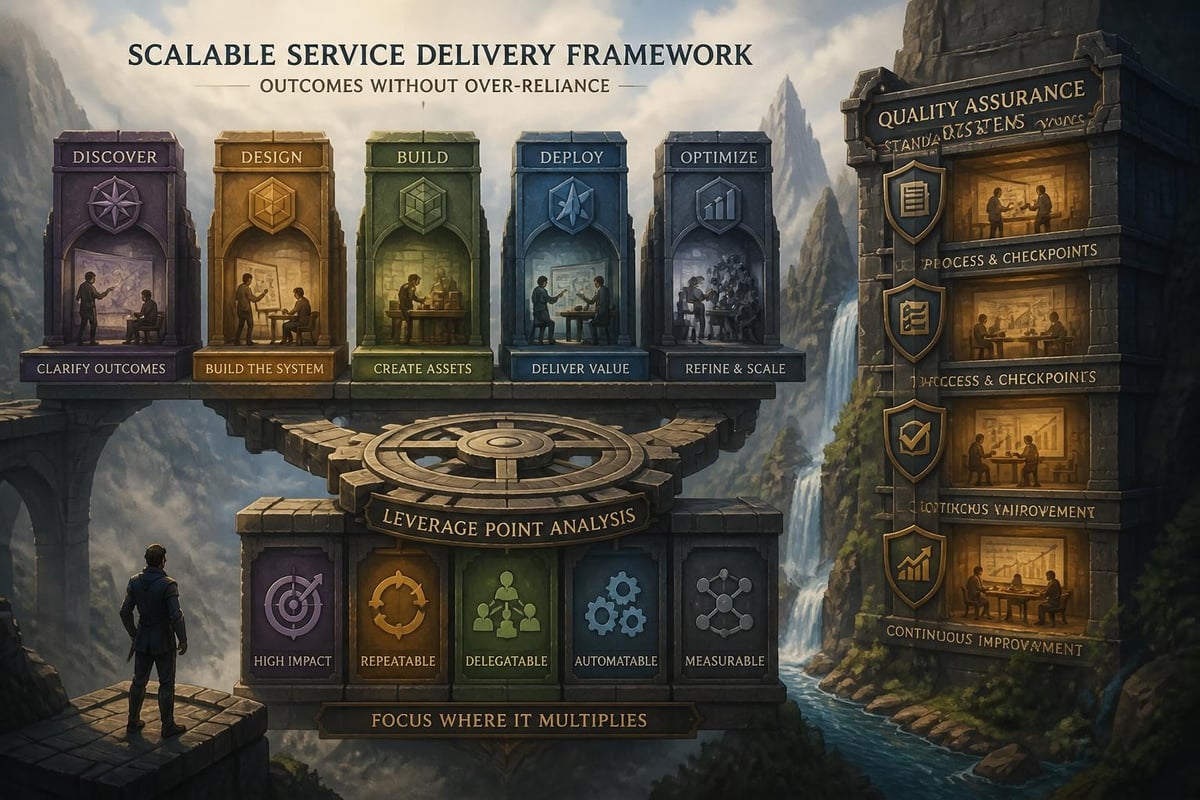
Coaching in business addresses delivery systematization through three critical mechanisms:
Modular Methodology Design: Breaking your transformation into discrete phases with clear deliverables, decision points, and success metrics. This creates consistency while enabling team members to own specific components.
Leverage Points Identification: Most founder involvement is habitual, not essential. Strategic coaching helps you identify the 20% of activities where your expertise is truly irreplacable, then systematize the remaining 80%.
Quality Assurance Frameworks: Maintaining exceptional outcomes while reducing your direct involvement requires explicit quality metrics, review protocols, and corrective systems. Without these, delegation degrades results.
Research on managers' coaching behaviors demonstrates that effective coaching focuses on building capability rather than doing the work. The same principle applies to client delivery. You're not trying to clone yourself. You're building systems that achieve outcomes regardless of who executes specific tasks.
Leadership: The Boundary Framework for Sustainable Scaling
The most overlooked aspect of coaching in business is leadership infrastructure. You can have perfect positioning, systematic acquisition, and efficient delivery, but without clear boundaries and decision protocols, growth creates chaos.
Building Decision Architecture That Scales
Every decision you make personally is a scaling constraint. Strategic coaching helps you install decision frameworks that enable team autonomy while maintaining quality standards.
This includes:
- Authority matrices: Clear parameters for who makes which decisions under what circumstances
- Exception protocols: Defined escalation paths when situations fall outside standard parameters
- Review cadences: Scheduled checkpoints that catch issues early without micromanagement
- Performance metrics: Objective measures that trigger interventions when thresholds are breached
When you're still approving every proposal, reviewing every deliverable, and troubleshooting every client issue, you haven't built a business. You've created an expensive job.
The Boundary System: Protecting Your Strategic Capacity
High-ticket founders often struggle with boundaries because excellent client service is central to their identity. But without protected space for strategic thinking, you'll perpetually operate reactively.
Effective boundary systems include:
| Boundary Type | Implementation | Protection Created |
|---|---|---|
| Time blocks | Non-negotiable strategic planning hours | Space for systems development |
| Communication protocols | Defined response timeframes and channels | Reduction in context switching |
| Client interaction limits | Structured touchpoints vs. unlimited access | Predictable availability |
| Team escalation thresholds | Clear criteria for founder involvement | Focus on highest-leverage activities |
The goal isn't to become unavailable or disconnected. It's to engineer your involvement for maximum strategic impact rather than operational firefighting. This is where working with a career and leadership coach specializing in high-ticket service businesses becomes invaluable.
Technology's Role in Modern Coaching in Business
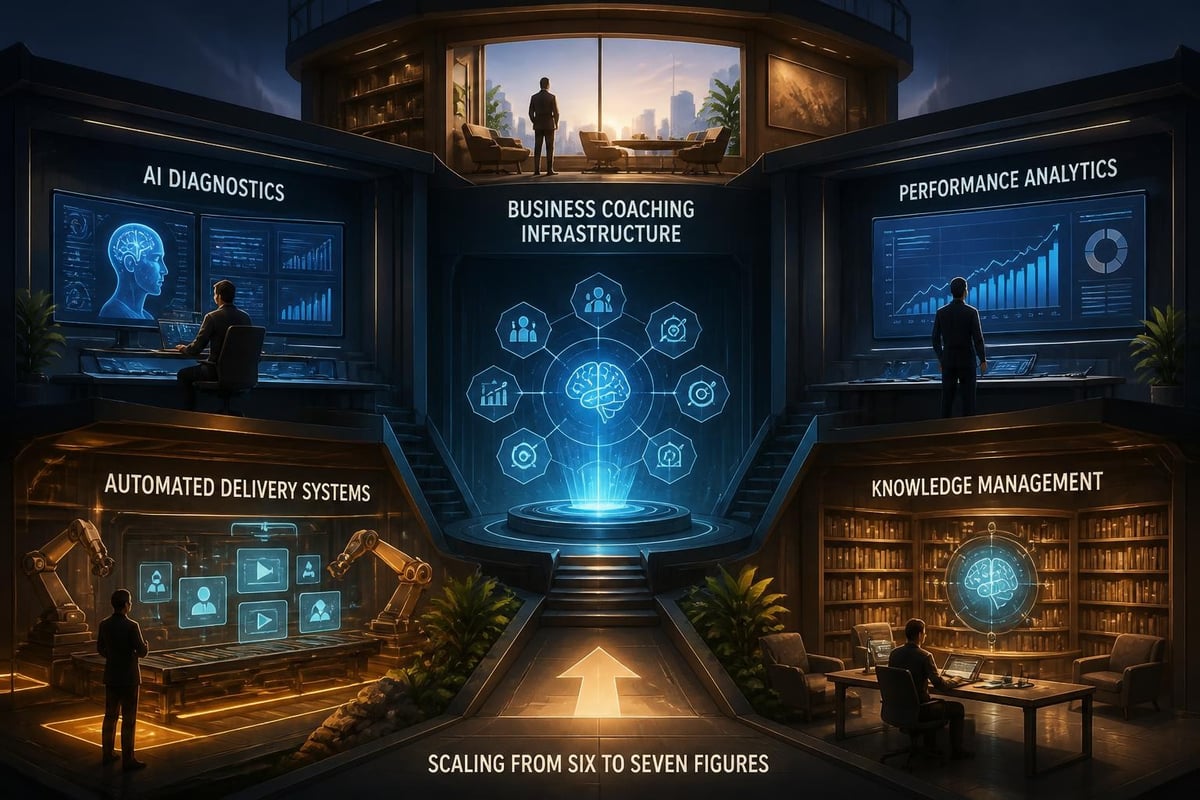
The landscape of business coaching is transforming rapidly. AI and emerging technologies are reshaping how coaching is delivered and how businesses implement strategic frameworks.
For high-ticket service companies, technology enables leverage previously impossible:
- Automated diagnostic tools that assess operational bottlenecks with precision
- Data analytics platforms that reveal patterns in client acquisition and delivery
- Communication systems that maintain connection without consuming founder time
- Knowledge management solutions that make your methodology accessible and scalable
- Performance dashboards that provide real-time visibility into business health
Technology doesn't replace strategic coaching. It amplifies implementation capacity. When you understand what systems need to exist, technology accelerates their deployment and refinement.
Implementing Coaching Frameworks: The 90-Day Transformation Model
Strategic coaching in business delivers results through structured implementation, not endless planning. The most effective approach follows a 90-day cycle that installs one complete pillar of your Profit Architecture.
Month One: Diagnostic and Design
The first 30 days establish absolute clarity on current state and desired outcomes. This phase includes:
- Comprehensive operational audit: Mapping exactly where your time goes and identifying bottlenecks
- Revenue architecture analysis: Understanding your actual unit economics and profit drivers
- System gap identification: Pinpointing which missing frameworks create the most constraint
- Priority framework selection: Choosing which pillar (Positioning, Acquisition, Delivery, or Leadership) will produce the greatest immediate impact
Most founders resist this diagnostic rigor because it reveals uncomfortable truths. But without accurate diagnosis, you're implementing solutions to problems you don't actually have. A personal development company approach might focus on mindset, but strategic coaching focuses on systems.
Month Two: Framework Installation
The second month builds and deploys your chosen system. This isn't theory or planning. It's actual implementation with real clients and real operations.
Key installation activities include:
- Creating documented processes with clear steps, decision points, and quality criteria
- Training team members on new frameworks with competency verification
- Implementing supporting technology and automation infrastructure
- Establishing metrics that measure system performance objectively
- Running pilot cycles that test frameworks under real conditions
This phase requires focused execution. You're not trying to transform everything simultaneously. You're installing one complete, functional system that immediately changes how your business operates.
Month Three: Optimization and Scale
The final 30 days refine your new framework based on real-world performance data and prepare for scaling.
This includes systematically reviewing what's working and what's creating friction, adjusting protocols based on actual results rather than assumptions, documenting lessons learned so future implementations are faster, and identifying the next priority pillar for the subsequent 90-day cycle.
Strategic coaching in business treats transformation as iterative installation of interconnected systems rather than one-time events. Each 90-day cycle builds on previous work, creating compounding leverage.
Measuring Coaching Impact: Beyond Vanity Metrics
How do you know if coaching in business is actually working? Most founders track the wrong indicators and miss the real transformation signals.
The Three Critical Measurement Categories
Revenue Quality Metrics: Total revenue is meaningless if profit margins are shrinking or delivery costs are escalating. Effective coaching improves revenue per client, profit margin percentage, client acquisition cost, and lifetime value ratios.
Operational Efficiency Indicators: The goal is profitable growth, not just growth. Track founder hours per client served, team productivity per revenue dollar, client delivery cost as percentage of contract value, and time from sale to delivery completion.
Scaling Capacity Measures: Can your business actually handle more clients without breaking? Monitor new client capacity at current staffing, revenue per founder hour, percentage of operations running without founder involvement, and team decision-making autonomy scores.
| Metric Category | Before Coaching | After 12 Months | Impact |
|---|---|---|---|
| Profit Margin | 22% | 38% | +73% increase |
| Founder Hours/Client | 47 hours | 12 hours | 75% reduction |
| New Client Capacity | 2/month | 8/month | 4x capacity |
| Revenue Per Hour | $425 | $1,683 | 4x efficiency |
These numbers represent actual transformations when coaching in business focuses on systematic infrastructure rather than motivational platitudes.
The ROI Framework: Calculating Coaching Investment Returns
High-ticket founders make investment decisions based on returns, not costs. Strategic coaching should be evaluated through the same lens as any business investment.
Calculate your coaching ROI using this framework:
Identify your current operational bottleneck and quantify its cost. If you're personally maxed at 60 hours weekly and turning away qualified prospects, what's the revenue opportunity cost? If poor positioning requires excessive sales effort, what's the time and conversion cost?
Estimate the value of solving that bottleneck. If systematic delivery freed 25 hours weekly, what could you build or sell with that capacity? If improved positioning increased conversion by 15%, what's the annual revenue impact?
Compare the investment cost against the bottleneck value. Quality coaching for high-ticket businesses typically ranges from $15k to $75k annually depending on scope. If solving your delivery bottleneck creates $200k in additional capacity, the ROI is immediate and substantial.
The businesses that hesitate on strategic coaching often invest more in tactics that don't address root causes. You'll spend $8k on a website redesign when the real issue is positioning clarity. You'll hire another team member when the problem is systems, not capacity.
Selecting the Right Coaching Partner for Your Business
Not all coaching in business delivers equal value. For women-owned high-ticket service companies, the selection criteria are specific and non-negotiable.
The Five Essential Qualifications
Look for coaches with proven experience scaling service businesses in your revenue range. Someone who's built a $100k business has different expertise than someone who's scaled multiple companies through $1M+ consistently. The challenges are fundamentally different.
Demand proprietary frameworks with documented outcomes, not generic advice repackaged as methodology. Effective coaching should articulate exactly how they solve specific problems with repeatable systems.
Verify direct industry relevance to high-ticket services. The dynamics of selling and delivering $25k engagements differ completely from product businesses or low-ticket services. Your coach should understand these nuances intimately.
Ensure implementation focus over endless strategy sessions. You don't need more ideas. You need systems installed in your actual business with real results.
Confirm alignment with your growth vision. If you're building for sustainable profit and eventual exit, coaching should architect accordingly. If you're optimizing for lifestyle business design, the frameworks differ.
The wrong coaching relationship costs more than money. It costs months or years of momentum building systems that don't actually solve your constraints.
Coaching in business transforms from cost to investment when it installs systematic frameworks that create lasting leverage. For high-ticket service founders navigating the complex path from $250k to $5M, strategic infrastructure determines whether growth feels expansive or exhausting. If you're ready to eliminate operational drag and build your Profit Architecture across Positioning, Acquisition, Delivery, and Leadership, Rise Reign Rule specializes in exactly this transformation for women-owned service businesses. The question isn't whether you need better systems, but whether you're ready to install them strategically.


