
Executive Coaching for CEOs: A Practical Guide for Founders
Executive coaching for CEOs is a structured, confidential partnership with a trained coach who helps you set goals, spot blind spots, and change the behaviors that limit your company's growth. For founders running high-ticket service businesses, it works best when it targets the real constraint: you.
The Center for Creative Leadership describes coaching as a process that helps leaders set goals, create action plans, and improve performance. That sounds simple, and it is. What makes it valuable is the quality of the questions, the honesty of the feedback, and the accountability that follows. This guide covers what a CEO coach actually does, what changes when you hire one, how to choose well, and how to measure whether it paid off.
What Executive Coaching Actually Is (and Isn't)
Executive coaching is a one-on-one, goal-driven relationship in which a coach asks hard questions, gives candid feedback, and holds you accountable for decisions and habits that affect your whole company.
It is easy to confuse with three neighbors, so draw the lines clearly:
- Coaching vs. consulting: A consultant hands you answers and often builds the system. A coach draws the answers out of you and sharpens your judgment.
- Coaching vs. mentoring: A mentor shares a path they have walked. A coach does not need to have run your kind of company; they need to be skilled at changing how you think and act.
- Coaching vs. therapy: Therapy looks backward to heal. Coaching looks forward to perform, though personal patterns inevitably surface.
The best engagements blend these without losing the core. A coach who only cheers you on is a very expensive friend. A coach who challenges you against a clear standard is worth the invoice.
Why Founders Need a Coach More Than Corporate CEOs Do
Founder-CEOs need coaching more urgently than appointed executives because nobody sits above them, nobody reviews their performance, and the business is tangled up with their identity.
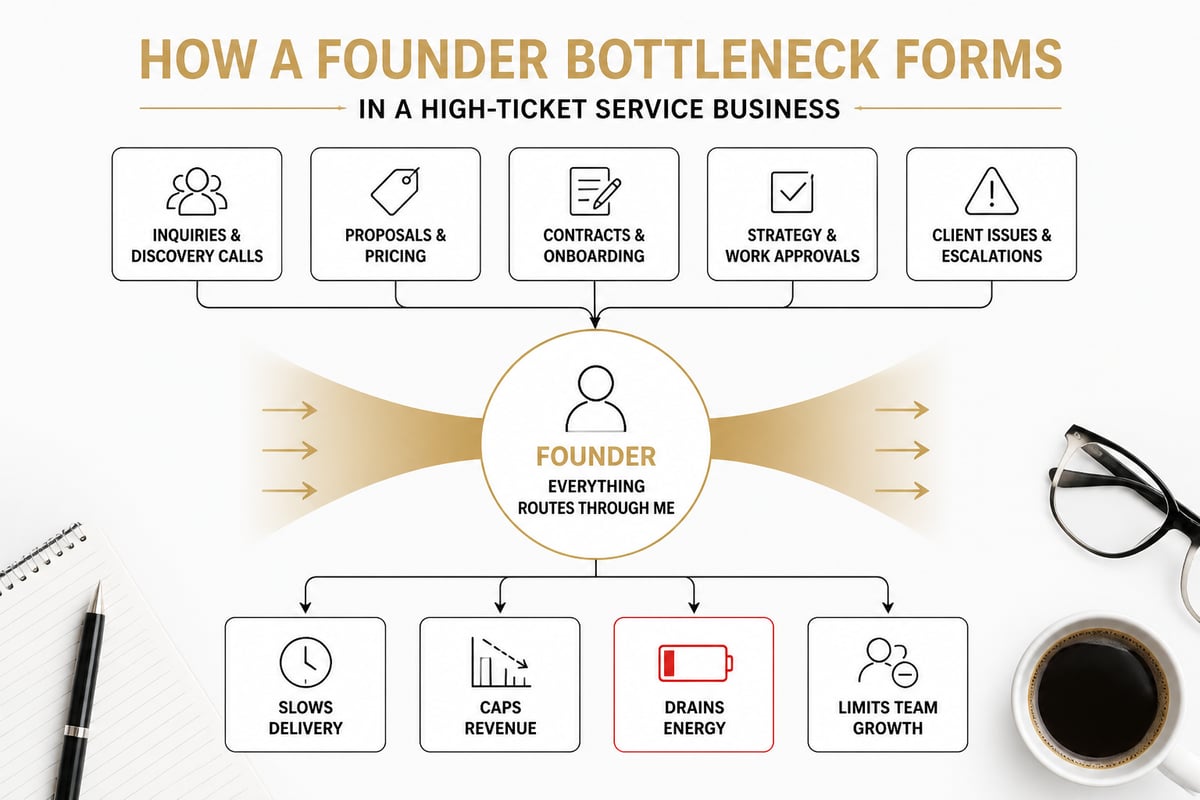
A corporate CEO answers to a board. You, the owner of a $500k or $3M service business, often answer to no one. Your team won't tell you that you are the bottleneck. Your clients see the polished version of you. Your peers are busy with their own fires. That isolation is the real problem coaching solves.
The evidence points the same way. A 2024 DSG Global CEO pulse survey of 230 nonprofit and social-impact leaders found that nearly 60% used an executive coach, and most users found it moderately to extremely valuable. And a 2025 SMB CEO article reported on a qualitative study of 70 senior executives working with personal coaches, noting improvements in focus, alignment of leadership behaviors, emotional intelligence, and well-being.
For women-owned high-ticket businesses, the stakes carry an extra layer. You are often selling expertise, trust, and access to you personally. When your calendar, boundaries, and energy are the product, a leadership problem becomes a revenue problem fast. If that resonates, the thinking in female coaching is a useful companion read.
What a CEO Coach Helps You Change
A good coach helps you change a short list of high-leverage things: how you decide, how you delegate, how you lead people, and how you protect your own capacity.
According to the Center for Creative Leadership, coaching can support smoother transitions into new roles, stronger team leadership, resilience, emotional intelligence, self-awareness, and strategic thinking. Translated into founder terms, here is where the work usually lands.
Delegation and letting go
Founders tend to hoard decisions. A 2025 piece from Leaders Adapt reports that many founders in a study of 122 startups were poor at delegating. A coach makes that pattern visible and walks you through handing off work in a way that sticks, rather than reclaiming it the moment something wobbles.
Decision quality
When every choice feels urgent, you decide fast and often wrong. Coaching builds a repeatable way to separate reversible decisions from permanent ones, and to stop treating each as a crisis.
Blind spots
You cannot see how your tone lands in a hard meeting or how often you rescue your team from problems they should solve. A coach, especially one who gathers input from your team, hands you the mirror.
Boundaries and capacity
Burnout is a business risk, not a character flaw. Coaching helps you design a role you can sustain for ten years, not just ten months.
Accountability
Setting a goal is easy. Doing the uncomfortable thing you promised in session three is where coaching earns its fee. Someone who asks "did you do it?" changes behavior more reliably than any planner.
How the Executive Coaching Process Works
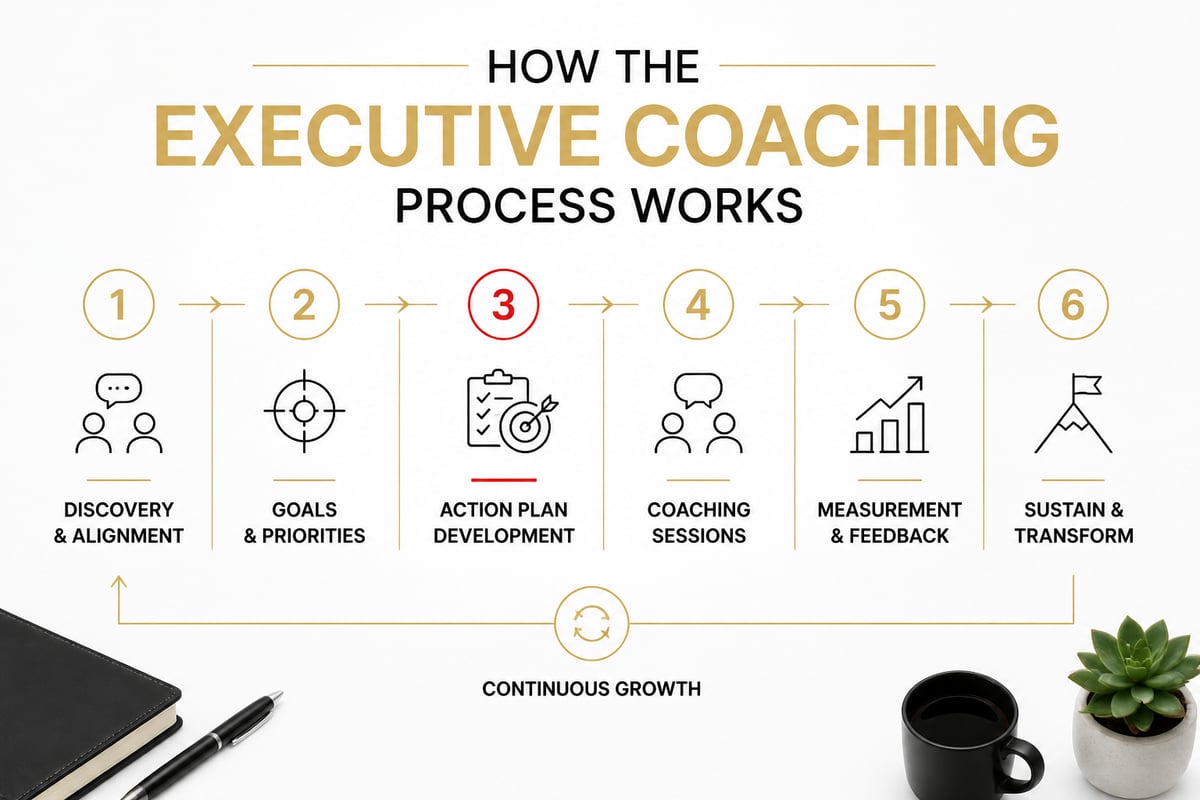
Most engagements follow the same arc: assessment, goal-setting, regular sessions with real-world experiments between them, and a formal review at the end.
- Discovery and assessment. The coach learns your business, your goals, and your patterns. This may include a 360-degree review, personality or leadership assessments, and confidential interviews with your team.
- Goal setting. You agree on two or three outcomes that matter, such as stepping out of sales calls, hiring a second-in-command, or raising prices with confidence. Vague goals produce vague coaching.
- Regular sessions. Typically every two weeks, often 60 to 90 minutes. Each session ends with specific actions you will take before the next.
- Practice between sessions. The real change happens on Tuesday afternoon when you decline to jump into a client escalation, not during the call.
- Review and adjust. At the three- or six-month mark you compare progress against the original goals and decide whether to renew, refocus, or stop.
Online formats work well for busy founders, and coaching online can remove the travel and scheduling friction that derails in-person arrangements. Some founders also pair private sessions with a peer coaching group for shared accountability and perspective.
How to Choose the Right Executive Coach
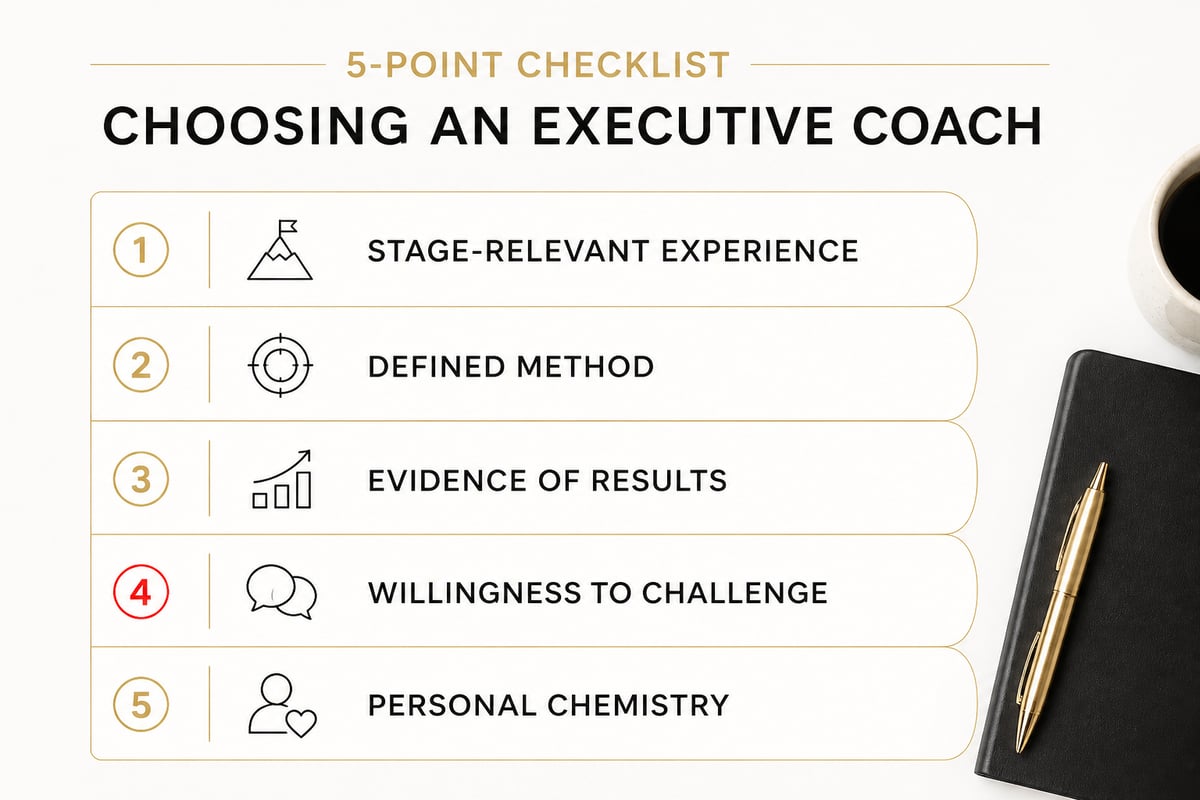
Choose a coach on four criteria: relevant experience with your stage of business, a clear method, evidence of results, and a personality you will not hide from.
The last one matters more than most people expect. If you will perform for your coach instead of being honest, you are paying to protect your ego. The Institute of Coaching's definitive guide on executive coaching results covers selecting coaches, following up, and evaluating costs and results, and it is a solid reference when you are comparing candidates.
Use this checklist in your first conversations:
- Do they understand your business model? A coach who has only worked with corporate executives may struggle with the cash-flow and client-delivery realities of a founder-led service firm.
- Can they describe their process? Look for a defined structure, not "we'll see where the conversation goes."
- Will they challenge you? Ask for a time they told a client something unwelcome.
- Is there a chemistry fit? Book a trial session or a short intake conversation.
- What are the boundaries? Confidentiality, cancellation terms, and how success will be judged should all be explicit.
| Coach type | Best at | Watch out for |
|---|---|---|
| Executive or CEO coach | Leadership behavior, decision-making, accountability | Little operational or revenue expertise |
| Business strategy coach | Positioning, offers, growth plan | Light on personal and leadership patterns |
| Consultant-coach hybrid | Pairing mindset work with installed systems | Make sure the "coach" part is real, not a sales hook |
If you are comparing options, the overview of CEO coaching services and the notes on finding a coach can help you build a shortlist.
What Executive Coaching Costs, and How to Measure the Return
Judge the cost of a CEO coach against what your current bottlenecks already cost you: lost sales calls, delayed hires, discounted prices, and your own hours spent on work worth a fraction of your rate.
Fees vary widely by coach and format, so rather than quote a number I can't verify, use this framing. Estimate the revenue you lose each month from one stuck decision, one delayed hire, or one pricing change you keep postponing. If a six-month engagement fixes even one of those, the math often works. The longer treatment in the ROI of coaching walks through this reasoning.
Then decide up front how you will measure it. Soft results are real but fuzzy, so pair them with numbers. The Institute of Coaching's chapter on coaching practice and evaluation lays out stakeholders, processes, and ways to assess leadership-coaching effectiveness if you want a formal approach.
Practical metrics for a founder-led service business:
- Hours you spend in delivery or sales each week, trending down
- Revenue per owner-hour, trending up
- Time from decision to action on major choices
- Team feedback on clarity, autonomy, and your availability
- Profit margin, since cleaner scaling should protect it
- Goal completion rate against the commitments you set with your coach
Review these quarterly. If nothing moves after two quarters, either the goals were wrong or the fit was.
Where Executive Coaching Falls Short for Founders
Coaching changes you, but it does not install the machinery your business needs, so a founder with broken offers, no sales process, or shaky delivery will hit a ceiling coaching alone cannot lift.
This is the point worth understanding before you sign anything. Suppose your coach helps you become a calmer, more decisive leader. Wonderful. But if your positioning is fuzzy, your pipeline depends on referrals, and every client engagement is custom-built from scratch, your new clarity has nowhere to go. Operational drag stays in place.
That is why many founders at the $250k to $5M stage get better results from pairing leadership work with a framework that fixes the underlying structure. At Rise Reign Rule, that framework is called Profit Architecture, built on four pillars:
- Positioning: becoming the obvious authority in your market
- Acquisition: sales systems that do not rely on you closing every deal
- Delivery: client outcomes that repeat without heroics
- Leadership: the boundaries that protect your time and capacity
Notice that Leadership is one pillar of four. Coaching can strengthen it, but the other three need structure too. If you want to explore adjacent approaches, strategic leadership coaching and business strategy coaching show how leadership and strategy connect.
There is also a modern wrinkle. Many founders now want to bring AI into their operations while they sharpen their leadership. Structured training such as the practical AI certifications at AI Certified can help you and your managers build working skills, and firms like Digital Scientists build custom AI solutions when you are ready to automate parts of delivery. Both belong in the plan only after your positioning and delivery are clear enough to be worth automating.
Getting the Most From Your Coaching Investment
Founders who get results treat coaching as a working relationship with homework, not a weekly hour of venting.
Use these habits to protect your return:
- Arrive with an agenda. Send your coach the one decision or pattern you most want to work on before each session.
- Do the between-session work. Ten minutes of honest reflection beats ten extra sessions.
- Tell the truth early. If something is not working, say so in session two, not session ten.
- Involve your team where appropriate. Letting your leadership team know what you are working on builds trust and gives your coach better data.
- Write down commitments. Review them at the start of each session so nothing slides.
- Plan the exit. Decide at the start what "done" looks like so coaching does not become a permanent expense.
Founders also benefit from seeing how others describe the experience. The collected feedback in coaching testimonials shows what changes clients tend to report, which helps you set realistic expectations for your own engagement.
A last point on urgency. The hardest part of executive coaching for CEOs is not the cost or the time. It is the months you spend deciding while the same bottleneck keeps taxing your revenue and your energy. Each quarter you wait is a quarter of the same hours and the same ceiling.
Start this week by writing down the three tasks only you currently do that a trained team member could own within 90 days, then bring that list to a first conversation with any coach you are considering. If you run a women-owned high-ticket service business and want those bottlenecks fixed through structure as well as leadership, Rise Reign Rule can show you how Profit Architecture turns positioning, sales, delivery, and boundaries into predictable profit and clean scaling.


