
Leadership Coaching for Women Scaling High-Ticket Services
You built a successful high-ticket service business. Revenue crossed six figures, then seven. Clients value your expertise. Your team is growing. Yet you're working harder than ever, still holding too many pieces, making every decision, answering every question. The business hasn't freed you-it's consumed you. This is the founder bottleneck, and leadership coaching is the strategic intervention that transforms operators into CEOs.
For women-owned service businesses generating $250k to $5M annually, the path to clean scaling demands a fundamental shift in how founders show up. The skills that built your business to this point won't carry it to the next level. Leadership coaching creates the space, accountability, and framework to make that transition deliberate rather than chaotic.
Why Traditional Leadership Development Fails Service Business Founders
Most leadership training was designed for corporate environments with established hierarchies, HR departments, and management layers. You don't have that infrastructure. You need coaching that addresses the unique dynamics of founder-led service businesses where every leadership gap directly impacts client delivery and profit margins.
The Center for Creative Leadership research on coaching for leaders shows that effective coaching must be contextual, tied to real business challenges, and focused on behavioral change. Generic leadership courses don't account for the reality that you're simultaneously managing client relationships, team dynamics, systems development, and your own capacity limits.
Traditional programs fall short because they:
- Assume you have time for lengthy certification programs
- Focus on theory instead of immediate implementation
- Ignore the revenue pressure of service delivery businesses
- Don't address the emotional complexity of founder identity
- Skip the operational architecture needed to support leadership growth
Leadership coaching works when it's embedded in your actual business challenges. When your coach understands profit margins, client acquisition costs, delivery systems, and team leverage, the coaching becomes strategic rather than therapeutic.

The Four Leadership Transitions That Unlock Scale
Scaling a high-ticket service business requires mastering four distinct leadership transitions. Each represents a fundamental shift in how you relate to your business, your team, and your role.
From Expert to Architect
Your expertise built credibility and attracted clients. But expertise alone creates a ceiling. Clients hire you specifically, team members need your input on everything, and processes exist only in your head. This transition means codifying what you know into systems others can execute.
Leadership coaching helps you identify which expertise must stay with you and which can be transferred. You learn to build frameworks, create decision trees, and document standards. The goal isn't to remove yourself from delivery entirely-it's to design delivery systems where your expertise amplifies rather than bottlenecks.
Key indicators you're ready for this transition:
- You're the only one who can handle certain client situations
- Onboarding new team members takes weeks of your direct time
- Quality depends entirely on your personal involvement
- You can't take vacation without business disruption
From Doer to Delegator
Delegation sounds simple until you're handing over work you've done better and faster yourself for years. This transition requires rewiring your relationship with control, perfectionism, and trust. It demands clarity about outcomes versus methods.
Effective coaching skill development focuses on building your capacity to set clear expectations, create accountability without micromanaging, and tolerate the learning curve of others. You discover that delegation isn't dumping tasks-it's transferring ownership with the right context and support.
The delegation framework that works in high-ticket services includes:
- Outcome specification - What success looks like, not how to get there
- Context transfer - Why this matters and how it connects to bigger goals
- Authority boundaries - What they can decide versus what needs your input
- Feedback loops - When and how you'll review progress
- Skill development - What support they need to grow into the role
| Delegation Level | Founder Involvement | Team Ownership | Business Impact |
|---|---|---|---|
| Task delegation | High (checking every step) | Low (following instructions) | Minimal time savings |
| Process delegation | Medium (reviewing outcomes) | Medium (executing processes) | Moderate leverage |
| Outcome delegation | Low (strategic check-ins) | High (owning results) | Maximum scale potential |
From Reactive to Strategic
In the early stages, responsiveness is your competitive advantage. You answer client emails within the hour, jump on calls to solve problems, adjust delivery on the fly. That agility served you well. Now it's killing your ability to build anything sustainable.
This leadership transition means creating boundaries around your time and attention. It requires distinguishing between urgent and important, between client emergencies and coachable team moments. Strategic founders protect space for thinking, planning, and designing the business rather than just operating it.
Leadership coaching provides the external accountability to maintain these boundaries when internal pressure mounts. Your coach helps you see patterns in what triggers reactivity and builds alternative response systems. According to Harvard Business Publishing's 2024 Global Leadership Development Study, leaders who engage in reflective practices through coaching demonstrate significantly stronger strategic thinking capabilities.
From Solo to Team Leader
The identity shift from "I am the business" to "I lead a business" challenges your self-concept at its core. Your value is no longer just your deliverables-it's your ability to create an environment where others deliver exceptional results. This transition feels vulnerable because success now depends on people you can't fully control.
Team leadership in high-ticket services requires different skills than corporate management. You're building culture, setting standards, and developing people while maintaining the intimate client relationships and quality that define premium services. The personal development required to make this shift often surfaces limiting beliefs about worthiness, capability, and what makes you valuable.
What Effective Leadership Coaching Actually Addresses
Leadership coaching for high-ticket service founders goes far beyond communication skills or time management tips. It tackles the operational, psychological, and strategic challenges that keep you trapped in the operator role.
The operational layer focuses on installing systems that reduce your decision load. This includes building your leadership team structure, creating clarity around roles and responsibilities, implementing review rhythms that catch issues early, and designing information flow that keeps you informed without requiring constant involvement.
The psychological layer addresses the identity work required to step into CEO authority. Many women founders struggle with imposter syndrome at new revenue levels, difficulty receiving support after years of self-reliance, perfectionism that prevents delegation, and guilt about becoming "unavailable" to clients or team members in the same way. Leadership coaching creates space to work through these patterns rather than just push through them.
The strategic layer builds your capacity to think in systems rather than tasks. You develop skills in scenario planning, resource allocation, risk assessment, and market positioning. This is where coaching becomes consultative-your coach brings pattern recognition from other businesses and industries to accelerate your strategic development.
Research from the APA on organizational consulting emphasizes that effective coaching integrates psychological insight with business strategy. The best outcomes occur when coaches understand both the internal dynamics of leadership development and the external realities of business models, markets, and financial sustainability.
How to Evaluate Leadership Coaching for Your Business
Not all leadership coaching is created equal. The coach who helped an executive navigate corporate politics may struggle to advise on profit margins and client retention in a service business. Choosing the right coaching relationship requires clarity about what you actually need.
Essential Qualifications to Look For
Your leadership coach should have demonstrated experience in high-ticket service business models. They need to understand unit economics, client lifetime value, delivery leverage, and the specific scaling challenges of expertise-based businesses. Career and leadership coaching that works for founders differs fundamentally from career coaching for employees.
Look for coaches who can show you their framework. Methodology matters. You need structured approaches to common challenges, not just reactive problem-solving. Ask about their philosophy on team building, delegation, boundaries, and profit optimization.
Green flags in potential coaches:
- They ask detailed questions about your business model and numbers
- They have client case studies from similar business types
- They offer a clear diagnostic process before proposing solutions
- They connect leadership development to specific business outcomes
- They're willing to challenge your thinking, not just validate you
Red flags to avoid:
- Coaching focuses exclusively on mindset without operational strategy
- No experience with service business economics or scaling
- Can't articulate how success will be measured
- Sells packages without understanding your specific situation
- Emphasizes credentials over results
Structure and Time Commitment
Effective leadership coaching requires consistent engagement over meaningful time periods. One-off sessions create insights but rarely change behavior. Monthly check-ins lack the intensity to drive transformation. Most founders see significant shifts with weekly or biweekly sessions over six to twelve months.
The World Economic Forum's perspective on responsible leadership highlights that leadership development is ongoing, not episodic. Your business evolves, markets shift, teams grow-your leadership must continuously adapt. Consider coaching an investment in your business infrastructure, not a one-time fix.
The ROI of Leadership Development in Service Businesses
Leadership coaching is a significant investment. At the high-ticket level, expect to invest $2,000 to $10,000+ monthly for quality strategic coaching. That number can feel uncomfortable, especially when you're trying to increase profit margins. The question is whether the cost is justified by the return.
Calculate the cost of your operational bottlenecks. Every proposal you personally write, every client fire you personally extinguish, every team question only you can answer represents either revenue you can't capture or hours you can't reclaim. If your effective hourly value is $500 and you spend 20 hours weekly on work that could be delegated, you're losing $520,000 annually in opportunity cost.
Measurable returns from leadership coaching include:
- Increased revenue capacity without proportional time increase
- Higher profit margins from improved operational efficiency
- Reduced owner salary dependency as business generates true profit
- Faster decision-making with clearer frameworks and boundaries
- Improved team retention and performance reducing hiring costs
- Better client outcomes from systematized delivery
According to Gallup's research on manager development, organizations that invest in leadership development see measurable improvements in team engagement, productivity, and retention. For service businesses where team leverage directly impacts profitability, these gains compound quickly.
Building Leadership Capacity Alongside Systems
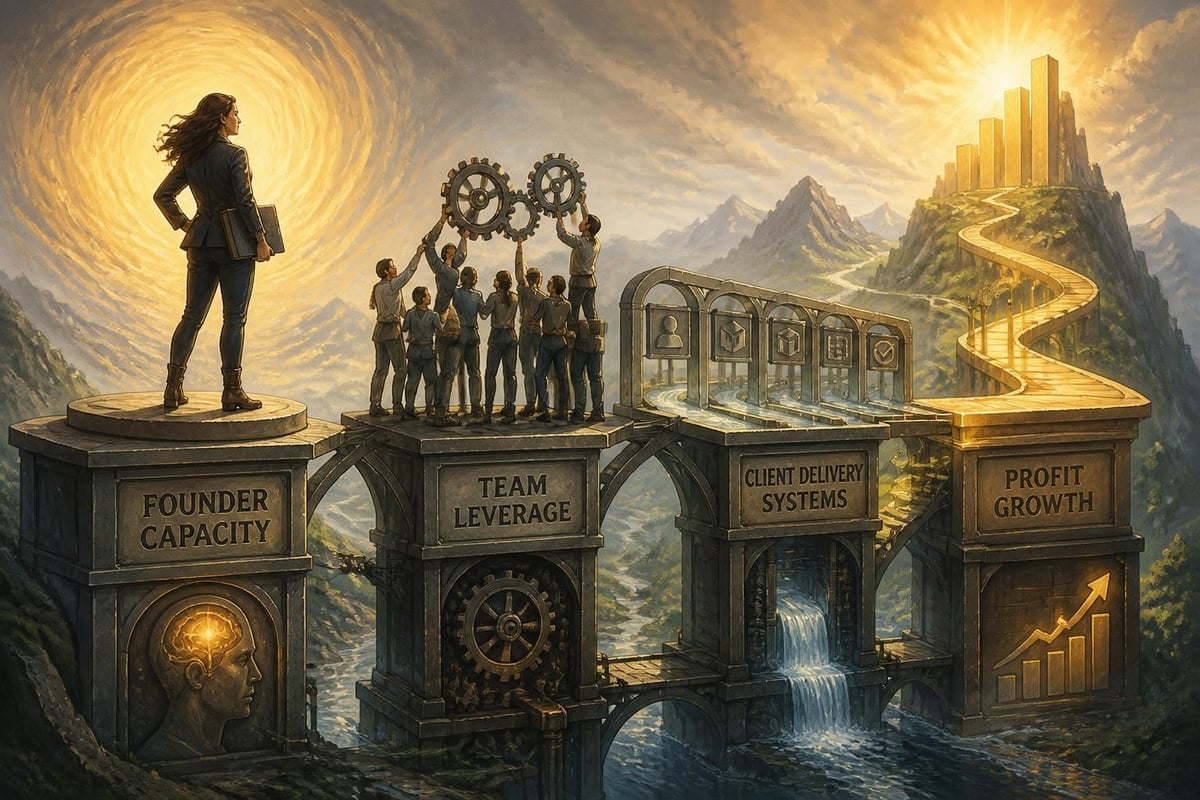
Leadership coaching works best when paired with operational infrastructure development. Your personal growth as a leader needs systems to support it. You can develop excellent delegation skills, but without clear processes to delegate or team members with defined ownership, the behavior change won't stick.
This is why the most effective coaching relationships address both the leader and the business architecture simultaneously. LinkedIn's 2024 Workplace Learning Report shows that companies achieving the best results from leadership development integrate coaching with operational improvements and structural changes.
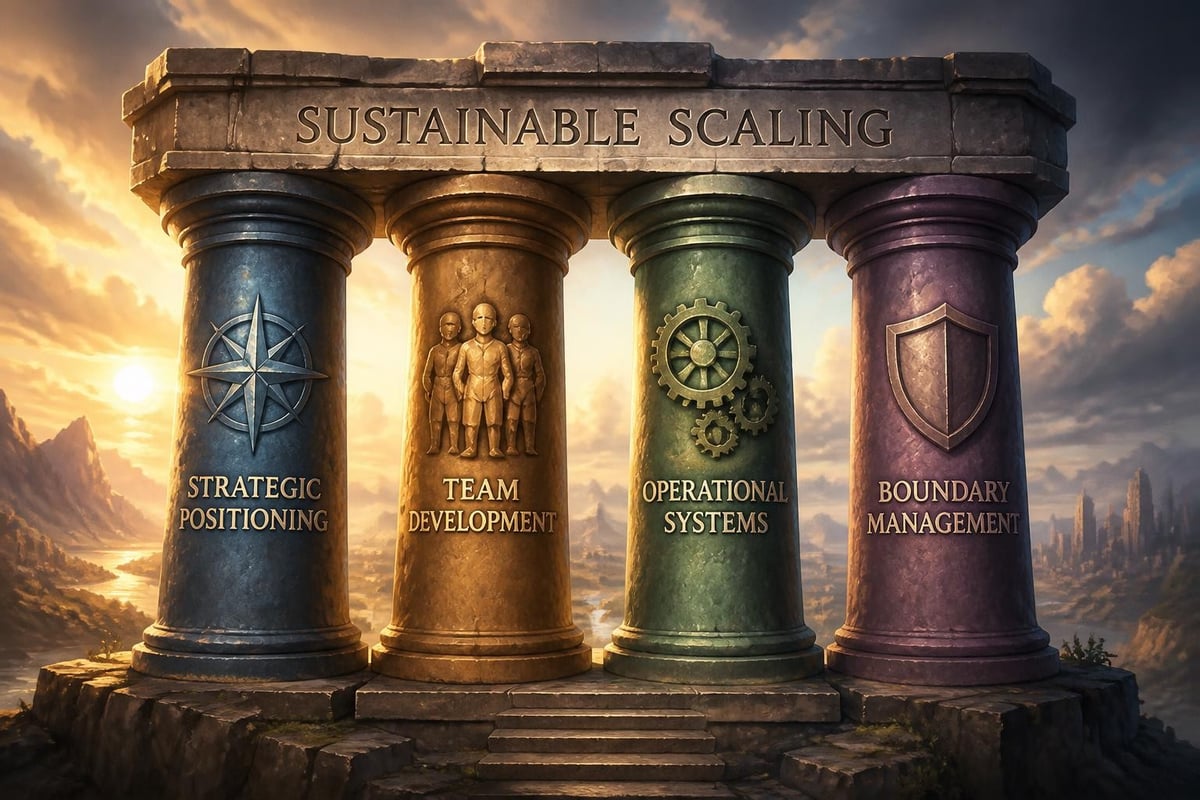
The Profit Architecture framework demonstrates this integration. Leadership development in positioning helps you establish market authority that doesn't depend on your constant visibility. Acquisition coaching builds sales systems that convert without your personal involvement in every deal. Delivery work creates client outcome systems that maintain quality while distributing execution. Leadership coaching on boundaries protects your capacity and models healthy standards for your team.
Integration with Team Development
As you grow as a leader, your team must grow alongside you. Leadership coaching should include strategy for developing leadership capacity in your team. This creates the bench strength needed for true scale and reduces single points of failure across the organization.
SHRM's resources on coaching in the workplace emphasize manager-as-coach models where leadership development cascades through the organization. For service businesses, this might mean coaching your director of client services to independently solve delivery challenges or developing your operations manager to optimize systems without your constant input.
| Business Stage | Founder Leadership Focus | Team Development Priority | Coaching Emphasis |
|---|---|---|---|
| $250k-$500k | Building first systems | Hiring key operators | Delegation basics, role clarity |
| $500k-$1M | Installing frameworks | Developing specialists | Process ownership, feedback systems |
| $1M-$3M | Strategic direction | Building management layer | Leadership development in others |
| $3M-$5M | Market positioning | Scaling operations team | Organizational design, culture |
When Leadership Coaching Isn't Enough
Leadership coaching is powerful but not sufficient on its own for scaling high-ticket service businesses. Some challenges require strategic consulting, operational support, or specialized expertise beyond what coaching provides.
If your business model has fundamental flaws-pricing too low for sustainability, service offerings that don't scale, or market positioning that attracts price-sensitive clients-coaching alone won't solve these issues. You need strategic repositioning first. If you lack basic operational infrastructure like financial systems, project management tools, or client onboarding processes, you need implementation support alongside coaching.
The difference between coaching and consulting matters. Coaching helps you develop the capability to solve problems and make decisions. Consulting provides expertise and answers to specific business challenges. Strategic consultancies like Rise Reign Rule combine both-coaching your leadership development while installing the operational frameworks that support your growth.
Making the Decision to Invest
If you're reading this and recognizing yourself in the founder bottleneck description, you're likely ready for leadership coaching. The question isn't whether you need it-it's whether you're willing to prioritize it among competing demands for your attention and resources.
Consider these decision factors:
Your business is ready when:
- Revenue is consistent enough to support the investment
- You have basic team infrastructure in place
- Client delivery is systematized enough that you can protect coaching time
- You're genuinely willing to change how you work, not just optimize current patterns
You're personally ready when:
- You're exhausted by the current operational reality
- You recognize that working harder isn't the answer
- You're willing to be challenged on beliefs and behaviors
- You can commit to consistent engagement over months
The founders who get the most from leadership coaching approach it as strategic infrastructure investment, not personal development luxury. They track results, apply insights immediately, and hold themselves accountable to behavior change between sessions.
Leadership coaching transforms how you show up, make decisions, and build your business-but only when paired with the right operational systems and strategic framework. If you're ready to move from founder-operator to strategic CEO while building a business that delivers predictable profit without consuming your life, Rise Reign Rule combines leadership development with the Profit Architecture framework designed specifically for women-owned high-ticket service businesses scaling from $250k to $5M and beyond.


