
Online Group Coaching: Scale Your High-Ticket Business
The landscape of high-ticket service delivery has fundamentally shifted. If you're running a women-owned service business generating $250k–$5M annually, you've likely hit the ceiling where 1-on-1 delivery becomes your constraint. You trade hours for dollars, even at premium rates. Your calendar controls your revenue. Online group coaching solves this bottleneck by allowing you to serve multiple clients simultaneously while maintaining premium positioning and transformational outcomes. This isn't about diluting your expertise-it's about architecting a delivery model that scales your impact without sacrificing profit margins or creating operational chaos.
Why Online Group Coaching Works for High-Ticket Businesses
The traditional service model traps founders in a scarcity mindset. You can only serve as many clients as you have calendar slots. Online group coaching breaks this constraint by transforming your expertise into a leveraged delivery system.
The economics are compelling. A single cohort of 10-15 clients generates revenue equivalent to individual engagements while requiring roughly 40% of the delivery time. Your profit margins expand dramatically because you're not duplicating effort for each client interaction.
But revenue isn't the only metric that matters. Research on group coaching implementation shows measurable improvements in participant outcomes when programs are structured correctly. The key word is structured-throwing people into a Zoom room without framework creates chaos, not transformation.

The Profit Architecture Advantage
Your delivery model either reinforces or undermines your positioning. Online group coaching done poorly signals that you're commoditizing your services. Done strategically, it elevates your authority while solving the founder bottleneck that caps your growth.
The Profit Architecture framework applies directly here:
- Positioning (Market Authority): Group programs establish you as the definitive expert who sets the standard for an entire cohort
- Acquisition (Sales Systems): Cohort launches create urgency and social proof that individual sales conversations can't match
- Delivery (Client Outcomes): Structured curriculum plus peer learning accelerates results beyond 1-on-1 delivery
- Leadership (Boundaries): Fixed program schedules protect your time while increasing client commitment
Women-owned businesses particularly benefit from the coaching skills and leadership behaviors that group facilitation demands. You're not just teaching content-you're orchestrating transformation.
Designing Your Group Coaching Architecture
Most founders approach online group coaching backward. They think about curriculum first. Smart operators think about outcomes, then reverse-engineer the delivery model that produces those results consistently.
Start with Outcome Definition
Your clients don't buy coaching sessions. They buy specific business transformations. A career and leadership coach might promise executive presence and promotion velocity. A strategic consultant promises predictable profit and clean scaling.
Define the before state and after state with precision:
| Before State | After State | Evidence Metric |
|---|---|---|
| Inconsistent revenue | Predictable monthly revenue | 90-day revenue forecast accuracy |
| Founder does everything | Delegated delivery system | Hours per client engagement |
| Reactive client work | Proactive systems | Client outcome consistency score |
| No profit margins | 40%+ profit margin | Net profit percentage |
This clarity drives every program design decision. Your curriculum, session cadence, peer collaboration structure, and resource library all serve these defined transformations.
Structure Your Delivery Model
Online group coaching requires intentional architecture across three dimensions: live interaction, asynchronous learning, and peer collaboration.
Live sessions should focus on high-value activities impossible in recorded content-real-time problem-solving, hot-seat coaching, skill practice, and accountability. Studies on group coaching for career development reveal that scheduling consistency and facilitator presence drive program completion more than content volume.
Asynchronous learning delivers frameworks, templates, and implementation guidance on participants' schedules. This respects the reality that your high-ticket clients are running businesses-they need flexibility. Video lessons, written frameworks, and tool libraries allow clients to move at their pace between live sessions.
Peer collaboration transforms your program from teaching to transformation. Structured peer pods, accountability partnerships, and cohort discussion forums create the social proof and support that accelerate implementation. Modern facilitation research on online discussions and engagement emphasizes the importance of guided interaction over passive consumption.
Pricing and Positioning Strategy
Online group coaching occupies premium positioning when you structure it correctly. The mistake most founders make is pricing group programs as "cheaper 1-on-1." This commoditizes your expertise and attracts the wrong clients.
Value-Based Pricing Framework
Your pricing should reflect transformation value, not delivery cost. A well-designed group program often produces better outcomes than individual coaching because peer learning, social proof, and cohort momentum accelerate implementation.
Consider this pricing architecture:
Foundational Tier ($3,000–$7,500): Core curriculum, all live sessions, asynchronous learning library, community access. This tier delivers the essential transformation with structured guidance.
Accelerated Tier ($8,000–$15,000): Everything in Foundational plus monthly 1-on-1 strategy sessions, priority hot-seat coaching, custom implementation support. This tier combines group leverage with personalized attention.
VIP/Mastermind Tier ($15,000–$30,000): Small cohort size (6-8 participants), bi-weekly 1-on-1s, direct access between sessions, in-person intensive option. This tier is for clients who want maximum proximity to your expertise.
The tiered approach allows you to serve different client segments while maintaining premium positioning. You're not discounting-you're creating choice architecture that increases average transaction value.

The Cohort Launch Model
Traditional evergreen programs create operational complexity and dilute cohort energy. The cohort model generates urgency, simplifies delivery, and protects your calendar boundaries.
Launch windows create scarcity. Applications close. The program starts. Everyone moves through together. This structure:
- Eliminates the onboarding burden of rolling enrollment
- Creates peer bonding that drives completion rates
- Allows you to batch delivery and focus effort
- Generates revenue predictability through scheduled launches
Plan 2-4 cohort launches annually. This cadence gives you delivery periods and business development periods. You're not constantly selling and delivering simultaneously-the operational chaos that burns out founders.
Operational Systems That Scale
Online group coaching only scales if you build systems that remove you from daily execution. The founder who manually sends Zoom links and answers every question has simply created a different bottleneck.
Technology Stack Essentials
Your platform choices either support or sabotage your delivery model. Accessibility should guide every technology decision-the Web Content Accessibility Guidelines provide standards that ensure your program serves all participants effectively.
Program delivery platform: Kajabi, Thinkific, or Circle for housing curriculum, managing cohorts, and facilitating community. Choose based on your team's technical capacity and desired client experience.
Live session hosting: Zoom remains the standard for reliability and recording quality. However, consider Butter or Whereby for more interactive session experiences with built-in collaboration tools.
Project management: Asana, Monday, or ClickUp for tracking cohort milestones, deliverable timelines, and team responsibilities. This removes mental load from the founder.
CRM and sales: Your existing CRM should track application-to-enrollment conversion, cohort waitlists, and alumni relationship management. Don't add separate systems-integrate group coaching into existing infrastructure.
Facilitation and Team Leverage
The biggest scaling mistake is believing you must personally deliver every session. Strategic management coaching principles apply to team development-you can train facilitators to deliver portions of your curriculum.
Identify which sessions require your unique expertise versus which elements a trained facilitator can guide. Your proprietary frameworks and strategic guidance sessions demand your presence. Implementation workshops, peer collaboration sessions, and skill practice can be effectively facilitated by trained team members.
Build a facilitation playbook documenting:
- Session objectives and outcomes
- Time allocation for each segment
- Key teaching points and frameworks
- Common questions and responses
- Transition scripts between activities
This documentation allows you to delegate delivery while maintaining quality control and brand consistency.
Measuring Impact and ROI
High-ticket clients demand measurable outcomes. Your online group coaching program needs defined metrics that prove value beyond participation. Recent frameworks on measuring coaching's impact emphasize business outcomes over activity metrics.
Outcome Tracking Framework
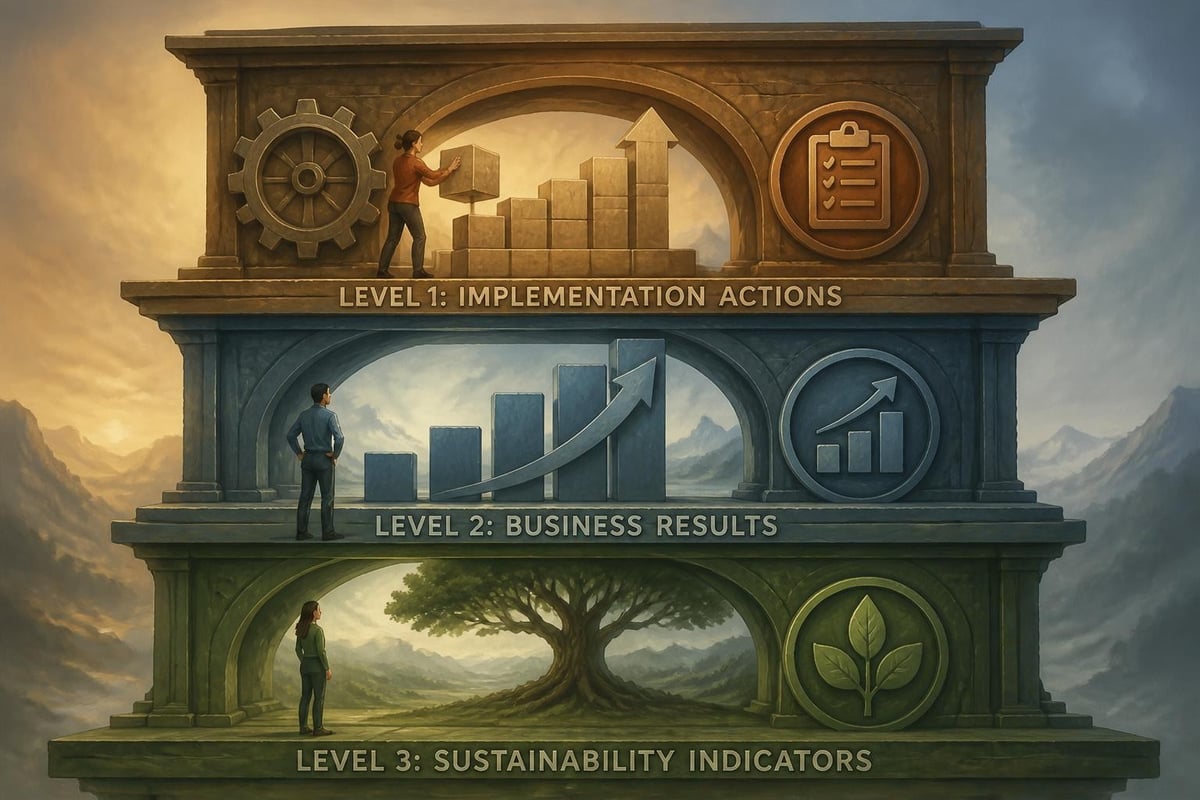
Track transformation across three levels:
Implementation metrics measure what participants actually do-modules completed, frameworks deployed, systems installed. These are leading indicators that predict business outcomes.
Business metrics capture revenue growth, profit margin improvement, time savings, and operational efficiency gains. These directly connect program participation to business results.
Sustainability metrics assess whether changes persist post-program-are clients still using your frameworks six months later? Are the systems still functioning? This measures true transformation versus temporary behavior change.
A randomized trial of an online group coaching program demonstrated that structured measurement and accountability significantly improved outcomes compared to untracked participation. Build data collection into your program rhythm-monthly metric submissions, quarterly outcome reviews, and alumni tracking.
Client Success Systems
Participant success isn't accidental. It's engineered through deliberate systems that remove implementation barriers and maintain momentum.
Onboarding sequences set expectations, establish baseline metrics, and create early wins. The first 14 days determine completion likelihood-make them count.
Accountability structures prevent the passive consumption trap. Require metric submissions. Create peer accountability partnerships. Use cohort leaderboards (with permission). Public commitment increases follow-through.
Implementation support bridges the gap between learning and doing. Office hours, template libraries, real-time feedback on client deliverables-these tactical supports drive results that justify premium pricing.
Building Community That Converts
The most valuable asset your online group coaching creates isn't curriculum-it's community. A thriving alumni network becomes your most powerful acquisition channel and proof source.
Cohort Bonding Strategies
Peer relationships form through structured interaction, not accidental proximity. Design specific mechanisms that build connection:
- Launch with a synchronous kickoff intensive (virtual or in-person) that creates immediate bonding
- Assign peer pods of 3-4 participants who meet between sessions for accountability and support
- Create cohort rituals-wins channels, Friday implementation wrap-ups, monthly challenges
- Facilitate meaningful introductions that go beyond surface-level backgrounds
The women-owned business context adds layers here. Your participants navigate similar challenges around authority, pricing confidence, and boundary-setting. Acknowledge these shared experiences explicitly and create space for peer mentoring around them.
Alumni Leverage
Your program alumni become case studies, testimonials, referral sources, and future staff. Treat alumni relationships as strategic assets requiring intentional cultivation.
Maintain an active alumni community with:
- Monthly alumni calls featuring advanced topics and guest experts
- Private alumni directory enabling peer collaboration and partnerships
- First-access invitations to new program launches and VIP experiences
- Alumni ambassador program rewarding referrals and testimonials
This community compounds program value. New cohort members see the long-term network they're joining, not just a 12-week program. The personal development company model recognizes that transformation happens in community over time, not isolation during a program window.
Scaling Beyond Your First Cohort
Your first cohort is a pilot. Expect imperfection. Gather feedback relentlessly. The second cohort should be significantly refined. By cohort three, you have a repeatable system.
Iteration Framework
After each cohort, conduct a structured retrospective examining:
| Evaluation Area | Questions to Answer | Action Items |
|---|---|---|
| Content | Which modules drove results? Which fell flat? | Cut, consolidate, or enhance specific sessions |
| Delivery | What delivery format worked best? Where did energy drop? | Adjust session length, frequency, or format |
| Community | When did peer bonding happen? Where did isolation occur? | Strengthen connection mechanisms |
| Operations | What created bottlenecks? What required manual intervention? | Build systems and automation |
| Outcomes | Who succeeded dramatically? Who struggled? Why? | Refine ideal client criteria and support systems |
Track these learnings in a program playbook that evolves with each iteration. This documentation becomes the foundation for team training and eventual delegation.
Multi-Program Strategy
One online group coaching program is a starting point. Strategic scaling involves creating a portfolio of offerings serving different client segments and transformation depths.
Foundational program: Serves clients at the beginning of their scaling journey, establishing core systems and frameworks. This becomes your primary client acquisition program.
Advanced program: Serves alumni and experienced clients ready for next-level complexity-team building, multiple revenue streams, strategic partnerships.
Mastermind: Intimate cohort of 6-8 clients at similar revenue levels, focusing on high-level strategy, peer consultation, and proximity to your expertise.
This portfolio creates natural client progression pathways while allowing you to serve different market segments without diluting your positioning. Each program feeds the next, creating a self-sustaining ecosystem.
Integration with Your Broader Business Model
Online group coaching shouldn't exist in isolation. It's one component of a comprehensive delivery architecture that includes strategic consulting services, done-for-you implementation, and digital products.
The smartest integration treats group coaching as your client acquisition engine. Participants experience your frameworks firsthand, build trust through results, and naturally progress to higher-ticket offerings when they're ready for deeper support.
Build intentional pathways:
- Group program alumni receive priority access to VIP consulting days
- Participants who hit specific milestones qualify for done-for-you implementation services
- High-potential clients are invited to private mastermind experiences
This approach, based on principles similar to leading like a coach, creates organic progression rather than aggressive upselling. You're guiding clients to appropriate next steps based on their readiness and goals.
The Profit Architecture framework applies here-your delivery ecosystem should position you as the definitive authority (Positioning), create multiple entry points and progression pathways (Acquisition), deliver consistent transformational outcomes (Delivery), and protect your time through leveraged systems (Leadership). Online group coaching becomes the keystone that supports and connects all four pillars.
Online group coaching transforms high-ticket service delivery from a time-for-dollars constraint into a leveraged growth engine that scales your expertise while maintaining premium positioning and client outcomes. The key is approaching program design strategically-building systems, measuring rigorously, and creating community that compounds value beyond curriculum. If you're ready to architect a scalable delivery model that eliminates founder bottlenecks while expanding profit margins, Rise Reign Rule helps women-owned service businesses install the Profit Architecture framework that turns operational chaos into predictable, profitable growth.


