
How to Become a Business Coach: Career Path and Skills
A business coach career starts with real operating experience, a defined niche, and the ability to guide owners toward measurable results. You can enter it from corporate leadership, consulting, or from running your own company, and you don't need a mandatory license. What you do need is proof that you can help a business owner make better decisions and hit specific goals.
This guide walks through the path step by step: what the job involves, the skills that matter, how to get started, how coaches earn money, and how to avoid the mistakes that stall new practices.
What does a business coach actually do?
A business coach helps owners and leaders clarify goals, spot what is holding the business back, and build the habits and systems to fix it. The work is part strategist, part accountability partner, part sounding board.
A typical engagement includes:
- Setting measurable goals for revenue, profit, hiring, or time
- Diagnosing bottlenecks in sales, delivery, or leadership
- Holding the client accountable to commitments between sessions
- Challenging assumptions the owner has stopped questioning
Coaches differ from consultants in one important way. A consultant often does the work or hands over a finished plan. A coach asks sharp questions, pressure-tests decisions, and builds the client's own capability. In practice, the line blurs. The strongest practitioners blend both, coaching where judgment is needed and advising where the client needs a direct answer. If you want a deeper look at how owners think about this relationship, coaching for business owners breaks down what clients expect from the arrangement.
How does one become a business coach?
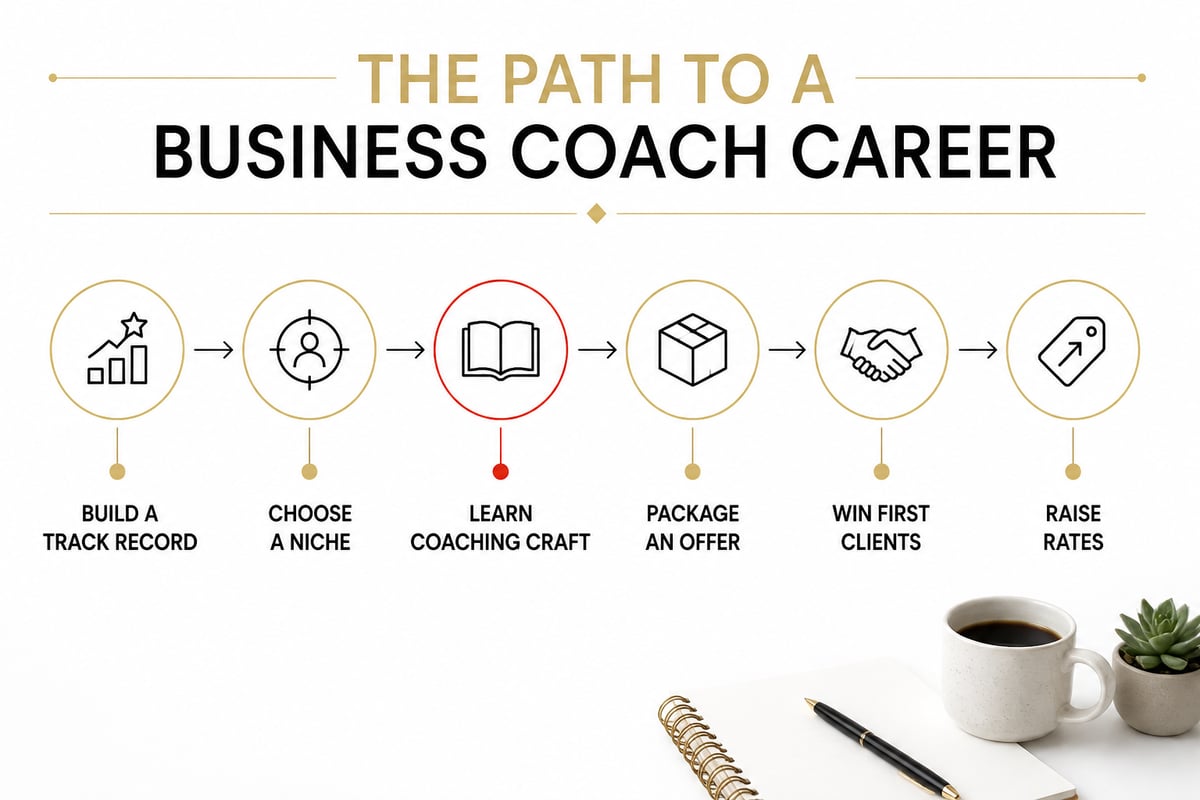
You become a business coach by building credible experience, choosing a niche, learning coaching methods, and landing your first paying clients. The order matters less than completing all four.
- Build a track record. Run a business, lead a team, or hold a senior role where you owned results. Clients pay for judgment earned through experience.
- Choose a niche. "Business coach" is too broad to sell. "Coach for service firm owners stuck at $500k" is specific enough to attract referrals.
- Learn the craft. Study coaching methods, listening, and questioning techniques. Certification is optional, but training sharpens your delivery.
- Package an offer. Define the outcome, the length of the engagement, and the price before you pitch anyone.
- Win your first clients. Start with your network, offer a small pilot, and collect results you can turn into case studies.
- Refine and raise your rates. Each engagement teaches you what works. Use that to tighten your process and charge more.
Do you need a certification to start?
No law requires a business coach to hold a certification, and the industry is largely unregulated. That freedom cuts both ways. It lowers the barrier to entry, and it also means credibility has to come from somewhere else.
Certification helps in a few situations: when you coach inside large organizations that screen vendors, when you lack a visible track record, or when you want a structured method to build confidence. It matters less when you have a strong operating history and documented client results.
Think of credentials as one signal among several. Buyers weigh your results, your clarity about who you serve, and how well you diagnose their problem in the first conversation. A certificate with no results behind it rarely wins a high-value client. Results with no certificate often do.
Which skills define an effective business coach?
The qualities that make a business coach effective are listening, strategic thinking, honesty, structure, and the ability to hold a client accountable without damaging trust. These show up in every successful engagement.
The seven qualities worth developing:
- Active listening. You hear what the owner is avoiding, not just what they say.
- Strategic thinking. You connect daily problems to the bigger business model.
- Directness. You name the uncomfortable thing, kindly and clearly.
- Curiosity. You ask questions that open new options.
- Structure. You run sessions with an agenda, outcomes, and follow-up.
- Emotional steadiness. You stay calm when a client is stressed or defensive.
- Commercial fluency. You understand pricing, margins, sales, and cash flow.
The last one separates business coaches from general life or career coaches. A client with a profit problem needs someone who can read a P&L and spot where margin leaks. Warm encouragement alone won't fix it.
What are the 5 C's of coaching?
The 5 C's of coaching are commonly described as clarity, commitment, competence, confidence, and consistency. The exact list varies by training program, but the idea holds up in practice.
- Clarity: the client knows what they want and why.
- Commitment: they agree to specific actions with deadlines.
- Competence: they build the skills the goal requires.
- Confidence: they trust their own decisions enough to act.
- Consistency: they repeat the right behaviors until results compound.
Use this as a diagnostic. When a client stalls, ask which of the five is weakest. A stuck owner is rarely short on information. More often, commitment or consistency has slipped, and the coach's job is to rebuild it.
How much does a business coach career pay?
Earnings in a business coach career vary widely because pricing depends on niche, results, and positioning, so no single figure applies to everyone. New coaches who sell hourly sessions to general audiences usually earn the least. Coaches who sell outcome-based packages to a specific type of business owner can earn far more.
For context, the U.S. Bureau of Labor Statistics projects management analyst employment to grow 8.8% from 2024 to 2034, and employment in management, scientific, and technical consulting services to grow 9.4% over the same period. Those figures describe related consulting fields, not business coaching directly, but they point to steady demand for outside expertise.
Four factors move your income the most:
- Niche specificity. A narrow audience with a costly problem pays more.
- Offer design. Packages tied to a result beat hourly billing.
- Proof. Documented outcomes justify higher fees.
- Capacity. One-to-one work has a ceiling, so many coaches add groups, workshops, or advisory retainers.
Do career coaches make money? Yes, though the ones who do treat it as a business with a defined audience and a repeatable offer, not a side conversation. The same applies to anyone building a business coach career.

Where do business coaches find clients?
Business coaches find clients through referrals, content that shows their thinking, speaking, partnerships, and direct outreach to a clearly defined audience. Referrals and reputation do most of the heavy lifting in the early years.
A practical mix looks like this:
- Your existing network. Former colleagues, vendors, and peers know your track record.
- Content with a point of view. Articles and talks that solve a real problem attract inbound interest.
- Strategic partners. Accountants, attorneys, and bankers meet owners at the moment they need help.
- Community presence. Industry groups and founder communities build trust over time.
If you're weighing how buyers evaluate a coach, the process described in how to find a business coach shows the questions clients ask before they sign. Build your marketing around answering those questions before they're asked.

Which niche should you choose?
Choose the niche where your own experience, a painful and expensive client problem, and your genuine interest overlap. That intersection gives you credibility, demand, and staying power.
Some niches grow naturally from your history:
- Industry-based: coaching owners in professional services, healthcare, or construction
- Stage-based: startups, owners scaling past a revenue plateau, or founders preparing to exit
- Role-based: first-time CEOs, sales leaders, or executive coaching for CEOs
- Problem-based: pricing, hiring, delegation, or time and energy management
Take a founder who spent a decade running an agency. She knows how scope creep erodes margin, how to price retainers, and how to stop being the bottleneck on every decision. Coaching other agency owners is a natural fit, and prospects trust her because she has lived the problem.
Narrow beats broad. A tight niche makes your message obvious and your referrals easier to generate.
How do coaches differ from free mentors and advisors?
A coach works under a paid, structured agreement with defined goals, while a mentor usually shares experience informally and a free advisor offers general guidance. All three can help, and they serve different needs.
Free resources are worth knowing about, because your future clients may already use them. SCORE, funded by the SBA, has a nationwide network of more than 9,000 volunteer mentors across almost 200 chapters. Its mentoring is offered at no cost and can cover areas such as financing, human resources, and business planning.
What does that mean for your practice? Free mentoring is a feeder, not a threat. Owners who outgrow general advice look for someone with specialized expertise, a repeatable method, and accountability that produces measurable change. Position yourself there.
What separates a strong coach from an average one?
A strong coach ties every conversation to a business outcome and builds a method clients can see working. An average coach offers encouragement and general advice with no system behind it.
Consider a framework approach. A coach who works from a defined model, such as one that examines positioning, sales, delivery, and leadership in sequence, can diagnose faster and prescribe with confidence. Rise Reign Rule's Profit Architecture is built this way for women-owned high-ticket service businesses, moving through Positioning, Acquisition, Delivery, and Leadership so that each fix supports the next. You don't need to copy anyone's model, but you do need your own repeatable structure.
Strong coaches also share these habits:
- They measure progress with numbers the client already tracks.
- They separate a founder bottleneck from a system problem before suggesting a fix.
- They tell clients when coaching isn't the right tool.
- They keep boundaries on time, scope, and availability.
Boundaries deserve special attention. Coaches who answer messages at all hours and rescue clients between sessions burn out and teach clients to depend on them. Clear limits protect both sides. For more on the leadership side of this work, see this look at leadership coaching.
What mistakes stall a new business coach career?
The most common mistakes are staying too general, underpricing, selling hours instead of outcomes, and skipping proof. Each one is fixable early and expensive to fix later.
- Going broad. "I help anyone grow their business" gives people no reason to remember you.
- Underpricing out of fear. Low fees attract clients who value your time less, and they undermine your results.
- Selling hours. Time-based billing caps your income and shifts focus from results to the clock.
- Skipping case studies. Prospects want evidence. Collect results with permission from the first client.
- Neglecting your own business systems. A coach with messy follow-up and no sales process models the exact problem they claim to solve.
One more trap: treating coaching as a stage you rush through. Many practitioners eventually blend coaching with advisory work, workshops, or done-with-you implementation. If you're curious how that evolves, the overview of the coaching business model maps out common paths.
FAQ
Is a business coach career a good fit for former founders?
Yes, former founders often make strong coaches because they have lived the pressure of payroll, sales, and decision fatigue. Their experience gives them instant credibility. The shift to make is moving from doing the work to guiding someone else through it.
How long does it take to build a full client roster?
It depends on your network, niche clarity, and consistency of outreach, so no fixed timeline applies. Many coaches take several months to land early clients and longer to build steady referrals. Starting with a focused offer and a defined audience shortens the runway.
Can you coach part-time while keeping a day job?
Yes, many people test a coaching practice on evenings and weekends before leaving full-time work. A part-time start lets you refine your offer, gather results, and build a pipeline with less financial pressure. Just protect enough time to serve clients well.
This week, write a one-sentence niche statement naming who you help, the problem you solve, and the result you deliver, then test it on three people in that audience. If you're a woman running a high-ticket service business and you'd rather fix operational drag and founder bottlenecks than coach others through them, Rise Reign Rule installs Profit Architecture so your positioning, sales, delivery, and leadership work together and your profit becomes predictable.


