
How to Build a Coaching Business Without Founder Burnout
A coaching business is a company that sells guidance, accountability, and transformation to clients, and the way to build one without burning out is to design the business around systems and boundaries instead of your personal hours. Most founders do the opposite. They trade time for money, say yes to every call, and become the bottleneck in their own company. This article shows you how to reverse that pattern.
The stakes are real. The World Health Organization defines burnout as a syndrome resulting from chronic workplace stress that has not been successfully managed, marked by exhaustion, mental distance or cynicism, and reduced professional efficacy. If you are the product, the delivery team, the salesperson, and the marketer, that pattern makes burnout a foreseeable risk, not bad luck.
What Do You Need to Start a Coaching Business?
You need a clear audience, a defined result you can deliver, a simple offer, a way to get paid, and a basic plan for how clients will find you. Credentials can help, but they are not the foundation. The foundation is a specific promise to a specific buyer.
Start with this short list:
- A narrow market. "Women-owned consulting firms stuck at $400k" beats "women who want to grow."
- One core offer. A defined container with a start, an end, and a measurable outcome.
- Legal and financial basics. A business entity, a separate bank account, contracts, and a tax plan. A local accountant such as Wilkins & Co Accountants is the kind of partner that handles bookkeeping, payroll, and start-up advice so you are not doing it at midnight.
- A written plan. The U.S. Small Business Administration offers guidance on market research, business-plan formats, and financial projections, including forecasts for income and cash flow. Use it.
- A sales path. A way for strangers to become conversations, and conversations to become clients.
If you want to compare formats before committing, our breakdown of one-on-one coaching and business group coaching shows how each model affects your calendar and your margins.
Why Coaching Founders Burn Out Faster Than They Expect
Coaching founders burn out because the business model quietly rewards overextension. Every new client adds hours, every hour is yours, and there is no ceiling on how much emotional labor the work absorbs.
Three patterns show up again and again in service businesses:
- Personal delivery for everything. Clients expect you in every session, every message, every review.
- Pricing that assumes unlimited energy. Low rates force high volume, and high volume forces long weeks.
- No separation between roles. You are the CEO, the closer, the coach, and the customer support line.
This is what we call operational drag: the friction that makes each additional dollar of revenue cost more effort than the last. Founders feel it as exhaustion. The business feels it as a revenue plateau.
The fix is not working harder or taking a vacation. It is changing the structure so growth no longer depends on your availability.
The Profit Architecture Approach to a Coaching Business
A sustainable coaching business rests on four pillars: Positioning, Acquisition, Delivery, and Leadership. Rise Reign Rule built its Profit Architecture framework around these four because a weakness in any one of them pushes work back onto the founder.
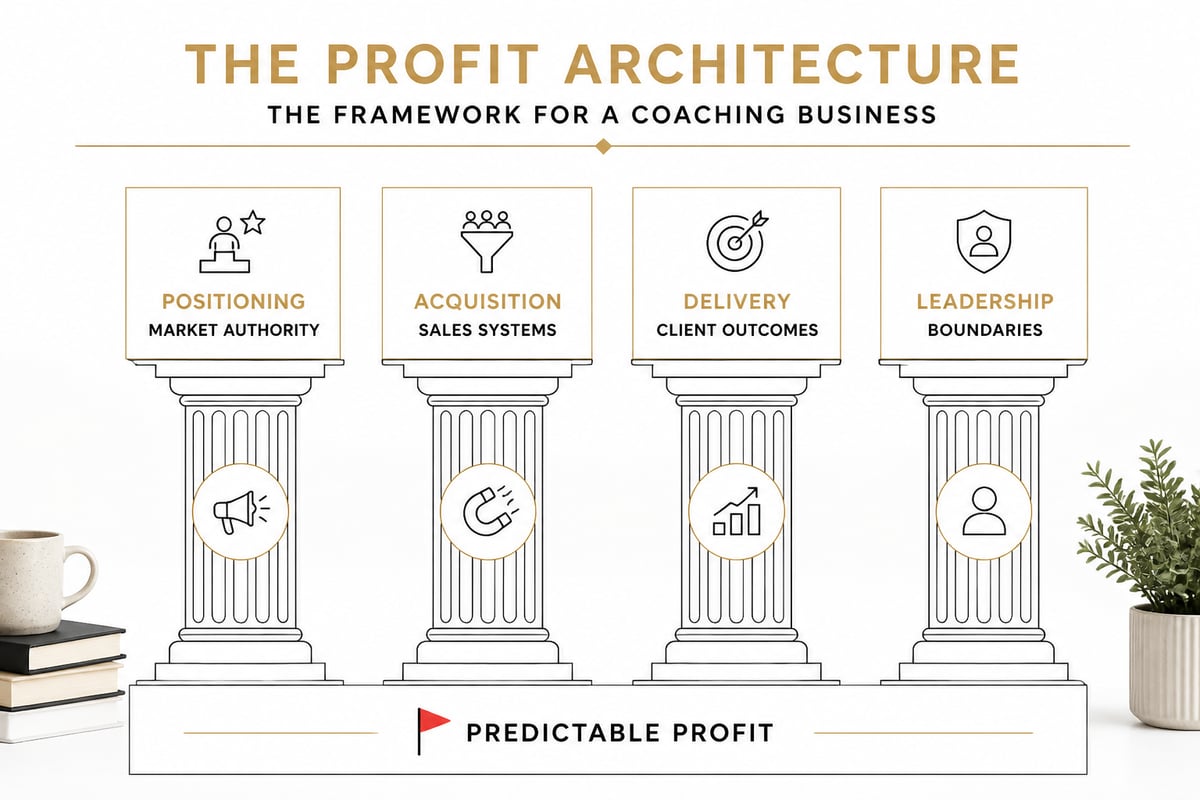
Here is how each pillar protects your energy:
- Positioning (Market Authority). When you are clearly known for one result, leads arrive pre-sold. You spend less time convincing and more time serving.
- Acquisition (Sales Systems). A repeatable path from first touch to signed client replaces the feast-or-famine scramble.
- Delivery (Client Outcomes). A structured program produces results without requiring you to improvise every session.
- Leadership (Boundaries). Clear rules about access, scope, and response time keep the business from consuming you.
Skip one pillar and the others strain. Strong positioning with no sales system leaves you with interest but no revenue. Great delivery with no boundaries leaves you with happy clients and an exhausted founder.
Build Positioning That Makes Selling Easier
Positioning is the decision about who you serve and what you are known for, and it is the cheapest way to cut your workload. A sharp position shortens sales cycles, supports higher prices, and attracts clients who respect your process.
Make three choices:
- Pick a buyer, not a demographic. Define the stage, revenue range, and problem they share.
- Name the transformation. State the before and after in plain language a client could repeat to a friend.
- Prove it. Collect case results, testimonials, and specific numbers with permission.
Visibility matters here too. If you want search to bring qualified buyers to you, a specialist like Best SEO Tools can help you build the kind of organic presence that reduces your dependence on constant outreach. For brand-level thinking, our guide to branding coaching walks through how to translate expertise into a recognizable market identity.
Price for Profit, Not for Hours
Your pricing should reflect the outcome you deliver and the capacity you actually have, not the number of hours you can survive. High-ticket offers are not about greed. They are a burnout-prevention tool, because fewer clients paying more means fewer conversations, fewer deadlines, and more room to do the work well.
A quick comparison shows why:
| Model | Clients needed for $240k/year | Typical founder load |
|---|---|---|
| Low-ticket hourly sessions | Dozens of recurring clients | Constant scheduling and admin |
| Mid-ticket monthly packages | Roughly 20 to 40 active clients | Heavy, steady delivery |
| High-ticket outcome programs | A handful of clients per cycle | Focused, capped delivery |
Those figures are illustrative, not benchmarks, so run your own numbers. Work backward from the income you want, divide by your realistic client capacity, and see what each engagement must be worth. The SBA's guide to writing a business plan recommends financial projections that show income and cash flow, which is the level of detail a pricing decision needs.
If you are unsure your fees justify themselves, read how to think about the ROI of coaching from the client's side. Buyers pay premium rates when the return is obvious.
Systemize Delivery So You Are Not the Bottleneck
Systemizing delivery means turning what you do intuitively into a repeatable program that produces results without you reinventing it each week. This is the step that separates a practice from a business.
Build your delivery in layers:
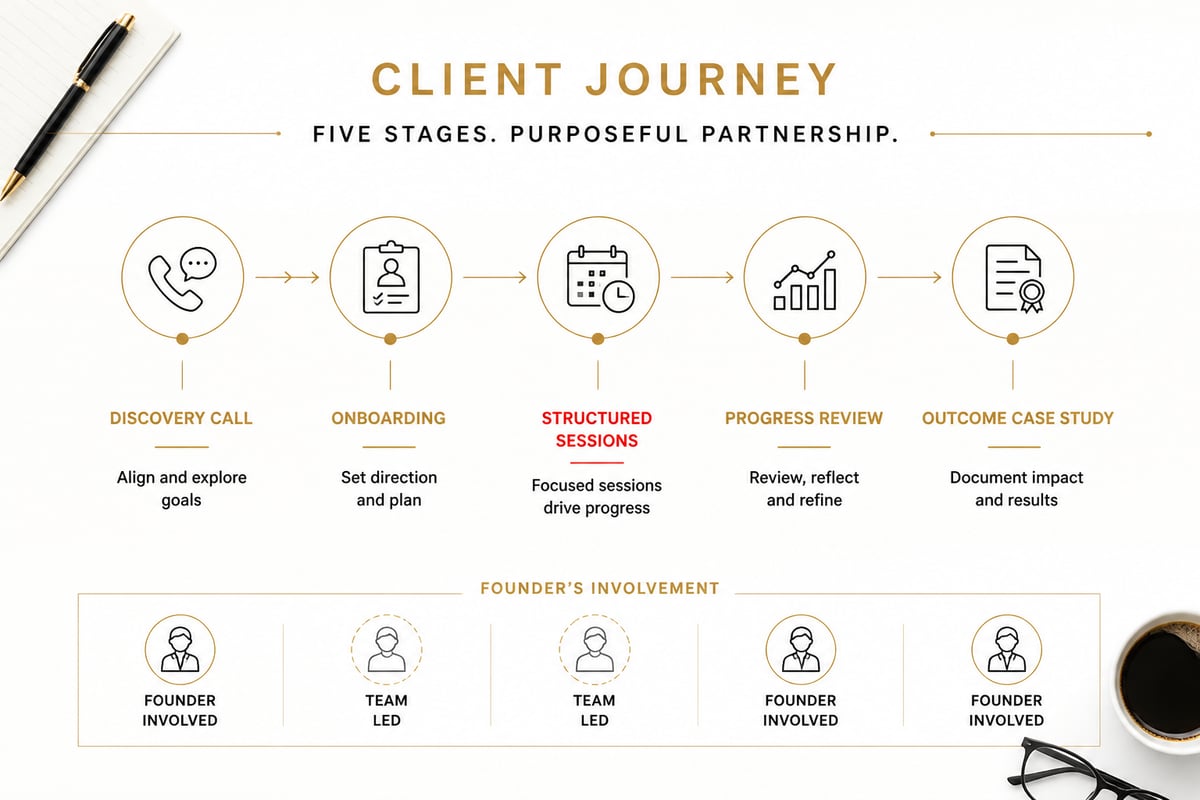
- Map the client journey. Write down every step from signed contract to final outcome.
- Create reusable assets. Intake forms, session frameworks, worksheets, and progress trackers.
- Standardize communication. Set office hours, response windows, and one channel for questions.
- Add leverage carefully. Group sessions, workshops, or a trained associate can serve more clients without multiplying your hours.
The International Coaching Federation's 2025 Global Coaching Study, which surveyed 10,035 respondents across 127 countries, found that 60% of coaches also offered training, 57% consulting, 55% facilitation, and 49% mentoring alongside coaching. That spread shows how many practitioners diversify their delivery formats, and diversified formats are often what let a founder serve more people without adding more one-to-one hours. You can read the ICF's overview of industry growth for the revenue picture behind those trends.
Create a Sales System That Doesn't Run on Adrenaline
A sales system is a defined sequence that moves a prospect from awareness to a paid engagement, and having one replaces desperation with predictability. Without it, revenue depends on how many hours you spent networking last week.
A simple structure works for most high-ticket service businesses:
- Attract. Content, referrals, and partnerships that speak to one buyer.
- Qualify. An application or short screening so you only take calls with real fits.
- Convert. A consistent conversation structure that addresses budget, timing, and risk.
- Onboard. A clear welcome process that starts the engagement strong and prevents scope confusion.
Referral partners can lighten the load considerably. Professionals who already serve your audience, such as accountants, brokers, or creative platforms like UpStage Platform for talent-driven businesses, can introduce you to people who are already trusting them. A real estate group like The Bauer Group is a good example of a business whose clients are often founders in transition. Choose partners whose audience matches your buyer, and the pipeline fills without cold outreach.
Not sure where you fit? The guide on how to find a business coach can help you see what a strong advisory relationship looks like before you build your own.

Set Boundaries as Part of the Business Model
Boundaries are operating rules written into your offers and contracts, and they are the most direct defense against burnout. They work because they remove daily negotiation. You decide once, publish it, and stop defending it.
Put these in writing:
- Access. When clients can reach you and through what channel.
- Scope. What is included, what is not, and what costs extra.
- Capacity. The maximum number of active clients you will carry at one time.
- Recovery. Scheduled weeks off, no-meeting days, and a policy for rescheduling.
Leadership is the fourth pillar for a reason. A founder who cannot hold a boundary will eventually hold a grudge, and clients can feel the difference. If you are growing a team, our piece on leadership coaching covers how to lead others without becoming everyone's emergency contact.
What Is the 70/30 Rule in Coaching?
The 70/30 rule is a guideline that the client should do roughly 70% of the talking in a session while the coach speaks about 30%. It keeps the client doing the thinking, which is where insight and ownership come from.
For a founder protecting her energy, the rule has a side benefit. Listening-led sessions are less draining than sessions where you carry the whole conversation, perform expertise nonstop, or solve every problem aloud. Ask better questions, talk less, and let silence do some of the work. It improves outcomes and your stamina at the same time.
Know Your Numbers Before You Scale
Scaling a coaching business safely means tracking a few core metrics so you can see strain before it becomes a crisis. Revenue alone hides problems. A founder can hit a record month while working seventy-hour weeks.
Watch these:
- Revenue per client and profit margin after expenses and any contractors.
- Hours worked per client to expose where delivery is leaking time.
- Close rate on qualified calls.
- Capacity utilization, meaning how full your client roster is against your cap.
- Founder hours per week, tracked honestly.
Review them monthly. When founder hours climb while revenue per client stays flat, you have found operational drag. That is the signal to systemize, raise prices, or narrow the offer, not to push harder.
FAQ
Will coaching be replaced by AI?
AI will automate parts of the work, such as note-taking, scheduling, and content drafting, but it is unlikely to replace the trust, accountability, and judgment clients pay for in high-ticket coaching. The smart move is to use AI to cut your admin load while keeping the human relationship at the center of your premium offer.
What are the 5 C's of coaching?
There is no single universal list, but the commonly cited versions include concepts like clarity, commitment, communication, confidence, and consistency. Use whichever framework you choose as a way to structure sessions, and make sure it connects directly to the outcome your client is paying for.
Do I need a certification to run a coaching business?
Coaching is generally an unregulated field, so a certification is not legally required in most places. Credentials can build credibility and sharpen your skills, and our overview of business coaching certifications helps you decide whether one fits your market. Proven client results usually matter more to premium buyers.
Your next step this week is simple: block one hour, list every task you personally do in your business, and mark the ones only you can do. Everything else is a candidate for a system, a boundary, or a hire. If you want a structured way to do that across positioning, sales, delivery, and leadership, Rise Reign Rule installs Profit Architecture for women-owned high-ticket service businesses so growth stops depending on your every waking hour. Reach out and start building a coaching business that pays you well and lets you rest.


