
One-on-One Coaching Guide for Women Business Owners
One on one coaching is a private, ongoing working relationship between you and a coach who helps you reach specific goals, with every session built around your business, your numbers, and your decisions. For women who run high-ticket service companies, it is the fastest way to get an outside perspective, spot the bottlenecks you are too close to see, and turn insight into action on a schedule.
The case for it is strong. A 2025 survey found that a 2025 survey found that many American women currently own a small business, yet fewer women owners said they felt financially successful than men owners. That gap rarely comes from lack of talent. It comes from thin support, tight capital, and a founder doing too many jobs at once. A good coach attacks that problem directly.
What One-on-One Coaching Actually Means
One-on-one coaching means a single client works privately with a single coach, with no group, no cohort, and no shared agenda. The coach asks sharper questions than your team does, holds you to commitments, and brings pattern recognition from watching many businesses face the same walls.
It differs from a few neighboring things people confuse it with:
- Mentoring: A mentor shares their own path. A coach works from your path.
- Consulting: A consultant diagnoses and often builds the fix. A coach guides you to build it and keeps you accountable. (Many strategic partners blend both, which is covered in this breakdown of coaching and consulting.)
- Group coaching: Lower cost, but your problem competes for airtime with everyone else's.
- Therapy: Therapy heals the past. Coaching builds the next ninety days.
For a founder with a $250k to $5M service business, the private format matters most when you are discussing pricing, difficult client situations, team conflict, or a pivot you are not ready to say out loud in a room full of peers.
Who Benefits Most From a Private Coach
The women who get the most from one-on-one coaching are founders who already have revenue and traction but feel capped by their own capacity. If you are the only person who can close deals, approve work, or calm a nervous client, you are the bottleneck, and no amount of hustle fixes a structural problem.
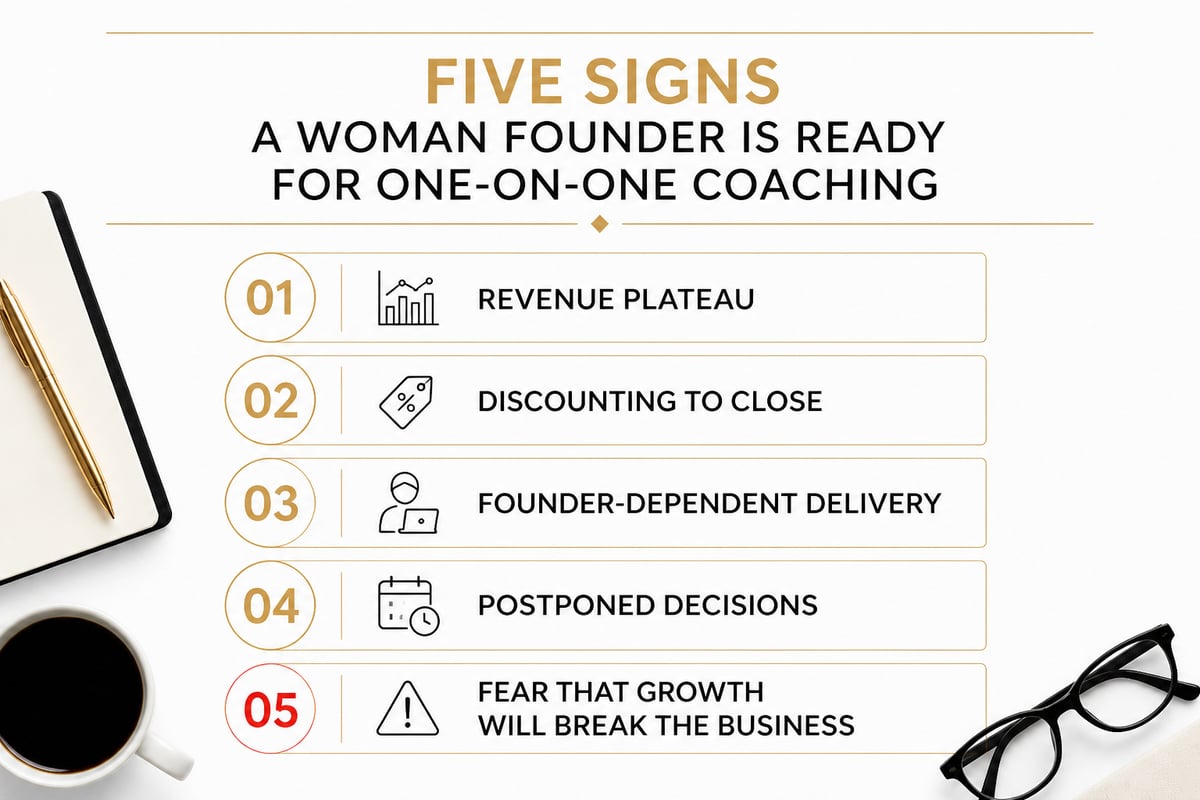
Signs you are ready:
- Revenue has plateaued, or grows only when you work more hours.
- You discount to close sales and resent it afterward.
- Delivery depends on your personal involvement.
- You know what to do but keep postponing the hard decisions.
- Growth feels risky because one slip could break what you have built.
That last point is worth taking seriously. Only a small minority of women small-business owners in the same NerdWallet survey planned to expand in 2025. Caution is understandable, but hesitation often comes from missing systems, not missing ambition. A coach helps you build the safety rails first, so expansion stops feeling like a gamble.
What Happens Inside a Coaching Engagement
A strong engagement follows a clear rhythm instead of drifting from chat to chat. Most effective programs run through the same five stages.
- Intake and baseline. You share revenue, margins, pipeline, team structure, and your honest frustrations. The coach needs real numbers, not a polished summary.
- Goal setting. Together you pick one to three measurable outcomes for the next 90 days, such as raising average contract value or removing yourself from weekly delivery.
- Working sessions. Typically 60 to 90 minutes, weekly or biweekly. You bring a live problem, leave with a decision, and commit to specific actions.
- Between-session accountability. Short check-ins, shared documents, or message support keep momentum alive.
- Review and reset. At the end of each cycle you measure results against the baseline and choose the next target.
Many coaches talk about a 70/30 rule, meaning the client should do about 70% of the talking while the coach listens, questions, and reflects for roughly 30%. It is a useful rule of thumb rather than a formal standard, and it tells you something about quality. If your coach talks most of the session, you are buying lectures, not coaching.
What Makes Coaching Pay Off for High-Ticket Service Firms
Coaching pays off when it is tied to the mechanics of your business instead of general motivation. Feeling inspired on Tuesday does nothing for your margins on Friday.
Rise Reign Rule organizes this work through Profit Architecture, a framework with four pillars. Each one gives a coaching conversation something concrete to fix:
| Pillar | What gets coached | Typical outcome |
|---|---|---|
| Positioning | Market authority, niche clarity, premium messaging | Prospects arrive already convinced of your value |
| Acquisition | Sales process, pipeline, offer structure | Predictable closing without constant discounting |
| Delivery | Client outcomes, handoffs, quality control | Results that do not depend on you personally |
| Leadership | Boundaries, delegation, decision rights | A founder who leads instead of firefights |
Notice the order matters. Many founders try to fix delivery by working harder when the real leak sits in positioning, where weak authority forces them to sell on price. A coach with a framework finds the true constraint instead of treating the loudest symptom.
If you want a closer look at how this applies to women-led firms, the guide on coaching for women goes deeper on the unique pressures founders face.
One on One Coaching Costs and Packages
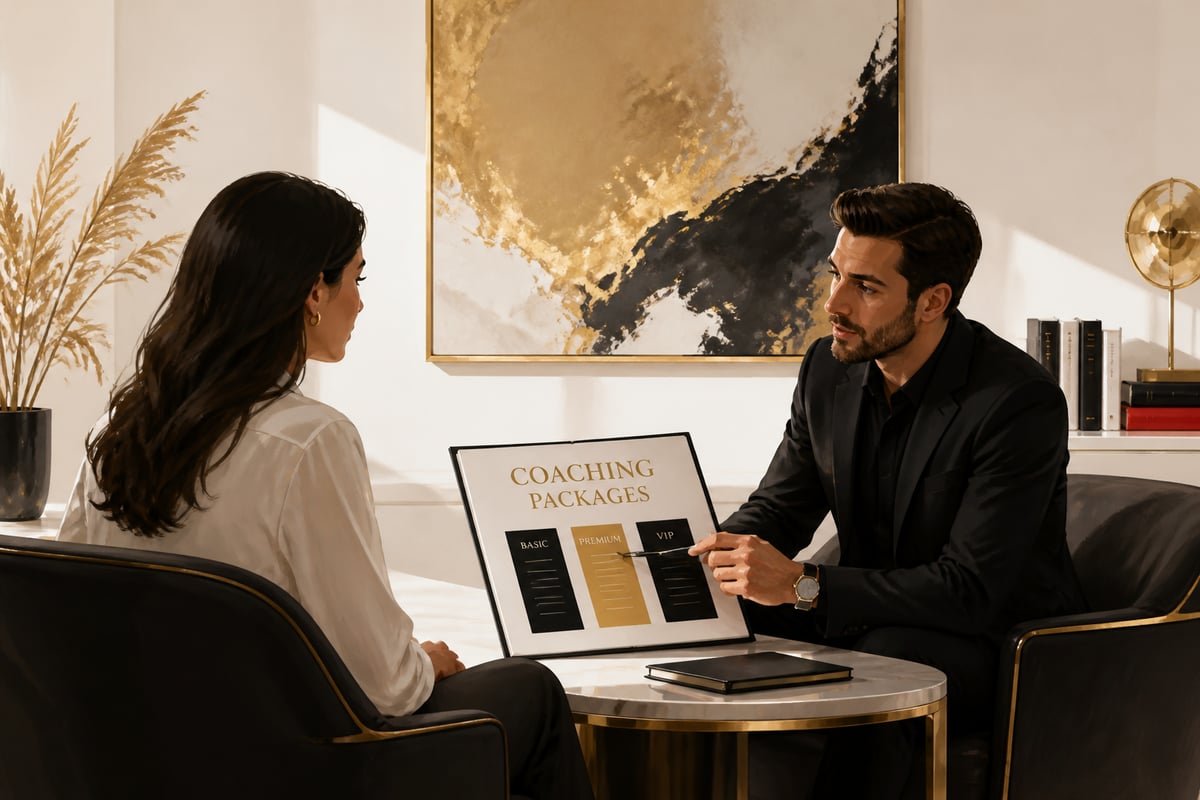
Prices vary widely, but business and executive coaching for established founders generally costs far more than entry-level life coaching, and the ranges you see online are inconsistent. Rates vary widely depending on experience and specialty, and executive and high-ticket business coaches often charge monthly retainers or fixed program fees well above entry-level life coaching. Treat any single "average" with caution, because it blends very different services.
Common structures you will encounter:
- Per-session pricing. Flexible, but usually the highest rate per hour and the weakest accountability.
- Monthly retainer. Regular sessions plus between-call support. The most common model for ongoing growth work.
- Fixed-term program. Three, six, or twelve months with defined milestones. Best when you have a clear target.
- Bank of sessions. A bundle you use as needed. Good for founders with unpredictable schedules, though it can encourage procrastination.
- Hybrid. Private sessions plus templates, audits, or team workshops.
Judge cost against return, not against other coaches. If a $3,000 monthly engagement helps you raise your pricing 20% and cut 15 hours of weekly firefighting, the math is lopsided in your favor. The piece on the ROI of coaching shows how to build that calculation before you commit.
Capital is also part of the picture. The GEM data shows that in 2025, women reported less recent business investment than men, and women invested roughly one-third less capital on average. When money is tighter, every dollar spent on guidance should be tied to a measurable result, which is exactly why outcome-based coaching beats open-ended chat.
How to Choose the Right Coach
Choose a coach by evidence of results in businesses like yours, not by charisma or follower count. A smooth intro call proves they can sell, not that they can coach.
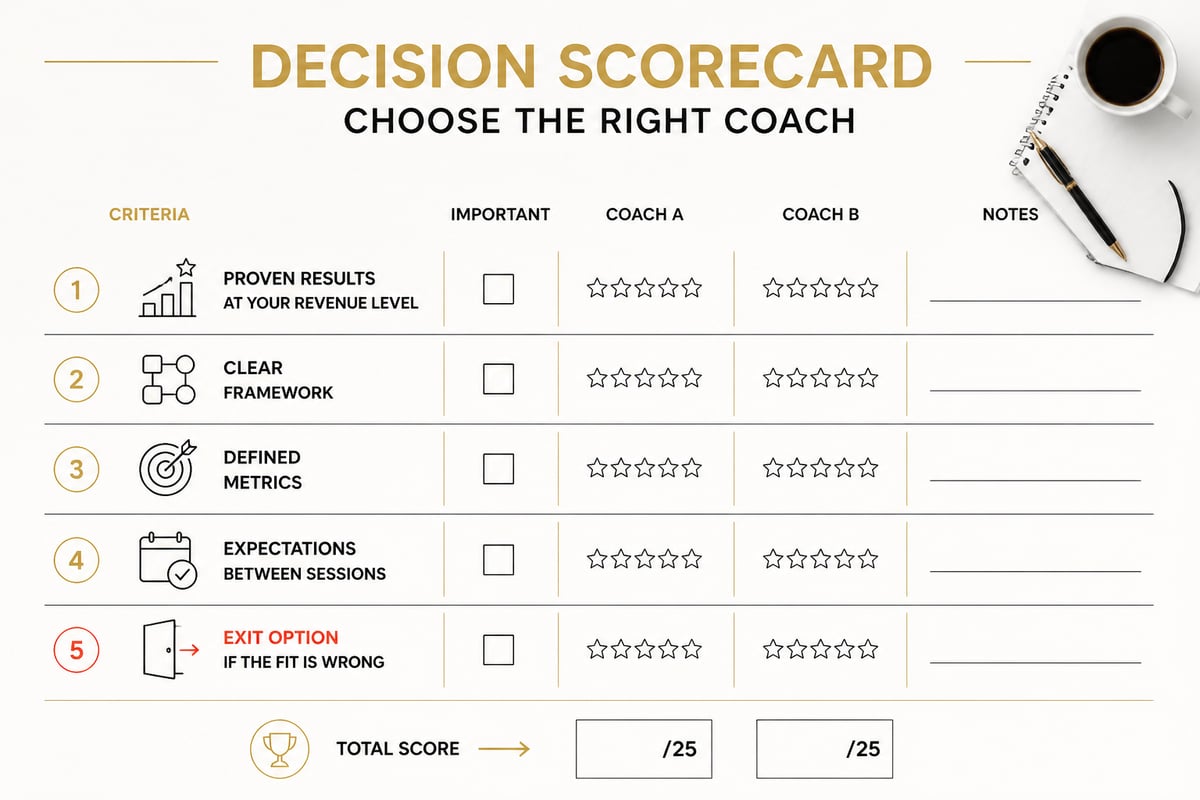
Ask these questions before you sign:
- Have you worked with service firms at my revenue level, and what changed for them?
- What is your framework, and which problem does it solve first?
- How do you measure progress, and when do we review it?
- What do you expect from me between sessions?
- What happens if the fit is wrong after the first month?
Look for testimonials that include specific numbers rather than vague praise like "life-changing." Specifics such as "cut onboarding time in half" or "closed our first $40k contract" signal a coach who works with metrics.
Also consider fit of style. Some founders want a blunt challenger. Others need a steady strategist who builds structure first. Neither is better, but a mismatch wastes months. If you are comparing options, this guide to finding a coach walks through the screening process step by step.
Online, In-Person, or Hybrid Sessions
Online sessions suit most founders because they remove travel, widen your choice of coach, and make consistent scheduling realistic. A video call every week beats an in-person meeting that happens twice a quarter.
In-person coaching still has a place for intensive strategy days, team offsites, or leaders who think better away from a screen. A hybrid model often works best: regular video sessions with an occasional in-person deep dive to reset the plan.
One practical tip applies to every format. Run your sessions with the same discipline as a client meeting. Block the time, close your inbox, and prepare an agenda. Founders who arrive with a clear question get far more from an hour than those who arrive hoping inspiration appears.
How to Prepare So Every Session Counts
You get out of coaching roughly what you bring in, so a short preparation routine multiplies the return on every hour you pay for.
Before each session:
- Write down the single decision you most want to resolve.
- Pull the two or three numbers tied to it, such as close rate, margin, or hours worked.
- List what you did since the last session and what you avoided.
- Name the fear underneath the decision, because it is usually the real topic.
After each session, send yourself a three-line recap: the decision, the first action, and the deadline. This habit prevents the common trap where a great conversation produces zero change.
Support outside the coach helps too. Free and low-cost counseling through the U.S. Small Business Administration, including Women's Business Centers and SCORE mentors, can complement paid coaching with local networks and basic training. Many founders also tighten the operational basics around their coaching: reliable managed IT support protects client data and keeps your delivery systems stable, and a trusted resource like Seasonably Fare can help you keep the rest of your life balanced while the business scales.
Protecting the Business While You Grow
Sustainable growth means building structure that survives your worst week, not just your best one. The 2024 GEM findings are sobering here: women were more likely than men to close a business for family or personal reasons. Many of those closures reflect businesses that were built around one exhausted person.
This is where the Leadership pillar earns its keep. Boundaries are an operating system, not a personality trait. A coach helps you define:
- Which decisions only you make, and which move to your team.
- Response times that protect your focus without hurting client trust.
- Capacity limits that keep delivery quality high.
- A succession of roles so the business can run through illness, travel, or a family emergency.
Founders who build this early rarely regret it. The ones who delay usually discover the gap during a crisis. If you are building a leadership layer, the guide to strategic leadership coaching shows how those decision rights get mapped.
FAQ
What does "one-on-one coaching" mean?
It means you work privately with a coach in sessions designed entirely around your goals, rather than learning alongside a group. The coach asks questions, offers frameworks, and holds you accountable to specific actions. You get full attention on your business and no time spent on other people's problems.
What is the average charge for a life coach?
Published rates vary enormously, from under $100 to several hundred dollars per session, depending on experience and specialty. Business coaches who work with established founders usually price by monthly retainer or program rather than hourly, and those fees are considerably higher. Compare packages by expected outcomes and deliverables, not by hourly rate alone.
What is the 70/30 rule in coaching?
It is an informal guideline that the client should speak about 70% of the time while the coach speaks about 30%. The idea is that insight sticks better when you reach it yourself. If a coach dominates the conversation, that is a signal to ask for a different approach.
Your next step is simple: write down the one decision you have postponed longest, then list the numbers behind it, because that page becomes the agenda for your first coaching conversation. If you want a partner who treats that decision as a systems problem and not a motivation problem, Rise Reign Rule installs Profit Architecture across positioning, acquisition, delivery, and leadership so your growth becomes predictable instead of exhausting. Start the conversation at Rise Reign Rule.


