
Courses on Coaching: How to Choose the Right One
The right courses on coaching match your goal: becoming a credentialed coach, coaching your own team, or sharpening the leadership skills you use to run a business. Pick the goal first, then check accreditation, contact hours, format and cost, in that order, and most of the confusion disappears.
The market is crowded because demand is real. The 2025 ICF Global Coaching Study estimates coaching generated $5.34 billion in revenue over the past year, nearly double the 2023 estimate of $2.849 billion. More money means more programs, and not all of them are worth your time or tuition.
What Courses on Coaching Actually Cover
Most coaching programs teach a core set of skills, and the differences come from how deeply they teach each one and what they ask you to prove at the end.
Expect these building blocks in nearly any serious curriculum:
- Coaching ethics and boundaries, including confidentiality and when to refer a client elsewhere
- Active listening and powerful questions, the daily mechanics of a coaching conversation
- Goal setting and accountability, turning insight into measurable action
- Agreement and contracting, how to define scope, outcomes and responsibilities up front
- Observed practice, where a mentor coach listens to your sessions and gives feedback
The last item separates strong programs from weak ones. Reading about coaching is easy. Being recorded, critiqued and corrected is what builds skill.
Some courses go beyond the fundamentals into niches such as athletic coaching, health coaching, team coaching or executive coaching. If you already know your niche, a specialized program saves you from paying for modules you won't use. If you don't, start with a general foundation. Our breakdown of team coaching courses shows what changes when you coach groups instead of individuals.
Which Type of Coaching Course Fits Your Goal?
Match the course type to your end use before you compare prices, because a mismatch wastes more money than any tuition difference.
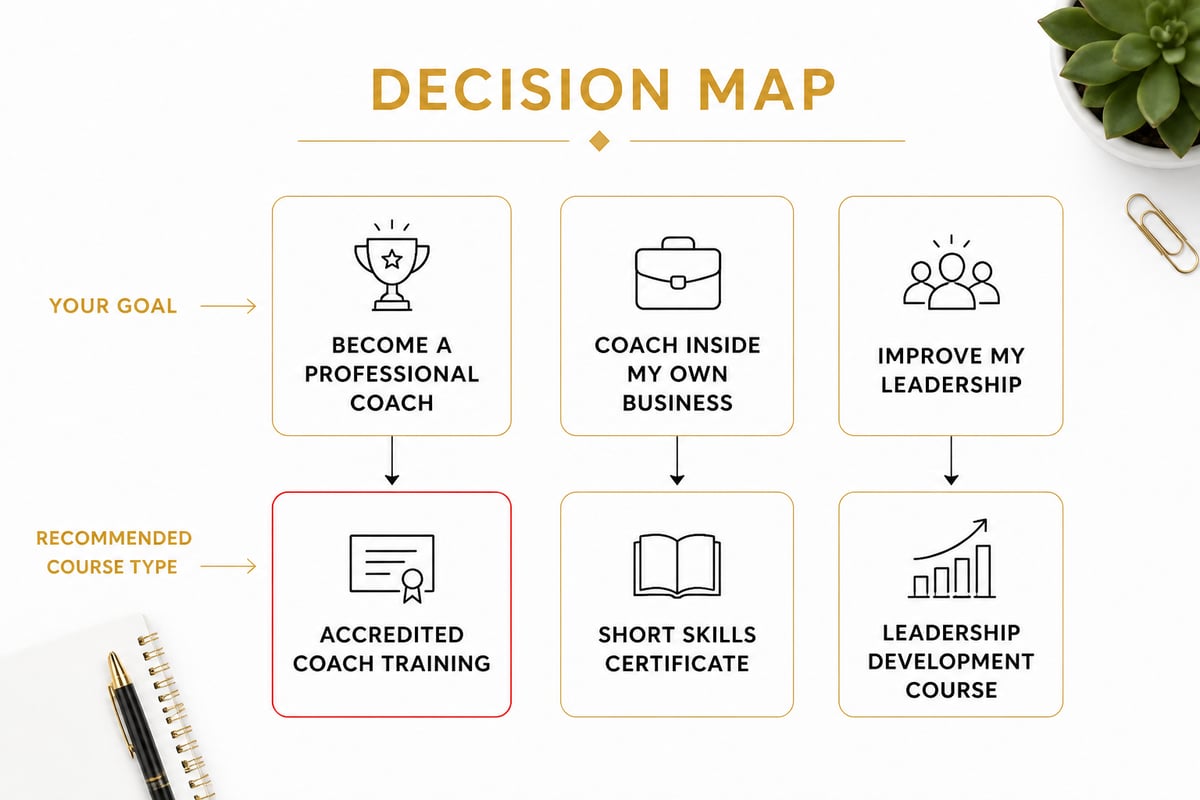
Accredited coach training
This is the path if you want to coach clients for a living. Programs are accredited by bodies such as the International Coaching Federation (ICF) or EMCC Global, and they lead toward formal credentials.
Short skills courses and certificates
These run from a weekend to a few weeks. They suit managers, consultants and founders who want to use coaching techniques without becoming full-time coaches.
Leadership and executive development courses
University-style programs often bundle coaching skills with communication, resilience and leadership content. They build your capability as a leader more than they prepare you to launch a coaching practice.
Sport and activity coaching
Youth and school sports organizations offer role-specific courses, often with safety and compliance components. They are a separate category from business or life coaching, so don't compare them directly.
If your goal is applying coaching inside a company you run, read how coaching for business owners differs from training to become a coach. For most founders, the shorter, applied route wins.
Why Accreditation Should Come First
Accreditation is the quickest filter because it tells you an outside body has checked the curriculum, the instructors and the hours.
The ICF sets clear benchmarks. According to ICF Support, Level 1 programs require at least 60 student contact hours and serve as a pathway to the ACC credential. Level 2 programs require at least 125 student contact hours and lead toward the PCC credential. Those requirements give you a yardstick: a program promising full certification in a weekend is not operating in the same league.
Accreditation also isn't limited to one body. EMCC Global accredits coaching and mentoring education programmes through its EQA and says its accreditation assesses practice against professional standards and supports continuing development. If you work with clients in Europe, or your clients expect EMCC recognition, that matters.
A quick way to verify any program:
- Ask which accrediting body approved it and at what level.
- Look the program up in that body's public directory.
- Confirm that the accreditation covers the exact course you're buying, not a sister program.
- Ask how many hours are live instruction versus self-paced video.
Unaccredited courses can still be useful for personal skill-building. Just don't pay accredited prices for them.
Contact Hours, Mentoring and Credential Pathways
The number of live hours and the quality of mentor feedback predict your results better than the course title does.
Contact hours are the time you spend in real-time instruction or supervised practice. Self-paced videos usually don't count the same way. If you plan to apply for an ICF credential later, you also need logged client coaching hours, and the ICF explains which client-coaching hours count toward a credential application. Read that before you enroll so you start logging hours correctly from your first paid or pro bono session.
Ask every provider these questions:
- How many mentor coaching hours are included, and with whom?
- Are practice sessions recorded and reviewed?
- Is there a performance evaluation or exam at the end?
- Does the program help you log hours toward a credential?
Strong answers are specific. Vague answers like "ongoing support" usually mean there's little structure behind it.
Online, In-Person or Hybrid: Which Format Works?
Online delivery is now the default for most coaching education, and it works well when it includes live, small-group practice rather than only recorded lectures.
Here is how the three formats compare:
| Format | Strengths | Watch out for |
|---|---|---|
| Fully online, live | Flexible location, global cohort, lower cost | Zoom fatigue, time-zone clashes |
| Self-paced online | Cheapest, fits any schedule | Little feedback, low completion rates |
| In-person | Deep networking, fewer distractions | Travel cost, time away from clients |
| Hybrid | Combines live practice with flexibility | Scheduling both parts |
Busy founders usually do best with live online or hybrid formats. You get accountability from a cohort without losing a week of billable time. Our guide to coaching online covers how to deliver sessions well once you're trained, which is worth knowing before you choose a platform-heavy program.

What Do Courses on Coaching Cost, and Are They Worth It?
Prices range from free introductory modules to five-figure accredited programs, so judge cost against the outcome you need rather than the sticker price.
I won't quote tuition figures for specific providers, because they change and vary by country. What you can do is price the whole path:
- Tuition for the program itself
- Mentor coaching fees, if billed separately
- Credential application and exam fees
- Time away from your business, which is often the largest cost
Then ask what the course must return. A coach hoping to charge premium rates needs credibility and a strong niche. A founder who wants better one-on-one conversations with her leadership team needs a few good frameworks and practice. The second person should not buy the first person's program.
Read a provider's outcomes honestly. Testimonials help, but look for specifics: what graduates did afterward, how long it took, and what they charge. One former trainee, a service-business founder, told us she took a short applied course and her team's weekly one-on-ones became shorter and more decisive within a month. That kind of practical result is worth more than a glossy certificate.
The Business-Owner Lens: Coaching Skills That Cut Founder Bottlenecks
If you run a high-ticket service business, the best course is the one that removes you from daily decisions without lowering your standards.
Founders often hit a ceiling because every question routes through them. Coaching skills fix part of that. When you learn to ask instead of tell, your team starts solving problems before they reach you. That is one piece of what we call the Leadership pillar of Profit Architecture: clear boundaries and decision rights.
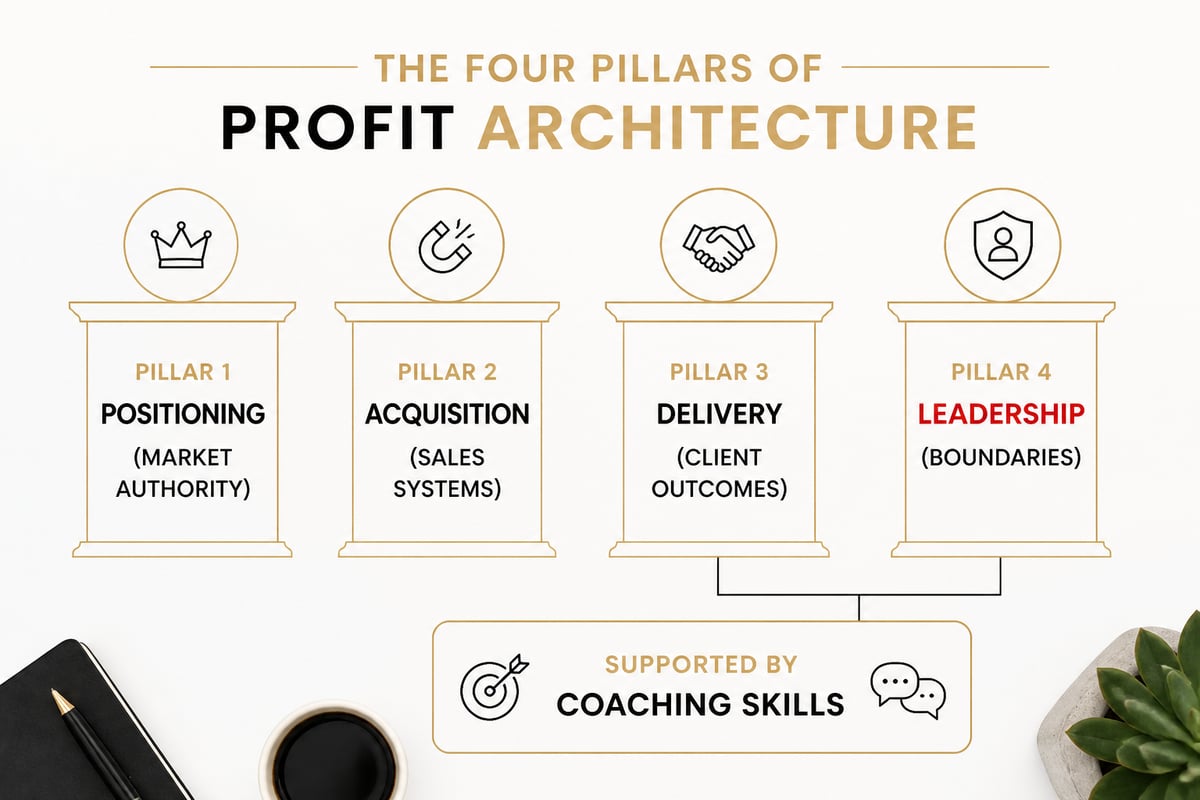
Coaching skills pay off most in two areas:
- Delivery. Coaching your delivery team to own client outcomes means fewer escalations and more consistent results.
- Leadership. Holding boundaries while developing people is a coaching skill. It separates a founder who delegates from one who abandons.
A coaching course won't build your positioning or your sales system, though. Those need strategy, not facilitation technique. If you're weighing training against structural fixes, our overview of coaching in business explains where coaching helps and where a different intervention is the better spend. For senior-level development, executive coaching consultants can be a more targeted option than a classroom course.
How to Compare Programs Side by Side
A simple scorecard keeps you from choosing on brand name or the best sales page.
Rate each shortlisted course from 1 to 5 on these criteria:
- Accreditation level and whether it's verifiable
- Live contact hours and mentor access
- Fit with your niche or business model
- Format and schedule you can actually sustain
- Total cost including fees outside tuition
- Graduate outcomes you can verify
Anything below a 3 on accreditation or mentor access deserves a hard second look. Then talk to two graduates, not only the ones the provider hands you. Ask what they'd change and whether they'd pick the same course again.
Also check the instructors' own track record. A trainer who has coached paying clients for years teaches differently from one who only teaches. For founders weighing a longer-term relationship over a classroom, one-on-one coaching offers a different model worth comparing.
Red Flags to Walk Away From
Some warning signs show up before you ever pay, and most of them are visible on the sales page or in the first conversation with an enrollment rep.
- Guaranteed income or "six-figure coach" promises
- A "certification" issued only by the company selling it, with no outside accreditor
- No named instructors or no coaching credentials among them
- Pressure tactics like countdown timers on enrollment
- No refund or deferral policy in writing
Income guarantees deserve the hardest look. A coach's earnings depend on niche, pricing, sales skill and hours worked, none of which a training provider controls. A promise of results the provider can't deliver tells you how the whole company treats its claims.
Check the accreditation language word for word. "ICF-aligned" or "based on ICF competencies" is not the same as being an accredited program. Level 1 programs require at least 60 student contact hours and Level 2 programs require at least 125, so a course that offers "full certification" in a weekend cannot be on either pathway. Ask for the program's name in the accreditor's public directory.
Pay attention to how the provider handles your questions. If you ask about mentor coaching hours or graduate outcomes and get a testimonial reel instead of numbers, that is your answer. If a provider can't explain its accreditation in two sentences, move on. Good programs are proud of their standards and happy to show them.
Your Next Steps
Choosing well takes a short, structured process:
- Write down your goal in one sentence.
- Decide whether you need accredited training or applied skills.
- Shortlist three programs and verify accreditation.
- Score them and speak with graduates.
- Check your calendar and cash flow before you commit.
Make each step specific enough to finish in a sitting. For the first, a usable goal sounds like "coach my four-person delivery team to handle client escalations without me," or "earn an ICF credential and take on paying clients within a year." Those two goals point to very different purchases, and writing yours down makes the choice obvious.
For the third step, look each program up in the accrediting body's public directory rather than trusting the badge on the sales page. Confirm the level, since 60 contact hours and 125 contact hours lead toward different credentials, ACC and PCC. If you work with European clients, check whether EMCC Global recognition through its EQA matters to them.
For the fourth, ask each provider to connect you with two graduates and ask what they would change. For the fifth, add up tuition, mentor fees, application fees and the billable time you'll give up, then compare the total against what the course must return for you. If the numbers only work on the best-case scenario, keep looking.
Start today by writing your one-sentence goal and shortlisting three programs to score against the criteria above. If your real aim is to grow a women-owned high-ticket service business without being the bottleneck in every decision, training alone won't get you there, and a structured plan will. Rise Reign Rule installs Profit Architecture, a framework covering positioning, sales systems, client delivery and leadership boundaries, so your growth becomes predictable instead of exhausting. Reach out through the contact page to see where your business has the most room to scale.


