
Why Your Business Needs a Business Life Coach in 2026
You've built a high-ticket service business past $250k in revenue. The systems that got you here are now suffocating your growth. Every client relationship runs through you, every decision waits on your approval, and strategic thinking gets squeezed into the margins of your day. This isn't a time management problem. It's a leadership architecture problem. And it's precisely why hundreds of women-owned service businesses are turning to a business life coach to bridge the gap between operational chaos and predictable profit.
The Founder Bottleneck Crisis in High-Ticket Service Businesses
Most service founders hit a ceiling between $500k and $2M revenue. Not because of market demand. Not because of pricing issues. The bottleneck is the founder herself.
You became the product. Clients buy access to you. Your team escalates to you. Your systems depend on your judgment. Research from Harvard Business Review on coaching styles shows that directive, hands-on leadership works brilliantly in startup mode but becomes the primary constraint at scale.
Why Traditional Business Consulting Falls Short
Standard business consultants deliver strategies and frameworks. They diagnose operational inefficiencies and prescribe process improvements. What they don't address is the invisible architecture holding everything together: your beliefs about control, your relationship with delegation, your identity as the "expert in the room."
A business life coach operates at the intersection of strategy and psychology. This dual lens is critical because:
- Strategic gaps often stem from leadership identity issues
- Operational drag reflects boundary and decision-making patterns
- Revenue plateaus mirror internal capacity beliefs
- Team dysfunction replicates the founder's unresolved conflicts
The Institute of Coaching has documented extensively how behavioral change requires addressing both the tactical "what to do" and the developmental "who you need to become."
What a Business Life Coach Actually Does for Service-Based Founders
Unlike therapy (which processes the past) or consulting (which delivers answers), a business life coach partners with you to build new operating capacity. The work happens across four integrated domains.
Strategic Positioning and Market Authority
Your positioning determines everything downstream. A business life coach helps you:
- Identify the market problem only you can solve at premium pricing
- Articulate your methodology in a way that builds intellectual property
- Establish boundaries around ideal client profiles and engagement models
- Design your authority platform (thought leadership, speaking, content)
For women-owned high-ticket service businesses, positioning often requires confronting imposter syndrome and "proving" narratives. The coaching relationship becomes the laboratory where you practice new levels of authority before taking them public.
Acquisition Systems That Scale Without You
Most founders confuse sales with "being on sales calls." A business life coach guides the transition from founder-led selling to systematized acquisition by addressing:
| Challenge | Coaching Focus | Outcome |
|---|---|---|
| Every sale requires founder involvement | Build trust in team to close deals | Sales team closes 70%+ without founder |
| Inconsistent pipeline | Install predictable lead generation | Weekly qualified opportunities |
| Pricing conversations feel uncomfortable | Reframe value and anchor premium positioning | Confident pricing conversations |
| Proposal process is manual chaos | Document decision criteria and templates | Streamlined proposal-to-close system |
The Forbes article on business coaching ROI found that coached executives reported 70% improvement in work performance and 86% recouped their investment through increased revenue.
Delivery Excellence and Client Outcomes
Scaling delivery without sacrificing outcomes requires operational maturity most founders resist. Why? Because standardizing delivery feels like losing the "magic" that made clients choose you.
A business life coach helps you distinguish between:
- Core methodology (what must stay consistent)
- Delivery variables (what can flex based on team or client)
- Quality indicators (how you measure successful outcomes)
This creates space to develop team coaching capacity and transition from "I deliver everything" to "I architect outcomes my team delivers."

Leadership Development: The Hidden Multiplier
Here's where business life coaching diverges sharply from standard consulting. You can install perfect systems, but if your leadership operating system hasn't evolved, you'll unconsciously sabotage them.
Boundaries as Business Infrastructure
Every "yes" you say carries an opportunity cost. A business life coach helps you build what we call strategic boundaries:
- Client access protocols (when, how, and through whom clients reach you)
- Decision-making authority levels (what only you decide vs. what the team owns)
- Time architecture (protected CEO time for strategy vs. reactive availability)
- Energy management (which activities generate vs. deplete your capacity)
Women founders especially struggle with boundary-setting because we've been socialized to be accommodating and accessible. The APA's research on coaching psychology demonstrates that sustainable behavioral change requires both skill-building and identity-level shifts.
From Operator to Architect
The most valuable transformation a business life coach facilitates is the identity shift from operator to architect.
Operators solve problems. Architects design systems that prevent problems.
| Operator Mindset | Architect Mindset |
|---|---|
| "I'll just handle this client issue quickly" | "What system would prevent this type of issue?" |
| "It's faster if I do it myself" | "Investing time to train creates permanent leverage" |
| "I need to be available for my team" | "I need to be unavailable so my team builds capacity" |
| "Revenue is the goal" | "Profit margin and founder capacity are the goals" |
This shift doesn't happen through willpower. It requires structured reflection, pattern interruption, and supported experimentation. That's the coaching container.
The Business Life Coach Selection Process
Not all coaches are created equal. The coaching industry remains largely unregulated, which means credential quality varies wildly. When evaluating a business life coach for your high-ticket service business, prioritize these factors.
Relevant Business Experience
Your business life coach should understand the specific economics and operational realities of service-based businesses. Questions to ask:
- Have you scaled a service business past $1M personally?
- Do you understand high-ticket sales cycles and client retention dynamics?
- Can you speak to the operational differences between productized services and bespoke delivery?
Generic "life coaching" rarely translates to the sharp strategic decisions required in a $500k+ business. You need someone who lives in your world.
Framework and Methodology
Beware the coach who "customizes everything." While personalization matters, you want a proven framework adapted to your context, not made up session-by-session.
At Rise Reign Rule, we use the Profit Architecture framework specifically because high-ticket service businesses require integrated work across positioning, acquisition, delivery, and leadership. Ask potential coaches to walk you through their methodology before engaging.
Evidence-Based Approaches
The APA's continuing education on coaching psychology emphasizes the importance of evidence-based methods. Your business life coach should integrate research-backed approaches such as:
- Cognitive-behavioral techniques for reframing limiting beliefs
- Adult development theory for leadership capacity building
- Organizational psychology for team and systems design
- Behavioral economics for decision-making optimization

Measuring ROI: What Success Looks Like
The value of a business life coach shows up in both hard metrics and qualitative shifts. Smart founders track both.
Quantitative Indicators
- Revenue per hour worked (the ultimate scaling metric)
- Profit margin expansion (not just top-line growth)
- Team close rate on sales (reduction in founder dependency)
- Client acquisition cost (efficiency of systems)
- Founder hours in delivery (moving toward zero)
One client came to us doing $800k revenue but working 60-hour weeks with 22% profit margins. Eighteen months later: $1.4M revenue, 35-hour weeks, 41% margins. The business life coach engagement created $168k in additional annual profit while buying back 25 hours per week.
Qualitative Transformations
Numbers tell part of the story. The deeper ROI appears in:
- Decision-making speed and confidence (fewer cycles of second-guessing)
- Team initiative and ownership (reduced escalation to founder)
- Client outcome consistency (delivery excellence independent of founder involvement)
- Strategic clarity (knowing exactly what to pursue and what to decline)
- Personal sustainability (business success without burnout)
Research highlighted by SHRM on talent lifecycle strategy shows that leadership development investments create compounding returns through improved retention, faster decision-making, and enhanced organizational resilience.
Common Misconceptions About Business Life Coaching
Let's clear up what business life coaching is not.
Misconception #1: "Coaching is for broken businesses or struggling founders."
Elite athletes have coaches. Top performers in every domain have coaches. A business life coach isn't remedial support; it's strategic acceleration. The best time to engage a coach is when you're already successful but hitting a ceiling.
Misconception #2: "I just need better systems, not mindset work."
Systems fail when leadership capacity lags behind operational complexity. You can install a CRM, build Standard Operating Procedures, and hire a COO, but if you can't delegate authority or trust team judgment, those systems become expensive shelf-ware. Executive coaching for leadership development addresses both the tactical and developmental dimensions.
Misconception #3: "Coaching is the same as mentorship."
A mentor shares their path and gives advice based on their experience. A business life coach asks powerful questions that help you discover your unique path. Mentorship is valuable but prescriptive. Coaching is generative.
Misconception #4: "I can't afford a business life coach right now."
The question isn't whether you can afford coaching. It's whether you can afford to stay stuck. If founder dependency is capping your revenue, costing you weekends, and preventing strategic growth, the opportunity cost of not coaching is substantial. Most businesses recoup their coaching investment within 90-180 days through improved profit margins and operational efficiency alone.
Integration with Your Existing Business Infrastructure
A business life coach doesn't operate in isolation from your other business functions. The most powerful engagements integrate coaching with your existing team and advisors.
Coordination with Your Team
Your business life coach should work in service of your business goals, which means coordination with key team members:
- Integrator/COO: Ensure operational initiatives align with leadership development
- Sales Director: Bridge strategic positioning shifts into sales messaging
- Delivery Lead: Support methodology documentation and team training
- Financial Advisor: Connect profit margin goals with operational decisions
This integrated approach prevents the common problem of "founder gets coached, nothing changes in the business" because the coaching insights translate directly into structural business improvements.
Timeline and Engagement Models
Most effective business life coaching engagements for service-based businesses run 12-24 months. Why?
Months 1-3: Assessment, framework introduction, quick wins
Months 4-9: System installation, team development, habit formation
Months 10-18: Optimization, scaling, advanced leadership capacity
Months 19-24: Sustainability, transition to independence
Short-term coaching (3-6 months) can address specific challenges but rarely creates the deep structural and leadership transformations required to scale a high-ticket service business sustainably. The research from the effectiveness of coaching shows that sustained engagement produces dramatically better outcomes than episodic interventions.
When to Engage a Business Life Coach
Timing matters. The ideal moment to bring in a business life coach is when you're experiencing one or more of these inflection points:
Revenue plateau despite strong demand. Your pipeline is healthy, but growth has stalled because operational capacity maxed out.
Profitable but exhausted. The business makes money, but it requires unsustainable founder hours. You're the highest-paid operator in your company.
Team growing but chaos increasing. Headcount expanded but coordination overhead and communication breakdowns ate the efficiency gains.
Strategic opportunities you can't pursue. You see the next level clearly but lack the internal architecture to execute on it.
Considering a major pivot. New service line, market repositioning, or business model shift that requires leadership evolution to execute well.
The common thread: you've hit a ceiling that can't be solved with more effort or better tactics. You need capacity expansion, which is precisely what a business life coach engineers.
The Profit Architecture Framework in Action
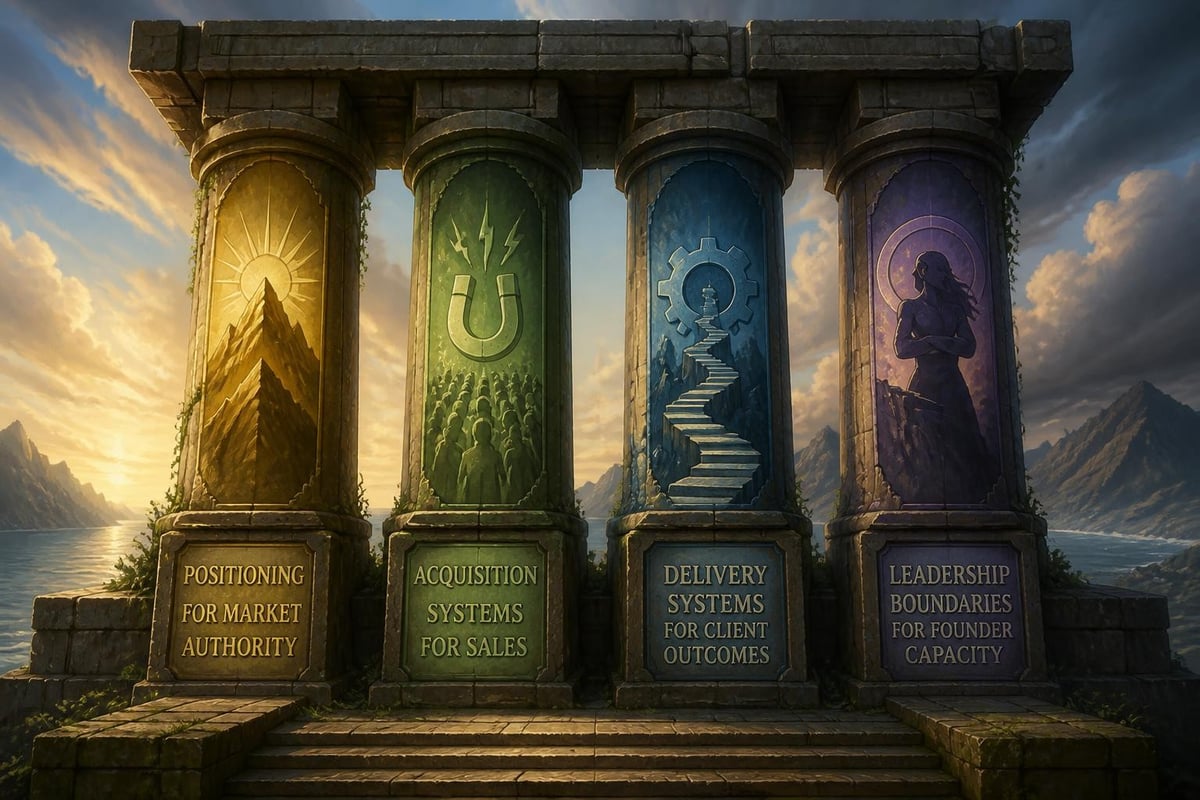
At Rise Reign Rule, we've codified the business life coach methodology into what we call Profit Architecture. This framework addresses the four structural pillars that determine whether a high-ticket service business scales cleanly or collapses under its own weight.
Positioning (Market Authority): Define the unique market problem you solve, articulate your methodology, establish premium pricing, and build visible authority in your category.
Acquisition (Sales Systems): Install predictable lead generation, systematize sales process and team enablement, implement proposal-to-close efficiency, and reduce founder dependency in closing.
Delivery (Client Outcomes): Document core methodology, train team delivery capacity, implement quality assurance frameworks, and ensure consistent outcomes independent of founder involvement.
Leadership (Boundaries): Establish strategic decision-making protocols, protect CEO time architecture, develop team ownership and initiative, and create sustainable energy management.
These pillars work interdependently. Weak positioning undermines pricing power in acquisition. Poor delivery systems create founder dependency. Inadequate leadership boundaries prevent team development. A comprehensive business life coach engagement strengthens all four simultaneously.
You can explore how other service-based founders have implemented these frameworks through case studies that document specific transformations.
Building Your Strategic Support Ecosystem
A business life coach is one critical piece of your strategic support ecosystem. The most successful founders we work with also maintain:
- Financial advisor/CFO: For profit optimization and capital strategy
- Legal counsel: For contract structuring and risk mitigation
- Peer community: For perspective and pattern recognition
- Industry mentors: For market-specific guidance
The business life coach serves as the integrating force, helping you synthesize inputs from these advisors into coherent strategic decisions aligned with your capacity and values.
Think of it this way: your accountant tells you the numbers, your lawyer tells you the risks, your mentor tells you what worked for them. Your business life coach helps you decide what's right for you based on your unique context, capacity, and vision.
This work coaching approach recognizes that sustainable business success requires both external expertise and internal leadership development.
Scaling a high-ticket service business past $500k requires more than working harder or hiring more people. It demands fundamental transformation in how you lead, decide, delegate, and architect operational systems. A business life coach provides the strategic partnership and developmental container to make that transformation sustainable and profitable. If you're ready to move from founder bottleneck to clean scaling with predictable profit, Rise Reign Rule specializes in exactly this transition for women-owned service businesses doing $250k-$5M in revenue.


